
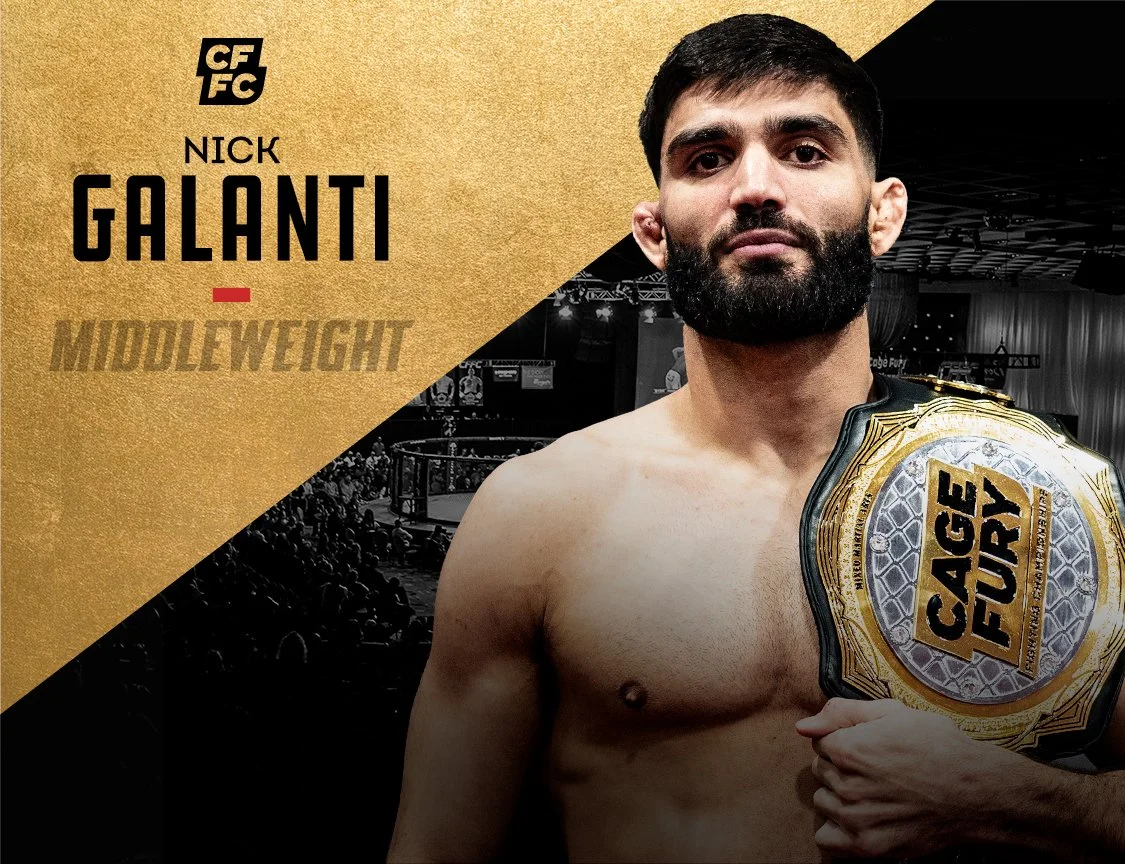
Julien Leblanc vs Nick Galanti: analysis & prediction

PRELIMS · MIDDLEWEIGHT · 3 ROUNDSUFC Fight Night: Buckley vs. Malott
Julien Leblanc — Middleweight fighter

Julien Leblanc

10W3L
…
VS
Nick Galanti — Middleweight fighter

Nick Galanti

8W1L
…

A fast starter meets a fighter who needs a second exchange

MiddleweightRogers Place2026-10-17

The fight in 30 seconds

Julien Leblanc 50% / Nick Galanti 50%. No overall preference; neither side has a central estimated advantage. A 50/50 starting point is retained because one short UFC loss and one short contract-winning finish cannot establish a durable overall advantage. Galanti receives more of the knockout allocation; Leblanc receives more submission and decision mass. This is asymmetric route risk within an even fight, not evidence that the two athletes are identical.

Subjective editorial probabilities, not calibrated model outputs.

Julien Leblanc

Insufficient price data
Editorial win estimate
50%
Fair odds
+100
Reference quote
—
Fair decimal odds
2.00

Nick Galanti

Insufficient price data
Editorial win estimate
50%
Fair odds
+100
Reference quote
—
Fair decimal odds
2.00
Price freshness & calculation notes

Quotes older than 48 hours are marked outdated. EV at an old or undated price is a historical calculation, not a current opportunity. Date-only snapshots have no verified capture time.

Read the handicapping and counterarguments
01

The Frame

What this fight is really about — and the measurements that shape it

The Analyst's Take

Julien Leblanc (10-3) vs. Nick Galanti (8-1): Middleweight, 3 five-minute rounds at Rogers Place. Galanti's 35-second Contender Series knockout establishes a dangerous opening, not a sustainable UFC pace. Leblanc needs to make the debutant reset without turning a defensive clinch into another exposed-back position.

Julien Leblanc
Attribute
Nick Galanti
10-3
Pro record
8-1
Middleweight
Booked division
Middleweight
185 lb
Booked limit
185 lb
74.00
Height
—
74.50
Reach
—
34
Age in reviewed profile
28
Patenaude Martial Arts, Kill Cliff FC
Trains at
—

Measurements come from the reviewed athlete profiles (height and reach in inches). Age is the source snapshot, not a projected fight-night age. The listed fight limit follows the supplied card; past profile weigh-ins do not change the booking.

Venue Factor
Scheduled for 3 five-minute rounds. The round scenarios below are tactical questions, not invented statistical forecasts.
02

The Fighters

Careers, chins, schedules — and the form they bring into the cage

Julien Leblanc portrait

Julien Leblanc

Julien Leblanc

Pro record
10-3
UFC bouts
—
Career KO/TKO wins
4
Career submission wins
4

Leblanc enters at 10-3. His only completed UFC appearance ended with Robert Valentin taking his back and finishing a rear-naked choke in the opening round. That is a specific defensive sequence to investigate, rather than proof that every grappler will beat him. His background spans kickboxing and no-gi grappling, and his professional record contains wins by both strikes and submission. The missing evidence is how that mixture holds up over sustained UFC exchanges.

Recent results

  • L

    Robert Valentin

    Submission · 4/18/26 · UFC Fight Night

Nick Galanti portrait

Nick Galanti

Nick Galanti

Pro record
8-1
UFC bouts
0
Career KO/TKO wins
—
Career submission wins
—

Galanti enters at 8-1 after winning a CFFC middleweight title and stopping Carlos Petruzzella on Contender Series. The title win over Austin Clayton supplies a longer competitive test; the contract-winning knockout supplies evidence of immediate finishing danger. Those performances should remain separate samples. The spectacular per-minute knockdown number on his UFC profile is an extrapolation of a very short fight, not a reliable expectation against Leblanc.

Recent results

  • W

    Carlos Petruzzella

    KO, R1 0:35 · 2026-08-25 · DWCS — Season 10, Week 3

03

The Numbers

Career statistics and what they say about this matchup

Published career statistics

Published profile averages describe past opposition, not a prediction of this fight. The source sample may include Contender Series appearances.

Julien Leblanc: Published UFC athlete-profile averages reviewed October 11, 2026. 1 UFC results appear in the reviewed log; the rate denominator may also include Contender Series appearances. These are not opponent- or division-adjusted.

Nick Galanti: No reconciled completed UFC rate sample. Showcase or regional figures are withheld; unavailable observations are not zero. The supplied card record 8-1 takes precedence over the profile header 1-0-0; no extra fight result is inferred from that difference.

Career statistical comparison for Julien Leblanc and Nick Galanti
MetricJulien LeblancNick Galanti
Significant strikes landed / min1.69—
Significant strikes absorbed / min2.96—
Striking accuracy67%—
Striking defence46%—
Takedowns / 15 min0—
Takedown defence——
Submission attempts / 15 min0—
Knockdowns / 15 min0—

Submission attempts are not submission wins. Defence percentages depend on attempts faced. No matched division cohort is supplied for these profile averages, so division ranks are unavailable. A dash means unavailable data, not zero.

04

The Story of the Fight

Advantages, worst cases, gameplans — and the patterns underneath

A fast starter meets a fighter who needs a second exchange

Galanti's 35-second Contender Series knockout establishes a dangerous opening, not a sustainable UFC pace. Leblanc needs to make the debutant reset without turning a defensive clinch into another exposed-back position.

The Deep Read

The opening minute presents an awkward choice for Leblanc. Waiting passively at the end of Galanti's attacks risks giving the newcomer the exact clean launch he wants. Charging forward to smother that threat can expose the clinch and back. A disciplined first exchange should therefore end with Leblanc facing his opponent in a recoverable stance, whether he has scored or not. Surviving a burst is useful only if it does not hand over the next position.

Galanti should test the body and the exit before deciding that another immediate finish is available. The useful consequence of an early hard connection may be a predictable defensive reaction, not a knockout. If Leblanc shells and retreats, Galanti can build pressure with shorter combinations; if Leblanc changes levels, his first priority becomes balance and hand position. Committing both hands to offence without preparing for contact would turn his clearest advantage into a route for the opponent.

The fence is the main pivot. Leblanc's loss to Valentin makes back exposure a relevant concern, but Galanti's available UFC-level evidence does not establish elite back-taking. The analysis cannot simply transfer Valentin's skill set to a different fighter. Instead, watch whether Leblanc can win an underhook and turn off the fence, and whether Galanti can prevent that reset without exhausting his arms. Those repeatable actions matter more than an isolated first takedown.

A longer fight changes what is being tested. Galanti's CFFC title experience is useful evidence that he has encountered resistance, but the 35-second showcase tells us little about his pace against this opponent. Leblanc should make each attack require a fresh setup, while still scoring enough to avoid conceding the opening two rounds. A slow, losing fight is not automatically a successful veteran strategy.

Path to Victory

Julien Leblanc

Use measured kicks and straight strikes to interrupt the first burst, meet contact with inside position, and return to open space without exposing the back. Make Galanti build several separate attacks rather than gifting one continuous chase.

Why they win
01
Primary route

Use measured kicks and straight strikes to interrupt the first burst, meet contact with inside position, and return to open space without exposing the back. Make Galanti build several separate attacks rather than gifting one continuous chase.

02
Supporting evidence

Leblanc enters at 10-3. His only completed UFC appearance ended with Robert Valentin taking his back and finishing a rear-naked choke in the opening round. That is a specific defensive sequence to investigate, rather than proof that every grappler will beat him. His background spans kickboxing and no-gi grappling, and his professional record contains wins by both strikes and submission. The missing evidence is how that mixture holds up over sustained UFC exchanges.

The gameplan
  1. 1
    Entry

    Open with a strike that leaves the hips available to defend, then exit facing Galanti.

  2. 2
    Position

    Fight for an underhook before attempting a turn off the fence; do not stand upright and give the back.

  3. 3
    Adjustment

    Make the final minute of each round productive with clear strikes or secure top position, rather than merely surviving.

Path to Victory

Nick Galanti

Apply controlled pressure, attack the body behind the initial power threat, and force Leblanc to defend while moving. Finish the positional sequence before launching another combination; a stable fence position is more valuable than an off-balance swing.

Why they win
01
Primary route

Apply controlled pressure, attack the body behind the initial power threat, and force Leblanc to defend while moving. Finish the positional sequence before launching another combination; a stable fence position is more valuable than an off-balance swing.

02
Supporting evidence

Galanti enters at 8-1 after winning a CFFC middleweight title and stopping Carlos Petruzzella on Contender Series. The title win over Austin Clayton supplies a longer competitive test; the contract-winning knockout supplies evidence of immediate finishing danger. Those performances should remain separate samples. The spectacular per-minute knockdown number on his UFC profile is an extrapolation of a very short fight, not a reliable expectation against Leblanc.

The gameplan
  1. 1
    Entry

    Use the first hard exchange to identify Leblanc's preferred escape and cut that exit on the next entry.

  2. 2
    Position

    Keep combinations short when the opponent can clinch; make balance the condition for adding power.

  3. 3
    Adjustment

    If the early finish does not appear, return to body work and position instead of chasing the memory of the Contender Series knockout.

Danger Zone

How Julien Leblanc loses

  • An early retreat becomes a prolonged fence sequence, and Leblanc gives his back while trying to stand.

  • He slows the contest but produces too little clean offence to win the rounds.

Danger Zone

How Nick Galanti loses

  • Galanti throws past his stance and allows the clinch or takedown before he can recover his hands.

  • A blocked first burst becomes repeated loading up, reducing his ability to defend the next entry.

Conditional tactical scenario, not a statistical projection

Round 1: what to watch

Round 1: assess whether Leblanc can leave the first serious exchange square to his opponent. Galanti landing once matters less than whether he can repeat the attack without losing position.

Conditional tactical scenario, not a statistical projection

Round 2: what to watch

Round 2: look for changes in the quality of Galanti's setups and Leblanc's fence escapes. A competitive first round should not automatically be treated as evidence that either fighter owns the later minutes.

Conditional tactical scenario, not a statistical projection

Round 3: what to watch

Round 3: the score determines the risk. Leblanc may need proactive offence rather than another defensive reset; Galanti should distinguish a round-winning attack from an unnecessary finish attempt.

05

The Verdict

The matchup read, the betting market, and the swing factors

Editorial handicapping

Julien Leblanc 50% · Nick Galanti 50%

Subjective analyst estimates for the announced opponent and distance. These are not calibrated outputs from the prediction model. Method probabilities are portions of the overall outcome distribution, not percentages conditional on winning.

A 50/50 starting point is retained because one short UFC loss and one short contract-winning finish cannot establish a durable overall advantage. Galanti receives more of the knockout allocation; Leblanc receives more submission and decision mass. This is asymmetric route risk within an even fight, not evidence that the two athletes are identical.

Galanti's 35-second Contender Series knockout establishes a dangerous opening, not a sustainable UFC pace. Leblanc needs to make the debutant reset without turning a defensive clinch into another exposed-back position.

The assessment is for 3 five-minute rounds at 185 lb. The six outcomes are mutually exclusive allocations conditional on a decisive result; draws and no-contests are not separately priced. Method shares are not conditional on the fighter winning, and the 100-cell display visualises these allocations rather than reporting simulated fights.

Leblanc moves toward 60% in a scenario where he consistently resets the first burst and Galanti cannot sustain pressure; toward 40% if those resets repeatedly expose the back or another damaging exchange. Scenario range for Julien Leblanc: 40–60%; the complementary range for Nick Galanti is 40–60%. These are judgment-based scenarios, not statistical confidence intervals.

If you only read 2 things
1

Julien Leblanc 50% / Nick Galanti 50%. No overall preference; neither side has a central estimated advantage. A 50/50 starting point is retained because one short UFC loss and one short contract-winning finish cannot establish a durable overall advantage. Galanti receives more of the knockout allocation; Leblanc receives more submission and decision mass. This is asymmetric route risk within an even fight, not evidence that the two athletes are identical.

2

Leblanc moves toward 60% in a scenario where he consistently resets the first burst and Galanti cannot sustain pressure; toward 40% if those resets repeatedly expose the back or another damaging exchange.

Editorial outcome distribution · 100 percentage points

Each square represents one percentage point of the subjective editorial distribution. This is an illustration of the assigned probabilities, not a simulation or an observed result.

Julien Leblanc · KO/TKO — 15%Julien Leblanc · Decision — 20%Julien Leblanc · Submission — 15%Nick Galanti · KO/TKO — 30%Nick Galanti · Decision — 15%Nick Galanti · Submission — 5%

Each square = 1 editorial percentage point. Julien Leblanc gold · Nick Galanti orange · color opacity: 100% = decision, 70% = submission, 45% = KO/TKO.

Julien Leblanc win probability
0%
15%
20%
15%
KO/TKODECSUB
  • A reset followed by a clean counter or accumulated damage is plausible, but the UFC evidence is very thin.

  • Extending the fight beyond the opening burst offers a route through mixed exchanges.

  • His documented submission wins support a route if Galanti overcommits, without establishing a reliable conversion rate.

Nick Galanti win probability
0%
30%
15%
5%
KO/TKODECSUB
  • The 35-second DWCS knockout makes immediate striking damage the clearest documented route, without extrapolating its per-minute rate.

  • Pressure can win rounds if it remains organised after the first attack fails.

  • Back exposure is a concern for Leblanc, but Galanti has less individually verified submission evidence.

Editorial estimate vs market

Julien Leblanc

Insufficient price data
Editorial win estimate
50%
Fair odds
+100
Reference quote
—
Fair decimal odds
2.00
Estimated EV
—
Edge vs no-vig market
—

Nick Galanti

Insufficient price data
Editorial win estimate
50%
Fair odds
+100
Reference quote
—
Fair decimal odds
2.00
Estimated EV
—
Edge vs no-vig market
—

EV uses the displayed price: probability × decimal odds − 1. Edge is a percentage-point difference from a proportionally de-vigged, same-book pair. A dash means that comparison is unavailable.

Price freshness & calculation notes

Quotes older than 48 hours are marked outdated. EV at an old or undated price is a historical calculation, not a current opportunity. Date-only snapshots have no verified capture time.

Fair odds are the break-even price under this estimate, not a recommended entry price. Model uncertainty can erase a small edge.

What price would change the calculation? · Julien Leblanc

Change the assumptions to see how the required price moves. This does not update the published model or recommend an entry price.

Required decimal price: 2.00 or higher. At the exact unrounded break-even price, estimated EV is zero.

What price would change the calculation? · Nick Galanti

Change the assumptions to see how the required price moves. This does not update the published model or recommend an entry price.

Required decimal price: 2.00 or higher. At the exact unrounded break-even price, estimated EV is zero.

Fair prices and expected value are arithmetic consequences of these subjective estimates. A positive calculation at an old quote is not a verified current opportunity.

Conviction
0
2/10

Editorial confidence in the evidence, not a win probability or a calibrated confidence interval.

Limited comparable evidence leaves the central estimate even; method risks remain different. Lean: No preference (50/50).

What backs the lean
  • Galanti's 35-second Contender Series knockout establishes a dangerous opening, not a sustainable UFC pace. Leblanc needs to make the debutant reset without turning a defensive clinch into another exposed-back position.

  • A 50/50 starting point is retained because one short UFC loss and one short contract-winning finish cannot establish a durable overall advantage. Galanti receives more of the knockout allocation; Leblanc receives more submission and decision mass. This is asymmetric route risk within an even fight, not evidence that the two athletes are identical.

What limits it
  • Galanti's Contender Series figures are withheld from the UFC comparison; no completed UFC bout sample is established.

  • Leblanc's one-fight UFC rates are too small to establish a durable pace, defence or grappling trend.

  • These are subjective editorial estimates without out-of-sample calibration; numerical precision does not imply measurement precision.

Final Assessment

Julien Leblanc 50% / Nick Galanti 50%. No overall preference; neither side has a central estimated advantage. A 50/50 starting point is retained because one short UFC loss and one short contract-winning finish cannot establish a durable overall advantage. Galanti receives more of the knockout allocation; Leblanc receives more submission and decision mass. This is asymmetric route risk within an even fight, not evidence that the two athletes are identical.

Leblanc moves toward 60% in a scenario where he consistently resets the first burst and Galanti cannot sustain pressure; toward 40% if those resets repeatedly expose the back or another damaging exchange.

Skip to main content
Use Tab to navigate through elements, Enter to activate buttons and links.