


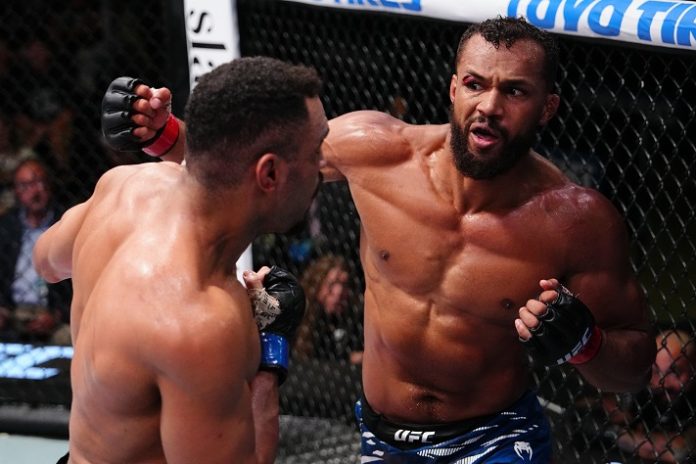
Julius Walker vs Gerald Meerschaert: analysis & prediction

MAIN CARD · LIGHT HEAVYWEIGHT · 3 ROUNDSUFC Fight Night: Allen vs. Duncan
Julius Walker — Light Heavyweight fighter

Julius Walker

7W3L
Wrestling pressure
VS
Gerald Meerschaert — Light Heavyweight fighter

Gerald Meerschaert

37W22L
Submission specialist

Walker must make top position safe as well as accessible

Light HeavyweightMeta APEX, Las Vegas, NevadaOctober 10, 202625ft Octagon (Meta APEX)

Fight overview

The fight in 30 seconds

Walker's wrestling should get this fight to the mat; the question is whether top position stays safe once he is there. Meerschaert has won 29 fights by submission, feeding on overcommitted entries with front headlocks and back takes. If Walker protects his neck and settles before adding damage, his size against a career middleweight should tell; one loose scramble chasing a quick finish is the opening Meerschaert needs.

Paths that change the fight

  • Julius WalkerGet to the clinch and the mat early, settle into top position before throwing, and keep his head out of front headlocks — the Cerqueira template, 11:46 of control, without the loose standing exchanges that got him stopped by Jacoby and Yakhyaev.
  • Gerald MeerschaertSurvive the first round — where he has been out-landed in 20 of 26 UFC fights and absorbed six of his seven knockdowns — then turn Walker's entries into front headlocks, guillotines and back takes as the pace drops.
What limits this estimate · Analyst conviction: 3/10
  • Walker has been stopped in each of his last two fights and absorbs 4.18 significant strikes per minute at 43% defence.
  • 29 career submissions — 11 in the UFC — and 1.49 attempts per fifteen: every takedown creates a scramble.

Editorial assessment of the evidence, not a win probability or a calibrated confidence interval.

Julius Walker

Freshness unverified
Model win probability
55%
Fair odds
-122
Reference quote
-255 (BetOnline)
Fair decimal odds
1.82

Gerald Meerschaert

Freshness unverified
Model win probability
45%
Fair odds
+122
Reference quote
+212 (BetOnline)
Fair decimal odds
2.22
Price freshness & calculation notes

Quotes older than 48 hours are marked outdated. EV at an old or undated price is a historical calculation, not a current opportunity. Date-only snapshots have no verified capture time.

Sources and data limitations

Career records, UFC fight logs, round-by-round figures and rate lines run through each man's most recent bout (June 2026 for Walker, May 2026 for Meerschaert). Meerschaert's figures come from 26 UFC bouts at middleweight. Composite scores, probabilities and fair prices are MMA Analytics model outputs.

Model methodology
01

The Frame

What this fight is really about — and the measurements that shape it

The Analyst's Take

Julius Walker is a big, young wrestler who has been stopped in each of his last two fights, and Gerald Meerschaert, owner of the most submission wins in UFC middleweight history, arrives on a five-fight skid and moves up to light heavyweight. The fight asks whether a wrestler who wins positions can keep them against a veteran who turns transitions into chokes. Walker's control is front-loaded while Meerschaert grows more dangerous late, so Walker wants the cards settled before those rounds arrive. The swing is Walker's discipline on the feet, since both stoppages began in loose exchanges.

Julius Walker
Attribute
Gerald Meerschaert
2711-year gap
Age
38
6'4"+3" Walker
Height
6'1"
78"+0.5" Walker
Reach
77.5"
43"+3" Walker
Leg Reach
40"
Orthodox
Stance
Southpaw
Team Fusion
Team
Valle Flow Striking Academy
7-3-0
Pro Record
37-22-0
1-3 (4 bouts)
UFC Record
12-14 (26 bouts, all at middleweight)
4
Octagon Bouts
26
105 (KO loss)
Days Since Last Fight
161 (decision loss)
Wrestling pressure
Fighting Style
Submission specialist

Walker is the bigger man by every measure — three inches taller (6'4" to 6'1"), half an inch longer in the arms, three inches longer in the legs — and 11 years younger. Meerschaert fought all 26 of his UFC bouts at middleweight; this is his first UFC appearance at 205, against a natural light heavyweight. The size gap matters most in the positions Walker wants — clinch, fence and top control — and least in the scrambles Meerschaert wants.

Venue Factor
The Meta APEX's 25-foot Octagon shortens the walk to the fence and the clinch, where 30% of Walker's UFC significant strikes land. Less room also means fewer resets for Meerschaert, who has been out-landed in 20 of his 26 UFC first rounds. The trade-off is that a tighter cage packs more scrambles into each minute, and scrambles are where Meerschaert's front headlocks and back takes come from.
02

The Fighters

Careers, chins, schedules — and the form they bring into the cage

Julius Walker in his UFC bout against Rafael Cerqueira

Julius Walker

Pro Record
7-3-0
UFC Record
1-3 across four bouts since February 2025
Streak
Two straight KO/TKO losses — Jacoby (R2, Feb 2026) and Yakhyaev (R1, 0:08, Jun 2026)
Finish Rate
86% (6 of 7 wins) — 4 KO/TKO, 2 submissions
Avg Fight Time
9:13
Chin · Vulnerable — stopped in his last two fights, 2 knockdowns absorbed in 36:50SOS · DevelopingWrestling pressure

Walker came to the UFC 6-0 from Synergy FC and Peak Fighting, where four of his six wins were first-round knockouts, and debuted in February 2025 with a split-decision loss to Alonzo Menifield in an 86–87 slugfest. His best UFC performance followed in August 2025: a unanimous decision over Rafael Cerqueira built on six takedowns and 11:46 of control, with the only knockdown he has scored in the Octagon. Since then he has been stopped twice. Dustin Jacoby dropped and finished him at 1:42 of the second round in February, and Abdul Rakhman Yakhyaev knocked him out eight seconds into their June bout in Baku. The wrestling is real — 4.07 takedowns per fifteen minutes at 38% accuracy and 20:04 of control across four fights — but so is the defensive leak: he absorbs 4.18 significant strikes per minute and defends 43%.

Gerald Meerschaert in the Octagon

Gerald Meerschaert

Pro Record
37-22-0
UFC Record
12-14 across 26 bouts since December 2016, all at middleweight
Streak
Five straight losses — latest a decision to Jacob Malkoun (May 2026)
Finish Rate
95% (35 of 37 wins) — 29 submissions, 6 KO/TKO
Avg Fight Time
8:30
Chin · Vulnerable — 5 UFC KO/TKO losses, 7 knockdowns absorbed in 26 boutsSOS · VeteranSubmission specialist

Meerschaert has been a UFC middleweight for nearly ten years, and his record there is exactly what his style promises: 12-14, with every win a finish and 11 of those finishes by submission — the most submission wins in UFC middleweight history. He finishes late more than early: five of his 12 UFC wins came in Round 2 and four in Round 3, and 9 of his 22 UFC submission attempts came in third rounds. The losses have piled up since his comeback arm-triangle of Edmen Shahbazyan in August 2024: Reinier de Ridder (arm-triangle, Round 3), Brad Tavares (decision), Michał Oleksiejczuk (TKO, Round 1), Kyle Daukaus (D'Arce choke at 0:50) and Jacob Malkoun (decision). At 38 he moves to light heavyweight for the first time in the UFC, bringing 1.49 submission attempts per fifteen minutes and a 40% takedown defence.

Julius Walker
0 dealt · 0 absorbed
Knockdown Exchange
Knockdowns dealt vs absorbed.
Gerald Meerschaert
0 dealt · 0 absorbed

Julius Walkersignature weapons

First-Round StrikesFour regional KO/TKO wins, all in Round 1 — Henry Essley, Mike Cook (0:46), Bevon Lewis and Myron Dennis (1:58)
×4
Rear-Naked ChokeBryan Porritt at 1:57 of Round 1, Synergy FC 8, October 2023
×1
Triangle ArmbarNyle Bartling at 1:38 of Round 2, Synergy FC 13, June 2024
×1
Takedowns and Top ControlNot yet a UFC finisher: 10 takedowns on 26 attempts and 20:04 of control in 36:50 — more than half of his Octagon time
×0

Gerald Meerschaertsignature weapons

Rear-Naked ChokeThe most used of his 29 submissions — Oskar Piechota, Deron Winn, Makhmud Muradov and Dustin Stoltzfus in the UFC
×9
Guillotine ChokeTrevin Giles (Round 3, 2019), Bartosz Fabiński (Round 1, 2021) and Bruno Silva (Round 3, 2022) in the UFC
×7
Arm-Triangle ChokeLatest: the comeback finish of Edmen Shahbazyan at 4:12 of Round 2, August 2024 — his 12th UFC finish (11 submissions plus the Spicely body kick), passing Anderson Silva for the most finishes in UFC middleweight history
×5
Body KickEric Spicely at 2:18 of Round 2, December 2017 — his only UFC win that did not end with a submission
×1

Julius Walker

L
Abdul Rakhman Yakhyaev
KO/TKO — Right hook, then ground strikes

Opponent context: prospect

R1 (0:08)
UFC Fight Night: Fiziev vs. Torres, Baku — Jun 27, 2026
L
Dustin Jacoby
KO/TKO — Strikes after a knockdown

Opponent context: veteran

R2 (1:42)
UFC Fight Night: Bautista vs. Oliveira — Feb 7, 2026
W
Rafael Cerqueira
Decision — Unanimous

Opponent context: ufc

R3 (5:00)
UFC Fight Night: Dolidze vs. Hernandez — Aug 9, 2025
L
Alonzo Menifield
Decision — Split

Opponent context: veteran

R3 (5:00)
UFC Fight Night: Cejudo vs. Song — Feb 22, 2025
W
Myron Dennis
KO/TKO
R1 (1:58)
Peak Fighting 41 — Dec 2024
Pattern

Two stoppage losses in a row after a 1-1 start. The wrestling showed up in every fight that lasted — six of ten takedowns and 11:46 of control against Cerqueira, 5:31 of control against Menifield. The defence did not: he absorbed 87 significant strikes from Menifield and 42 from Jacoby before the finish, and he has been dropped in two of his last three fights.

Gerald Meerschaert

L
Jacob Malkoun
Decision — Unanimous

Opponent context: veteran

R3 (5:00)
UFC Fight Night: Della Maddalena vs. Prates, Perth — May 2, 2026
L
Kyle Daukaus
Submission — D'Arce choke

Opponent context: veteran

R1 (0:50)
UFC 322: Della Maddalena vs. Makhachev — Nov 15, 2025
L
Michał Oleksiejczuk
KO/TKO — Punches

Opponent context: veteran

R1 (3:03)
UFC 319: Du Plessis vs. Chimaev — Aug 16, 2025
L
Brad Tavares
Decision — Unanimous

Opponent context: veteran

R3 (5:00)
UFC Fight Night: Emmett vs. Murphy — Apr 5, 2025
L
Reinier de Ridder
Submission — Arm-triangle choke

Opponent context: elite

R3 (1:44)
UFC Fight Night: Magny vs. Prates — Nov 9, 2024
Pattern

Five straight losses and 3-8 since April 2022. They split three ways: two first-round stoppages in his last three fights (Oleksiejczuk at 3:03, Daukaus at 0:50), two decisions and a third-round arm-triangle. He stays dangerous in defeat — three submission attempts and 4:23 of control against Malkoun in May — but lost that fight 36–32 on significant strikes and on all three cards.

Julius Walker

Win Methods
Wins by Round

Gerald Meerschaert

Win Methods
Wins by Round
Critical Insight
Both charts are scoped to career wins. Walker's seven: five first-round finishes on the regional scene (four knockouts and a rear-naked choke), a second-round triangle armbar and the Cerqueira decision — he has not finished anyone in the UFC. Meerschaert's 37: 29 submissions, 6 KO/TKO and only 2 decisions, with 16 wins in Round 1, 13 in Round 2, 5 in Round 3 and a fifth-round guillotine of Sam Alvey in 2010. In the UFC his finishes come later — 3 in Round 1, 5 in Round 2, 4 in Round 3. Walker's finishing power has come early; Meerschaert's arrives when opponents tire.

Opposition strength (no shared opponents)

Without a reliable shared-opponent table, compare who each fighter has been tested against using SOS tier, UFC sample size, and recent elite-tier form — not raw records alone.

FactorJuliusGerald
Strength of schedule (SOS tier)Developing — Menifield (split decision), Cerqueira, Jacoby and Yakhyaev — two UFC veterans and two prospectsVeteran — Chimaev, de Ridder, Hermansson, Santos, Holland, Pyfer and Malkoun — a decade of middleweight contenders and veterans
UFC sample1-3 across four bouts since February 202512-14 across 26 bouts since December 2016, all at middleweight
Recent ranked / elite touches (last 5)0 elite · 2 veteran tier1 elite · 4 veteran tier
Form-window difficulty edge: Fighter B (11 vs 5 tier points in listed bouts).
Last three opponentsAbdul Rakhman Yakhyaev, Dustin Jacoby, Rafael CerqueiraJacob Malkoun, Kyle Daukaus, Michał Oleksiejczuk
03

The Numbers

Composites, division ranks and round-by-round evidence

Composite scores summarize selected statistics on a 0–100 scale. They are not win probabilities. Compare the underlying metrics, opponent quality and UFC experience before interpreting a score difference as a matchup advantage.

Striking

SLpM 25% · StrAcc 30% · StrDef 30% · SApM 15%

0
Juliusfew UFC fights
0
Gerald

Level at 43. Walker lands more (3.72 to 2.95 per minute) and more accurately (54% to 45%); Meerschaert defends better (54% to 43%) and absorbs less (3.44 to 4.18). Both sit below the light heavyweight averages for output (4.50) and accuracy (51.7%).

Grappling

TD/15 25% · TDAcc 25% · TDDef 30% · Sub/15 20%

0
Juliusfew UFC fights
0
Gerald

Walker by 22 on takedown rate (4.07 to 1.70 per fifteen), accuracy (38% to 29%) and defence (one attempt against him, stopped; 40% for Meerschaert). Meerschaert's only lead is submission attempts, 1.49 per fifteen to zero — the single input behind 11 of his UFC wins. The gauge measures takedown economy, not submission danger.

Technical

(Striking + Grappling) / 2

0
Juliusfew UFC fights
0
Gerald

Walker by 11 on paper — a grappling gap, not a striking one.

MetricJuliusGerald
Avg Fight Time9:13 (4 UFC bouts)few UFC fights8:30 (26 UFC bouts)
Control per 15 min8:103:21
Takedowns Conceded (UFC)0 of 1few UFC fights27 of 45
Round 1 Strike Differential−2.0 per round−5.9 per round
Submission Attempts / 150.001.49

Archetype Base Rate

Wrestling pressure 55%45% Submission specialist

MMA Analytics model · The 55/45 split comes from the matchup itself — Walker's takedown rate, control time and size against Meerschaert's submission threat and Walker's two straight stoppage losses.

Julius WalkerGerald Meerschaert

Light Heavyweight

· 26 fighters

Rank bars use the recorded division cohort. Where a rank is unavailable, the comparison shows the difference from the published division average; the white marker denotes equality. Percentage differences are percentage points (pp). Higher is not always better: fewer strikes absorbed is preferable. Missing benchmarks are not estimated.

StatJuliusJulius comparisonDiv avgGerald comparisonGerald
SLpM3.72
12/26few UFC fights
4.50
-1.55 vs avg
2.95
Str Acc54%
5/26few UFC fights
51.7%
-6.70 pp vs avg
45%
Str Def43%
23/26few UFC fights
51.9%
+2.10 pp vs avg
54%
SApM4.18
14/26few UFC fights
3.70
-0.26 vs avg
3.44
KD Avg0.41
18/26few UFC fights
0.64
-0.44 vs avg
0.20
TD/154.07
3/26elitefew UFC fights
1.16
+0.54 vs avg
1.70
TD Acc38% (10 of 26)
Not availablefew UFC fights
—
Not available
29% (25 of 85)
TD Def100% (1 attempt against)
Not availablefew UFC fights
—
Not available
40% (27 of 45 conceded)
Sub/150.00
-0.27 vs avg
0.27
+1.22 vs avg
1.49
Control per 158:10
Not available
—
Not available
3:21
Statistical Verdict
Walker's numbers are a wrestler's line with a striker's defensive problem: third of 26 in takedown rate and fifth in accuracy, but 23rd in striking defence. Meerschaert, measured against light heavyweights for the first time, is below the division average on output and accuracy but above it on defence, and his 1.49 submission attempts per fifteen are more than five times the light heavyweight average. The table says Walker should win the positional battle; it cannot say how often a man who concedes 60% of takedowns turns bottom position into a submission.

Significant Strikes Landed per Round

Control Time per Round (sec)

Julius Walker

  • Walker's output climbs each round — 11.3, 17.0 and 20.5 landed — but the first-round average includes the eight-second Yakhyaev fight; over his three full first rounds he averages 15.0.
  • Control is the constant: 133, 125 and 149 seconds per round. In Round 1, 55.6% of his strikes land in the clinch and 48.9% go to the body.
  • The danger rounds are early. Both knockdowns he has absorbed and both stoppage losses came in Rounds 1–2, where opponents out-land him 53–45 and 61–51.

Gerald Meerschaert

  • Meerschaert's first round is his worst: 9.2 landed per round at 42%, out-landed in 20 of 26 UFC first rounds, and six of his seven knockdowns absorbed came there.
  • He improves as fights go on — 16.0 landed in Round 2 — and out-lands opponents 272–255 across 17 UFC second rounds and 140–112 across 11 third rounds.
  • Round 3 is his submission round: 9 of his 22 UFC submission attempts and 4 of his 12 UFC wins came there (Giles, Winn, Stoltzfus, Bruno Silva). Opponents also landed 10 of 11 takedowns on him in third rounds.
Critical Insight
Read the two lines against each other. Walker is at his most dangerous and his most vulnerable in the first ten minutes — his clinch work and control are front-loaded, and so are his two stoppage losses. Meerschaert is the opposite: out-landed and knocked down early, better and more submission-minded late. If Walker banks Rounds 1 and 2 without getting caught, Meerschaert's best round arrives with him already behind on the cards.

Strike targeting

Julius

Head
48%
Body
31%
Legs
21%

Gerald

Head
73%
Body
17%
Legs
10%

Head hunting vs body work vs leg attack — the shape of the damage.

Striking range — distance, clinch and ground

JuliusGerald
53%Distance81%
30%Clinch10%
17%Ground9%

Share of significant strikes landed at distance, in the clinch and on the ground across each fighter's UFC rounds, weighted by strike volume.

04

The Story of the Fight

Advantages, worst cases, gameplans — and the patterns underneath

Where the fight lives

Who owns each phase — and by how much
Open SpaceGerald owns it

Meerschaert's 54% striking defence against Walker's 43% — and both of Walker's stoppage losses began in exchanges

Pocket / ExchangesEven

Walker's 54% accuracy against Meerschaert's seven knockdowns absorbed, offset by Walker being dropped in two of his last three fights

ClinchJulius owns it

30% of Walker's UFC strikes land in the clinch; a natural light heavyweight with a three-inch height edge against a career middleweight

GroundEven

Walker's 8:10 of control per 15 minutes against 29 submission wins and 1.49 attempts per 15

Path to Victory

Julius Walker

Get to the clinch and the mat early, settle into top position before throwing, and keep his head out of front headlocks — the Cerqueira template, 11:46 of control, without the loose standing exchanges that got him stopped by Jacoby and Yakhyaev.

Why they win
01
Takedown volume

4.07 takedowns per fifteen minutes, third in the light heavyweight pool, against a fighter who has conceded 27 of 45 UFC takedown attempts.

02
Control time

20:04 of control across 36:50 in the Octagon — 8:10 per fifteen minutes against Meerschaert's 3:21.

03
Size and age

Three inches taller, three inches longer in the legs, 11 years younger, and a natural light heavyweight against a career middleweight.

04
Accuracy

54% significant-strike accuracy, fifth of 26, against Meerschaert's 45% — with heavy body work from the clinch in Round 1.

05
The first round

Meerschaert has been out-landed in 20 of 26 UFC first rounds and absorbed six of his seven knockdowns there, the round in which Walker's pressure is strongest.

The gameplan
  1. 1
    Close behind the jab

    Avoid long exchanges at range, where he absorbs 4.18 per minute; enter behind feints and the jab to reach the clinch.

  2. 2
    Clinch first, then shoot

    Start from the clinch, where more than half of his first-round strikes land, and finish takedowns along the fence rather than shooting from open space.

  3. 3
    Head position on every entry

    Keep his head up and to the outside; a low, head-inside shot is exactly the entry seven guillotine wins are built on.

  4. 4
    Settle before striking

    Pass and pin before throwing ground strikes — loose ground-and-pound creates the scrambles in which Meerschaert takes backs.

  5. 5
    Bank the rounds

    He does not need a finish: the model's largest Walker outcome is a decision (32 of 100), and control-heavy rounds win cards.

Path to Victory

Gerald Meerschaert

Survive the first round — where he has been out-landed in 20 of 26 UFC fights and absorbed six of his seven knockdowns — then turn Walker's entries into front headlocks, guillotines and back takes as the pace drops.

Why they win
01
Submission record

29 submission wins, 11 in the UFC — the most in UFC middleweight history — and 1.49 attempts per fifteen minutes.

02
Finishing late

Nine of his 22 UFC submission attempts and four of his 12 UFC wins came in Round 3.

03
Walker's durability

Walker has been stopped in each of his last two fights and absorbs 4.18 significant strikes per minute with 43% striking defence.

04
Striking defence

54% defence and 3.44 absorbed per minute — better than Walker on both counts.

05
Experience

59 pro fights and 26 UFC bouts against Walker's 10 and 4; he has been in every kind of scramble.

The gameplan
  1. 1
    Survive Round 1

    Stay off the fence and out of long exchanges early — the round in which he has been out-landed in 20 of 26 UFC fights.

  2. 2
    Punish the entry

    Meet level changes with front headlocks and guillotine grips; Walker has shot 26 times in four UFC fights.

  3. 3
    Scramble, don't hold

    Use underhooks and wall-walks to force scrambles, where back takes and arm-triangles open up.

  4. 4
    Test the chin

    Counter when Walker loads up standing — he has been dropped in two of his last three fights.

  5. 5
    Win the late minutes

    Push in Round 3, where 9 of his 22 UFC submission attempts have come, as a heavier opponent slows.

Danger Zone

How Julius Walker loses

  • A takedown entry leaves his neck exposed and Meerschaert jumps a guillotine — seven of Meerschaert's 29 submissions are guillotines.

  • He stands and trades early the way he did against Jacoby and gets hurt again; both knockdowns he has absorbed came in Rounds 1–2.

  • He wins the takedowns but not the positions: Meerschaert reverses in a scramble and takes the back, the route to nine career rear-naked chokes.

Danger Zone

How Gerald Meerschaert loses

  • Walker chains takedowns from the clinch and holds top position for ten-plus minutes, as he did for 11:46 against Cerqueira — the model's largest single outcome (32 of 100).

  • An early exchange goes wrong: Meerschaert has been stopped by strikes five times in the UFC, four of them in Round 1.

  • The weight class tells: a career middleweight carrying a natural light heavyweight for three rounds has little left for the late submission attempts that win him fights.

Walker's entries against Meerschaert's defence

The Takedown Economy

Walker lands 38% of his takedown attempts, and Meerschaert has let 60% of the attempts against him succeed. Across 26 UFC bouts opponents have taken him down 27 times and controlled him for 48:46. If Walker's attempt rate holds, he should get this fight to the mat repeatedly in fifteen minutes.

4.07 vs 40%
Walker's takedowns per 15 vs Meerschaert's takedown defence
Where the reversal lives

Every Takedown Is a Scramble

Meerschaert's submission game does not need him on top. He has 22 UFC submission attempts and 11 UFC submission wins — the most by any middleweight in UFC history — and seven of his 29 career submissions are guillotines, the choke that punishes a careless shot.

11
UFC submission wins — a middleweight record
Both men have been stopped recently

Two Chins Under Pressure

Walker has been stopped in each of his last two fights; Meerschaert has absorbed seven UFC knockdowns and suffered five KO/TKO losses, including Oleksiejczuk in Round 1 last August. Neither man's power is his calling card — Walker has one UFC knockdown, Meerschaert three in 26 fights — which is why the model keeps both knockout buckets small (12 and 8).

2 & 5
Walker's straight stoppage losses · Meerschaert's UFC KO/TKO losses
Who owns which round

Front-Loaded vs Back-Loaded

Walker's control peaks in Rounds 1 and 3 and both of his losses by stoppage came early. Meerschaert is out-landed in 20 of 26 UFC first rounds but out-lands opponents in his second and third rounds, and 9 of his 22 submission attempts come in Round 3.

20 of 26
UFC first rounds Meerschaert has lost on the strike count
The weight-class question

A Middleweight at 205

All 26 of Meerschaert's UFC bouts were at middleweight, and he is 38. The size gap matters most in the positions Walker wants — clinch, fence and top control — and least in the scrambles Meerschaert wants.

+3" / 11 yrs
Walker's height and age edge

Finish Threat by Round

Share of each fighter's wins that end in each round — early finishers spike left, grinders rise right.

05

The Verdict

One hundred simulated fights, the betting market, and our conviction

If you only read 3 things
1

Walker should win most of the minutes: he wrestles far more than Meerschaert defends, and he has spent more than half of his UFC cage time in control.

2

Meerschaert's path is the submission — the finish behind 29 of his wins, and the reason every Walker takedown is also a risk.

3

Both men arrive on bad runs: Walker has been stopped twice in a row, Meerschaert beaten five times in a row, and the model has the fight going the distance 44 times in 100.

Model outcomes per 100 fights

Each square represents one percentage point of the model distribution, not an observed fight. This visualization does not measure model accuracy or reduce uncertainty in the inputs.

Julius Walker KO/TKO — 12%Julius Walker Decision — 32%Julius Walker Submission — 11%Gerald Meerschaert KO/TKO — 8%Gerald Meerschaert Decision — 12%Gerald Meerschaert Submission — 25%

Each square = 1 model percentage point. Julius Walker gold · Gerald Meerschaert orange · color opacity: 100% = decision, 70% = submission, 45% = KO/TKO.

The takedown economy

4.07 takedowns per fifteen at 38% against a 40% takedown defence — the core of Walker's 55%.

Control time

Walker holds 8:10 of control per fifteen minutes. That drives his 32-point decision bucket, the largest outcome in the model.

Meerschaert's submission rate

1.49 attempts per fifteen and 11 UFC submission wins make Meerschaert by submission the largest Meerschaert outcome, 25 of 100.

Walker's durability

Two straight stoppage losses and 4.18 strikes absorbed per minute keep the knockout paths open on both sides (12 and 8).

Age, form and weight

38 against 27, five straight losses against a 1-3 UFC run, and Meerschaert's first UFC bout at 205. Both men enter on poor form, which caps conviction at 3/10.

Fight Scripts

0%
of simulations

The Control Grind

Walker takes Meerschaert down in every round, keeps his head out of guillotine range and settles into half guard and side control, as he did for 11:46 against Cerqueira. Meerschaert attacks from underneath but never gets the scramble he needs. 30-27 or 29-28 Walker.

Scripted outcomes for Julius Walker vs Gerald Meerschaert — how each version of this fight unfolds.

Julius Walker win probability
0%
12%
32%
11%
KO/TKODECSUB
  • Twelve. Four career knockouts, all first-round regional finishes, and one UFC knockdown — against an opponent with five UFC KO/TKO losses and seven knockdowns absorbed.

  • Thirty-two, the largest single outcome. Takedowns and 8:10 of control per fifteen minutes win rounds without damage.

  • Eleven. Two regional submissions (rear-naked choke, triangle armbar) and top position against a man who concedes 60% of takedowns — though he has no UFC submission attempts yet.

Gerald Meerschaert win probability
0%
8%
12%
25%
KO/TKODECSUB
  • Eight. Six career KO/TKO wins and three UFC knockdowns, against a fighter stopped in each of his last two bouts.

  • Twelve. Better striking defence (54% to 43%) and a stronger third round; he needs to stop enough takedowns to win two rounds.

  • Twenty-five, his largest bucket. 29 career submissions, 11 in the UFC, and 1.49 attempts per fifteen minutes against a wrestler who will give him scrambles.

Projected Scorecards

How the model scores each round
R1
Julius
R2
Julius
R3
Even
29-28 Walker
Walker's control wins Rounds 1 and 2; Meerschaert's submission attempts take Round 3
Most likely card if it goes the distance — 32 of the model's 44 decisions go to Walker
30-27 Walker
Walker holds top position in all three rounds
The clean version of the Cerqueira fight
29-28 Meerschaert
Meerschaert's defence and late submission attempts outwork a fading Walker
12 of the 44 decisions

Model and price

Julius Walker

Freshness unverified
Model win probability
55%
Fair odds
-122
Reference quote
-255 (BetOnline)
Fair decimal odds
1.82
Estimated EV
-23.4%
Edge vs no-vig market
-14.1 pp

Gerald Meerschaert

Freshness unverified
Model win probability
45%
Fair odds
+122
Reference quote
+212 (BetOnline)
Fair decimal odds
2.22
Estimated EV
+40.4%
Edge vs no-vig market
+14.1 pp

EV uses the displayed price: probability × decimal odds − 1. Edge is a percentage-point difference from a proportionally de-vigged, same-book pair. A dash means that comparison is unavailable.

Price freshness & calculation notes

Quotes older than 48 hours are marked outdated. EV at an old or undated price is a historical calculation, not a current opportunity. Date-only snapshots have no verified capture time.

Fair odds are the break-even price under this estimate, not a recommended entry price. Model uncertainty can erase a small edge.

What price would change the calculation? · Julius Walker

Change the assumptions to see how the required price moves. This does not update the published model or recommend an entry price.

Required decimal price: 1.82 or higher. At the exact unrounded break-even price, estimated EV is zero.

What price would change the calculation? · Gerald Meerschaert

Change the assumptions to see how the required price moves. This does not update the published model or recommend an entry price.

Required decimal price: 2.23 or higher. At the exact unrounded break-even price, estimated EV is zero.

Analyst price notes

Written against the prices of October 5.

Walker is a bet only at −122 or better. BetOnline −255 is well inside that number, so the moneyline favourite is not the value side. Meerschaert at +212 is longer than the model's +122 fair price. The model's strongest single call is Meerschaert by submission at 25% (fair +300). Walker by decision is 32% (fair +213).

Conviction
0
3/10

Editorial confidence in the evidence, not a win probability or a calibrated confidence interval.

A lean, not a strong call. Walker's takedowns and control should win most of the minutes, but he has been stopped in his last two fights, has four UFC bouts, and will spend the night in the one position — on top of a submission specialist — where one mistake ends it. Lean: Julius Walker.

What backs the lean
  • 4.07 takedowns per fifteen (third of 26 at light heavyweight) against a fighter who has conceded 27 of 45 UFC takedown attempts.

  • 8:10 of control per fifteen minutes — a scoring route that does not require Walker to win exchanges.

  • Size and age: three inches taller, three inches longer in the legs and 11 years younger, against a career middleweight in his first UFC bout at 205.

  • Meerschaert's first rounds: out-landed in 20 of 26, with six of his seven knockdowns absorbed there.

What limits it
  • Walker has been stopped in each of his last two fights and absorbs 4.18 significant strikes per minute at 43% defence.

  • 29 career submissions — 11 in the UFC — and 1.49 attempts per fifteen: every takedown creates a scramble.

  • Walker's UFC sample is four bouts, one of them eight seconds long.

  • Both men are on losing streaks, so recent form does not separate them.

Final Assessment

In roughly 55 of 100 simulations Julius Walker does what his rate line says he does. He closes distance, finishes takedowns along the fence and keeps a career middleweight underneath him for long stretches, the way he held Rafael Cerqueira for 11:46. Most often that wins on the cards (32%); sometimes the pressure breaks Meerschaert early, as five UFC opponents already have with strikes (12%); occasionally Walker finds a choke of his own from the top (11%).

In the other 45, Gerald Meerschaert makes the takedowns cost something. A careless entry gives him a guillotine, a scramble gives him the back, or Walker's recent durability problems resurface in an exchange. The submission is his main route (25%) — the finish behind 29 career wins and a UFC middleweight record 11 submission victories — with a late-rounds decision (12%) or a knockout (8%) behind it.

On October 10 at the Meta APEX the model takes Walker narrowly, because his size, youth and control time give him more ways to win the minutes than Meerschaert has to win them back. Conviction stays at 3/10: Walker has been finished twice in a row, has four UFC fights, and is walking into the one position where a single mistake ends the night.

Skip to main content
Use Tab to navigate through elements, Enter to activate buttons and links.