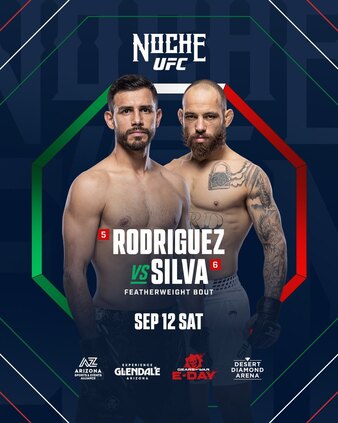


PRELIM · FEATHERWEIGHT · 3 ROUNDSUFC Fight Night: Rodriguez vs. Silva (Noche UFC)
Tommy McMillen — Featherweight fighter

Tommy McMillen

Gun
11W0L
Record-Setting Volume
VS
Marwan Rahiki — Featherweight fighter

Marwan Rahiki

Freaky
9W0L
100% Finisher

A UFC volume record against a knockdown rate five times the norm

FeatherweightDesert Diamond Arena, Glendale, ArizonaSeptember 12, 2026Standard 30ft Octagon
01

The Frame

What this fight is really about — and the measurements that shape it

The Analyst's Take

Two undefeated featherweights, both 2-0 in the Octagon, both statistical outliers of a kind the division rarely sees at once — and a matchup Marwan Rahiki spent months calling for before Tommy McMillen asked for this card. McMillen holds the UFC record for significant strikes landed in a three-round fight (252, against Alberto Montes in July) and carries 5 knockouts, 5 submissions and 9 first-round finishes. Rahiki has finished every professional opponent he has ever faced — 9 for 9, 8 by knockout — behind a 2.25 knockdown average that is more than five times the featherweight baseline. The decisive asymmetry is in the phase neither man's Octagon tape shows: McMillen has five career submissions, and Rahiki has never met a grappler who lasted long enough to test him.

Tommy McMillen
Attribute
Marwan Rahiki
28
Age
24
6'0" (72")+4" McMillen
Height
5'8" (68")
74"+2" McMillen
Reach
72"
43.5"
Leg Reach
42"
Not listed
Stance
Not listed
Red Hawk Academy, Arizona
Team
Lion's Den Academy, Sydney
Apr 4, 2026
Octagon Debut
Mar 14, 2026
Well-rounded MMA — striker with a submission base
Fighting Style
Striker

The largest frame gap on this prelim card. McMillen is four inches taller and two inches longer with an inch and a half more leg reach — and in a 145-pound division where a two-inch reach edge is usually the whole conversation, a 72"-to-68" height difference dictates who jabs, who has to close, and who eats the counter on the way in. Rahiki's 72-inch reach on a 5'8" frame is unusually long for his height and does most of the work to close that gap; his arms are only two inches shorter than a man four inches taller. The practical consequence is that Rahiki has the reach to be dangerous at range but has to fight at head height for a taller man — and 65% of his strikes go to the head.

Venue Factor
Three rounds is the shape that helps McMillen, and the round data says so twice. Rahiki has finished 89% of his career wins inside two rounds and has never won a Round 3 in his professional life; his only trip past the third was a Round 4 guillotine on an Australian regional card. McMillen has won two third rounds, one of them by setting a UFC record for significant strikes landed. Both men absorb well above the divisional average — 4.96 and 5.90 per minute against a 4.07 baseline — so a fight that reaches the last five minutes is not neutral territory. It is measurably one man's ground.
02

The Fighters

Careers, chins, schedules — and the form they bring into the cage

Tommy McMillen

Pro Record
11-0-0
UFC Record
2-0 — two knockouts
Streak
11-fight win streak; won his last by third-round TKO of Alberto Montes
Finish Rate
91% (10 of 11 wins) — 5 KO/TKO, 5 submission
Avg Fight Time
10:49
Chin · Untested — never dropped in the OctagonSOS · BuildingVolume striker with a first-round submission base

A lifelong martial artist whose ceiling keeps climbing as the level rises. He has trained in combat sports since he was three, debuted professionally in November 2019, then went dormant until 2023 — at which point he ran off six straight finishes on the Fusion Fight League and RUF circuits, four of them guillotines or rear-naked chokes and every single one in Round 1. On September 2, 2025 he beat unbeaten David Mgoyan by majority decision on the Contender Series, the only fight of his career ever to reach a scorecard. He stopped Manolo Zecchini in 3:57 of the first on debut for Fight of the Night, then on July 18, 2026 outlanded Alberto Montes 250-to-54 and set a UFC record with 252 significant strikes landed in a three-round bout, finishing at 3:29 of the third. The context that makes it remarkable: he did all of it while managing a pinched sciatic nerve that left his foot numb and kept him from grappling for two years, and which only resolved five to six weeks before his UFC debut. He called the Montes camp the healthiest of his life.

Marwan Rahiki

Pro Record
9-0-0
UFC Record
2-0 — two stoppages
Streak
9-fight win streak; won his last by first-round TKO of Ollie Schmid
Finish Rate
100% (9 of 9 wins) — 8 KO/TKO, 1 submission
Avg Fight Time
6:40
Chin · Untested — never been dropped or finishedSOS · BuildingPure finisher — knockout-first striker

A sprint. Rahiki left Rabat at nineteen, relocated to Sydney, and had his first professional fight in February 2024 — his ninth came in May 2026. In between he cleared Eternal MMA, Superfight MMA, HEX Fight Series and Beatdown Promotions without ever hearing a scorecard, including a spinning-back-kick knockout and a Round 4 guillotine, then took a Contender Series contract in October 2025 with a knee-elbows-uppercut stoppage of Ananias Mulumba. His Octagon debut on March 14, 2026 ended when Harry Hardwick's corner pulled him out with a broken jaw; seven weeks later he took a short-notice replacement assignment in Perth after Jack Jenkins withdrew injured and stopped Ollie Schmid at 2:47 of the first. At 24 with nine professional bouts and roughly sixty career minutes of cage time, he is the least-mileage fighter on this card and the one with the least tape for a camp to study.

Tommy McMillen
0 dealt · 0 absorbed
Knockdown Exchange
KD dealt vs absorbed
Marwan Rahiki
0 dealt · 0 absorbed

Tommy McMillensignature weapons

Guillotine ChokeDustin Winter (1:41), Josh Wright (2:13), Genier Penagos (1:10) — all in Round 1
×3
Rear-Naked ChokeBen Hollier and Dumar Roa (1:58) — both first-round finishes
×2
Volume Accumulation252 significant strikes landed against Alberto Montes — a UFC record for a three-round fight
×2

Marwan Rahikisignature weapons

Knockout Power8 of 9 career wins by KO/TKO, at a 2.25 knockdown average — more than five times the featherweight baseline
×8
Spinning Back KickRyan Dennis at 4:31 of Round 1, Superfight MMA 22 — 14% of his strikes go to the legs
×1
Guillotine ChokeSemakadde Kakembo in Round 4, HEX 35 — his only career submission and his only trip past Round 3
×1

Tommy McMillen

W
Alberto Montes (11-1)
TKO — punches (UFC record: 252 sig. strikes landed)
RR3 (3:29)
UFC Oklahoma City — Jul 18, 2026
W
Manolo Zecchini (11-4)
TKO — punches & knees
RR1 (3:57)
UFC Fight Night — Apr 4, 2026 (Octagon debut, Fight of the Night)
W
David Mgoyan (7-0)
Decision — Majority
RR3
Dana White's Contender Series — Sep 2, 2025
W
Dumar Roa
Submission — Rear-Naked Choke
RR1 (1:58)
RUF 62 — Apr 26, 2025
W
Genier Penagos (7-4)
Submission — Guillotine
RR1 (1:10)
Fusion Fight League — Dec 14, 2024
Pattern

The Roa and Penagos chokes are the tail of a six-fight regional run in which he never once left the first round. The Mgoyan decision is the outlier and, in context, the most useful fight on the list — the only time McMillen has been forced to problem-solve for fifteen minutes, against another unbeaten fighter, and he won it. The two Octagon results describe an escalating, remarkably violent operator: a first-round stoppage on debut for Fight of the Night, then a performance that broke a UFC record, outlanding a 11-1 opponent 250 to 54 before finishing him in the third.

Marwan Rahiki

W
Ollie Schmid
TKO — strikes
RR1 (2:47)
UFC Perth — May 2, 2026 (short-notice replacement)
W
Harry Hardwick
TKO — corner stoppage (broken jaw)
RR2 (5:00)
UFC Vegas 114 — Mar 14, 2026 (Octagon debut)
W
Ananias Mulumba
TKO — knee, elbows & uppercut
RR2 (2:13)
Dana White's Contender Series S9 — Oct 14, 2025
W
Gabriel Schlupp
TKO — ground & pound
RR2
Beatdown Promotions 11 — Jul 5, 2025
W
Semakadde Kakembo
Submission — Guillotine
RR4
HEX Fight Series 35 — May 31, 2025
Pattern

Five fights, five finishes, zero scorecards, in fifteen months. The Kakembo guillotine is the only non-strike finish in this window and the only fight to reach a fourth round — everything else ended by damage inside two. The Octagon results are the important ones: he broke Harry Hardwick's jaw badly enough that the corner pulled him out between rounds, then took a short-notice replacement assignment in Perth and ended it in under three minutes. Neither opponent is a ranked featherweight, but both were live UFC roster fighters, and he did not need a full camp for the second.

Tommy McMillen

Win Methods
Wins by Round

Marwan Rahiki

Win Methods
Wins by Round
Critical Insight
Two donuts that look nothing alike and two bar charts that explain why the model is close. McMillen's method split is almost perfectly symmetrical — five knockouts and five submissions with one decision — so he genuinely threatens in two phases and has proven he can win fifteen minutes if forced to. Rahiki's is the most concentrated on the card: eight of nine wins by knockout, one guillotine, zero decisions, a 100% finish rate. The round bars are the sharper read. McMillen's distribution is a barbell — nine wins in Round 1, none in Round 2, two in Round 3 — meaning he is simultaneously the fastest finisher and the only man here with proven three-round wins. Rahiki has four in the first and four in the second, and has never won a Round 3 in his professional life; his single trip past the third was a Round 4 guillotine on an Australian regional card. Both logs are verified fight-by-fight and reconcile exactly with ufc.com's published first-round-finish counts of 9 and 4.

Common Opponents

OpponentTommyMarwan
Alberto Montes (style proxy)W· TKO R3 (Jul 2026)(blueprint for Rahiki)
An 11-1 opponent who chose to stand and trade was outlanded 250 to 54 before being stopped in the third
Harry Hardwick (style proxy)(blueprint for McMillen)W· TKO R2 (Mar 2026)
A durable UFC roster fighter had his jaw broken badly enough that his corner pulled him out between rounds
03

The Numbers

Composites, division ranks and round-by-round evidence

Striking

SLpM 25% · StrAcc 30% · StrDef 30% · SApM 15%

0
Tommysmall sample
0
Marwansmall sample

Two of the most extreme striking lines in the division, extreme in different ways. McMillen: 13.54 landed per minute — roughly three times the featherweight baseline, and heavily loaded by the 252-strike Montes record — at 51% accuracy with 60% defence. Rahiki: 7.75 per minute at 53% accuracy, and a 2.25 knockdown average against a divisional 0.44. Both absorb well above baseline (4.96 and 5.90 against 4.07).

Grappling

TD/15 25% · TDAcc 25% · TDDef 30% · Sub/15 20%

0
Tommysmall sample
0
Marwansmall sample

The most misleading table on the page if read literally. Both men are credited with 0.00 takedowns per fifteen and 0% accuracy despite each having one takedown on the books, and McMillen shows 0.00 submissions per fifteen — yet five of his eleven career wins are submissions, all in Round 1, all chokes. He simply did not need them in two Octagon fights, after two years of a nerve injury that made grappling impossible. Rahiki's perfect 100% takedown defence has been earned against two strikers.

Technical

(Striking + Grappling) / 2

0
Tommysmall sample
0.0
Marwansmall sample

A 4.5-point technical gap, driven by the frame advantage and the unused submission game rather than by anything in the striking columns, where the two are genuinely close.

Cardio

Fight time · pace · R3/R1 output · champ rounds

0
Tommysmall sample
0
Marwansmall sample

The clearest gap on the page. McMillen landed 252 significant strikes across three full rounds and finished in the third rather than fading into it; he has been past ten minutes twice and won both. Rahiki's 6:40 average fight time is the shortest on the card, and his only evidence past ten minutes is a Round 4 guillotine on a regional Australian show.

Overall

(Technical + Cardio) / 2

0.0
Tommysmall sample
0.0
Marwansmall sample

An 8.25-point overall gap — and it deliberately does not survive contact with the knockdown data. A fighter who drops opponents 2.25 times per fifteen minutes does not need to win a composite comparison, which is why the model prices 56-44 rather than anything wider.

MetricTommyMarwan
Avg Fight Time10:49small sample6:40small sample
Pace TierRecord-setting — 13.54 SLpMsmall sampleElite — 7.75 SLpMsmall sample
R3/R1 OutputNo round data — but 252 sig. strikes over 3 roundssmall sampleNo round data — never won a R3small sample
Slow Start %Very low — 9 of 11 wins end in R1Very low — 4 of 9 wins end in R1
Champ RoundsN/A — 3-round boutN/A — 3-round bout

Archetype Base Rate

Volume Striker with a Submission Base 56%44% Pure Knockout Finisher

No archetype base-rate row exists for this pairing · No historical archetype win-rate is applied. The 56-44 line is the frame advantage, the three-round proof-of-work and the unused submission game, capped hard by a knockdown average more than five times the divisional norm and by both men's rate stats resting on two fights.

Tommy McMillenMarwan Rahiki

Featherweight

· 45 fighters
StatTommyTommy rankDiv avgMarwan rankMarwan
SLpM13.544.467.75
Str Acc51%49.0%53%
Str Def60%53.6%58%
SApM4.964.075.90
KD Avg1.390.442.25
Damage Ratio2.73~1.101.31
TD/150.001.610.00
TD Def83%100%
Sub/150.000.540.75
Avg Fight Time10:496:40
Statistical Verdict
Both men grade far above the featherweight baseline on output, accuracy, striking defence and knockdown rate — and far below it on damage avoidance, absorbing 4.96 and 5.90 significant strikes per minute against a 4.07 divisional norm. That combination has one obvious implication: this fight is overwhelmingly likely to end inside the distance, which is exactly what an 81% combined finish probability reflects. The cleanest edges are McMillen's frame, his three-round proof-of-work and his five career submissions against a takedown defence that has never been meaningfully tested; Rahiki's are his 2.25 knockdown average, his marginally better accuracy, and four years of youth. Almost everything else is noise at these sample sizes.

Significant Strikes Landed per Round

R1, R2, R3: single-fight sample for Tommy McMillen

R1, R2, R3: single-fight sample for Marwan Rahiki

Control Time per Round (sec)

Tommy McMillen

  • No round-by-round rows exist. Two Octagon bouts is below the threshold for a computed round profile, so nothing is drawn rather than estimated from a two-fight sample.
  • The verified substitute is the finish log, and it is a barbell: nine of his eleven wins ended in Round 1, none in Round 2, and two in Round 3 — the Mgoyan decision and the Montes stoppage.
  • Both Round 3 results came against his two best opponents, and he won both. His only deep-water experience is also his highest-quality experience.
  • His career aggregate splits are known even though his round splits are not: 90% of his strikes land standing, 74% to the head, 21% to the body and only 5% to the legs.

Marwan Rahiki

  • No round-by-round rows exist. Two Octagon bouts and roughly 13 minutes of cage time is well below the threshold, so his side of every chart here is blank rather than estimated.
  • The finish log is the round-level evidence: four wins in Round 1, four in Round 2, and one in Round 4 — 89% of his career wins finished inside ten minutes.
  • He has never won a Round 3. His only trip past the third was the Kakembo guillotine at HEX 35, a single regional data point, and his 6:40 average fight time is the shortest on this card.
  • His aggregate splits: 95% of strikes landed standing, 65% to the head, 21% to the body and 14% to the legs — a more varied target map than his opponent's.
Critical Insight
Overlay the two finish logs and the fight's shape becomes unusually legible. Rounds 1 and 2 are shared danger territory: McMillen finishes 82% of his fights in the first and Rahiki finishes 89% inside two, so the opening ten minutes are by a wide margin the most probable ending window for either man. Round 3 belongs to McMillen and nobody else — he has won there twice, including a UFC-record volume performance that closed with a stoppage, while Rahiki has never won a third round in his professional life and absorbs 5.90 significant strikes per minute while trying. The central tension is whether a 2.25-per-fifteen knockdown rate can end it in the window where both men are dangerous.

Strike Targeting (career avg)

No UFC strike-target data for either fighter — nothing is estimated.

Head hunting vs body work vs leg attack — the shape of the damage. Fighters without UFC samples are omitted rather than shown as 0%.

Range Profile — where the minutes go

Tommy · N/AMarwan · N/A

No UFC range-share data for either fighter — nothing is estimated.

Share of significant-strike volume by range from UFC career data. Debutants / fighters without Octagon samples show as N/A.

04

The Story of the Fight

Advantages, worst cases, gameplans — and the patterns underneath

Where the fight lives

Who owns each phase — and by how much
Open SpaceTommy owns it

Four inches of height and two of reach, plus 13.54 SLpM, against a man who must travel to reach the head

Pocket / ExchangesMarwan owns it

A 2.25 knockdown average — five times the divisional 0.44 — against an opponent absorbing 4.96 per minute

ClinchTommy owns it

8% of McMillen's strikes land in the clinch against 2% of Rahiki's; the knee finish of Zecchini came from there

GroundTommy owns it

Five career submissions, all Round 1 chokes, against a 100% takedown defence tested only by two strikers

The Deep Read

The temptation with this fight is to treat 13.54 significant strikes per minute and 2.25 knockdowns per fifteen as settled facts about who these men are. They are not — they are what happened across two Octagon fights apiece, roughly twenty and thirteen minutes respectively. McMillen's output figure is heavily loaded by a single record-setting performance; strip out the Montes fight and the number would look very different. Rahiki's knockdown average is built on two fights in which he ended both opponents with strikes. Both are real, both are extraordinary, and both carry the widest uncertainty bands on the page — which is precisely why a matchup between the two most impressive statistical profiles on the card produces a 56-44 line rather than a 70-30 one.

Every measured grappling statistic in this fight says nothing happens on the mat: 0.00 takedowns per fifteen for both, 0% accuracy for both, 0.00 submissions per fifteen for McMillen. And yet five of McMillen's eleven career wins are submissions, all in Round 1, all chokes. The resolution to that contradiction is medical rather than technical — he spent the two years before his UFC debut with a pinched sciatic nerve that made grappling impossible, and has fought only twice since it cleared, both times choosing to strike. A fighter does not lose three guillotines and two rear-naked chokes from his skill set because he skipped them for two fights. Meanwhile Rahiki's 100% Octagon takedown defence has been earned against Harry Hardwick and Ollie Schmid. The most likely single surprise in this fight is a grappling sequence that neither man's UFC statistics predict.

Strip everything else away and one structural fact remains: McMillen has won two third rounds, including a UFC-record volume performance that ended in a stoppage. Rahiki has won zero, and his only trip past the third in his career was a Round 4 guillotine on a regional Australian card in May 2025. Both men absorb well above the divisional average, so the fight getting late is not neutral — it is a measurable advantage for the man who has been there and a measurable unknown for the man who has not. In a fight where 81% of simulations end inside the distance, the 19% that do not are heavily weighted toward one side.

Path to Victory

Tommy McMillen

Fight tall, bank volume, and make it a third round. He has won two of those, one by setting a UFC record; his opponent has won none.

Why they win
01
Four inches of height and two of reach

The largest frame advantage on this prelim card, against a pressure striker who lands 95% of his strikes at range and 65% of them to the head. He has to travel to reach a head that is four inches higher than his own.

02
Proven over fifteen minutes, twice, against his two best opponents

The Mgoyan majority decision and the record-setting Montes stoppage are the only fights of his career past Round 1, and both came against unbeaten or near-unbeaten opposition. Rahiki has never won a Round 3.

03
Five career submissions against an untested takedown defence

Three guillotines and two rear-naked chokes, all in Round 1 — aimed at a man whose 100% takedown defence has been earned against two strikers. The largest unpriced variable in the fight.

04
A UFC volume record and the engine behind it

252 significant strikes in a three-round fight is a cardio and output ceiling almost nobody in the division can match. Against an opponent absorbing 5.90 per minute, volume is a genuine kill mechanism.

05
Full health for the first time

Two years of a pinched sciatic nerve meant he could not grapple or train fully — and he still went undefeated. He has now had one full-health camp, and it produced a UFC record.

The gameplan
  1. 1
    Fight tall and long

    Four inches of height and two of reach exist for exactly this opponent. Every exchange fought at his range is an exchange Rahiki has to travel to reach.

  2. 2
    Bank volume from the opening bell

    13.54 significant strikes per minute is his identity and his best round-winning tool against a fighter with no decision equity whatsoever.

  3. 3
    Show the grappling early, even without committing

    The threat alone forces a fighter with 95% standing strikes to respect a level change — and the guillotine is right there every time Rahiki ducks in.

  4. 4
    Make it a third round

    Rahiki has never won one. McMillen has won two, one of them by record-setting stoppage.

  5. 5
    Respect the first exchange

    2.25 knockdowns per fifteen minutes is not a number to walk into casually, however large the volume edge.

Path to Victory

Marwan Rahiki

One clean connection inside ten minutes, where 89% of his career wins have already happened — against a man who absorbs nearly five significant strikes a minute.

Why they win
01
A 2.25 knockdown average — five times the divisional rate

The most extreme single statistic on this page, against a featherweight baseline of 0.44. He does not out-point people; he drops them, and his opponent absorbs 4.96 significant strikes a minute.

02
A 100% finish rate across nine professional fights

Nobody has ever heard a judge read a Marwan Rahiki scorecard. Eight of nine by knockout, including a broken jaw in his Octagon debut and a sub-three-minute stoppage on short notice in Perth.

03
Four years younger with half the mileage

24 to 28, nine professional bouts to eleven, and roughly sixty career minutes of cage time — the fresher fighter and the harder one to game-plan against, with almost no tape available.

04
Better accuracy and a more varied target map

53% to 51%, and a strike distribution that includes 14% to the legs against McMillen's 5%. He has a low line his opponent essentially does not use, and it is the tool most likely to slow a volume fighter down.

05
He called for this fight

Rahiki spent months publicly asking for McMillen. Not a statistic, but it means he has been preparing for this specific opponent longer than the booking has existed.

The gameplan
  1. 1
    Close the distance and stay inside the jab

    The four-inch height gap is only a problem at range; it is an irrelevance once he is past the elbow.

  2. 2
    Hunt the knockdown in the first ten minutes

    89% of his career wins are already finished by that point, and his own round data says the third is unfamiliar ground.

  3. 3
    Attack the legs

    14% of his strikes go low against McMillen's 5% — the fastest way to degrade an opponent whose entire game is a volume engine standing on his feet.

  4. 4
    Never get caught in a scramble

    McMillen's five submissions are all first-round chokes. A duck-under or sloppy shot defence is the one way Rahiki loses without being out-struck.

  5. 5
    Trust the power over the clock

    He has never won a decision, has never needed to, and nothing in his profile suggests a points-based fifteen-minute plan is his best version.

Danger Zone

How Tommy McMillen loses

  • He walks onto the shot in the opening exchanges — 4.96 absorbed per minute says he will be hit, and a fighter with eight knockouts in nine wins only needs the one.

  • His volume game requires him to be in range, and being in range against Rahiki is where 89% of Rahiki's wins have happened.

  • He never uses the grappling — the one clear edge he owns — because two years of a nerve injury and two purely striking-based Octagon fights have taken it out of his default plan.

Danger Zone

How Marwan Rahiki loses

  • The four-inch height gap means he spends the fight walking into a jab, and the volume simply accumulates. 250-to-54 was not a fluke; it is what happens to opponents who cannot solve the range.

  • The fight reaches Round 3, where he has never been, having absorbed 5.90 significant strikes per minute the whole way there.

  • McMillen catches a neck, and a takedown defence verified against two strikers meets a man with three career guillotines.

The underdog's whole case

Five Times the Divisional Knockdown Rate

Rahiki drops opponents 2.25 times per fifteen minutes against a featherweight baseline of 0.44 — the most extreme single metric on this page. It is the statistical expression of an 89% knockout rate: he is not out-pointing people, he is dropping them. And McMillen absorbs 4.96 significant strikes a minute, well above the divisional 4.07.

2.25
Rahiki knockdown average per 15 min (division: 0.44)
A UFC record, and a cardio ceiling

252 Significant Strikes in Three Rounds

Against Alberto Montes on July 18, 2026, McMillen outlanded an 11-1 opponent 250 to 54 and set a UFC record for significant strikes landed in a three-round fight, finishing at 3:29 of the third rather than fading into it. It came out of what he called the healthiest camp of his life — his first at full health.

252
UFC record, sig. strikes landed in a 3-round bout
Five chokes hiding behind a 0.00

The Grappling That Isn't in the Numbers

McMillen's Octagon submission rate reads 0.00 per fifteen minutes, and five of his eleven career wins are submissions — three guillotines and two rear-naked chokes, every one in Round 1. He spent the two years before his debut unable to grapple because of a pinched sciatic nerve. Rahiki's perfect 100% takedown defence has been tested by two strikers.

One man has been there, one has not

The Round 3 Asymmetry

McMillen has won two third rounds against his two best opponents. Rahiki has won zero in nine professional fights, and his average fight time is 6:40 — the shortest on this card. In a bout where both men absorb well above the divisional average, the fight getting late is not a neutral event.

Why the line is 56-44

Two Extreme Outliers, One Small Sample Each

Every headline number on this page comes from two Octagon fights. McMillen's 13.54 SLpM is loaded by one record-setting night; Rahiki's 2.25 knockdown average is built on two stoppages. The direction of the model is not in doubt; the magnitude is entirely a sample-size argument.

The Five-Round Clock

Tommy McMillen danger windowMarwan Rahiki danger windowNeutral / contested
R1 · 0:00–5:00Shared danger

Nine of McMillen's eleven wins ended here, and four of Rahiki's nine. Both men absorb well above the divisional average and both drop opponents at several times the divisional rate. The highest-variance five minutes on the card.

Critical Insight
The opening ten minutes are the most probable ending window by a wide margin — McMillen finishes 82% of his fights in the first and Rahiki finishes 89% inside two — and they belong to neither man in particular. What is not shared is the last five minutes. McMillen has won two third rounds, one by setting a UFC record; Rahiki has never won one in his professional life. If the fight is still going at the ten-minute mark, the historical evidence points one direction only, which is why the favourite's decision share is nearly three times the underdog's.

Finish Threat by Round

Share of each fighter's wins that end in each round — early finishers spike left, grinders rise right.

05

The Verdict

One hundred simulated fights, the betting market, and our conviction

If you only read 3 things
1

Tommy McMillen holds the UFC record for significant strikes landed in a three-round fight (252, against Alberto Montes) and has won two third rounds. Marwan Rahiki has never won a Round 3 in nine professional fights.

2

Rahiki drops opponents 2.25 times per fifteen minutes — more than five times the featherweight baseline of 0.44 — and has finished 100% of his career wins. McMillen absorbs 4.96 significant strikes a minute, well above the divisional 4.07.

3

Model: McMillen 56% / Rahiki 44%, conviction 4/10, with an 81% combined finish probability — the highest on the card. The decisive unknown is McMillen's five career Round 1 chokes against a takedown defence tested only by strikers.

100 Simulated Fights

Rahiki KO/TKO 33%McMillen KO/TKO 26%McMillen Submission 16%McMillen Decision 14%Rahiki Submission 6%Rahiki Decision 5%

Each square = 1 simulated fight. Tommy McMillen gold · Marwan Rahiki orange · full color = decision, 70% = submission, 45% = KO/TKO.

Who lands first

In the large majority of sims this fight ends by strikes, and the ordering matters more than the totals. Rahiki drops opponents at 5.1× the divisional rate; McMillen throws at 3× the divisional rate. Both are hittable. The opening ten minutes are the highest-variance stretch on the card.

Does the frame gap hold?

In sims where McMillen fights tall and keeps Rahiki travelling, the Montes template repeats — accumulation, a widening differential, a late stoppage. In sims where Rahiki gets inside early, the height edge evaporates and his accuracy and power take over.

Does the grappling appear?

In a meaningful minority of sims McMillen catches a neck — the exact sequence that produced three of his five career submissions — against a fighter who has never faced a real submission threat. This is the largest source of his non-striking win share, at 16 of 100.

What if it reaches the third?

In sims that get there, the split tilts sharply toward McMillen: he has won two third rounds and holds a UFC record for one of them; Rahiki has never had one and absorbs 5.90 per minute on the way.

How much do two-fight samples deserve to be trusted?

Not entirely — which is why the model widens the variance on both sides and produces a narrower line than the composite gauges alone would suggest.

Fight Scripts

0%
of simulations

One Clean Connection

Rahiki closes the four-inch height gap, lands the shot his 2.25-per-fifteen knockdown rate keeps promising, and ends it the way he has ended all nine of his professional fights. The single most likely individual outcome on the page.

Scripted outcomes for Tommy McMillen vs Marwan Rahiki — how each version of this fight unfolds.

Tommy McMillen win probability
0%
26%
14%
16%
KO/TKODECSUB
  • The Montes template — accumulation into a late stoppage — plus a 1.39 knockdown average that is itself more than three times the divisional norm, against a man absorbing 5.90 significant strikes a minute.

  • Small in absolute terms but nearly three times Rahiki's decision share, and it rests on the only two three-round wins between them: the Mgoyan majority decision and the record-setting Montes performance.

  • The model's most contrarian call, and deliberate: five career submissions, all Round 1 chokes, against a takedown defence verified only against two strikers, from a fighter who has been healthy enough to grapple for exactly two fights.

Marwan Rahiki win probability
0%
33%
5%
6%
KO/TKODECSUB
  • The single most likely individual outcome in the simulation and the largest single-method share held by an underdog anywhere on this card — the direct expression of a 2.25 knockdown average, an 89% career knockout rate and 53% accuracy.

  • The thinnest path on the page by design: he has never won a decision in nine professional fights and has never won a third round at all.

  • Credits his 0.75 submissions per fifteen — above the divisional 0.54 — and his Round 4 guillotine of Semakadde Kakembo, without over-reading a single regional data point.

Projected Scorecards

How the model scores each round
R1
Even
R2
Marwan
R3
Tommy
29-28 McMillen
He survives the second and takes a clear third
The most likely card in a fight that reaches them — but only 19% do
29-28 Rahiki
An early knockdown banks two rounds
His only realistic path to the scorecards
30-27 McMillen
Volume from the opening bell, no clean reply
Requires Rahiki never solving the range

Moneyline

Tommy McMillen
Not posted
Marwan Rahiki
Not posted

No BetOnline line has been published for this bout yet and none is invented here. The model's fair, no-vig prices from the 56-44 split are McMillen -127 and Rahiki +127. Live odds appear in the hero above once the books post the Noche UFC card.

Props: model vs market

PropOddsImplied %Model %FairEdgeVerdict
Best Value
McMillen by submission is the structural best value — 16 of 100 simulations at a fair price of roughly +525, on a prop every market will price off his two purely striking-based UFC fights and his 0.00 submissions-per-fifteen while ignoring the five first-round chokes on his career log and the medical reason they have not appeared yet. Rahiki by KO/TKO (fair ≈ +203 against 33%) is the cleanest expression of the underdog's case and a better bet than his moneyline. The prop to avoid is the fight going to decision at anything short of +426: two men who between them have finished nineteen of twenty career wins, both absorbing well above the divisional average, is about as strong a no-scorecards structure as this card offers.
Conviction
0
4/10

A modest lean on a genuinely volatile fight. Both men are undefeated, both are 2-0 in the Octagon, and both statistical profiles rest on roughly twenty minutes of UFC cage time. Lean: Tommy McMillen.

What backs the lean
  • Four inches of height, two of reach and 1.5 of leg reach — the largest frame advantage on this prelim card, against an opponent who must close to function.

  • Two proven three-round wins, including a UFC record of 252 significant strikes landed. Rahiki has never won a Round 3.

  • Five career submissions, all Round 1 chokes, aimed at a takedown defence tested only against strikers.

  • The better damage avoidance of the two (4.96 absorbed to 5.90) and slightly better striking defence (60% to 58%).

What limits it
  • A 2.25 knockdown average, more than five times the featherweight baseline — the most extreme metric on this page, and it only needs one connection.

  • A 100% career finish rate across nine fights, including a broken jaw in his Octagon debut and a sub-three-minute short-notice stoppage in Perth.

  • McMillen absorbs 4.96 significant strikes per minute, well above the divisional 4.07 — he will be hit, repeatedly, by a man who ends fights when he hits people.

  • Both men's rate stats rest on two Octagon fights, so every number on this page carries an unusually wide uncertainty band.

  • Four years of age and roughly half the mileage favour the younger man in a fight likely to be decided by who absorbs a clean shot better.

Final Assessment

Run the hundred simulations and the two most common shapes sit almost on top of each other. In the first, Rahiki closes the four-inch height gap, lands the shot his 2.25-per-fifteen knockdown rate keeps promising, and ends it the way he has ended all nine of his professional fights — 33 of 100 sims, the single most likely individual outcome on the page. In the second, McMillen fights tall, turns it into the Montes fight again, and either drowns Rahiki in volume before stopping him late or catches the neck that three of his career guillotines came from — 26 sims by knockout and another 16 by submission.

What this page reflects, that two undefeated records and two Contender Series contracts cannot, is that the decisive asymmetry is not in either man's striking numbers. It is in the phases neither man's UFC tape has shown. Rahiki's takedown defence reads 100% and has never met a grappler. McMillen's submission rate reads 0.00 and he has five first-round chokes on his career log, unused since a nerve injury that only cleared five weeks before his debut.

One of those unknowns is going to matter, and it points toward the favourite. The numbers lean to the taller, higher-volume, three-round-proven American with a hidden submission game — but Marwan Rahiki knocks opponents down at more than five times the featherweight rate, has never in nine professional fights let a judge touch a scorecard, and is fighting a man who takes nearly five significant strikes a minute to do the work that made him a record-holder.

Skip to main content
Use Tab to navigate through elements, Enter to activate buttons and links.