
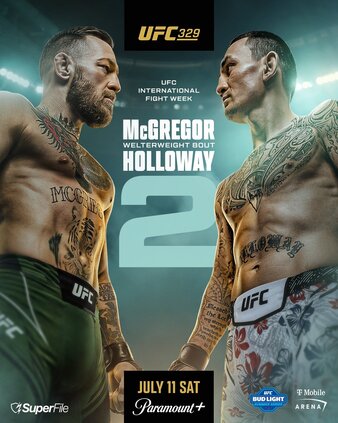
Benoit Saint-Denis vs Paddy Pimblett
Lightweight Bout • UFC 329: McGregor vs. Holloway 2
Saturday, July 11, 2026
Explore Detailed Fighter Profiles
Click on either the fighter's name or profile image for each fighter to access comprehensive UFC statistics including striking metrics, grappling data, clinch performance, complete fight history, offensive & defensive analytics, and round-by-round breakdowns.

Benoit Saint-Denis
Fighter Metrics
Victory Methods
Win Round Distribution
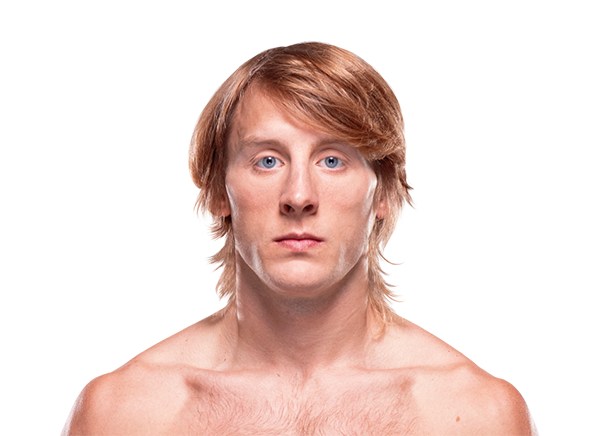
Paddy Pimblett
Fighter Metrics
Victory Methods
Win Round Distribution
📋 Last 5 Fights - Benoit Saint-Denis
| Date | Opponent | Result | Method |
|---|---|---|---|
| 2026-01-31 | Dan Hooker | W | KO/TKO - Punches (Mount) (R2, 4:45) |
| 2025-11-15 | Beneil Dariush | W | KO/TKO - Punch at Distance (R1, 0:16) |
| 2025-09-06 | Mauricio Ruffy | W | SUB - Rear Naked Choke (R2, 2:56) |
| 2025-05-10 | Kyle Prepolec | W | SUB - Arm Triangle (R2, 2:35) |
| 2024-09-28 | Renato Moicano | L | TKO - Doctor's Stoppage (R2, 5:00) |
📋 Last 5 Fights - Paddy Pimblett
| Date | Opponent | Result | Method |
|---|---|---|---|
| 2026-01-24 | Justin Gaethje | L | U-DEC (R5, 5:00) |
| 2025-04-12 | Michael Chandler | W | KO/TKO - Elbows (Mount) (R3, 3:07) |
| 2024-07-27 | King Green | W | SUB - Triangle Choke (R1, 3:22) |
| 2023-12-16 | Tony Ferguson | W | U-DEC (R3, 5:00) |
| 2022-12-10 | Jared Gordon | W | U-DEC (R3, 5:00) |
Technical Analysis
Technical Score
Cardio Score
Overall Rating
📊 Technical Score
BSD: 70.3 (53.5 striking + 87.0 grappling). Paddy: 47.2 (57.1 striking + 37.3 grappling). BSD holds a 23.1-point advantage—one of the widest gaps in our analysis series. This reflects BSD's complete grappling superiority (rank 3/57 TD rate, rank 6/57 sub attempts) vs Paddy's poor TD defense (rank ~50/57).
💪 Cardio Score
BSD: 73 (105% R3/R1 output—"Steady", 7:35 avg fight time). Paddy: 58 (62% R3/R1—"Fades Late", 8:56 avg). BSD has never been to decision (0%) but maintains elite pace throughout. Paddy's "Fades Late" pattern shows significant output decline from R1 (27.5 sig) to R3 (23.5 sig).
🎯 Overall Rating
BSD: 71.7/100 (Technical 70.3 + Cardio 73). Paddy: 52.6/100 (Technical 47.2 + Cardio 58). A 19.1-point gap favoring BSD across both dimensions. Archetype baseline: Well-Rounded vs Technical Striker = 51.5% win rate for Well-Rounded (165-fight sample).
Striking Composite
Grappling Composite
Technical Radar Comparison
Visual comparison of key performance metrics between both fighters
📊 Detailed Statistical Comparison
🥊 Fight Analysis Breakdown
🧩 Benoit Saint-Denis Key Advantages
BSD's TD rate of 4.19/15 min (rank 3/57) vs Paddy's TD defense of 44% (rank ~50/57) is the mathematical engine that drives this fight. BSD does not telegraph his takedowns—he sets them up with body kicks, southpaw pressure combinations, and clinch entries. Once Paddy is in the clinch, BSD's 77.5% clinch striking accuracy and 37.9% clinch TD accuracy mean he wins nearly every exchange inside. The 136-second average control time per R1 represents nearly half of every opening round spent in dominant positions.
Paddy is orthodox. BSD is southpaw. The cross-stance matchup creates automatic outside lead-foot positioning advantages for BSD's left straight and body kick entries. BSD's R1 body targeting of 32.4% is one of the most extreme body-first approaches in the division. Against Paddy, whose R1 dist% is 84% (almost entirely distance-fighting), the body attack serves three functions: forces Paddy's elbows down (opening the head), creates the takedown entry (body shots naturally load the double leg), and wears Paddy's cardio earlier in the fight—accelerating his "Fades Late" pattern.
BSD's peak round is R2: 27.6 sig landed at 62.4% accuracy with the highest ground% (42%) and sub attempts (0.56). Paddy's output drops from 27.5 (R1) to 22.0 (R2) while his ground exposure increases (10.2% → 24.5%). The intersection of BSD being at his most dangerous with Paddy beginning to decline is a fight-defining dynamic. Every one of BSD's UFC wins has come in R1 or R2. He doesn't need three rounds to close fights; he closes them at the exact moment Paddy is most vulnerable to fatigue-based decision-making errors.
⚠️ Unfavorable Scenarios
The highest-probability scenario that ends this fight against BSD: he shoots a fast double leg in the first two minutes, Paddy reacts with proper timing, slides into half guard, and chains into a triangle choke setup from bottom. Paddy's tech_triangle_rate (0.42) and sub_r1_pct (71.4%) place this within a documented, recurring pattern. The King Green triangle from guard in R1 (3:22) shows this is not theoretical. BSD's protection: maintain posture and avoid the shooting-triangle alignment.
If BSD's R1 body-attack entries are read by Paddy as takedown setups, and Paddy's leg kick response (28.4% R1 leg targeting) disrupts BSD's base before he can connect the clinch, the wrestling game stalls. BSD's TD/15 of 4.19 requires mobility—compromised legs from early damage make his double-leg approach more difficult. Paddy's early leg kick game is specifically designed to shut down aggressive wrestlers.
BSD has never been to decision in the UFC (0% decision rate). If Paddy's Iron chin absorbs R2 without being finished and the fight reaches R3, BSD is in genuinely unfamiliar territory. His avg fight time of 7:35 has never been tested over a full 15-minute war. Paddy's decision wins over Gordon and Ferguson show he can win on the cards if the fight goes the distance and he successfully defends the grappling.
📋 Likely Gameplan
Open with body attack in the first 30 seconds—DB confirms R1 body% of 32.4%. The goal is not to finish with body shots; it's to lower Paddy's guard and make him defend two levels simultaneously. Against a leg-kick-heavy R1 opponent (Paddy: 28.4% leg in R1), BSD needs to get inside the kicking range quickly— body shots are the entry mechanism that naturally load the double leg.
BSD's signature: the left hand to the face that makes the opponent's weight shift backward, then the immediate double leg entry while they're off-balance. At 73" identical reach, the southpaw straight covers distance efficiently. Against Paddy's 44% TDDef, this combo has higher-than-average completion probability. DB confirms BSD's clinch TD accuracy at 37.9%—he regularly secures takedowns from inside the clinch by locking the body and driving.
When BSD establishes top position, he does not celebrate control time. He actively hunts. Sub attempts of 0.56 per R2 and the Prepolec arm triangle confirm he is technically aggressive from top. Paddy's bottom-position triangle threat means BSD cannot be sloppy inside the guard, but half-guard, side control, and mount are his preferred finishing positions—all of which he reaches quickly. Close by R2—BSD has finished every single UFC fight in R1 or R2.
🚀 Paddy Pimblett Key Advantages
The DB is unequivocal: 0 career knockdowns absorbed across 27 professional fights. Chin Tier: Iron. His damage ratio of 1.65 (rank 6/57) means Paddy consistently deals significantly more cumulative damage than he receives. His ability to absorb BSD's KD average of 0.79 (rank ~9/57 — ELITE power) without being finished is the single factor that most constrains BSD's probability of a decisive early finish. Every fighter who has faced Paddy has assumed they could hurt him quickly. Almost none have.
Paddy's tech_triangle_rate of 0.42 and sub_r1_pct of 71.4% define his most dangerous window. The King Green submission (triangle choke from bottom guard, R1) and Leavitt RNC demonstrate that when Paddy's back hits the mat, he is not simply defending—he is actively hunting. BSD's ground accuracy and sub attempts are both elite, but a submission exchange on the ground involves two-way threat assessment. The triangle is live whenever BSD is inside Paddy's guard without proper posture established.
Paddy averages 27.5 sig strikes in R1 (vs BSD's 17.9)—he generates 53.6% more first-round output. His R1 leg kick percentage of 28.4% is a weapon designed to disrupt rhythm and shut down an aggressive wrestler's ability to set his feet. Repeated hard leg kicks in the opening minutes will make BSD's double-leg approach more difficult by compromising his base. If Paddy can damage BSD's legs early, the takedown threat diminishes meaningfully.
Paddy last fought in a title fight against a top-5 LW (Gaethje). That experience, while a loss, means he enters this fight having faced the biggest possible pressure moment. BSD, despite his finishing streak, has not fought a main-card PPV fight at this level. The T-Mobile Arena crowd, the UFC 329 atmosphere—Paddy has been in that environment. That mental edge is subtle but real. Paddy thrives in atmospheres; BSD has yet to demonstrate a PPV-headline-environment ceiling.
⚠️ Unfavorable Scenarios
If BSD's 0% slow start meets Paddy's 25% slow start in the opening minute—BSD is already executing body attack and clinch entries while Paddy is still calibrating, and a R1 clinch trip leads to ground-and-pound inside 2 minutes. BSD has finished every single UFC fight in R1 or R2. Paddy's R1 sub hunting from guard requires him to first be taken down, which plays directly into BSD's strength.
Paddy's "Fades Late" profile produces a Round 2 output drop to 22.0 sig landed exactly as BSD hits his peak 27.6 sig landed R2 average. The output gap compounds with BSD's ground control time and Paddy's body damage from R1. If Paddy's 44% TDDef cannot handle the volume and variety of BSD's takedown system, BSD lands multiple TDs in R2, establishes mount between them, and the elbows-or-sub scenario plays out exactly as it did for BSD against Dan Hooker (UFC 325).
If Paddy relies on his Iron chin to absorb early BSD power and walk through it, BSD's KD average of 0.79 (rank 9/57) eventually lands a clean southpaw left straight that not even Paddy's 1.65 damage ratio can absorb cleanly enough to avoid a finish sequence. BSD's R1 body targeting of 32.4% specifically attacks Paddy's fade mechanism—body damage accelerates that curve.
📋 Likely Gameplan
Open the fight with R1 leg kicks immediately—his 28.4% R1 leg targeting is a documented tactic. BSD's southpaw stance creates excellent lead-leg exposure (the front right leg in southpaw is BSD's most available target from an orthodox kicker). Repeated hard leg kicks in the opening two minutes will disrupt BSD's ability to set his feet for double-leg entries and slow the grappling momentum.
The moment BSD establishes even partial guard control, Paddy's first-round instinct (71.4% of sub attempts in R1) is to actively guard-play. His tech_triangle_rate of 0.42 is his highest-rated submission mechanic. Any time BSD is inside half-guard or full guard, the triangle threat is live and must shape how BSD distributes his weight and postures. The King Green submission is the blueprint—triangle from bottom guard, R1, 3:22.
BSD's 32.4% body targeting in R1 is predictable enough to plan for specifically. Paddy's camp should have Teep kicks prepared as a body-attack counter, and his defensive work against southpaw left body kicks needs to be front-loaded in his preparation. He cannot let the body attack accumulate unchecked—his "Fades Late" pattern is partly triggered by early body damage that compounds into R2 and R3 fatigue. Use the high-stakes UFC 329 environment as a momentum reset—Paddy has been in title fights; BSD has not faced this level of PPV pressure.
🎯 Fight Prediction Analysis
Data-driven prediction model based on statistical analysis
📊Detailed Analysis Summary
🏟️The Physical Mirror
This fight is unique: identical reach (73"), one-inch height difference. There is no structural size advantage—this is a true peer-level physical matchup at 155 lbs. The southpaw vs orthodox angle creates one meaningful geometric advantage: BSD's left straight travels directly at Paddy's open-side jaw from a trajectory orthodox fighters see less frequently. Paddy's 42% StrDef against orthodox fighters is concerning; against a southpaw setting up that straight with body kicks and takedown threats, coverage is even harder to maintain.
🎯Technical Breakdown
The statistical analysis reveals a decisive grappling chasm: BSD has three of the four grappling metrics in the top-10 of the division while Paddy has three of the four in the bottom-20. BSD's TD rate of 4.19/15 min (rank 3/57) vs Paddy's TD defense of 44% (rank ~50/57) is one of the widest grappling mismatch metrics in our analysis series. Both fighters share terrible striking defense (42% each), meaning this will be a high-output brawl that lands for both men. The difference: Paddy absorbs those shots better (Iron chin, rank 11 absorption) while BSD carries more stopping power per combination and has the grappling system to take the fight where Paddy is weakest.
🧩Key Battle Areas
Three critical battle areas will determine the outcome: BSD's R1 takedown completion vs Paddy's R1 sub counter (triangle), the R2 fade dynamic where BSD peaks (27.6 sig, 62.4% acc) as Paddy declines (22.0 sig), and whether Paddy's Iron chin can absorb BSD's elite power (KD avg 0.79, rank 9/57) long enough to reach R3. BSD's 0% slow start means he engages immediately; Paddy's 25% slow start creates early vulnerability. The Gaethje blueprint showed that pressure-wrestling breaks Paddy's game—but BSD has better submission finishing than Gaethje, and this is a 3-round fight where BSD's R2 peak is the danger zone.
🏁Final Prediction
The most likely outcome is Benoit Saint-Denis by Submission (30% probability) or KO/TKO (16%), achieved through R1-R2 takedown pressure, control time accumulation, and elite grappling against Paddy's poor TD defense. BSD's submission path is the highest single method category—reflecting rank 3/57 TD rate vs rank ~50/57 TDDef, combined with rank 6/57 sub attempts. Paddy's upset lane centers on R1 Submission (16%) via triangle counter or Decision (17%) if his Iron chin weathers the storm and he accumulates enough output on the feet in R3. Paddy's KO/TKO path (9%) is viable but limited by BSD's 4:1 KD exchange ratio.
💰 Betting Analysis: Model vs Market
Detailed value assessment in the betting market
📊Market Odds
🤖Analytical Model
💎Value Opportunities
MAXIMUM VALUE
GOOD VALUE
SLIGHT VALUE
⚠️Key Market Discrepancies
- • Overweights early KO volatility – Underprices five-round wrestling cycles.
- • Undervalues damage economy – Low SApM differential drives optics on cards.
- • Big-cage bias – Space helps early, but fence/rides erode it late.
🎯 Comprehensive Probabilistic Analysis
100 hypothetical fight simulation based on statistical data
🏆Outcome Distribution - Benoit Saint-Denis
Primary path via fence control and rides
Attritional GNP and accumulative pressure
Back-takes off rides create RNC chances
💥Outcome Distribution - Paddy Pimblett
Best lane via intercepts and counters
Requires extended range control in big cage
Low historical submission profile
⏰Fight Timeline Analysis
⚡Window of Opportunity - Paddy Pimblett
- • First 3–5 minutes: Highest triangle counter equity from bottom guard.
- • Leg kick disruption: BSD's southpaw stance exposes lead leg to early damage.
- • Iron chin test: Absorb BSD's early power and extend the fight to R3.
🎯Progressive Dominance - Benoit Saint-Denis
- • Chain shots: TD rate rank 3/57 vs TDDef rank ~50/57 is the fight's central story.
- • Body attack: 32.4% R1 body% lowers guard and loads the double leg.
- • R2 peak: BSD's finishing window aligns perfectly with Paddy's fade curve.
🎯 Final Confidence Assessment
Confidence level and uncertainty factors
Conviction Rating
Clear BSD lean, but Iron chin and physical parity create uncertainty
✅Supporting Factors
- • Elite TD rate (4.19/15 min, rank 3/57) vs poor TDDef (44%, rank ~50/57)
- • 23.1-point Technical Score advantage (70.3 vs 47.2)
- • 0% slow start vs 25% slow start—immediate pressure
- • R2 peak aligns with Paddy's fade curve
⚠️Risk Factors
- • Paddy's Iron chin (0 career KDs) extends fight
- • R1 triangle counter threat (71.4% subs in R1)
- • Leg kick disruption slows BSD's wrestling base
🏁Executive Summary
Benoit Saint-Denis enters this matchup with a statistically dominant profile against Paddy Pimblett's most exploitable weakness. The grappling chasm—TD rate rank 3/57 vs TDDef rank ~50/57—is the fight's central engine. BSD's 0% slow start means he attacks immediately, while Paddy's 25% slow start creates early vulnerability. Both fighters share terrible striking defense (42% each), ensuring a high-action fight, but BSD's southpaw stance and 58% accuracy create brutal openings against Paddy's poor defense. The R2 convergence is fight-defining: BSD peaks (27.6 sig, 62.4% acc) exactly as Paddy fades (22.0 sig). However, Paddy's Iron chin (0 career KDs) and triangle counter (71.4% of subs in R1) create genuine upset pathways if BSD overcommits early. The 3-round format benefits BSD—he's never needed R3 to finish, while Paddy's best moments often come late in decisions he's already secured. The physical parity (identical 73" reach) forces this to be decided entirely on stylistic execution—and BSD's execution metrics are among the best in the division at what Paddy defends worst.
Prediction: Benoit Saint-Denis by Submission (30% probability) or KO/TKO (16%) through R1-R2 takedown pressure and elite grappling against Paddy's poor TD defense. Pimblett's upset lane centers on R1 Submission (16%) via triangle counter or Decision (17%) if his Iron chin weathers the storm and he accumulates striking volume in R3. The fight's outcome hinges on whether Paddy can survive the R2 danger window where BSD's peak meets Paddy's fade. Conviction: 6/10—clear BSD lean, but Paddy's Iron chin and 15 months of preparation since Gaethje create genuine uncertainty in a 3-round fight.