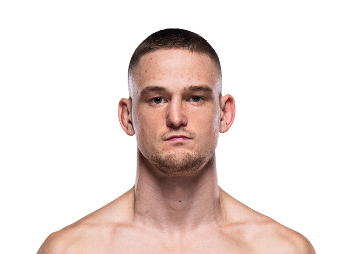
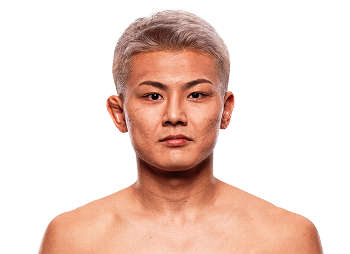
Ollie Schmid vs Keiichiro Nakamura: analysis & prediction

PRELIMS · FEATHERWEIGHT · 3 ROUNDSUFC Fight Night: Cortes Acosta vs. Walker
Ollie Schmid — Featherweight fighter

Ollie Schmid

“The Hungarian Stallion”
4W3L
Taekwondo Kickboxer
VS
Keiichiro Nakamura — Featherweight fighter

Keiichiro Nakamura

8W1L
Southpaw Knee Finisher

A Road to UFC champion's knee against a City Kickboxing kicker on his first full camp.

FeatherweightMeta APEX, Las Vegas, Nevada, United StatesNovember 7, 202625ft Octagon (Meta APEX)

Fight overview

The fight in 30 seconds

Nakamura's biggest finishes have come from a southpaw knee, the latest after Sebastian Szalay had out-worked him for two rounds. Schmid's cleanest work in his debut went to the body and legs, exactly where Szalay hurt Nakamura, so his kicks can build a lead only if he stops stepping straight into the pocket where that knee waits.

Paths that change the fight

  • Ollie SchmidKick the body and legs from range, bank the first two rounds the way Szalay did, and never step straight into the pocket where Nakamura's rear knee waits.
  • Keiichiro NakamuraLet Schmid kick, cover the body, and counter the straight entry or spinning attack with the southpaw knee or straight left — at any point, including the third round.
What limits this estimate · Analyst conviction: 5/10
  • Nakamura's UFC volume: out-landed 79–45 by Szalay and beaten clearly in the first two rounds.
  • The target match: Schmid's UFC strikes all landed to the body and legs, where Szalay landed 32 on Nakamura.

Editorial assessment of the evidence, not a win probability or a calibrated confidence interval.

Ollie Schmid

Quote age unknown
Model win probability
30%
Fair odds
+233
Reference quote
+298 (BetOnline)
Fair decimal odds
3.33

Keiichiro Nakamura

Quote age unknown
Model win probability
70%
Fair odds
-233
Reference quote
-370 (BetOnline)
Fair decimal odds
1.43
Price freshness & calculation notes

Quotes older than 48 hours are marked outdated. EV at an old or undated price is a historical calculation, not a current opportunity. Quotes listed with a date but no time are treated as undated.

Sources and data limitations

Career records and fight results through September 2026. Nakamura's rate figures include his two Road to UFC tournament bouts, with UFC-only figures shown where they differ. Composite scores, simulations, probabilities and fair prices are MMA Analytics model outputs.

Model methodology
01

The Frame

Two one-fight UFC résumés — and the measurements that shape the matchup

The Analyst's Take

Each man has fought once in the UFC, and the two results read very differently. Keiichiro Nakamura (8-1, 27 on fight night) won the Road to UFC Season 4 featherweight tournament the hard way: a knee knockout of Park Eoh-jin, a decision over the veteran Li Kaiwen, and then a final at UFC 325 in Sydney in which Sebastian Szalay out-landed him 79–45 and won the first two rounds before a southpaw knee ended it late in the third. He has won eight straight, seven of his eight wins are knockouts, and he has never been stopped by strikes. Ollie Schmid (4-3, 25) is a City Kickboxing striker with a taekwondo black belt and two spinning-backfist knockouts, but his UFC debut in May came on four days' notice against the unbeaten Marwan Rahiki and lasted less than three minutes: every strike he landed went to the body and legs, and the first clean counter he took put him down. The real gap is the résumé. Nakamura's three wins in UFC-promoted fights came against opponents with a combined 34-8-1 record; Schmid's four professional wins came against opponents with a combined 5-7-3, and all three of his losses were stoppages, two of them in the last ninety seconds of a third round. Schmid's case is the Szalay tape — pressure and body kicks beat Nakamura for ten minutes — plus a full camp this time. The model makes Nakamura a 70-30 favourite with a conviction of 5 out of 10: the knee, the chin and the résumé point one way, while one UFC fight apiece and Nakamura's volume deficit in Sydney keep Schmid's path open.

Ollie Schmid
Attribute
Keiichiro Nakamura
252-year gap
Age
27
5'11"+1" Schmid
Height
5'10"
71"+0.5" Schmid
Reach
70.5"
Orthodox
Stance
Southpaw
City Kickboxing, Auckland
Team
EXFIGHT, Japan
May 2, 2026 (Perth, four days' notice)
Octagon Debut
Jan 31, 2026 (UFC 325, Sydney)
1 (0-1)
UFC Bouts
1 (1-0) · 2-0 in Road to UFC
1
UFC Knockdowns Absorbed
0
189 (R1 TKO loss)
Days Since Last Fight
280 (R3 TKO win)
5-7-3 (four pro wins)
Wins — Opponents' Combined Record
34-8-1 (three UFC-promoted wins)
Taekwondo-based kickboxer
Fighting Style
Southpaw power striker

The frames are close to even; the stances are not. Schmid is listed an inch taller and half an inch longer (71" to 70.5"), which is not enough to keep a southpaw at kicking range for fifteen minutes. The stance matters more than the tape: orthodox against southpaw opens the lead-leg kick and the open-side body kick for both men, and it lines up Nakamura's rear left knee with anyone who steps straight in. Both of his finishes in UFC-promoted fights came from that knee. Age is not a factor at 25 against 27. Activity slightly favours Schmid, who has fought three times between July 2025 and May 2026; Nakamura returns after 280 days with one fight in the last twelve months.

Venue Factor
The 25-foot APEX cage takes away the space a kicker needs to reset between exchanges. Schmid is a range fighter: all nine strikes he landed against Rahiki came at distance, six of them to the legs. The small cage pushes him toward the pocket, and the pocket is where Nakamura's knee lives. It cuts the other way on one point. Szalay found Nakamura's body 24 times from close range in Sydney, and a shorter cage puts Schmid's body kick on target more often. Neither man has attempted a takedown in the UFC, so the fence works as a tool for trapping an opponent, not for wrestling.
02

The Fighters

Careers, chins, opposition — and the form they bring into the cage

Ollie Schmid portrait

Ollie Schmid

Pro Record
4-3-0
UFC Record
0-1 — TKO loss to Marwan Rahiki on four days' notice (May 2, 2026)
Streak
Lost his last — three straight wins before the UFC call
Finish Rate
75% (3 of 4 wins) — 3 KO/TKO, all in Round 1
Avg Fight Time
2:47 (1 UFC bout)
Chin · Vulnerable — stopped in all three losses, dropped by the first clean counter he took in the UFCSOS · Regional, plus one UFC boutStriker

Schmid came up through a long amateur career — a taekwondo black belt, MMA from age 15, and IMMAF Oceania and world championships appearances — and turned pro in May 2023. His pro start was slow: a technical-submission loss to Harry Webb in his debut, a spinning-backfist knockout of Dane Edge at 1:15, and a third-round TKO loss to Dimps Gillies seven weeks later — both losses in the last ninety seconds of the fight. He then won three straight: a decision over Saynarvat Srisawat, a first-round punching knockout of Ford Gerbes and a spinning-backfist knockout of Jeff Mesa at 0:15. None of his four winning opponents had a winning record: two were making their pro debuts and Srisawat was 0-2. City Kickboxing's Eugene Bareman then called him on a Sunday night for a Saturday fight in Perth against the unbeaten Marwan Rahiki, in place of the injured Jack Jenkins. He opened with kicks, landed six of nine to the legs and three of six to the body, missed all fifteen head strikes, and was dropped by a counter left hand and finished on the ground at 2:47. The debut says almost nothing about his volume with a full camp. It does show that his straight entries against a sharp counter-puncher were a problem.

Keiichiro Nakamura roars in celebration in the Octagon as Sebastian Szalay is attended to behind him at UFC 325 in Sydney

Keiichiro Nakamura

Pro Record
8-1-0
UFC Record
1-0 — TKO of Sebastian Szalay at UFC 325 (Road to UFC final), plus 2-0 in the tournament
Streak
8-fight win streak — unbeaten since his April 2022 pro debut
Finish Rate
88% (7 of 8 wins) — 7 KO/TKO, 0 submissions
Avg Fight Time
12:04 across three UFC-promoted bouts (13:48 UFC-only)
Chin · Durable — never stopped by strikes in nine pro fights; took 79 significant strikes from Szalay and finished himSOS · Road to UFC tournament winnerStriker

Nakamura, a former Japan Maritime Self-Defense Force member from Hokkaido, lost his pro debut in April 2022 to an arm-triangle choke — he says he didn't know any ground fighting at the time — and has not lost since. Five straight Round 1 stoppages followed on the Japanese regional circuit (ExFight, J-MMA Rookies Cup, Grachan, Poundout), mostly against veterans with .500-level records. Road to UFC raised the level sharply. He knocked out the 9-1-1 Park Eoh-jin with a knee at 2:24 of Round 2, beat the 15-6 veteran Li Kaiwen by unanimous decision (29-28, 29-28, 29-27), and met the 10-1 Australian Sebastian Szalay in the final at UFC 325 in Sydney. Szalay won the first two rounds — 23–13 and 24–11 on significant strikes, with a slam takedown in the second — and led going into the last two minutes. Told by his corner to stop being defensive and walk forward, Nakamura had his best round in the third, landing 21, and a left knee dropped Szalay; punches ended it at 3:48. He became the first Japanese fighter to win the Road to UFC featherweight tournament. As the opposition got better, his finishes moved later and switched from punches to knees, while his output fell behind his opponents'. He has not fought in 280 days.

Ollie Schmid
0 dealt · 0 absorbed
Knockdown Exchange
Knockdowns dealt vs absorbed.
Keiichiro Nakamura
0 dealt · 0 absorbed

Ollie Schmidsignature weapons

Spinning BackfistJeff Mesa at 0:15 of Round 1 (March 2026) and Dane Edge at 1:15 of Round 1 (May 2024) — his signature finishing shot
×2
Straight Punching KnockoutFord Gerbes in Round 1, July 2025 — all three of his knockouts came in the opening round
×1
Body and Leg KicksNot a finisher on its own: all nine strikes he landed in his UFC debut went to the body and legs, including six of nine leg kicks, while none of his 15 head strikes landed
×0

Keiichiro Nakamurasignature weapons

Southpaw KneePark Eoh-jin, KO at 2:24 of Round 2 in the Road to UFC quarterfinal, and Sebastian Szalay at 3:48 of Round 3 at UFC 325 — both of his finishes against Road to UFC-level opposition
×2
Punching CombinationsFive straight Round 1 stoppages on the Japanese regional circuit, 2022–24: Hinuma, Ishizuka, Otsuki, Murata and Kagiyama
×5
Leg Kicks13 of 15 leg kicks landed against Szalay, eight of them in Round 1 — a scoring tool he can use against another kicker
×0

Ollie Schmid

L
Marwan Rahiki
KO/TKO — Left hand, then ground strikes

Opponent context: ufc

R1 (2:47)
UFC Fight Night: Della Maddalena vs. Prates, Perth — May 2, 2026 (four days' notice; Rahiki 8-0)
W
Jeff Mesa
KO/TKO — Spinning backfist

Opponent context: veteran

R1 (0:15)
Shuriken Fight Series 23 — Mar 7, 2026 (Mesa 5-5-3)
W
Ford Gerbes
KO/TKO — Punch

Opponent context: prospect

R1
Supremacy FC: Rivalry — Jul 5, 2025 (Gerbes' pro debut)
W
Saynarvat Srisawat
Decision — Unanimous

Opponent context: prospect

R3 (5:00)
Shuriken Fight Series 20 — Mar 8, 2025 (Srisawat 0-2)
L
Dimps Gillies
KO/TKO — Punches

Opponent context: veteran

R3 (3:48)
Eternal MMA 86, Gold Coast — Jun 22, 2024 (Gillies 6-4)
Pattern

Three straight regional wins, then a short-notice UFC loss. The run was real but soft: Srisawat was 0-2, Gerbes was debuting and Mesa, at 5-5-3, lasted fifteen seconds. Before it, Gillies stopped him late in the third round. Against Rahiki he opened with kicks and landed nine strikes, all to the body and legs, before a counter left hand dropped him. Across all seven pro fights the split is stark: 4-0 against opponents without a winning record, 0-2 against opponents with one, and his third loss came to a debutant, Harry Webb, who is 5-0 since.

Keiichiro Nakamura

W
Sebastian Szalay
KO/TKO — Knee, then punches

Opponent context: ufc

R3 (3:48)
UFC 325: Volkanovski vs. Lopes 2, Sydney — Jan 31, 2026 (Road to UFC final; Szalay 10-1)
W
Li Kaiwen
Decision — Unanimous (29-28, 29-28, 29-27)

Opponent context: ufc adjacent

R3 (5:00)
Road to UFC Season 4 semifinal, Shanghai — Aug 22, 2025 (Li 15-6)
W
Park Eoh-jin
KO/TKO — Knee

Opponent context: ufc adjacent

R2 (2:24)
Road to UFC Season 4 quarterfinal, Shanghai — May 22, 2025 (Park 9-1-1)
W
Yusuke Kagiyama
KO/TKO — Punches

Opponent context: veteran

R1 (4:28)
Poundout 1 — Oct 5, 2024 (Kagiyama 20-18-3)
W
Shun Murata
KO/TKO — Punches

Opponent context: veteran

R1 (3:51)
Grachan 66 — Dec 17, 2023 (Murata 6-7-2)
Pattern

Eight straight wins and a clear step up in the last three. The regional wins were all Round 1 punching stoppages against mostly .500-level veterans. In Road to UFC the level jumped to a combined 34-8-1 and the finishes moved later and switched to the knee: Park in Round 2, then Szalay in Round 3. Sydney cut both ways. He was out-landed 79–45, lost the first two rounds and conceded a slam takedown, then produced his best round in the third and ended it with one strike. The regional record says he is a fast starter; the tournament says his power still works late, even when he is behind on volume.

Ollie Schmid

Win Methods
Wins by Round

Keiichiro Nakamura

Win Methods
Wins by Round
Critical Insight
Both donuts and both round charts cover career wins, so they sum to each pro record: Schmid's 4 (3 KO/TKO, 1 decision) and Nakamura's 8 (7 KO/TKO, 1 decision). Neither man has a submission win. The timing tells more than the methods. All three of Schmid's finishes came in Round 1 — two spinning backfists and a punch — while two of his three losses came in the last ninety seconds of Round 3. Nakamura's five regional stoppages were all in Round 1, but at Road to UFC level his finishes came in Round 2 (Park, knee) and Round 3 (Szalay, knee). Schmid's finishing threat is concentrated early; Nakamura's lasts the whole fight.

Opposition strength (no shared opponents)

Without a reliable shared-opponent table, compare who each fighter has been tested against using SOS tier, UFC sample size, and recent elite-tier form — not raw records alone.

FactorOllieKeiichiro
Strength of schedule (SOS tier)Regional, plus one UFC bout — Wins over opponents who were 0-0, 0-2, 0-0 and 5-5-3 at the time; losses to Harry Webb (debuting, 5-0 since), Dimps Gillies (6-4) and the unbeaten Marwan Rahiki (8-0)Road to UFC tournament winner — Park Eoh-jin (9-1-1), Li Kaiwen (15-6) and Sebastian Szalay (10-1) at the time — a combined 34-8-1
UFC sample0-1 — TKO loss to Marwan Rahiki on four days' notice (May 2, 2026)1-0 — TKO of Sebastian Szalay at UFC 325 (Road to UFC final), plus 2-0 in the tournament
Recent ranked / elite touches (last 5)0 elite · 2 veteran tier0 elite · 2 veteran tier
Form-window difficulty edge: Fighter A (6 vs 4 tier points in listed bouts).
Last three opponentsMarwan Rahiki, Jeff Mesa, Ford GerbesSebastian Szalay, Li Kaiwen, Park Eoh-jin
  • No shared opponents: They have never met and share no opponents. The one connection runs through the Australian regional scene and is indirect.
  • Dimps Gillies (indirect, via Szalay): Gillies stopped Schmid late in the third round. Eight weeks later Sebastian Szalay beat Gillies by unanimous decision over five rounds, and Nakamura then stopped Szalay at UFC 325. It is three steps removed, but every link points the same way.
  • Sebastian Szalay (indirect): Szalay's pressure and body work won him the first two rounds against Nakamura, 23–13 and 24–11 on significant strikes. That is the blueprint Schmid's camp will study, and the knee that ended it is the warning attached to it.
03

The Numbers

Composites, division context and round-by-round evidence

Composite scores summarize selected statistics on a 0–100 scale. They are not win probabilities. Compare the underlying metrics, opponent quality and UFC experience before interpreting a score difference as a matchup advantage.

Striking

SLpM 25% · StrAcc 30% · StrDef 30% · SApM 15%

0
Olliefew UFC fights
0
Keiichirofew UFC fights

A 19-point gap built mostly on Schmid's one short-notice round: 3.23 landed per minute at 30%, 45% defence and 7.90 absorbed, the last from one opponent's finishing burst. Nakamura's three-bout line sits near the featherweight average on output and above it on defence (64%). On his UFC fight alone, where Szalay out-landed him, the gauge falls to about 42. Knockdown rate is not an input, so the gauge understates Nakamura's power.

Grappling

TD/15 25% · TDAcc 25% · TDDef 30% · Sub/15 20%

0.0
Olliefew UFC fights
0
Keiichirofew UFC fights

Neither man wrestles: no takedown attempts from either in the UFC and no submission wins between them. Nakamura's edge comes from 79% takedown defence across his three UFC-promoted bouts; the one Szalay takedown in Sydney, a slam, produced no control time. Schmid has faced no takedown attempts in the UFC, so that input is scored at a neutral 50. The only ground-game signals are old losses on both sides: Schmid's technical rear-naked choke in 2023 and Nakamura's arm-triangle in 2022.

Technical

(Striking + Grappling) / 2

0.0
Ollie
0
Keiichiro

Nakamura by about fourteen points, or about ten on his UFC-only numbers. Both scores sit well below the division midpoint because both samples are small and one of them is a four-day-notice debut.

Cardio

Fight time · pace · R3/R1 output · late-round record

0
Olliefew UFC fights
0
Keiichiro

Nakamura has gone deep twice against strong opposition and won both times — a full 15:00 against Li and a Round 3 in Sydney that was his best round (21 landed, a knockdown, the finish). Schmid has been past the 13-minute mark three times as a pro and won once; the other two ended in stoppage losses. He is younger and more active, and City Kickboxing conditioning should narrow the gap, but the evidence favours Nakamura.

Overall

(Technical + Cardio) / 2

0.0
Ollie
0.0
Keiichiro

About fifteen points to Nakamura. Two factors the composite misses pull toward Schmid: the four-day-notice debut and the Szalay tape, which shows Nakamura can be out-worked. Two pull the other way: the gap in opposition quality and Nakamura's knockout power. On balance the model gets 70-30.

MetricOllieKeiichiro
Avg Fight Time2:47 (1 UFC bout)12:04 incl. Road to UFC · 13:48 UFC-only
Pace TierBelow average — 3.23 landed per minutefew UFC fightsDivision average — 4.48 (3.26 UFC-only)few UFC fights
R3/R1 OutputNo UFC third round yetfew UFC fights21 vs 13 landed — 162%few UFC fights
Opening RoundOut-landed 22–9 and droppedOut-landed 23–13 by Szalay
Late-Round RecordStopped at 13:33 and 13:48 in two pro lossesFinish at 13:48 · 15:00 decision win
Days Since Last Fight189280

Archetype Base Rate

Striker 50%50% Striker

368-fight sample · Archetype history settles nothing here: Striker against Striker is a dead-even 50.0% across 368 fights. The 70-30 lean comes from opposition quality, durability history, finishing power and the round-by-round evidence from each man's UFC bout.

Ollie SchmidKeiichiro Nakamura

Featherweight

· 47 fighters

Rank bars use the recorded division cohort. Where no rank is shown, the comparison shows the difference from the published division average; the white marker denotes equality. Percentage differences are percentage points (pp). Higher is not always better: fewer strikes absorbed is preferable.

StatOllieOllie comparisonDiv avgKeiichiro comparisonKeiichiro
SLpM3.23
-1.34 vs avgfew UFC fights
4.57
—few UFC fights
4.48 (UFC-only 3.26)
Str Acc30%
-19.20 pp vs avgfew UFC fights
49.2%
—few UFC fights
42% (UFC-only 38%)
Str Def45%
-9.00 pp vs avgfew UFC fights
54.0%
—few UFC fights
64% (UFC-only 61%)
SApM7.90
+3.82 vs avgfew UFC fights
4.08
—few UFC fights
4.28 (UFC-only 5.72)
KD Avg0.00
-0.44 vs avgfew UFC fights
0.44
+0.39 vs avgfew UFC fights
0.83
Damage Ratio0.41
-0.78 vs avgfew UFC fights
1.19
—few UFC fights
1.05 (UFC-only 0.57)
TD/150.00
-1.58 vs avg
1.58
-1.58 vs avg
0.00
TD Def—
—
—
—few UFC fights
79% (UFC-only 0 of 1)
Sub/150.00
-0.52 vs avg
0.52
-0.52 vs avg
0.00
Avg Fight Time2:47
—
—
—
12:04
Statistical Verdict
Nakamura leads every output, defence, damage and power row on his three-bout line, and most of them on his UFC fight alone. His knockdown rate, almost double the featherweight average, is the standout number. The table leaves out what Schmid's case rests on. His one UFC round was a four-day-notice outlier against an unbeaten finisher, so its strikes-absorbed figure will not hold with a full camp. And his strikes land where Nakamura's defence was weakest in Sydney, the body and legs. Neither man has attempted a takedown in the UFC, so this is a striking fight and the grappling rows are close to zero on both sides.

Significant Strikes Landed per Round

⚠ R1: single-fight sample for Ollie Schmid

⚠ R1, R2, R3: single-fight sample for Keiichiro Nakamura

Control Time per Round (sec)

Ollie Schmid

  • His one UFC round was all kicks and body work: 9 landed of 30, six to the legs and three to the body, all at distance. None of his 15 head strikes landed.
  • Rahiki landed 22 of 40 on him (55%), 14 of them to the head, and dropped him with a counter left hand before finishing on the ground at 2:47. The finish came off Schmid's straight entries — the same line a southpaw's rear knee travels.
  • He has never fought past Round 1 in the UFC. On the regional scene, two of his three losses came in the last ninety seconds of Round 3 (Webb at 3:33, Gillies at 3:48).

Keiichiro Nakamura

  • He started slowly in Sydney: 13 landed in Round 1, eight of them leg kicks, against 23 absorbed; then 11 at 28% accuracy in Round 2 against 24 absorbed and a slam takedown.
  • Round 3 was his best: 21 landed at 45%, his first UFC knockdown and the finish — a left knee and punches at 3:48, after his corner told him to walk forward.
  • His defence slipped as the fight went on: Szalay's accuracy climbed from 37% to 51%, and 12 of his 15 body strikes landed in the third round. The body is where Schmid's kicks go.
Critical Insight
Read the two lines against each other. Schmid's only UFC round went to the body and legs from range, and Nakamura's weakest defence in Sydney was the body and legs — Szalay landed 32 strikes there. Nakamura's best round was his last, and Schmid's two regional stoppage losses both came in the last ninety seconds of Round 3. The early rounds give Schmid a chance to win on points; the later rounds favour Nakamura.

Strike targeting

Ollie

Head
0%
Body
33%
Legs
67%

Keiichiro

Head
47%
Body
24%
Legs
29%

Head hunting vs body work vs leg attack — the shape of the damage.

Striking range — distance, clinch and ground

OllieKeiichiro
100%Distance91%
0%Clinch2%
0%Ground7%

Share of significant strikes landed at distance, in the clinch and on the ground across each fighter's UFC rounds, weighted by strike volume.

04

The Story of the Fight

Advantages, worst cases, gameplans — and the patterns underneath

Where the fight lives

Who owns each phase — and by how much
Open SpaceOllie owns it

Schmid's kicks at range — six of nine leg kicks and three of six body kicks landed in his debut — against a southpaw who lost two rounds to Szalay's volume

Pocket / ExchangesKeiichiro owns it

Southpaw rear knee and straight left into straight entries; Schmid absorbed 14 of 25 head strikes and a knockdown in 2:47, Nakamura has never been stopped by strikes

ClinchKeiichiro owns it

Knees at close range are Nakamura's finishing tool; Schmid has no clinch work on record in the UFC

GroundEven

No takedown attempts from either man in the UFC; the only ground-game signals are old submission losses on both sides

The Deep Read

Start with how little each man's UFC debut can tell us. Schmid's came after a Sunday-night call from Eugene Bareman, a Tuesday confirmation, medicals and flights from Auckland to Perth, and a weight cut on the way — against Marwan Rahiki, then 8-0 and one of the best prospects in the division. It lasted 2:47. The model discounts most of what that round says about his volume and defence. It keeps one detail: the finish came off a straight entry countered by a left hand, and a southpaw has that counter built into his stance. Nakamura's debut runs the other way. The result, a tournament-winning knockout, looks better than the round-by-round data, which shows Szalay out-landing him in all three rounds, winning the first two clearly and landing 12 of 15 body strikes in the third. Discount both debuts properly and what is left is the résumé.

The résumé gap is the widest on the card. Nakamura's three Road to UFC and UFC opponents were a combined 34-8-1 when he fought them — a 9-1-1 prospect he knocked out with a knee, a 15-6 veteran he out-pointed over fifteen minutes, and a 10-1 finalist he came back to stop. Schmid's four professional wins came against opponents who were a combined 5-7-3: two making their pro debuts, one 0-2, and Jeff Mesa at 5-5-3. His three losses — to Harry Webb, who is 5-0 since, Dimps Gillies (6-4) and Rahiki — were all stoppages. There is even a weak three-step chain between them: Gillies stopped Schmid in June 2024, Szalay beat Gillies eight weeks later, and Nakamura stopped Szalay. None of it is decisive on its own, but all of it points the same way.

Schmid's path is real, and it is specific. His offence in the UFC was all body and legs; Nakamura's biggest defensive leak was the body and legs, with 32 strikes landed there by Szalay. City Kickboxing has had a full camp to build a plan around an opponent who does not wrestle, starts slowly and has lost two UFC-level rounds on volume. Win Rounds 1 and 2 at range, stay out of the pocket in the third, and it is 29-28 Schmid. The model gives that path 14% and a first-round spinning-backfist finish another 14%. It still makes Nakamura a clear favourite, because of the one question that decides most fights like this: who has been stopped, and who has not. Schmid has been stopped three times in seven pro fights. Nakamura has not been stopped by strikes in nine, and his knee has ended fights while he was behind.
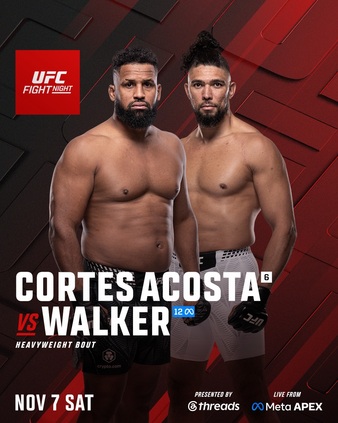
UFC Fight Night: Cortes Acosta vs. Walker event poster
Official event poster, Meta APEX, November 7, 2026
Path to Victory

Ollie Schmid

Kick the body and legs from range, bank the first two rounds the way Szalay did, and never step straight into the pocket where Nakamura's rear knee waits.

Why they win
01
Kicks aimed at the right target

All nine strikes he landed in the UFC went to the body and legs. Szalay landed 24 of 46 body strikes and all 8 of his leg kicks on Nakamura. Schmid's natural offence goes to the part of Nakamura's defence that has been easiest to hit.

02
A full camp, finally

His UFC debut came after a Sunday-night phone call and a Saturday fight in Perth, with medicals, travel and a weight cut in between. This time City Kickboxing has had months to build a plan around a southpaw who doesn't wrestle.

03
Sudden power early

Two spinning-backfist knockouts (Mesa at 0:15, Edge at 1:15) and three Round 1 finishes in four wins. Nakamura lost the opening round in Sydney 23–13 and went down to a knee from a balance issue.

04
Length and activity

An inch taller and half an inch longer, two years younger, and three fights between July 2025 and May 2026 against Nakamura's one in the last twelve months.

05
A points path that already exists

Szalay beat Nakamura for ten straight minutes on volume and pressure; Nakamura absorbed 5.72 significant strikes per minute in his UFC fight. Two banked rounds put Schmid 20-18 going into the third.

The gameplan
  1. 1
    Kick from range

    Use the inch of height and the half-inch of reach, stay on the outside, and invest in the lead leg and the open-side body kick — where his strikes landed against Rahiki and where Szalay found Nakamura.

  2. 2
    No straight entries

    Every straight step into the pocket gives a southpaw the knee or the straight left. Enter on an angle or behind a feint, and leave the same way.

  3. 3
    Save the backfist for a counter

    It is his best finishing tool, but thrown as a lead against a southpaw it turns his back into the knee. Throw it when Nakamura misses and is off balance.

  4. 4
    Bank Rounds 1 and 2

    Szalay showed how: pressure and volume win the early cards against Nakamura. Two banked rounds make the third a round Schmid only needs to survive.

  5. 5
    Treat Round 3 as its own fight

    Stay long, stay off the fence, and do not trade. His two late losses and Nakamura's tournament-winning finish all came in the last ninety seconds.

Path to Victory

Keiichiro Nakamura

Let Schmid kick, cover the body, and counter the straight entry or spinning attack with the southpaw knee or straight left — at any point, including the third round.

Why they win
01
The résumé gap

Park (9-1-1), Li (15-6) and Szalay (10-1) — a combined 34-8-1 — against Schmid's wins over opponents who were a combined 5-7-3. Schmid is 0-2 against opponents with a winning record; Nakamura is 6-1, the loss coming in his 2022 pro debut.

02
Knockout power that works late

Seven KO/TKO wins and 0.83 knockdowns per fifteen minutes, almost double the featherweight average. Both of his Road to UFC-level finishes came from knees in Rounds 2 and 3, after the opponent had settled into a rhythm.

03
Durability

Never stopped by strikes in nine pro fights. He took 79 significant strikes from Szalay, 47 of them to the head, and still produced his best round in the third. Schmid has been stopped three times in seven fights and was dropped by the first clean counter he took in the UFC.

04
Southpaw against straight entries

An orthodox fighter who steps into the open stance to kick or throw a backfist gives the southpaw the rear knee and the straight left — the knee that ended Szalay and the kind of counter that ended Schmid against Rahiki.

05
The late clock

His best UFC round was the third. Schmid's two regional stoppage losses both came in the last ninety seconds of Round 3, so the late part of the fight favours Nakamura from both sides.

The gameplan
  1. 1
    Start sharper than in Sydney

    He does not need to win Round 1, but he cannot give away ten minutes again to a man whose offence is almost all kicks.

  2. 2
    Check and counter the kick

    Each kick leaves Schmid on one leg for a moment — a chance to step in with the straight left or the knee.

  3. 3
    Wait for the straight entry

    Rahiki beat Schmid by reading the entry and countering. As a southpaw, Nakamura has that counter plus a rear knee.

  4. 4
    Cover the body

    Elbows in against the open-side kick. Szalay's 24 body strikes are the leak Schmid's camp will have studied.

  5. 5
    Walk forward in Round 3 if behind

    It won the tournament final, and Schmid's record says the last ninety seconds of Round 3 are where he has been stopped.

Danger Zone

How Ollie Schmid loses

  • The Rahiki replay from a southpaw: he steps in behind a straight right or winds up a spinning backfist, the rear knee or straight left meets him, and the fight ends before his kicks matter.

  • Two rounds banked, one knee absorbed: he out-lands Nakamura for ten minutes exactly as Szalay did, then walks onto the knee in Round 3 — the same late window in which both of his earlier stoppage losses came.

  • The kick gets caught: Nakamura times a body kick, counters over it while Schmid is on one leg, and Schmid ends up on the fence with no wrestling plan to reset.

Danger Zone

How Keiichiro Nakamura loses

  • The Sydney first ten minutes without the comeback: Schmid kicks the body and legs from outside, Nakamura stays defensive, and this time the knee never finds a target — 29-28 Schmid.

  • Caught cold after 280 days out: a spinning backfist in the first minute, like the Mesa and Edge finishes, lands before he has settled.

  • The body attack takes his legs: Round 3 arrives with his gas tank already drained by body kicks, and the late surge that won him the tournament never comes.

Who each man has actually beaten

The Résumé Gap

Schmid's four professional wins came against opponents who were a combined 5-7-3 at the time: Dane Edge and Ford Gerbes were making their pro debuts, Saynarvat Srisawat was 0-2 and Jeff Mesa was 5-5-3. Nakamura's three UFC-promoted wins came against a combined 34-8-1. Against opponents with a winning record, Schmid is 0-2 and Nakamura 6-1, the loss coming in his pro debut. Neither man's UFC sample is large, so this is the biggest gap in the matchup.

5-7-3 vs 34-8-1
combined records of the opponents each man has beaten (Schmid: all pro wins; Nakamura: UFC-promoted wins)
How Nakamura's power changed as the opposition improved

The Knee Is the Finisher

On the Japanese regional scene Nakamura finished five straight opponents with punches, all in Round 1. Once the level rose, the finishes moved later and the weapon became the rear knee: Park Eoh-jin at 2:24 of Round 2, then Sebastian Szalay at 3:48 of Round 3. Against an orthodox kicker who enters in straight lines, the southpaw rear knee is the natural counter, and it is the main reason the model's largest single outcome is a Nakamura knockout.

2 of 2
Nakamura's finishes against Road to UFC-level opposition that came from knees
What the Szalay fight says, in both directions

Out-Landed and Still Winning

Szalay out-landed Nakamura in every round, 23–13, 24–11 and 32–21, and scored the fight's only takedown. Nakamura's corner told him to walk forward, his third round was his best and one knee ended it with 72 seconds left. The fight shows two things: a pressure striker can out-work him, and his power stays live while he is losing. Schmid's camp will build its plan on the first. The second is why that plan has to work for all fifteen minutes.

45–79
Nakamura's significant strikes landed vs absorbed in his UFC win
The one matchup edge the data gives him

Where Schmid's Strikes Land

In his UFC debut, all nine of Schmid's significant strikes went to the body and legs: six of nine leg kicks and three of six body shots landed, and none of 15 head strikes did. In Sydney, Szalay landed 24 of 46 body strikes and all 8 of his leg kicks on Nakamura, including 12 of 15 to the body in Round 3 alone. Schmid's natural offence goes to Nakamura's biggest defensive leak, which is why a Schmid decision is still 14% in the model.

32
body and leg strikes Szalay landed on Nakamura in 13:48
Where both men's records meet

The Last Ninety Seconds

Two of Schmid's three pro losses came in the last ninety seconds of Round 3: a technical rear-naked choke against Harry Webb at 3:33 and a TKO against Dimps Gillies at 3:48. Nakamura's biggest win came at 3:48 of Round 3. Both of Schmid's late losses were early in his career, and City Kickboxing conditioning should help. Even so, if the fight is close going into the final minutes, the late-round evidence on both sides favours Nakamura.

2 of 3
Schmid's pro losses that ended in the final ninety seconds of Round 3

The Five-Round Clock

Ollie Schmid danger windowKeiichiro Nakamura danger windowNeutral / contested
R1 · 0:00–5:00Schmid's window

All three of Schmid's career finishes came here, two of them spinning backfists inside 1:15, and Nakamura lost the opening round in Sydney 23–13. It is still the round with the most finishes in the model: about 31 in 100, 22 of them Nakamura's, because Schmid's straight entries are most frequent early. Schmid's best chance to finish is here.

Critical Insight
Schmid's finishing threat is concentrated in the first five minutes, and his share of the finishes shrinks every round, from about 29% of Round 1 stoppages to about 18% of Round 3 ones. Nakamura is dangerous at any point. If the fight reaches the cards, the model splits the decisions 18–14 for Nakamura. Schmid needs the fight decided early or on points; Nakamura only needs one clean connection.

Finish Threat by Round

Share of each fighter's wins that end in each round — early finishers spike left, grinders rise right.

05

The Verdict

One hundred simulated fights, the betting market, and our conviction

If you only read 3 things
1

Nakamura 70% / Schmid 30%, conviction 5/10. Opposition quality decides the lean: Nakamura won a Road to UFC tournament against three strong prospects, while none of Schmid's four pro wins came against an opponent with a winning record.

2

Schmid's path is specific and real. His kicks go to the body and legs, exactly where Szalay out-worked Nakamura for two rounds in Sydney. A full City Kickboxing camp should produce a very different fighter from the one who took his debut on four days' notice.

3

The most important interaction is the southpaw knee meeting Schmid's straight entries. It is how Nakamura finished his last two Road to UFC-level opponents, and it is why a Nakamura knockout is the single most likely outcome.

Model outcomes per 100 fights

Each square represents one percentage point of the model distribution, not an observed fight. This visualization does not measure model accuracy or reduce uncertainty in the inputs.

Schmid KO/TKO — 14%Schmid Decision — 14%Schmid Submission — 2%Nakamura KO/TKO — 48%Nakamura Decision — 18%Nakamura Submission — 4%

Each square = 1 model percentage point. Ollie Schmid gold · Keiichiro Nakamura orange · color opacity: 100% = decision, 70% = submission, 45% = KO/TKO.

Who each man has beaten

Nakamura's UFC-promoted wins came against opponents who were a combined 34-8-1; Schmid's pro wins came against a combined 5-7-3. With one UFC fight each, opposition quality is the most reliable evidence available, and it is the core of the 70-30 lean.

Durability

Schmid has been stopped in all three of his losses and was dropped in 2:47 of UFC time. Nakamura has not been stopped by strikes in nine pro fights and absorbed 79 significant strikes from Szalay without going down. That gap is why Nakamura's KO/TKO share is 48%.

The southpaw knee against straight entries

Both of Nakamura's Road to UFC-level finishes came from the rear knee, and Schmid's debut ended on a counter to a straight entry. This is the single most likely finishing sequence in the model.

The Szalay blueprint

Szalay out-landed Nakamura in all three rounds, largely to the body and legs, where all of Schmid's UFC strikes landed. That keeps a 14% Schmid decision alive and caps conviction.

Sample size, camp and layoff

One UFC fight each, Schmid's taken on four days' notice with no camp, and 280 days out for Nakamura. The model discounts Schmid's debut numbers heavily, credits his early spinning-backfist power with a 14% knockout share, and holds conviction at 5.

Fight Scripts

0%
of simulations

The Knee Finds the Entry

Schmid kicks early and does some damage to the body, but he steps straight in once too often — to kick the open side or turn for a backfist — and Nakamura's rear knee or straight left meets him. Punches follow. It can happen in any round, but most often in the first two, before Schmid has adjusted. The single most likely outcome.

Scripted outcomes for Ollie Schmid vs Keiichiro Nakamura — how each version of this fight unfolds.

Ollie Schmid win probability
0%
14%
14%
KO/TKODECSUB
  • Nearly all of it in Round 1: a spinning backfist like the Mesa and Edge finishes, or a clean counter before Nakamura has settled after 280 days out. Capped by a chin that has never been stopped by strikes.

  • The Szalay path: body and leg kicks from range win Rounds 1 and 2 on volume, and he stays out of the pocket in the third. Real, but it takes fifteen minutes of discipline.

  • A token allowance. He holds a BJJ blue belt and has no submission wins; Nakamura's one loss, four years ago, was an arm-triangle.

Keiichiro Nakamura win probability
0%
48%
18%
4%
KO/TKODECSUB
  • The largest single outcome. Seven KO/TKO wins, two knee finishes against Road to UFC-level opposition, 0.83 knockdowns per fifteen minutes, and an opponent who has been stopped in all three of his losses and was dropped by the first clean counter he took in the UFC.

  • He out-pointed a 15-6 veteran over fifteen minutes in the tournament. If Schmid's kicks don't bank the early rounds, the cleaner power shots take the cards.

  • A finish after a knockdown or a scramble. He has no submission wins, but Schmid lost his pro debut to a technical rear-naked choke.

Projected Scorecards

How the model scores each round
R1
Ollie
R2
Even
R3
Keiichiro
29-28 Nakamura
Schmid banks Round 1 with kicks, Nakamura takes the second on cleaner power and the third on damage
Most likely card if it goes the distance — the model sends 18 of its 32 decisions to Nakamura
29-28 Schmid
The Szalay script without the ending: body and leg kicks win Rounds 1 and 2, and Schmid survives the third
Schmid's decision path — 14 of the model's 32 decisions
30-27 Nakamura
Nakamura starts sharper than in Sydney and wins every round on cleaner shots
The clean-sweep version of Nakamura's decision path

Model and price

Ollie Schmid

Quote age unknown
Model win probability
30%
Fair odds
+233
Reference quote
+298 (BetOnline)
Fair decimal odds
3.33
Estimated EV
+19.4%
Edge vs no-vig market
+5.8 pp

Keiichiro Nakamura

Quote age unknown
Model win probability
70%
Fair odds
-233
Reference quote
-370 (BetOnline)
Fair decimal odds
1.43
Estimated EV
-11.1%
Edge vs no-vig market
-5.8 pp

EV uses the displayed price: probability × decimal odds − 1. Edge is a percentage-point difference from a proportionally de-vigged, same-book pair. A dash marks a price without a same-book pair to compare.

Price freshness & calculation notes

Quotes older than 48 hours are marked outdated. EV at an old or undated price is a historical calculation, not a current opportunity. Quotes listed with a date but no time are treated as undated.

Fair odds are the break-even price under this estimate, not a recommended entry price. Model uncertainty can erase a small edge.

What price would change the calculation? · Ollie Schmid

Change the assumptions to see how the required price moves. This does not update the published model or recommend an entry price.

Required decimal price: 3.34 or higher. At the exact unrounded break-even price, estimated EV is zero.

What price would change the calculation? · Keiichiro Nakamura

Change the assumptions to see how the required price moves. This does not update the published model or recommend an entry price.

Required decimal price: 1.43 or higher. At the exact unrounded break-even price, estimated EV is zero.

Original analyst price notes

These notes describe the original analysis and may refer to older prices.

Pass Nakamura at −370. Ollie Schmid +298 is the moneyline price side: 30% model probability against a 25.1% raw break-even rate (about +19.4% arithmetic EV), with conviction capped at 5/10 because each man has one UFC fight. Nakamura by KO/TKO remains fair +108 and inside the distance fair −213.

Conviction
0
5/10

Editorial confidence in the evidence, not a win probability or a calibrated confidence interval.

A clear lean built on opposition quality, knockout power and durability, held at 5 because each man has fought only once in the UFC, Schmid's fight came on four days' notice, and Nakamura's showed him losing ten minutes on volume to a pressure striker who attacked the body. Lean: Keiichiro Nakamura.

What backs the lean
  • Opposition quality: Nakamura's UFC-promoted wins came against a combined 34-8-1, Schmid's pro wins against a combined 5-7-3. Schmid is 0-2 against opponents with a winning record.

  • Power: seven KO/TKO wins, 0.83 knockdowns per fifteen minutes and two knee finishes in Rounds 2 and 3 against Road to UFC-level opposition.

  • Durability: never stopped by strikes in nine pro fights, against an opponent stopped in all three of his losses and dropped in 2:47 of UFC time.

  • The late clock: Schmid's finishes all came in Round 1, and two of his three losses came in the final ninety seconds of Round 3 — Nakamura's best UFC round.

What limits it
  • Nakamura's UFC volume: out-landed 79–45 by Szalay and beaten clearly in the first two rounds.

  • The target match: Schmid's UFC strikes all landed to the body and legs, where Szalay landed 32 on Nakamura.

  • A full City Kickboxing camp for Schmid after a four-day-notice debut; the model discounts that debut rather than trusting it.

  • One UFC fight each, 280 days out for Nakamura, and Schmid's early spinning-backfist power against a slow starter.

Final Assessment

In roughly 70 of 100 simulations, Keiichiro Nakamura does what he did in Sydney, only sooner. He lets Schmid kick, takes some punishment to the body and legs, and waits for the straight entry or spinning attack that puts an orthodox head in front of a southpaw knee. Most often the finish comes from that knee or the straight left behind it, and it can arrive in any round (48%). Sometimes the cleaner power shots take a close decision without a finish (18%), and occasionally a knockdown turns into a scramble and a choke (4%). The durability gap does most of the work: one man has never been stopped by strikes, and the other has been stopped in all three of his losses.

In the other 30, Ollie Schmid shows what a full camp adds to the fighter who took his UFC debut on four days' notice. The most repeatable version follows Szalay's approach: body and leg kicks from range win Rounds 1 and 2 on volume, he stays out of the pocket in the third, and he takes the decision (14%). The loudest version is the fastest — a spinning backfist or clean counter in the first round, before a fighter coming off 280 days out has settled, like the Mesa and Edge finishes (14%). A choke from a scramble is a token 2%.

Nakamura has the résumé, the power, the chin and the late-round record. Schmid has the length, the activity, a full camp and a kicking attack aimed at the weakness Szalay exposed. On November 7 at the Meta APEX the model takes Keiichiro Nakamura, most likely by knockout, with a conviction of 5 out of 10 — and if the market prices Nakamura as a near-certainty, Schmid at +233 or longer is the side worth a look.

Skip to main content
Use Tab to navigate through elements, Enter to activate buttons and links.