Elves Brener vs Josiah Harrell: analysis & prediction

PRELIM · LIGHTWEIGHT · 3 ROUNDSUFC Fight Night: Rosas Jr. vs. Barcelos
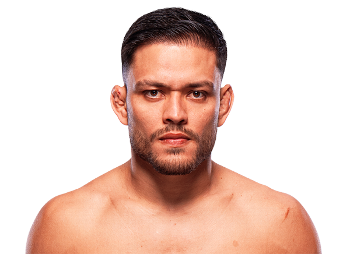
Elves Brener — Lightweight fighter

Elves Brener

16W6L
Distance Volume Kickboxer
…
VS
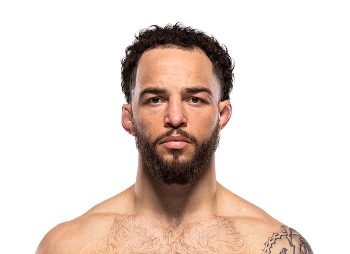
Josiah Harrell — Lightweight fighter

Josiah Harrell

“The Muscle Hamster”
11W1L
Pressure Finisher
…

A first cut to 155 against a lightweight volume striker

LightweightMeta APEX, Las Vegas, Nevada, United StatesSeptember 26, 2026Meta APEX — the smallest cage in the promotion
01

The Frame

What this fight is really about — and the measurements that shape it

The Analyst's Take

This is an asymmetric data build and the asymmetry is the story. Elves Brener is fully database-backed and cross-validated — 16-6-0, 5'10", 72.5" reach, SLpM 4.76 at 48% accuracy against 5.86 absorbed, TDDef 76%, average fight time 12:39 — and his career method split of 3 KO / 11 submissions / 2 decisions closes exactly at sixteen. Josiah "The Muscle Hamster" Harrell has zero rows in either Supabase project: his entire UFC statistical footprint is 181 seconds long. Brener turns 29 the day after this fight and owns +2.5" of height and +4.5" of reach; Harrell is a career welterweight listed at 170.5 lbs cutting to 155 for the first time, and he does it at 5'7" with a 68" reach. A UFC-seasoned, 92%-at-distance Brazilian volume kickboxer on a three-fight skid and a fourteen-month layoff, against an 11-1 regional finisher whose only Octagon night was a five-weeks-notice blowout. The editorial selection is Brener 60% / Harrell 40% for this announced lightweight bout — conviction 3/10 — a moderate preference resting on Brener's broader UFC evidence, not the extreme mismatch implied by reading Harrell's single-fight absorption figure literally. Career lightweight rates on the page are descriptive context, not a welterweight performance forecast.

Elves Brener
Attribute
Josiah Harrell
28
Age
Brener turns 29 the day after this fight27
5'10"+2.5" Brener
Height
5'7"
72.5"+4.5" Brener
Reach
68"
39.5"+0.5" Brener
Leg Reach
39"
Not found — unlisted in every source
Stance
Southpaw
Chute Boxe
Team
Grove City BJJ / Immortal MMA
Feb 11, 2023 (UFC 284)
Octagon Debut
Feb 21, 2026
Career lightweight — booked at 155
Weight-Class History
Career welterweight — first cut to 155
Jiu-jitsu by trade, distance kickboxer in the Octagon
Fighting Style
Pressure striking into front chokes and back takes

Length to Brener, density to Harrell. The Brazilian is two and a half inches taller and four and a half inches longer, and — critically — he uses it: 92.2% of his UFC significant strikes land at distance and only 3.0% in the clinch. Harrell arrives as a 5'7", 68"-reach welterweight coming down to lightweight, which is the classic move-down trade: he should be the physically denser man on fight night, but he has never made 155 before and his frame gives him no length advantage in either division. His 68" reach is 4.5" shorter than Brener's, and at lightweight that is a meaningful deficit against a man whose entire offensive identity is fought at range. The natural reading is that the cut fits Harrell's dimensions better than 170 ever did; the risk is that a first-time fifteen-pound reduction, in a fighter with a documented cerebrovascular history, is a variable nobody — including us — can price with confidence.

Venue Factor
The Meta APEX is the smallest canvas in the promotion and it systematically rewards pressure over lateral movement. That is a structural subsidy for Harrell, who must close four and a half inches of reach to do anything at all, and a structural tax on Brener, whose 92.2%-at-distance profile depends on space he will not always have. Brener's UFC skid was built in exactly this kind of firefight: he absorbs 5.86 significant strikes per minute and ranks 51st of 57 lightweights in absorption. The APEX does not fix that.
02

The Fighters

Careers, chins, schedules — and the form they bring into the cage

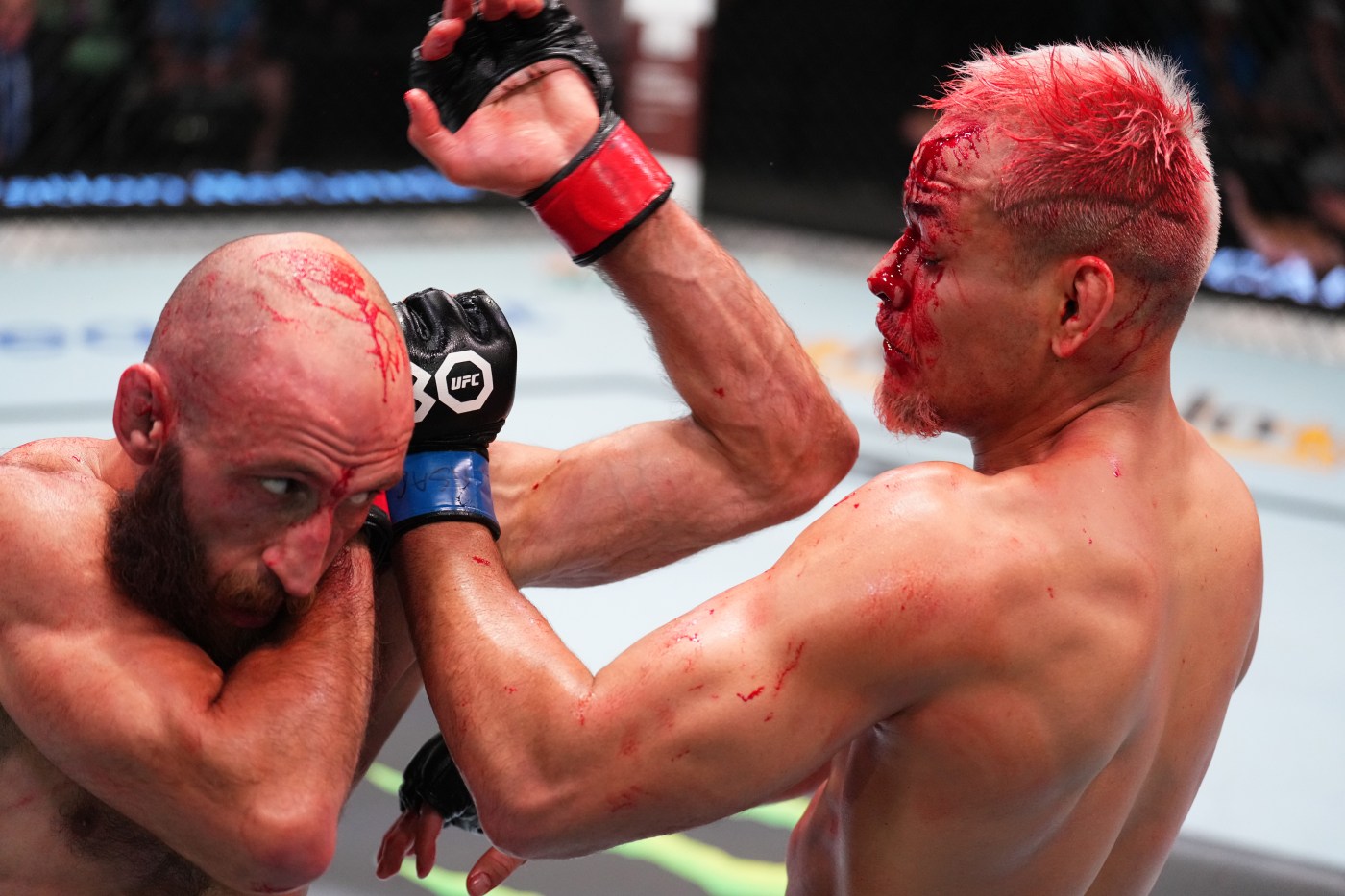
Elves Brener bloodied while battling Guram Kutateladze at UFC Apex

Elves Brener

Pro Record
16-6-0
UFC Record
3-3 across six bouts since February 2023
Streak
Lost three straight — Orolbai, Álvarez, Ribovics; last win Nov 4, 2023
Finish Rate
87.5% (14 of 16 wins) — 3 KO/TKO, 11 submissions
Avg Fight Time
12:39
Chin · Elite finish resistance — one stoppage in 22 fights, zero submission lossesSOS · ChampionshipSubmission Artist (DB tag)

He entered the UFC in February 2023 and went 3-0 — a split decision over Zubaira Tukhugov, a third-round TKO of Guram Kutateladze, a first-round TKO of Kaynan Kruschewsky. He has not won since November 4, 2023: three straight losses to Myktybek Orolbai (unanimous decision), Joel Álvarez (third-round TKO, knees to the head in the clinch) and Esteban Ribovics (unanimous decision, a $50,000 Fight of the Night). That skid is real, but its texture matters — those are three genuinely good lightweights, two of the three losses went the full fifteen minutes, and he carries three post-fight bonuses on his ledger. The regional version of this fighter was a first-round submission machine: eleven career submissions, six of them armbars, nine first-round finishes, all of it between May 2016 and March 2022. The Octagon version has attempted exactly zero submissions in sixteen rounds. He arrives here almost fourteen months idle and almost certainly fighting for his roster spot.

Josiah Harrell throwing a kick in the cage

Josiah Harrell

Pro Record
11-1-0
UFC Record
0-1 — one bout, 181 seconds
Streak
4-1 in his last five; lost his UFC debut to Jacobe Smith
Finish Rate
90.9% (10 of 11 wins) — 6 KO/TKO, 4 submissions
Avg Fight Time
03:01 (UFC — one fight)
Chin · Unproven — one stoppage loss in twelve fights, taken on 36 days' noticeSOS · RegionalPressure finisher — back takes off damage

The strangest trajectory on the card. He built an 11-0 record between 2020 and 2023, was signed on short notice for UFC 290 opposite Jack Della Maddalena in July 2023, and was pulled days out when pre-fight medicals revealed moyamoya — a rare cerebrovascular disease that narrows the arteries at the base of the brain and sharply elevates stroke risk. He underwent an eight-hour brain surgery that UFC insurance did not cover, suffered two seizures in recovery, was released from the roster, and rebuilt across Ohio Combat League and LFA through 2025. He was re-signed and debuted on February 21, 2026 — thirty-six days after a full three-round LFA fight — and was stopped by the undefeated wrestler Jacobe Smith at 3:01 of the first, in a finish widely criticised as a late stoppage after Harrell was already unconscious. Ten of his eleven wins are finishes and both paths are live: six KO/TKO built on accumulation, and four submissions of which three are rear-naked chokes taken off damage.

Elves Brener
0 dealt · 0 absorbed
Knockdown Exchange
KD dealt vs absorbed. A dash means that figure was not published.
Josiah Harrell
0 dealt · 0 absorbed

Elves Brenersignature weapons

ArmbarSix of his eleven career submissions — every one of them pre-UFC, the last in March 2022
×6
Rear-Naked ChokePart of an eleven-submission regional career; zero submission attempts across sixteen UFC rounds
×3
Punch to the Head at DistanceKutateladze TKO R3 3:17 and Kruschewsky TKO R1 4:01 — both of his Octagon finishes, both scored the same way
×2

Josiah Harrellsignature weapons

Accumulation TKOFinishing clocks of 4:30, 4:56, 3:34, 3:27 and 3:28 — a breaker, not a bomber
×6
Rear-Naked ChokeMangram R1, Garnett R2, Guillard R1 — all back-takes off accumulated damage rather than hunted entries
×3
ArmbarWorley, R2 — the fourth of his four career submissions
×1

Elves Brener

L
Esteban Ribovics
Decision — Unanimous (28-29, 27-30, 27-30)

Opponent context: elite

RR3 (5:00)
UFC FN: Taira vs. Park — Aug 2, 2025 · $50k Fight of the Night
L
Joel Álvarez
KO/TKO — Knees to head in clinch

Opponent context: elite

RR3 (3:36)
UFC FN: Sandhagen vs. Nurmagomedov — Aug 3, 2024
L
Myktybek Orolbai
Decision — Unanimous (27-29 ×3)

Opponent context: elite

RR3 (5:00)
UFC 301: Pantoja vs. Erceg — May 4, 2024
W
Kaynan Kruschewsky
KO/TKO — Punch to head at distance

Opponent context: prospect

RR1 (4:01)
UFC FN: Almeida vs. Lewis — Nov 4, 2023 (catchweight)
W
Guram Kutateladze
KO/TKO — Punch to head at distance

Opponent context: veteran

RR3 (3:17)
UFC FN: Strickland vs. Magomedov — Jul 1, 2023
Pattern

Three straight losses, and the shape of them is consistent: he is competitive, he is durable, and he is behind on the cards. Orolbai and Ribovics both took him fifteen minutes, and the Ribovics fight earned a Fight of the Night bonus — precisely the kind of bonus you win by having a war and losing it. The Álvarez stoppage is the only time in twenty-two professional fights he has been finished, and it came from a clinch knee, a range he almost never occupies voluntarily at 3.0% of his strikes. Note the round column: every one of his last five decisive moments happened in Round 3 or Round 1, never Round 2.

Josiah Harrell

L
Jacobe Smith
KO/TKO — Punches (controversial late stoppage)

Opponent context: prospect

RR1 (3:01)
UFC FN: Strickland vs. Hernandez — Feb 21, 2026
W
Bekmyrza Dosmatov
TKO — Corner stoppage

Opponent context: prospect

RR3 (3:28)
LFA 224: Adams vs. Bilalov — Jan 16, 2026
W
Kegan Gennrich
Decision — Unanimous

Opponent context: prospect

RR3 (5:00)
Ohio Combat League 39 — Aug 2, 2025
W
Melvin Guillard
Submission — Rear-naked choke

Opponent context: veteran

RR1 (3:25)
Ohio Combat League 38 — May 17, 2025
W
Quinton Parks Jr.
KO/TKO

Opponent context: prospect

RR2 (3:34)
Ohio Combat League 36 — Mar 1, 2025
Pattern

An extraordinarily compressed schedule — five fights in under twelve months after twenty and a half months out of competition for brain surgery and recovery. The critical context on the loss: he fought a full three rounds at LFA 224 on January 16, 2026, then took the UFC debut thirty-six days later on short notice against a 12-0 wrestler. He landed a takedown, got reversed, and was overwhelmed. That is not a clean read on his ceiling — it is a read on a man who accepted an impossible turnaround to get his contract back. Seven months of a real camp is the first normal preparation he will have had in three years.

Elves Brener

Win Methods
Wins by Round

Josiah Harrell

Win Methods
Wins by Round
Critical Insight
Both donuts are career-scoped and both flatter their man. Brener's 69% submission rate is a dead letter in the Octagon: all eleven submissions came between May 2016 and March 2022, and he has attempted exactly zero in six UFC fights and sixteen UFC rounds against a 0.48 lightweight average. Harrell's 90.9% finish rate is real but earned against Ohio Combat League opposition. Read the round bars with one caveat: Harrell's eleven wins are fully round-mapped, while four of Brener's sixteen have no round recorded in the log we hold, so his bars show the twelve that do — nine first-round finishes, the Kutateladze TKO in the third, and two decisions. Strip both illusions and the honest matchup is a proven-durable, average-accuracy distance volume striker who loses the damage exchange, against a short, dense, unproven pressure finisher who must get inside 68 inches to exist.
03

The Numbers

Composites, division ranks and round-by-round evidence

Composite scores summarize selected statistics on a 0–100 scale. They are not win probabilities. Compare the underlying metrics, opponent quality and sample flags before interpreting a score difference as a matchup advantage.

Striking

SLpM 25% · StrAcc 30% · StrDef 30% · SApM 15%

0
Elves
0
Josiahsmall sample

Brener is an average-accuracy, above-average-volume, below-average-defence striker: SLpM 4.76 against a 4.51 division mean (23rd of 57), accuracy 48% against 47.77% (28th), defence 51% against 52.35% (35th), and absorption 5.86 against 4.15 — 51st of 57 and the worst number in his file. Harrell's UFC rate line is 181 seconds long and is not scored; his 50 is built from six KO/TKO wins, a 90.9% finish rate and a southpaw stance, capped by an Ohio Combat League schedule.

Grappling

TD/15 25% · TDAcc 25% · TDDef 30% · Sub/15 20%

0
Elves
0
Josiahsmall sample

Brener's raw UFC rates alone score about 45 — TD/15 0.99 against a 1.67 mean, 17% accuracy on 5 of 30, Sub/15 0.00 in sixteen rounds — and the credited 53 is a career adjustment for eleven regional submissions treated as latent equity, not an active rate. His 76% takedown defence is his best grappling number. Harrell's 54 rests on four career submissions, a Grove City BJJ pedigree alongside Dante Leon's no-gi group, and zero submission losses; none of his UFC grappling rates exist.

Technical

(Striking + Grappling) / 2

0.0
Elves
0
Josiahsmall sample

Near-identical on paper — which is itself a finding, because one set of numbers is measured against UFC lightweights and the other is estimated from Ohio Combat League. A tie on the technical sheet is a win for the man whose sheet was written in harder ink.

Cardio

Fight time · pace · R3/R1 output · champ rounds

0
Elves
0
Josiahsmall sample

Brener's clearest single advantage: an average fight time of 12:39, output that climbs to 121% of his first round by the third, a DB label of Strong Finisher, and a fifteen-minute Fight of the Night war one bout ago. Deductions for a 40% slow-start rate and fourteen months of inactivity. Harrell has four fights that reached the third round including a corner stoppage at 3:28 of R3, but regional three-rounders are not UFC three-rounders and this is his first-ever cut to 155.

Overall

(Technical + Cardio) / 2

0.0
Elves
0.0
Josiahsmall sample

A five-point overall gap produced almost entirely by cardio and measurement confidence rather than technique. That directionally supports a 60/40 editorial lean, not a mismatch call.

MetricElvesJosiah
Avg Fight Time12:3903:01 (UFC — one fight)small sample
Pace TierHigh — 5.5 strikes/min, DB pace tier HighNot measured — 181 UFC secondssmall sample
R3/R1 Output121% (18.8 → 22.8 sig, as published)No UFC R2 or R3 datasmall sample
Slow Start %40% — he concedes early roundsNot found — one UFC round of tapesmall sample
Champ RoundsN/A — 3-round boutN/A — 3-round bout

Archetype Base Rate

Submission Artist (DB archetype) 56.6%43.4% Well-Rounded Finisher

n=145 archetype matchups (Submission Artist vs Well-Rounded) · The analytics database tags Brener a Submission Artist and gives that archetype 61.1% against Strikers (n=234) and 56.6% against Well-Rounded fighters (n=145). Directionally supportive — but the tag is derived from his career record, and his Octagon behaviour flatly contradicts it: zero submission attempts in sixteen UFC rounds. No weight is placed on this base rate in the 60/40 editorial lean.

Elves BrenerJosiah Harrell

Lightweight

· 57 fighters
StatElvesElves rankDiv avgJosiah rankJosiah
SLpM4.76
23/57
4.51—2.32 (181-sec sample)
Str Acc48%
28/57
47.77%—50% (7 of 14)
Str Def51%
35/57
52.35%—29%
SApM5.86
51/57
4.15—10.94
KD Avg0.40 (2 dealt / 2 absorbed)—0.51—0.00
Damage Ratio0.81 (361 dealt / 445 absorbed)
51/57
1.15—Not found
TD/150.99 — 17% accuracy (5 of 30, derived)
33/57
1.67—Not found
TD Def76% (opponents 6 of 25)———Not found
Sub/150.00 — 0 attempts in 16 UFC rounds
38/57
0.48—Not found
Avg Fight Time12:39———03:01 (one fight)
Statistical Verdict
Almost every measured row belongs to Brener — and that is partly because almost every row is only measured on one side. Strip out the columns where Harrell simply has no data and three real, comparable edges survive: Brener's reach (+4.5") and range identity (92.2% of his strikes thrown at distance); Brener's strength of schedule, which is championship-tier against an eight-fight Ohio Combat League core; and Harrell's 90.9% finish rate against Brener's 51st-of-57 absorption. The honest one-line summary: Brener wins the fight that is fought at 72 inches, Harrell wins the fight that is fought at 40 inches — and Brener's own numbers say he does not always get to choose.

Significant Strikes Landed per Round

Control Time per Round (sec)

Elves Brener

  • He is out-landed in every single round of his UFC career: 18.3 to 23.2 in the first, 27.4 to 32.4 in the second, 22.8 to 28.8 in the third. Round 2 is simultaneously his best offensive round (27.4 landed at 50.2% accuracy) and his worst defensive one.
  • Control time is a rout against him — 819 seconds conceded to his 368 across sixteen rounds, with his own totals of 181, 30 and 157 seconds shown here as per-round averages.
  • Both knockdowns he has conceded landed in Round 3, the same round the Álvarez stoppage came in and the same round in which his opponents throw their most accurate strikes at 50.2%.
  • His targeting drifts upstairs as the fight goes: legs fall from 36.4% of his first-round output to 16.7% by the third, while head strikes climb from 43.6% to 66.7% — a 23.1-point head-hunting shift. No second-round targeting split is published, so nothing is estimated for it.

Josiah Harrell

  • There is no round-by-round row for Harrell in either Supabase project. His only Octagon appearance lasted 181 seconds and ended inside the first round, so every cell above is blank rather than estimated.
  • What that one fight recorded: roughly seven significant strikes landed of fourteen attempted against thirty-three absorbed, which is evidence of a blowout and not a usable rate. The published TD/15 of 0.00 is contradicted by fight reports describing a landed takedown on Jacobe Smith before he was reversed — another instance of the corrupt UFC.com takedown block.
  • His usable round evidence is regional and it points one way: three first-round finishes, four in the second, three in the third plus a decision, with finishing clocks of 4:30, 4:56, 3:34, 3:27 and 3:28. He accumulates and the opponent folds late in the round.
Critical Insight
Read the offensive and defensive tables side by side and the skid explains itself: Brener has never won the damage exchange in any round of any UFC fight. He is out-landed in all three, out-controlled better than two to one, and the two knockdowns against him both arrived in the third. Neither man's equity is front-loaded, which is unusual. Harrell's best chances are Round 1 — a cold opponent, fresh legs, no cut fatigue yet — and Round 3, Brener's documented vulnerability window. Brener's equity is Round 2 and Round 3: peak output, rising volume, and a decision engine built on a 12:39 average fight time. The dead zone for Harrell is the two minutes after he fails to land early, because that is exactly when Brener's rate curve turns upward and the reach starts collecting.

Strike targeting (available rounds)

Elves

Head
56%
Body
18%
Legs
26%

Head hunting vs body work vs leg attack — the shape of the damage. Unavailable strike-target figures are omitted rather than shown as 0%.

Striking range — distance, clinch and ground

ElvesJosiah · N/A
92%Distance—
3%Clinch—
5%Ground—

Approximate share of significant strikes by range in available rounds, weighted by strike volume. Incomplete splits are excluded. Debutants / fighters without Octagon samples show as N/A.

04

The Story of the Fight

Advantages, worst cases, gameplans — and the patterns underneath

Where the fight lives

Who owns each phase — and by how much
Open SpaceElves owns it

+4.5" of reach and 92.2% of his strikes thrown at distance, against a 68" reach and no jab-range version of the fight that favours Harrell

Pocket / ExchangesJosiah owns it

SApM 5.86, 51% striking defence and a 0.81 damage ratio (51st of 57) against six career TKOs built on accumulation

ClinchJosiah owns it

Brener keeps 3.0% of his offence there, was finished there by Álvarez, and has been out-controlled 819 seconds to 368

GroundEven

76% takedown defence and zero career submission losses on both sides — 0 UFC sub attempts from Brener, three RNCs off damage from Harrell

Path to Victory

Elves Brener

Fight at seventy-two inches for fifteen minutes. If he survives a nervy opening five and starts collecting the lead leg, his output curve and a 12:39 average fight time take the cards from a man with one career decision win.

Why they win
01
Reach and range identity in combination

+4.5" of reach and 92.2% of his significant strikes thrown at distance. He does not merely have length; his entire offence is built to exploit it against a 68"-reach opponent.

02
A championship-tier strength of schedule

He has taken Ribovics, Orolbai, Álvarez, Kutateladze and Tukhugov into deep water. Harrell's best win is a faded 42-year-old Melvin Guillard. Nothing else on the sheet is worth as much as this.

03
Deep-water engine, measured

An average fight time of 12:39, third-round output at 121% of his first, and a Fight-of-the-Night fifteen-minute war one fight ago.

04
Elite finish resistance

One stoppage loss in twenty-two professional fights and zero career submission losses — directly opposing a man whose entire value proposition is a 90.9% finish rate.

05
76% takedown defence

Opponents have landed 6 of 25 against him. Harrell's UFC grappling entries are undocumented, and a cold shot into that number is a losing proposition.

06
Latent submission equity

Eleven career submissions, six by armbar, nine first-round finishes. Dormant in the Octagon — zero attempts in sixteen rounds — but genuinely live if a scramble opens and Harrell over-commits on top.

The gameplan
  1. 1
    Kick the lead leg early and often

    His first-round leg-strike share is 36.4%, the highest of any round, and it is the cheapest way to tax a shorter man's forward pressure before the cardio question matters.

  2. 2
    Fight at seventy-two inches, and treat the fence as lava

    Circle off, never square up on the cage. The Álvarez tape is the entire warning — one clinch sequence is the only finish of his professional life.

  3. 3
    Survive the first four minutes clean

    Accept a lost first round on points if the alternative is a firefight with a fresh welterweight. His slow-start rate is 40% and his first round is already his worst on the numbers.

  4. 4
    Turn the volume on in Round 2

    27.4 landed at 50.2% accuracy is his career peak in both columns, and it is where the scorecards get taken.

  5. 5
    Head-hunt in Round 3 and trust the engine

    His head share climbs to 66.7% in the third and his output to 121% of the first — a 12:39 average fight time against an opponent making 155 for the first time.

Path to Victory

Josiah Harrell

Close four and a half inches and make it a firefight. Brener has been out-landed in every UFC round he has ever fought and absorbs 5.86 a minute — accumulate on the fence and something breaks.

Why they win
01
Brener's absorption is the most exploitable number in this file

SApM 5.86, striking defence 51%, damage ratio 0.81, 51st of 57 in the division. He gets hit, a lot, by everyone, and it is measured across sixteen rounds rather than inferred.

02
A 90.9% finish rate with two independent paths

Six KO/TKO and four submissions. Ten of his eleven wins never reached a scorecard — he does not need judges.

03
The southpaw stance

Against an opponent whose own stance is not documented in a single source and whose recent tape is against orthodox pressure fighters.

04
Physical density from the move down

A career welterweight at 155 should be the stronger man in the clinch and on the fence — precisely the range where Joel Álvarez knocked Brener out with knees.

05
Freshness and momentum asymmetry

Seven months' rest and a full camp against Brener's fourteen months of inactivity and a three-fight skid. Harrell has won four of his last five; Brener has lost three straight.

06
The APEX cage

The smallest floor in the promotion, which compresses the exact 72.5-inch space Brener's entire game requires.

The gameplan
  1. 1
    Close the distance in the first ninety seconds

    Before the range template sets and while Brener is fourteen months cold. Every second spent at kicking range is a second the reach collects.

  2. 2
    Use the southpaw lead hand to enter, then get to the body and the fence

    Every yard of open canvas is a yard Brener wins. The open-stance lead hand is the entry tool against a man whose own stance nobody has recorded.

  3. 3
    Attack the clinch specifically

    Brener concedes only 3.0% of his own strikes there, has been finished there once, and has been out-controlled 819 seconds to 368 across his UFC career.

  4. 4
    Accumulate, do not hunt one shot

    His finishing clocks — 4:30, 4:56, 3:34, 3:27, 3:28 — say he breaks people down. Forcing a highlight against a twenty-two-fight veteran with one stoppage loss is the wrong ambition.

  5. 5
    Take the back off damage, not off entries

    All three of his rear-naked chokes followed hurt opponents. Brener's 76% takedown defence and zero career submission losses make a cold shot a losing proposition.

Danger Zone

How Elves Brener loses

  • The Álvarez replay in the small cage. He gets walked to the fence, a career welterweight's clinch knees and short elbows land, and the one range where he keeps 3.0% of his offence becomes the whole fight.

  • Cold start punished. Fourteen months idle, a 40% slow-start rate, and a fresh finisher swinging in the first four minutes — the first-round knockout branch is not exotic.

  • A fourth straight decision loss. He out-lands nobody, absorbs thirty a round again, and the 0.81 damage ratio writes another 27-30 scorecard — quite possibly the end of his UFC run.

Danger Zone

How Josiah Harrell loses

  • The cut breaks him before Brener does. A first-ever fifteen-pound reduction, a bad weigh-in, and no legs in Round 2 against a man whose output rises 21% into Round 3.

  • He never gets inside. Sixty-eight inches against seventy-two and a half, three rounds of eating a lead-leg kick and a jab, and a 30-27 he had no answer for — with only one career decision win to draw on.

  • He is hurt again. Given the moyamoya history, the eight-hour surgery and being left unconscious under a late stoppage seven months ago, another clean knockdown is a materially heavier event for him than for a typical fighter.

One record, two entirely different fighters

The Two Breners

Regional Brener (2016-2022) went 13-3 with eleven submissions, six of them armbars, and nine first-round finishes — a genuine Amazonian grappling specialist. UFC Brener (2023-present) is 3-3, throws 92.2% of his strikes at distance, has attempted zero submissions across sixteen Octagon rounds, and has won twice by punch to the head at distance. Chute Boxe reshaped him into a kickboxer, and the reshaping is complete enough that his published 69% submission rate is an artifact rather than a threat. Score him as the striker he is, and keep a small tax on the grappler he used to be.

0
submission attempts in 16 UFC rounds
The single most predictive number in this file

The Damage Ledger

Across his UFC career Brener has dealt 361 significant strikes and absorbed 445 — the 51st-worst damage ratio among 57 lightweights, in a division whose average is 1.15. The round table makes it concrete: out-landed 18.3 to 23.2 in the first, 27.4 to 32.4 in the second, 22.8 to 28.8 in the third. That is how a durable, high-paced, technically competent fighter goes 0-3 without ever being embarrassed — and it is exactly the vulnerability a 90.9%-finish-rate pressure fighter is built to punish. It is also why the editorial lean stops at 60% despite Brener's structural advantages on paper.

0.81
damage ratio — 51st of 57 lightweights
What the 181 seconds are actually worth

The Short-Notice Asterisk

Harrell's only UFC result reads as a catastrophe: knocked out in 181 seconds, thirty-three significant strikes absorbed, left unconscious under a stoppage that drew public criticism. The context substantially reframes it. He fought three full rounds at LFA 224 on January 16, 2026, then accepted the UFC debut thirty-six days later against Jacobe Smith, a 12-0 wrestler on a three-fight Octagon run. He landed a takedown, was reversed, and was buried. A thirty-six-day turnaround into an undefeated wrestler is not a fair test of anything — and this camp, seven months with full preparation and a fight he chose, is the first normal assessment since 2023. We discount the Smith line heavily. We do not erase it.

36
days between his LFA three-rounder and his UFC debut
Where analytical honesty matters more than cleverness

The Medical Variable and the Cut

Harrell was diagnosed with moyamoya in July 2023, underwent an eight-hour cerebral revascularisation, had two seizures during recovery, was released by the UFC, and fought his way back. He has since been cleared, has fought six times, and is entitled to be assessed as a fighter rather than as a patient. But two facts are load-bearing for a projection: he was knocked unconscious seven months ago, and he is making the first 155-pound cut of his career, and severe dehydration is in general terms the single most cardio-punishing thing a fighter does to himself. We do not model a medical outcome and will not speculate on one. We do model the cardio consequence — which is why his cardio score sits at roughly 57 against Brener's 66, and why the whole projection carries a HIGH-risk flag.

The largest single input to the lean

Strength of Schedule

Brener's six UFC opponents include a Fight-of-the-Night war with Esteban Ribovics, fifteen competitive minutes with Myktybek Orolbai, a stoppage win over Guram Kutateladze and a split decision over Zubaira Tukhugov; the analytics database classifies his schedule tier as Championship. Harrell's eleven wins include eight in Ohio Combat League, two in LFA, one in CFFC, and a submission of a 42-year-old, decade-past-prime Melvin Guillard. Brener has lost to better men than Harrell has beaten. That asymmetry does not guarantee anything — regional prospects clear this bar constantly — but it is the correct prior, and it is why a man on a three-fight skid is still favoured.

The Five-Round Clock

Elves Brener danger windowJosiah Harrell danger windowNeutral / contested
R1 · 0:00–5:00Harrell's best window

Historically Brener's worst round: 18.3 landed against 23.2 absorbed, and he concedes early rounds 40% of the time. A fresh, dense welterweight against a man who has not competed since August 2025. Brener's job is to survive it cleanly and start kicking.

Critical Insight
Neither man's equity is front-loaded, which is unusual for a three-round fight. Harrell's best chances are the opening five minutes — a cold opponent, fresh legs, no cut fatigue yet — and the third round, which is Brener's documented failure window. Brener's equity is the second and third: peak output, rising volume, and a decision engine. The dead zone for Harrell is the two minutes after he fails to land early, because that is exactly when Brener's rate curve turns upward and the reach starts collecting.

Finish Threat by Round

Share of each fighter's wins that end in each round — early finishers spike left, grinders rise right.

05

The Verdict

Editorial scenario weights, the betting market, and our conviction

If you only read 3 things
1

Brener is a cautious editorial selection at 60–40, with low conviction because Harrell is making 155 for the first time and Harrell's limited UFC sample.

2

Harrell overturns the case if he denies clean resets and makes the fight depend on sustained physical exchanges in which the historical comparison is less informative.

3

Do not turn Harrell's one-fight defensive numbers into an extreme favourite price or treat regional experience as absent.

Model outcomes per 100 fights

Each square represents one percentage point of the model distribution, not an observed fight. This visualization does not measure model accuracy or reduce uncertainty in the inputs.

Brener Decision — 25%Brener Submission — 10%Brener KO/TKO — 25%Harrell KO/TKO — 16%Harrell Decision — 16%Harrell Submission — 8%

Each square = 1 simulated fight. Elves Brener gold · Josiah Harrell orange · full color = decision, 70% = submission, 45% = KO/TKO.

Reach and range control

72.5" against 68", with Brener throwing 92.2% of his significant strikes at distance and only 3.0% in the clinch. A Brener-favourable scenario has him setting the timing of exchanges; the 25-point decision and 25-point KO/TKO editorial buckets reflect that route without treating Harrell's first cut to 155 as a solved variable.

Brener's absorption problem

SApM 5.86, striking defence 51%, damage ratio 0.81 and a 51st-of-57 absorption rank (lightweight pool). His absorption exceeds his landed rate, so the case cannot assume he wins every extended exchange — and Harrell's 16-point KO/TKO share preserves a live finishing path.

Strength of schedule

Championship-tier UFC opposition — Ribovics, Álvarez, Orolbai, Kutateladze, Tukhugov — against an eight-fight Ohio Combat League core. Regressed to schedule, Brener's 0-3 is more impressive than Harrell's 4-1, and that more than anything creates the lean.

Lightweight booking

The bout is contracted at lightweight (155). Brener's round averages were built in this division. Harrell's profile weight is 170.5 lbs, and this is his first cut to 155, so his welterweight frame does not yet have a rate line at the limit.

Round-3 finishing density

Both of Brener's conceded knockdowns and his only stoppage loss occurred in the third, in the round where his opponents strike at 50.2% — and three of Harrell's career finishes also came there. It is simultaneously Brener's peak-output round and his documented failure window.

Fight Scripts

0%
of simulations

Brener sets the pace

Build combinations without staying exposed after the final punch, then use clinch pressure if Harrell disrupts the rhythm — the editorial decision and striking-finish buckets at 25 points each.

Scripted outcomes for Elves Brener vs Josiah Harrell — how each version of this fight unfolds.

Elves Brener win probability
0%
25%
25%
10%
KO/TKODECSUB
  • Editorial striking-finish share of all outcomes; not a calibrated method forecast.

  • Editorial decision share across the announced distance.

  • Editorial submission share based on the positional routes and their counterarguments.

Josiah Harrell win probability
0%
16%
16%
8%
KO/TKODECSUB
  • Editorial striking-finish share of all outcomes; not a calibrated method forecast.

  • Editorial decision share across the announced distance.

  • Editorial submission share based on the positional routes and their counterarguments.

Projected Scorecards

How the model scores each round
R1
Josiah
R2
Elves
R3
Elves
29-28 Brener
He gives up a nervy first round, then takes the second and third on volume and reach
The single most likely card in our model
30-27 Brener
The range template sets from the opening bell and Harrell never gets inside 68 inches
Live if the first cut to 155 has taken Harrell's legs
29-28 Harrell
He wins the first on pressure and steals the third in the firefight
His thinnest route — one career decision win to draw on

Model and price

Elves Brener

Freshness unverified
Model win probability
60%
Fair decimal odds
1.67
Reference quote+111 (BetOnline)
Estimated EV
+26.6%
Edge vs no-vig market
+14.4 pp

Josiah Harrell

Freshness unverified
Model win probability
40%
Fair decimal odds
2.50
Reference quote-130 (BetOnline)
Estimated EV
-29.2%
Edge vs no-vig market
-14.4 pp

EV uses the displayed price: probability × decimal odds − 1. Edge is a percentage-point difference from a proportionally de-vigged, same-book pair. A dash means that comparison is unavailable.

Price freshness & calculation notes

Quotes older than 48 hours are marked outdated. EV at an old or undated price is a historical calculation, not a current opportunity. Date-only snapshots have no verified capture time.

Fair odds are the break-even price under this estimate, not a recommended entry price. Model uncertainty can erase a small edge.

What price would change the calculation? · Elves Brener

Change the assumptions to see how the required price moves. This does not update the published model or recommend an entry price.

Required decimal price: 1.67 or higher. At the exact unrounded break-even price, estimated EV is zero.

What price would change the calculation? · Josiah Harrell

Change the assumptions to see how the required price moves. This does not update the published model or recommend an entry price.

Required decimal price: 2.50 or higher. At the exact unrounded break-even price, estimated EV is zero.

Full prop table (0)Expand for odds, model %, implied % and analyst verdict per prop

No prop prices recorded in this analysis.

Original analyst price notes

These notes describe the original analysis and may refer to older prices.

Require a current, timestamped quote before treating any comparison as actionable. The editorial 60–40 split is a moderate preference resting on Brener's broader UFC evidence — not the extreme mismatch implied by reading Harrell's single-fight absorption figure literally. Harrell's 40% share preserves the possibility that the first appearance understates his level at 155.

Conviction
0
3/10

Editorial confidence in the evidence, not a win probability or a calibrated confidence interval.

Brener is a cautious editorial selection at 60–40, with low conviction because Harrell is making 155 for the first time and Harrell's limited UFC sample. Lean: Elves Brener.

What backs the lean
  • The editorial selection is Brener at 60% against Harrell at 40% for the announced lightweight bout. The adjustment rests on Brener's broader UFC evidence and demonstrated routes through active striking and occasional wrestling — a moderate preference, not a mismatch call.

  • Brener's published striking volume offers an active route; his takedown activity identifies another option, although an average below one takedown per fifteen minutes is not evidence that wrestling will reliably decide this specific matchup.

What limits it
  • Scheduled for 3 five-minute rounds at lightweight (155). Harrell is making the weight for the first time, so career rates do not establish how either fighter will perform in this specific booking.

  • The comparison is not adjusted for strength of opposition. Takedown accuracy and division rankings need separate verification. Historical round averages describe different opponents and may come from other divisions.

  • Josiah Harrell has only 1 UFC bout. One opponent or short finish can strongly influence these averages.

  • Harrell overturns the case if he denies clean resets and makes the fight depend on sustained physical exchanges in which the historical comparison is less informative.

Final Assessment

Brener is a cautious editorial selection at 60–40, with conviction 3/10, because the lightweight booking and Harrell's one-fight UFC sample limit how much of Brener's lightweight career file can be treated as predictive.

Harrell overturns the case if he denies clean resets and makes the fight depend on sustained physical exchanges in which the historical comparison is less informative.

Do not turn Harrell's one-fight defensive numbers into an extreme favourite price or treat regional experience as absent. Brener's central fair decimal price is 1.67 and Harrell's is 2.50; the division change and narrow opposing sample make assumption shifts material.

Skip to main content
Use Tab to navigate through elements, Enter to activate buttons and links.