
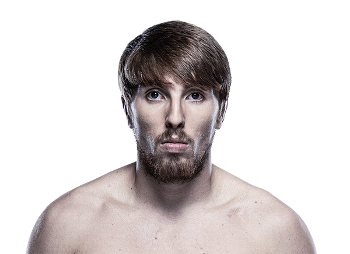

Kurtis Campbell
Get a hand on him inside the first two minutes. Peek has been taken down 22 times on 47 attempts and held for 102 seconds a round; if Campbell's published 8.76 takedowns per fifteen minutes is even half real, the fight is a wrestling match he wins.
Opponents have landed 22 takedowns on Peek from 47 attempts across five UFC fights and controlled him for 1,325 seconds. Nothing else on this page is as well-evidenced.
Small sample, flagged everywhere, but it is the largest single number in the matchup and it points directly at Peek's 53% takedown defence — 64th of 85 lightweights.
24 against 31, with a 72-inch reach against 70. He is the fresher, longer man in a bout where his opponent has not competed since September 2024.
2.63 significant strikes absorbed per minute against Peek's 3.88, and 51% striking defence against 44%. Even standing, Campbell takes less than the man opposite him.
14.3 significant strikes at 44% accuracy, 86% of them at range. If Campbell survives ten minutes, the last five are the most winnable on the card.
- 1Shoot inside the first two minutes
The analysis puts it plainly — shoot early, chain the takedown. Peek's opening round is his most dangerous (25.2 strikes, 0.40 knockdowns), so the entry has to come before the exchange, not after it.
- 2Chain, don't single-shot
47 takedown attempts have been made on Peek and 22 landed. That is a 47% conversion rate for opponents who keep going — the number rewards volume of entries, not one perfect double.
- 3Never stand in the pocket
Eight of nine career wins by knockout. Campbell's 51% striking defence is better than Peek's 44%, but nothing in the striking numbers is worth the risk of finding out whose is real.
- 4Use the two inches to enter, not to jab
A 72-inch reach against 70 is a tool for changing levels from outside the pocket. Trading at range is where 79.4% of Peek's first-round offence already lives.
- 5Bank control, then attack the third
1,325 seconds of career control absorbed and a third-round output of 14.3 strikes at 44%. If the first two rounds are close, the last one is where Peek has historically had nothing left.