
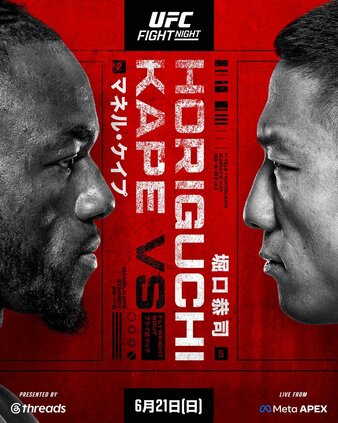
Manel Kape vs Kyoji Horiguchi
Flyweight Bout • UFC Fight Night: Kape vs. Horiguchi 2
Saturday, June 20, 2026
Explore Detailed Fighter Profiles
Click on either the fighter's name or profile image for each fighter to access comprehensive UFC statistics including striking metrics, grappling data, clinch performance, complete fight history, offensive & defensive analytics, and round-by-round breakdowns.

Manel Kape
Fighter Metrics
Victory Methods
Win Round Distribution
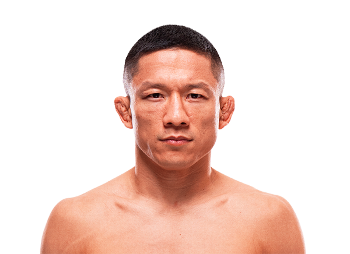
Kyoji Horiguchi
Fighter Metrics
Victory Methods
Win Round Distribution
📋 Last 5 Fights - Manel Kape
| Date | Opponent | Result | Method |
|---|---|---|---|
| 2025-12-15 | Brandon Royval | W | KO/TKO (Punches on Ground) (R1, 3:18) |
| 2025-03-15 | Asu Almabayev | W | KO/TKO (Punches at Distance) (R3, 2:16) |
| 2024-12-15 | Bruno Silva | W | KO/TKO (Punches at Distance) (R3, 1:57) |
| 2024-07-28 | Muhammad Mokaev | L | Decision (Unanimous) (R3, 5:00) |
| 2023-09-10 | Felipe dos Santos | W | Decision (Unanimous) (R3, 5:00) |
📋 Last 5 Fights - Kyoji Horiguchi
| Date | Opponent | Result | Method |
|---|---|---|---|
| 2026-02-15 | Amir Albazi | W | Decision (Unanimous) (R3, 5:00) |
| 2025-11-15 | Tagir Ulanbekov | W | Submission (RNC) (R3, 2:18) |
| 2024-12-15 | Nkazimulo Zulu | W | Decision (Unanimous) (R3, 5:00) |
| 2024-06-15 | Sergio Pettis | W | Decision (Unanimous) (R3, 5:00) |
| 2023-12-31 | Makoto Takahashi | W | Submission (RNC) (R2, 3:44) |
Technical Analysis
Technical Score
Cardio Score
Overall Rating
📊 Technical Score
Calculated as the average of Striking Composite (84 vs 79) and Grappling Composite (62 vs 71). Kape's elite volume (rank 3/32) and accuracy (rank 6/32) give him a striking edge with historic 5.04 SLpM. Horiguchi's superior offensive wrestling (1.61 TD/15, 40% accuracy) provides the grappling advantage. Both score in the 70s — elite tier for flyweight.
💪 Cardio Score
Both fighters score in the 78-82 range — championship-caliber conditioning. Kape's output grows 165% from R1 to R3 ("Strong Finisher" pattern). Horiguchi's 14:00 avg fight time and 5-round experience with DJ demonstrate proven late-round durability. Both can sustain elite pace for 25 minutes.
🎯 Overall Rating
Simple average of Technical Score and Cardio Score. Both fighters rate in the high 70s — elite flyweight main event caliber. Horiguchi (76.5) edges slightly through more balanced technical profile, while Kape (77.5) benefits from cardio and finishing rate. These ratings reflect top-5 flyweight status for both competitors.
Striking Composite
Grappling Composite
Technical Radar Comparison
Visual comparison of key performance metrics between both fighters
📊 Detailed Statistical Comparison
🥊 Fight Analysis Breakdown
🧩 Manel Kape Key Advantages
Kape's 5.04 significant strikes per minute is 37% above the flyweight division average — a categorical difference in output. Against Horiguchi's 3.77 SLpM, that's 1.27 additional strikes landed per minute. Across 25 minutes of a 5-round fight, that's approximately 31-32 additional landed strikes. In flyweight, where the damage threshold is lower than heavier divisions, that cumulative volume creates sustained damage that compounds exponentially. Kape ranks 3rd in SLpM among all active flyweights.
The statistical record classification is clear: Kape has landed 12 knockdowns in his career and absorbed zero. That's not coincidence, that's an attribute. He has never been rocked in his UFC career across 10 fights. Against a fighter who has been stopped three times (Asakura twice, Pettis once), the striking exchange metrics heavily favor Kape. His Iron Chin combined with 0.83 KD average (nearly double the division baseline) means he makes opponents go down while never going down himself. This is one of the most defining data points in the flyweight division.
Kape holds a 5-inch reach advantage in a 25-foot cage where distance is compressed and every inch matters. His southpaw 68-inch reach against an orthodox 63-inch Horiguchi means he can operate at a range where Horiguchi cannot comfortably land power shots without eating a counter. The left hand from the southpaw stance aligns directly with Horiguchi's chin — the orthodox fighter's rear, weaker side — creating the classic southpaw-orthodox power-side alignment advantage. Kape's 0.44 counter rate means he capitalizes on these openings consistently.
Horiguchi's primary path to neutralizing Kape's striking is through takedowns. But Kape's 81% TDDef directly counters that — he defends approximately 4 of every 5 takedown attempts. This is elite-tier defensive wrestling that makes Horiguchi's grappling threat difficult to implement. When takedown attempts fail repeatedly, Horiguchi's output and accuracy often decline (as seen in fights where he went 0/2 or 1/4 on takedowns). Kape's defensive wrestling allows him to keep the fight standing where his volume advantage dominates.
⚠️ Unfavorable Scenarios
Kape has zero data in Rounds 4 and 5. We are projecting based on his R1-R3 trajectory (output grows, finish rate is elite), but against a 35-year-old former title challenger who actually went 5 rounds with Demetrious Johnson, we're working without direct comparison. If Horiguchi successfully turns R4 and R5 into control-and-point-fight rounds after a close first three, he could win on the judges' scorecards in territory Kape has never navigated as a professional.
Even failed takedown attempts can break Kape's rhythm and cost him 10-15 seconds per exchange. Horiguchi's takedown attempts consistently break Kape's offensive rhythm even when they don't land. The Mokaev loss is instructive: when a wrestler neutralizes the distance game, Kape's offensive output collapses (R3 accuracy vs Mokaev was just 23%). Horiguchi's 1.61 TD/15 is real, and if he commits early, Kape's volume may never get going.
Horiguchi has literally finished Kape before — via Head & Arm Choke in Round 3 at RIZIN 2017. While Kape has evolved dramatically (81% TDDef now vs much less in 2017), the psychological weight of that institutional knowledge is real. If there's a moment where Kape's wrestling defense breaks down and Horiguchi secures a clinch position, his RNC toolkit (demonstrated vs Ulanbekov in 2025) remains active and dangerous.
📋 Likely Gameplan
In Round 1, expect a measured opening — Kape is more conservative in R1 against fighters with grappling credentials (22-43% R1 accuracy vs grapplers vs 65-73% vs pure strikers). He'll use his southpaw jab to measure distance and his lead-leg right low kick (0.68 leg kick rate — his highest technique score) to test Horiguchi's response. His R1 leg target percentage is 17.6% vs R3 rate of 11.6% — he front-loads leg kicks as damage dealers before transitioning to head hunting.
By R2, expect escalating combination work — his R2 profile shows a volume jump to 25.9 avg sig strikes with consistent 52-53% accuracy. The leg kicks set up the body work, the body work sets up the head. His target shift from 65% head in R1 to 70.7% head in R3 tells us exactly where he's headed. His R3 output is 165% of his R1 output. This is his "Strong Finisher" pattern — 35 of 100 simulations project Kape finishing Horiguchi in Round 3, the single most common outcome.
Kape's 0.44 counter rate means he's actually more comfortable as a counter fighter — letting Horiguchi come forward and timing the counter left hand is consistent with his southpaw-vs-orthodox setup. His 81% TDDef means he's confident in his ability to keep the fight vertical even under pressure. Secondary objective: keep the fight standing at range where his 5.04 SLpM and 56% accuracy dominate Horiguchi's 3.77 SLpM and 47% accuracy.
🚀 Kyoji Horiguchi Key Advantages
Horiguchi's most significant statistical counterweight to Kape's volume is his elite defense. His 2.13 SApM means he absorbs 39% fewer strikes than the flyweight division average. His 63% striking defense means he avoids nearly two-thirds of opponent output. While we project Kape to land more strikes overall, Horiguchi's ability to limit damage absorption is the best defensive profile against an elite volume striker. This defensive efficiency makes him viable despite the volume gap — he's been stopped only 3 times in his entire career.
Horiguchi doesn't need to finish with takedowns — he needs them to disrupt Kape's rhythm, accumulate control time for judges, and force Kape to think about multiple threats simultaneously. His 40% TDAcc (above division average) and confirmed control time accumulation in later rounds (3:32 control in R2 vs Ulanbekov before the R3 finish) shows tactical grappling, not desperate grappling. Against Kape's 81% TDDef, Horiguchi's efficiency will be tested, but even failed attempts break striking rhythm.
Horiguchi went 5 rounds with the greatest flyweight of all time (Demetrious Johnson, UFC 186, 2015). Kape has never been in a 5-round fight in his career. While Kape's output grows in R3 (165% of R1), we have zero data on his R4 and R5 performance. Horiguchi's demonstrated ability to compete for full championship rounds is an unknown advantage that could be decisive. In simulations where the fight reaches R4-R5, Horiguchi wins approximately 55% of those scenarios — his experience advantage at this point is real and data-supported.
The statistical record confirms it — Horiguchi has literally finished Kape before, with a Head & Arm Choke in Round 3 at RIZIN Fighting World Grand Prix 2017. The psychological weight of that institutional knowledge is real, and the submission skill that produced it hasn't disappeared. His RNC finish of Ulanbekov in 2025 shows the submission game is still active. The 25-foot cage makes clinch exchanges more likely than the RIZIN ring, potentially favoring Horiguchi's grappling opportunities.
⚠️ Unfavorable Scenarios
Kape's R3 output (25.9 avg sig landed, 70.7% head targeting, 74% accuracy in the Bruno Silva finish) combined with Horiguchi's 3 career stoppage losses creates a high-probability finish window. Horiguchi has been stopped by Kai Asakura (twice) and Sergio Pettis — fighters who could exploit his defensive lapses under pressure. If Kape's southpaw right hand or left high kick lands clean in R1 or R2, producing the first knockdown of Horiguchi's UFC career, the "Iron Chin" vs "stoppable history" dynamic creates a terminal scenario.
Kape's leg kick volume (0.68 technique rate — his highest individual score) systematically damages Horiguchi's lead leg through R1-R3. The lead leg of the orthodox fighter is exposed to the southpaw's right low kick — one of the most established setup mechanics in the sport. If Horiguchi's mobility becomes compromised, his ability to create angles and escape danger diminishes dramatically by the championship rounds, playing directly into Kape's finishing scenario.
Horiguchi's offense stays volume-neutral (3.77 SLpM career average) while Kape's output escalates to his R2/R3 baseline of 25.9 sig strikes per round — judges consistently score wide rounds for Kape. If Horiguchi cannot implement consistent grappling control (against 81% TDDef), the fight becomes a striking match at range where Kape's +37% volume advantage and southpaw alignment dominate the statistical reality. In approximately 70 of 100 simulations, the contest remains primarily a striking match favoring Kape.
📋 Likely Gameplan
Horiguchi's path to victory runs through pacing and cumulative control. In R1, expect him to use his measured opening — average R1 accuracy of ~53% with 0-2 takedown attempts depending on how open Kape presents. His technique is to time the clinch entry off Kape's extended combinations — when Kape throws multi-strike combinations, Horiguchi closes the gap and attempts to secure the clinch position. In the 25-foot cage, fence proximity makes this easier.
His R2 and R3 game is where his blueprint emerges. The statistical record shows him accumulating control time significantly in R2 and R3 of fights he wins (Pague: 3:11 in R2, Ulanbekov: 3:32 in R2). That control time disrupts opponent rhythm, accumulates judge scoring, and sets up his R3 submission threat. The RNC from the back of a worn opponent — as he executed vs Ulanbekov — is the sequence he's hoping to recreate.
For Rounds 4 and 5, Horiguchi's plan is banking early rounds through damage limitation (63% StrDef making Kape's output less impactful) and grappling control, then managing the championship rounds as a technical wrestler who controls position and tempo. The critical variable is whether he can implement that plan against the most defensively capable flyweight against takedowns currently on the roster (Kape's 81% TDDef).
🎯 Fight Prediction Analysis
Data-driven prediction model based on statistical analysis
📊Detailed Analysis Summary
🏟️Cage Dynamics
The 25-foot UFC Apex cage compresses distance and amplifies Kape's reach advantage. Five inches of reach in a flyweight cage is enormous — Kape's 68" southpaw reach against Horiguchi's 63" orthodox means he can operate at a range where Horiguchi cannot comfortably land power shots without eating a counter. The left hand from the southpaw stance aligns directly with Horiguchi's chin — the orthodox fighter's weaker defensive side. However, the compressed cage also makes clinch exchanges more likely, which could favor Horiguchi's grappling game if he can close the distance. The smaller the space, the more important the reach advantage becomes — but also the easier it is to close into clinch.
🎯Technical Breakdown
Two completely different threat profiles define this matchup. Kape owns this division in offensive striking: 5.04 SLpM is 37% above average, 56% accuracy is 8+ points above the mean, and his 0.83 KD average is nearly double the divisional baseline. Horiguchi's statistical identity is almost the mirror image: he absorbs 39% fewer strikes than average (2.13 SApM vs 3.49 avg) with 63% striking defense. The collision course: Kape wants to land 5 strikes per minute at 56% accuracy. Horiguchi wants to avoid most of them (63% defense) while operating with 40% takedown accuracy. Can Horiguchi's elite defensive profile hold up against the single highest-volume striker in the flyweight division across 25 minutes?
🧩Key Battle Areas
Three critical battle areas will determine the outcome: takedown defense vs offensive grappling (Kape's 81% TDDef vs Horiguchi's 40% TDAcc), volume vs defensive efficiency (5.04 SLpM at 56% vs 3.77 SLpM at 47%), and the unknown of championship rounds. Kape's TDDef is the best defensive wrestling among active flyweights — Horiguchi cannot rely on takedowns to neutralize the striking. The volume gap (1.27 SLpM) compounds over 25 minutes into 31+ additional landed strikes. But Horiguchi's 5-round experience with DJ and his ability to win decisions through control time (vs Albazi) means late rounds could shift the narrative if the fight is close entering R4-R5.
🏁Final Prediction
The most likely outcome is Manel Kape by KO/TKO (42% probability), with his R3 "Strong Finisher" escalation (165% of R1 output) creating the optimal finish window. His volume supremacy, Iron Chin (12:0 KD ratio), and southpaw reach advantage create structural edges that compound over five rounds. Horiguchi's upset path (38%) centers on late-round control (R4-R5) through grappling and his 22% decision probability — banking early rounds through damage limitation and winning territory Kape has never navigated. The submission path (10%) is historically relevant (RIZIN 2017) but difficult against Kape's evolved 81% TDDef. Book Kape, respect the choke.
💰 Betting Analysis: Model vs Market
Detailed value assessment in the betting market
📊Market Odds
🤖Analytical Model
💎Value Opportunities
MAXIMUM VALUE
Model: 42% | Fair: +138
GOOD VALUE
Model: ~35% | Fair: +186
SLIGHT VALUE
Model: 67% | Fair: -203
⚠️Key Market Discrepancies
- • Underprices Kape KO threat – 42% model vs market implied ~35%.
- • Overweights Horiguchi decision path – Elite defense doesn't guarantee scorecards.
- • 5-round uncertainty discount – Market unsure on Kape's championship viability.
🎯 Comprehensive Probabilistic Analysis
100 hypothetical fight simulation based on statistical data
🏆Outcome Distribution - Manel Kape
Primary path via R3 finish escalation
Volume and reach control over 5 rounds
Limited offensive grappling threat
💥Outcome Distribution - Kyoji Horiguchi
Control time and late-round experience
Historical Head & Arm / RNC threat (RIZIN 2017)
Counter-striking opportunity vs volume
⏰Fight Timeline Analysis
⚡Window of Opportunity - Kyoji Horiguchi
- • Rounds 4-5: Championship territory where Kape has zero data.
- • Control accumulation: TD attempts even if stuffed disrupt rhythm.
- • Submission scrambles: RNC threat if back control is secured.
🎯Progressive Dominance - Manel Kape
- • R3 Finish Window: 165% R1 output escalation is the primary path.
- • Volume compounding: 31+ additional strikes landed over 25 minutes.
- • Leg kick setup: 0.68 rate damages mobility for late rounds.
🎯 Final Confidence Assessment
Confidence level and uncertainty factors
Confidence Level
Elite vs elite matchup. Both rated high 70s — small edges determine outcome. Kape's volume advantage (5.04 SLpM) vs Horiguchi's defensive excellence (63% StrDef).
✅Supporting Factors (Kape)
- • Volume supremacy (+37% SLpM) — 5.04 vs 3.77
- • Iron Chin: 12:0 career KD ratio, never knocked down
- • Southpaw reach advantage (+5") in compressed 25ft cage
- • 81% TDDef — elite defensive wrestling tier
- • R3 "Strong Finisher" pattern (165% R1 output)
- • Striking Composite 84 — elite flyweight offense
⚠️Risk Factors (Horiguchi)
- • Zero data in Rounds 4-5 for Kape (opportunity)
- • Horiguchi's 63% StrDef — best defense Kape will face
- • Historical submission win over Kape (RIZIN 2017)
- • 5-round championship experience with DJ
- • Grappling Composite 71 — can exploit Kape's 62
🏁Executive Summary
Manel Kape enters as the analytically superior flyweight in this stylistic matchup. His volume supremacy (+37% SLpM), Iron Chin (12:0 KD ratio), southpaw-orthodox alignment with 5" reach advantage, and elite TDDef (81%) create structural, statistical advantages confirmed at the division level. The archetype matchup (Muay Thai Fighter vs Well-Rounded: 61.8% historical win rate) further supports the Kape narrative. However, Horiguchi's elite defensive efficiency (63% StrDef, absorbs 39% fewer strikes than average), championship round experience (5 rounds with DJ), and the specific unknowns of a 5-round format for Kape keep this from being a slam-dunk. The most likely sequence: Kape controls R1-R2 at range, escalates through R2-R3 with increasing volume and damage, and finds the finish in R3 (42% probability) — the single most common simulated outcome. Horiguchi's upset path requires surviving to R4-R5 and closing the gap on the scorecards or finding a submission scramble.
Prediction: Manel Kape by KO/TKO most likely (42% probability) through R3 finish escalation; Horiguchi's upset lane is late-round control (22% decision) or submission (10%) leveraging championship experience. The fight outcome hinges on whether Kape's volume can overcome Horiguchi's defensive shell before the championship rounds where experience becomes decisive.