
Kangjie Zhu vs Rodrigo Vera
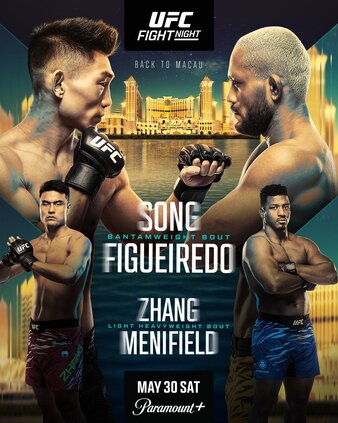
Men's Featherweight Bout • UFC Fight Night: Song vs. Figueiredo
Saturday, May 30, 2026 • 30 ft Octagon (Galaxy Arena, Macau)
Explore Detailed Fighter Profiles
Click on either the fighter's name or profile image for each fighter to access comprehensive UFC statistics including striking metrics, grappling data, clinch performance, complete fight history, offensive & defensive analytics, and round-by-round breakdowns.

Kangjie Zhu
Fighter Metrics
Victory Methods
Win Round Distribution

Rodrigo Vera
Fighter Metrics
Victory Methods
Win Round Distribution
📋 Last 5 Fights - Kangjie Zhu
| Date | Opponent | Result | Method |
|---|---|---|---|
| May 23, 2025 | Bin Xie | W | Split Decision (3, 5:00) |
| Aug 23, 2024 | Shin Haraguchi | W | Split Decision (3, 5:00) |
| May 18, 2024 | Tatsuya Ando | W | Unanimous Decision (3, 5:00) |
| Oct 01, 2023 | Huwannixi Wusikenbieke | W | KO/TKO (1, 3:51) |
| Jul 22, 2023 | Min Hyuk Lee | W | KO/TKO (1, 0:20) |
📋 Last 5 Fights - Rodrigo Vera
| Date | Opponent | Result | Method |
|---|---|---|---|
| Aug 01, 2025 | João Oliveira | W | Unanimous Decision (3, 5:00) |
| May 24, 2025 | Jonathan Caetano | W | Unanimous Decision (3, 5:00) |
| Sep 25, 2024 | Arivaldo Lima da Silva | W | Unanimous Decision (3, 5:00) |
| Jul 18, 2024 | Cleverson Luiz | W | KO/TKO (1, 1:20) |
| May 23, 2024 | Carlos Eduardo | W | Unanimous Decision (3, 5:00) |
Technical Analysis
Technical Score
Cardio Score
Overall Rating
📊 Technical Score
Calculated as the average of Striking Composite (68 vs 43) and Grappling Composite (38 vs 47). Zhu’s published row drives his composites; Vera’s grappling estimate is flagged until UFCStats backfills.
💪 Cardio Score
Based on average fight duration, striking rate per minute, takedown rate, and finish rate. Measures cardiovascular endurance and ability to maintain pace throughout fights.
🎯 Overall Rating
Simple average of Technical Score and Cardio Score. Provides a holistic view of fighter capabilities combining skill level with physical conditioning and fight performance.
Striking Composite
Grappling Composite
Technical Radar Comparison
Visual comparison of key performance metrics between both fighters
📊 Detailed Statistical Comparison
🥊 Fight Analysis Breakdown
🧩 Kangjie Zhu Key Advantages
Zhu’s numbers profile like a patient counter-striker: 48% accuracy with 70% strike defense and just 1.33 significant strikes absorbed per minute. That buys him clean optics on the feet against a guy who is modeled closer to 2.9 SApM in regional wars. In a 30-foot cage he can reset off exchanges, refuse to donate rounds on volume alone, and force Vera to pay for every blind step inward.
Zhu is an inch taller with a listed 70" reach vs a more compact opponent whose reach is inconsistently reported. On paper that supports intercept straights, teeps, and high-kick lanes—the same toolkit that showed up in blitz finishes (e.g. sub-30s violence vs Min Hyuk Lee). Vera has to cut the cage with purpose; chasing squared-up in open space is how Zhu’s straight lanes stay live.
The site model tags Zhu with a 72 cardio score alongside three full 15-minute Road to UFC scorecards (two splits). That matters in a 3×5 where there is no “title-round” bailout—if Vera’s entries fade, Zhu can still bank the final frame. His win distribution is bimodal: nine first-round wins vs 10 third-round wins on the internal ledger—either early burst or full-clock experience.
⚠️ Unfavorable Scenarios
Vera’s clearest template is Zhu’s own RTU ledger: against Bin Xie, Zhu lost the significant-strike count (25–29) and lost takedowns 0–4 but still squeaked a split—proof judges can reward control optics. Against Haraguchi he survived 16 takedown attempts. Vera does not need that kind of volume if a few rides convert. Zhu’s modeled 51% takedown defense is the structural hinge next to Vera’s ~1.5 TD15 estimate.
Round 1 is the highest-variance window: Vera packs KO/TKO in bursts (knees, punches, flying knees in the regional résumé), while Zhu carries first-round demolition equity when reads click. If Zhu’s lateral resets get killed and he is repeatedly squared on the fence, Vera’s body locks and trips become a scoring snowball—exactly the fight state where strike defense matters less than top time.
📋 Likely Gameplan
Expect Zhu to probe with jab/rear teep, keep the center when possible, and punish level changes with uppercuts and elbows—denying easy re-shot rhythms after Vera’s best bursts. The goal is to make Vera pay on entries without diving into clinch cycles he does not own statistically.
In round three Zhu needs active scoring, not a fade—split reads already happened twice on RTU. If he is up two rounds, composure matters; if it is even, his cardio edge is the cleaner damage-economy argument provided he is not stuck under rides.
🚀 Rodrigo Vera Key Advantages
Vera’s modeled UFC-style row tilts offense toward ~1.5 takedowns per 15 minutes against Zhu’s 0.33—a different sport than a pure kickboxing match. He also carries a ~0.35 submission rate per 15 with three pro subs on the résumé (guillotine / RNC class on tape). The swing question is not whether he tries hips—it is whether 2–3 quality sequences land without Zhu counter-finishing on the way in.
Half of Vera’s wins are decisions—he is comfortable in 15-minute pacing battles across FFC, LFA, and Shooto-shaped schedules. That pairs with the Xie template: you do not have to out-land Zhu to steal a close card if control and grappling optics compress the striking picture. His only loss is a 2019 unanimous decision; he has never been stopped, reinforcing composure under fire.
⚠️ Unfavorable Scenarios
When Zhu flows—74–14 significant strikes with a clean takedown edge vs Tatsuya Ando—the fight looks like a one-sided distance lesson. Vera cannot let the first clean minutes snowball; empty shots that burn clock while Zhu builds 3:1 optics are how judges get an easy night.
Zhu’s “Hypnotist” rhythm—measure, draw, punish—feeds straight counters, elbows, and head-kick equity. Vera must disguise entries; predictable naked shots into Zhu’s 70% strike defense are how highlight-reel volatility shows up early.
📋 Likely Gameplan
Vera’s best equity opens early: feint upstairs, force reactions, then crash to the hips or body lock. One confirmed takedown reframes judging; ride time and brief submission layers keep Zhu’s hands defensive.
In round three, prioritize control over hero shots: rack small wins on the fence, threaten neck attacks if Zhu fatigues, and avoid the empty-shot cycle that cedes optics to a counter-striker who already proved he can go 15 on RTU—even when down in takedown attempts.
🎯 Fight Prediction Analysis
Data-driven prediction model based on statistical analysis
📊Detailed Analysis Summary
🏟️Cage Dynamics
The 30-foot Galaxy Arena floor cuts both ways: Zhu gets more runway to disengage after winning exchanges, while Vera must deliberately cut space or risk chasing into straight shots. Booking context matters—this matchup replaced Zhu vs Ramon Taveras, trading some RTU symmetry for a fighter who has lived in 15-minute FFC/LFA/Shooto rhythms with a deeper decision portfolio and explicit submission finishes.
🎯Technical Breakdown
The bout largely resolves as open-space striking vs grappling phase changes. Zhu’s published row pairs 48% accuracy with 70% strike defense and 1.33 SApM—if that survives UFC calibration, judges see the cleaner man at distance. Vera’s modeled ~3.1 SLpM, ~57% strike defense, and ~2.9 SApM imply he must trade some risk for entries. The hinge is not volume—it is whether Vera can string 2–3 meaningful wrestling sequences against 51% takedown defense without running into Zhu’s early counter burst or late optics dumps.
🧩Key Battle Areas
Watch three levers: Zhu’s ability to sprawl-and-sting on first entries, Vera’s success pinning hips to the fence, and split card volatility (Zhu’s last two RTU wins were splits). Vera has never been stopped—his downside tends to look like close scorecards, not blowouts. Zhu’s downside can be positional: minutes lost in clinch or on the mat even when significant strikes look competitive, mirroring the Bin Xie fight.
🏁Final Prediction
Net model lean: Zhu by decision or counter-stoppage on the feet (~46–50 hypothetical cages out of 100) versus Vera by decision or submission when control stacks (~30–34). The residual mass lives in Vera R1 power lanes (~8–10) and Zhu round-three separation when entries empty (~6–8). Fair single-market prices align near Zhu −122 / Vera +122 for a 55/45 split—this is closer than a blowout because grappling alignment keeps hedges live.
💰 Betting Analysis: Model vs Market
Detailed value assessment in the betting market
📊Market Odds
🤖Analytical Model
💎Value Opportunities
MAXIMUM VALUE
Model ~54% joint mass on the scorecards (Vera banks minutes + Zhu split history).
GOOD VALUE
Honors Vera’s decision stack and Zhu’s RTU distance optics.
SLIGHT VALUE
Unconditional path ~30% of all outcomes in the breakdown lattice.
⚠️Key Market Discrepancies
- • Underestimates split volatility – Zhu already won twice while losing raw strike or TD totals.
- • TD defense hinge – Vera’s win Sim-path loads on 51% TDDef holding under live pressure.
- • Modeled B-side risk – Vera’s UFCMetrics row is estimated until official data lands; treat live prices accordingly.
🎯 Comprehensive Probabilistic Analysis
100 hypothetical fight simulation based on statistical data
🏆Outcome Distribution - Kangjie Zhu
Cleaner damage economy when grappling does not snowball
Counter lanes + elbows when Vera dives naked
Long-tail squeeze if mat weirdness opens (rare at pro level)
💥Outcome Distribution - Rodrigo Vera
Control-time optics even when losing strike totals
Burst knees/punches before Zhu’s reads settle
Neck ties when scrambles get sloppy
⏰Fight Timeline Analysis
⚡Window of Opportunity - Rodrigo Vera
- • R1 power: Knees and punches before Zhu’s timing locks in.
- • Fence funnel: Cut space instead of chasing in open mat.
- • Quality over volume: 2–3 deep entries beat 16 empty attempts.
🎯Progressive Dominance - Kangjie Zhu
- • Distance management: Reset in the large cage after clean exchanges.
- • Damage economy: 70% StrDef + 1.33 SApM shape scorecards.
- • Close-round awareness: RTU splits mean bank the final frame actively.
🎯 Final Confidence Assessment
Confidence level and uncertainty factors
Confidence Level
Data gaps on Vera’s official UFC row plus Zhu split history cap conviction
✅Supporting Factors
- • Striking composite 68 vs 43 with 70% StrDef for Zhu
- • Cardio model 72 vs 55 — three RTU 15s on ledger
- • 30-foot Galaxy Arena runway helps exits after exchanges
- • Opponent swap: Vera brings more grappling/sub finishes than Taveras on paper
⚠️Risk Factors
- • 51% TD defense vs persistent ~1.5 TD15 threat
- • Split cards already surfaced on RTU
- • Vera’s short-notice power round unknowns
🏁Executive Summary
Zhu’s win thesis is damage economy at distance—70% strike defense, 1.33 SApM, and a 68 striking composite—plus proven 15-minute Road to UFC reps inside a big cage where he can reset. Vera’s thesis is the Bin Xie / Haraguchi control script: force takedowns and top time against 51% takedown defense, layer submissions, and never let the fight look like the Ando blowout. Headline composites favor Zhu; Vera’s alignment on the mat is the live hedge that keeps this matchup inside a 55/45 band instead of a runaway price.
Prediction: Model lean Kangjie Zhu (~55%) most often via decision or late optics; Rodrigo Vera’s clearest lane is a gritty scorecard or sub (~45%) when grappling minutes land clean. The swing variable is whether Vera secures 2–3 quality wrestling sequences without feeding Zhu’s early counter burst—watch RTU strike/total columns plus fence state minute-by-minute.