
Rei Tsuruya vs Jesus Aguilar
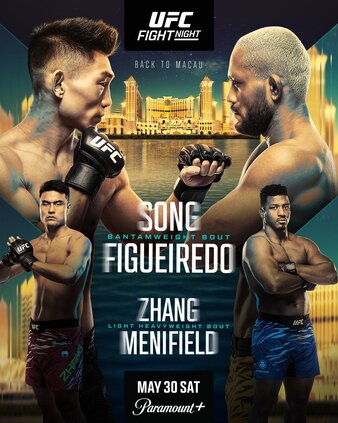
Men's Flyweight Bout • UFC Fight Night: Song vs. Figueiredo
Saturday, May 30, 2026 • Galaxy Arena, Macau — large 30 ft cage (resets matter)
Explore Detailed Fighter Profiles
Click on either the fighter's name or profile image for each fighter to access comprehensive UFC statistics including striking metrics, grappling data, clinch performance, complete fight history, offensive & defensive analytics, and round-by-round breakdowns.

Rei Tsuruya
Fighter Metrics
Victory Methods
Win Round Distribution

Jesus Aguilar
Fighter Metrics
Victory Methods
Win Round Distribution
📋 Last 5 Fights - Rei Tsuruya
| Date | Opponent | Result | Method |
|---|---|---|---|
| 2025-03-08 | Joshua Van | L | Decision - Unanimous (32–59 sig str) (R3, 5:00) |
| 2024-06-29 | Carlos Hernandez | W | Decision - Unanimous (17–16 sig str; wrestling optics) (R3, 5:00) |
| 2023-09-03 | Jiniushiyue | W | KO/TKO (R1, 4:52) |
| 2023-06-03 | Mark Climaco | W | Decision - Unanimous (R3, 5:00) |
| 2023-04-06 | Ronal Siahaan | W | Submission (R2, 3:58) |
📋 Last 5 Fights - Jesus Aguilar
| Date | Opponent | Result | Method |
|---|---|---|---|
| 2026-02-07 | Sumudaerji | L | Decision - Unanimous (31–62 sig str) (R3, 5:00) |
| 2025-09-13 | Luis Gurule | W | Decision - Unanimous (85–65 sig str) (R3, 5:00) |
| 2024-09-07 | Rafael Estevam | L | Decision - Unanimous (wrestling map) (R3, 5:00) |
| 2024-08-17 | Stewart Nicoll | W | Submission - Guillotine (R1, 2:39) |
| 2024-01-13 | Mateus Mendonça | W | Decision - Split (R3, 5:00) |
Technical Analysis
Technical Score
Cardio Score
Overall Rating
📊 Technical Score
Calculated as the average of Striking Composite (41 vs 45) and Grappling Composite (47 vs 42). Balances overall striking effectiveness with grappling ability to measure complete technical skills for this flyweight pairing.
💪 Cardio Score
Based on average fight duration, striking rate per minute, takedown rate, and finish rate. Measures cardiovascular endurance and ability to maintain pace throughout fights.
🎯 Overall Rating
Simple average of Technical Score and Cardio Score. Provides a holistic view of fighter capabilities combining skill level with physical conditioning and fight performance.
Striking Composite
Grappling Composite
Technical Radar Comparison
Visual comparison of key performance metrics between both fighters
📊 Detailed Statistical Comparison
🥊 Fight Analysis Breakdown
🧩 Rei Tsuruya Key Advantages
Tsuruya's official takedown throughput is the structural hinge: he lands attempts in bunches and chains second and third efforts at the fence — the same force that produced heavy control and a ground-heavy strike map versus Carlos Hernandez (including a round where the optics shifted on top). Aguilar is more of a selective snatcher than a spammer; Estevam/Sumudaerji receipts show what happens when opponents deny clean resets and pile positional minutes. If Rei keeps entries technical, he forces the fight into the zone where his ledger is built: rides, mat returns, and visible top work.
On the UFCstats-style row used for this page, Tsuruya retains the accuracy edge (52% vs 38%) while absorbing fewer significant strikes per minute (2.01 vs 2.29). That matters because his career damage ratio in the warehouse is still negative — he can look "busy wrong" at range when a sharp mover makes him miss — but against Aguilar the script is different: Rei isn't trying to win a pure touch-count in space; he's trying to convert entries into top time where his ground accuracy profile is loud.
Modeled control time per round favors Tsuruya by a wide margin — the quiet scoreboard that converts 29–28s when strikes look close. Warehouse tags also paint him as Elite Activity with a brutal slow-start ramp: early rounds can look muted, then the attempt rate and urgency climb (even the Van loss featured his highest shot-activity in Round 3). In a three-round flyweight, banking a Hernandez-style identity round matters more than flash in the first three minutes.
⚠️ Unfavorable Scenarios
Joshua Van's 32–59 significant-strike card is the caution tape: when Tsuruya chases a kickboxing fight against a cleaner stand-up operator, the optics collapse quickly. Aguilar isn't identical to Van, but his defensive shell and distance accuracy (modeled ~55% at range) mean Rei can still "lose pretty" if shots are telegraphed and resets are free.
Aguilar carries real front-head equity: an "Early Hunter" submission timing profile with a huge share of tracked attempts in Round 1, plus a proven guillotine finish (Nicoll). Every lazy double or head-outside entry is a sweepstakes ticket for Jesus — the single largest finish-variance skew in the matchup.
📋 Likely Gameplan
Hand-fight first, disguise level changes behind feints, and avoid jogging into Aguilar's counters in a big cage. The payoff isn't one blast double — it's repeated mat returns that deny the orbit Tsuruya loses when Jesus gets wide, lateral space after stuffed layers.
Once top position stabilizes, prioritize safe control with meaningful ground strikes — judges in three-round flyweights still punish "blanket" minutes. The Hernandez tape is the template: a round where top time and ground clusters flip the card without needing a hero sub attempt that gifts scrambles.
🚀 Jesus Aguilar Key Advantages
Aguilar's defensive batting average is the engine of his upset math: paired with modeled ~55.3% distance accuracy, he can steal optics in minutes where Rei looks busier than he is effective. Warehouse ranks frame him near the top of flyweight avoidance — the profile that survived bad moments against sharp stylists unless pace or wrestling maps run away (Sumudaerji/Estevam receipts).
Baseline pace tags read Low Output, but the Gurule tape is proof of a ceiling: ugly, judge-friendly activity spikes exist when Aguilar embraces volume. Mixed head/body/leg targeting (~55 / 21 / 24 ledger shares) lets him disrupt entries without requiring a knockout — useful when Tsuruya is hunting collar ties for rides.
Submission wins are real — not gimmick optics — with a motif of guillotines off defensive transitions (Nicoll) and scramble threat even in losses (multiple Estevam attempts). Rei's shot entries are the ignition switch: sloppy posture doubles the variance that keeps Aguilar live as a finishing underdog even when minutes favor the wrestler.
⚠️ Unfavorable Scenarios
Aguilar loses judge maps badly when wrestlers consolidate top time — Estevam's disparity and Rei's Hernandez blueprint are mirrored lessons. Passive survival under rides without reciprocating optics is the shortest path to 30–27 scorecards despite a durable chin tag.
When urgency never arrives and he stays in shelled-movement mode, judges tilt toward Rei's attempt volume and control seconds even without massive damage — especially in a three-round sample where Round 3 is the only true "late" frame. Aguilar's win condition often demands either a neck moment or an ugly-volume spike similar to Gurule, neither of which guarantees itself.
📋 Likely Gameplan
Use resets after exchanges to widen geography — Tsuruya wins when he cuts cage and collapses Aguilar linearly into fence drags; Jesus survives when lateral exits stay clean. Burst hand-fighting and collar ties punish low hands during level changes while keeping head position disciplined.
Threaten snap-down guillotine windows early when posture breaks, then escalate: modeled head-targeting climbs into Round 3 (+23.6 pts shift) mirrors a kickboxing sprint / desperation sub profile if rounds feel lost. Rei's modeled R3 output lift (~213%) means Aguilar rarely secures cruising speed — he either builds banked moments or loses minutes.
🎯 Fight Prediction Analysis
Data-driven prediction model based on statistical analysis
📊Detailed Analysis Summary
🏟️Cage Dynamics
The Macau card runs in the large 30 ft cage— a geometry that theoretically helps Aguilar recycle space if Tsuruya chases squared, linear entries. Conversely, Rei only "wins" cage math when he cuts resets instead of sprinting naked shots: two clean fence pins can swipe a close flyweight minute without flashy damage. Translation: resets early often look better for Jesus; cumulative control and mat returns degrade that edge if Rei stays disciplined entering ties.
🎯Technical Breakdown
Three lenses matter: UFCstats-rate comparison (posted on this page), modeled spatial mixes, and bout receipts (Van / Hernandez vs Gurule / Sumudaerji / Estevam). The posted row makes the trade stark: Rei leads accuracy (52% vs 38%), takedowns (5.06 vs 1.52 TD15), and absorbs fewer significant strikes per minute while Jesus owns strike defense (61% vs 42%) and nominal volume (2.54 vs 2.24 SLpM). statistical record phase shares emphasize Rei's canvas-written wins and Jesus's predominantly upright ledger — stylistic poles, not a coin flip in no-man's land.
🧩Key Battle Areas
The fight compresses into four hinges: (1) entry discipline — Rei's best is Hernandez control, his worst Van optics; (2) guillotine tax — Aguilar's timing label stacks danger in the first wrestling exchanges; (3) judge-visible offense — blankets lose; grounded strikes score; (4) three-round semantics — Round 3 is the only "championship" equity window both fighters share as modeled Strong Finishers.
🏁Final Prediction
Model headline (mental Monte Carlo anchored to breakdown): Rei Tsuruya by decision (~35% of all outcomes) stands tallest — chaining fence rides and visible top strikes across two of three rounds. KO/TKO (~18%) stays live via attritional clinch damage or blunt ground strikes. Rei's submission slice (~8%) prices opportunistic attacks mid-ride versus a scrambling opponent. Aguilar (~39% combined) clears most often via decision (~21%) when he owns pace arcs like Gurule, submission (~12%) on early guillotine or scramble panic, or KO/TKO (~6%) counters when Rei squares into shell-breaking shots — still the narrow limb.
💰 Betting Analysis: Model vs Market
Detailed value assessment in the betting market
📊Market Odds
🤖Analytical Model
💎Value Opportunities
MAXIMUM VALUE
Model: ~56% distance | breakdown fair near -125 — guillotine / panic subs keep non-distance paths respectably live
GOOD VALUE
Model: 12% absolute | largest single finish lever for the underdog when entries get sloppy
SLIGHT VALUE
Model: 35% absolute | primary scorecard path when control consolidates without a finish
⚠️Key Market Discrepancies
- • Guillotine skew – Books can understate front-head variance versus a chain wrestler with neck exposure on entries.
- • Three-round judging noise – One stolen swing round + one near sweep flips cards without a finish.
- • Low-output survival traps – Market may overweight defense optics while underweighting invisible control seconds for Rei.
🎯 Comprehensive Probabilistic Analysis
100 hypothetical fight simulation based on statistical data
🏆Outcome Distribution - Rei Tsuruya
Fence steering + Hernandez-style optics on cards
Clinch attrition / accumulative grounded damage
Opportunistic attacks during rides vs scrambler
💥Outcome Distribution - Jesus Aguilar
Counter bursts if Tsuruya squares on exits
Gurule-style pace spikes + defensive optics
Early guillotine / scramble neck attacks
⏰Fight Timeline Analysis
⚡Window of Opportunity - Jesus Aguilar
- • Minute 0–4: Highest guillotine / snap-down equity before reads tighten.
- • Open space: Force lateral resets to dull fence chains — avoid dying in pocket without counters.
- • R3 sprint: Modeled upstairs shift fights close scorecards once urgency spikes.
🎯Progressive Dominance - Rei Tsuruya
- • Chain wrestling: Second and third-layer shots break 45–50% TD defs over time when timed well.
- • Ride optics: Ground strikes tilt judges more than stalled attempts.
- • Late pacing: Modeled Strong Finisher + R3 output lift closes remaining swing minutes.
🎯 Final Confidence Assessment
Confidence level and uncertainty factors
Confidence Level
Solid lean to Rei — guillotine + small UFC sample inject real variance
✅Supporting Factors
- • Flyweight TD throughput gap (5.06 vs 1.52 TD15) & control priors
- • Accuracy edge + lower SApM on the posted comparison row
- • Youth/regression + wrestling redundancy in late R3
- • Strong Finisher tag still pairs with slow-start acceptance
⚠️Risk Factors
- • Guillotine traps / Early Hunter sequencing
- • 61% striking defense baseline + Gurule-volume ceiling
- • Macau judging noise / three-round judging volatility
🏁Executive Summary
Rei Tsuruya brings the statistically louder wrestle-forward lens — gigantic TD throughput, modeled control-second advantages, and a Hernandez template for flipping optics with rides + grounded strikes. Jesus Aguilar answers with arguably the cleaner avoidance/defense toolbox on the feet, diversified targeting, and credible front-head violence that spikes finish equity any time Rei dives with exposed posture. Cage geometry (30-footer) and three-round scarcity sharpen the swings: Aguilar thrives with clean resets early; Rei accrues if he cuts cage and denies those orbitals.
Prediction: Model headline ~61–39 Rei — most likely Rei by Decision (~35% absolute) behind chained fence wrestling and consolidated top work; Aguilar's strongest live lanes remain submission (~12% absolute) and counter-driven scorecards (~21% absolute) rather than cold KO power. Conviction tempered to 7 / 10 owing to neck variance and small-sample UFC tape on both sides.