
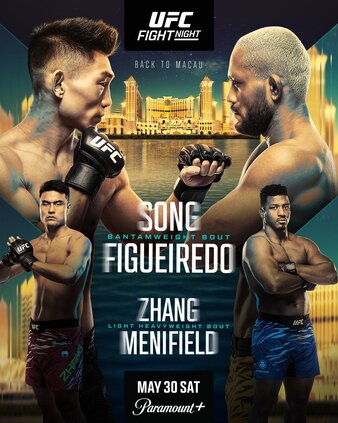
Sergei Pavlovich vs Tallison Teixeira
Men's Heavyweight Bout • UFC Fight Night: Song vs. Figueiredo
Saturday, May 30, 2026 • Galaxy Arena, Macau — 30 ft octagon (large cage)
Explore Detailed Fighter Profiles
Click on either the fighter's name or profile image for each fighter to access comprehensive UFC statistics including striking metrics, grappling data, clinch performance, complete fight history, offensive & defensive analytics, and round-by-round breakdowns.

Sergei Pavlovich
Fighter Metrics
Victory Methods
Win Round Distribution
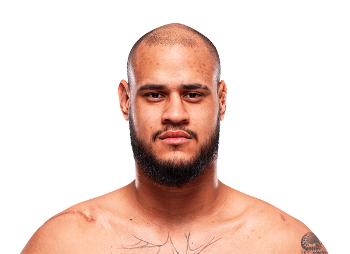
Tallison Teixeira
Fighter Metrics
Victory Methods
Win Round Distribution
📋 Last 5 Fights - Sergei Pavlovich
| Date | Opponent | Result | Method |
|---|---|---|---|
| 2025-08-23 | Waldo Cortes-Acosta | W | Decision - Unanimous (R3, 5:00) |
| 2025-02-01 | Jairzinho Rozenstruik | W | Decision - Unanimous (R3, 5:00) |
| 2024-06-22 | Alexander Volkov | L | Decision - Unanimous (R3, 5:00) |
| 2023-11-11 | Tom Aspinall | L | KO/TKO - Punches (R1, 1:09) |
| 2023-04-22 | Curtis Blaydes | W | KO/TKO - Punches (R1, 3:08) |
📋 Last 5 Fights - Tallison Teixeira
| Date | Opponent | Result | Method |
|---|---|---|---|
| 2026-01-11 | Tai Tuivasa | W | Decision - Unanimous (R3, 5:00) |
| 2025-09-27 | Derrick Lewis | L | KO/TKO - Punches (R1, 0:35) |
| 2025-05-10 | Justin Tafa | W | KO/TKO - Elbows and punches (R1, 0:35) |
| 2024-10-08 | Arthur Lopes | W | KO/TKO - Punches (R1, 1:57) |
| 2023-11-03 | Matheus Fonseca | W | KO/TKO - Head kick and punches (R1, 1:55) |
Technical Analysis
Technical Score
Cardio Score
Overall Rating
📊 Technical Score
Calculated as the average of Striking Composite (52 vs 48) and Grappling Composite (49 vs 44). Pavlovich’s edge comes from strike defense and validated TD denial versus Teixeira’s higher TD15 pressure but shallow UFC grapple-defence sample.
💪 Cardio Score
Anchored on fight duration, pace load, wrestling tax, and HW finishing volatility — Pavlovich gets the nudge after consecutive ranked heavyweight scorecards; Teixeira still has the Tuivasa proof-of-length counterpoint if the storm misses.
🎯 Overall Rating
Simple average of Technical Score and Cardio Score. Provides a holistic view of fighter capabilities combining skill level with physical conditioning and fight performance.
Striking Composite
Grappling Composite
Technical Radar Comparison
Visual comparison of key performance metrics between both fighters
📊 Detailed Statistical Comparison
🥊 Fight Analysis Breakdown
🧩 Sergei Pavlovich Key Advantages
FightMetric-style defence (55% vs 42%) is the clearest separator once you fold heavyweight counter-risk into the picture: Pavlovich hides behind structure more reliably while Teixeira’s eye-catching accuracy still pairs with getting touched when opponents answer back. Southpaw straight lines also bother orthodox swings—especially if Tallison squares off long entries the way he did versus Derrick Lewis.
Modern tape shows Pavlovich “learning to win ugly”: back-to-back unanimous decisions over durable ranked heavies prove he can bank optics without needing a hail-mary swarm every minute. That matters in a 3×5 where the fight can easily reach the scorecards—his cardio score nudges higher partly because those long samples exist against real gatekeepers, not just crash-out KOs.
Pavlovich is not a heavy initiator (0.48 TD15), but his 75% takedown defence is validated in a deep UFC sample—so Teixeira’s larger TD15 (2.48) is live pressure, not a guaranteed positional takeover. The live handicap is whether Tallison can turn attempts into ride time before Pavlovich circles off in the 30 ft cage and rebuilds distance.
⚠️ Unfavorable Scenarios
Teixeira’s indexed-round posture is brutally front-loaded: the statistical record tags a Fades Late motif while still carrying scary clinch/GP kill shots (Tafa elbows, Lewis lessons in what not to do). If Pavlovich resets poorly after an entry, the towering Brazilian can hammer downward shots in tie-ups—exactly the phase where his offensive profile diverges most from Pavlovich’s distance-first lifestyle.
Pavlovich’s loss to Alexander Volkov is the cautionary tale: high throw rate without cutting the cage, accuracy cratering into the 30s, and a near 2:1 sig-strike deficit. If he over-chases a taller man and eats counter hooks on the way in, judges can swing optics fast—even in a fight where his baseline defence metrics look cleaner on paper.
📋 Likely Gameplan
Expect Pavlovich to prioritize fence-side resets, a punishing rear left straight lane against an orthodox lead, and disciplined denial of cheap chest ties after failed blitzes. Low kicks / calf work to blunt Tallison’s entries pair with the breakdown’s spatial read: Pavlovich’s offensive world still lives overwhelmingly at distance in indexed data.
The Cortes-Acosta template (61–45 over 15) is the modern safety valve: positive differentials without reckless chase. If Round 3 arrives, Pavlovich’s modelled output curve inclines while Teixeira’s front-loaded curve cools—making minute-winning kickboxing a credible path, not a fantasy.
🚀 Tallison Teixeira Key Advantages
Estimated pacing tags Teixeira with higher modeled first-round striking output than Pavlovich—aligned with a career spent cashing sub-minute avalanches and brutality in the clinch. At heavyweight, that is not “scoreboard volume”; it is pure truncation risk if Pavlovich squares on the reset.
Tallison gives up a tick of reach but buys skyline shots and steep elbows when he folds posture chest-to-chest. His TD15 signals real ride-the-clock intent against lower legs of the divisional sample—relevant after the Tuivasa rebound proved he can grind minutes when violence does not arrive instantly.
⚠️ Unfavorable Scenarios
The Lewis loss is the cleanest “what not to do” reel: reckless entry, hands low, and a veteran hook that ends the night in 35 seconds. Pavlovich is not Lewis stylistically—but he is exactly the archetype who punishes naked midline approaches with short, heavy southpaw straights if Tallison dives without setup layers.
Computed-distance share diverges hard: Pavlovich’s profile clusters as a stand-up-first heavyweight, while Teixeira’s indexed rounds skew far more mat/clinch-heavy. If Pavlovich denies rides and keeps the fight in straight-shooting space, Tallison must win with fewer, higher-variance swings—exactly where 42% strike defence on the UFC line hurts on the exchanges that do materialize.
📋 Likely Gameplan
The playbook centers feints, disciplined cage-cutting, and first-clinch elbows/knees once Pavlovich stalls. Trip entries and body-lock sequences matter because control seconds per indexed round run high for Tallison when he does hit grappling phases—close rounds can swing on optics if he steals top time after failed blitzes.
Coaches may push a disciplined “sell the soul for minute one” blitz—but the Tuivasa performance proved there is a Plan B: extend, grapple minutes, and trust conditioning if the detonation window closes without landing the lottery shot.
🎯 Fight Prediction Analysis
Data-driven prediction model based on statistical analysis
📊Detailed Analysis Summary
🏟️Cage Dynamics
The 30 ft Galaxy Arena cage buys Pavlovich more reset space to circle off Teixeira’s lead hand and punish linear entries with southpaw straights—exactly the geometry the breakdown leans on for “patient Sergei.” The trade: if Pavlovich chases like the Volkov fight, Tallison’s height and counter hooks/elbows on the break become live in a hurry.
🎯Technical Breakdown
Two heavyweight universes collide statistically: Pavlovich lives at range in indexed samples; Teixeira’s rollups skew far more clinch/mat-heavy with explosive R1 output priors. The striking-defence gap (55% vs 42%) and Pavlovich’s validated 75% TD defence anchor the model lean, while Teixeira’s 2.48 TD15 and elbow/knee fingerprints keep the finishing distribution fat-tailed for both sides.
🧩Key Battle Areas
(1) Who wins the first 90 seconds of chest-range—Teixeira’s avalanche vs Pavlovich’s intercept discipline. (2) Whether TD attempts convert to ride time or become risky level-changes into left hands. (3) Round 3 optics if the fight is upright: modelled late-round striking tilt favours Pavlovich more than Tallison’s front-loaded curves on paper, with the Tuivasa rebound as a real counter-example for Teixeira’s cardio skeptics.
🏁Final Prediction
Monte-Carlo style pathway weights from the Macau breakdown cluster around ~40% “patient Sergei” scorecard/late-offence wins, ~25% R1 “Xicão storm,” ~20% early blitz Pavlovich, and a residual “Volkov mirror” tail where chasing costs optics. Net headline: Pavlovich 62% · Teixeira 38%, fair-style backbone −163 / +163 with KO/TKO mass the dominant lane for both men.
💰 Betting Analysis: Model vs Market
Detailed value assessment in the betting market
📊Market Odds
🤖Analytical Model
💎Value Opportunities
MAXIMUM VALUE
Model: ~38% absolute KO/TKO — heavyweight’s dominant lane
GOOD VALUE
Stacked decision mass + Teixeira UD tail (~6%) keeps “distance” alive
SLIGHT VALUE
~53% sim mass past R1 midpoint — still trimmed by HW first-shot curvature
⚠️Key Market Discrepancies
- • Overweights Teixeira’s paper accuracy without marrying it to defence, TD-defence sample noise, and Pavlovich’s recent decision templates.
- • Sleeps on large-cage footwork — space initially helps the patient counter until rides and tie-ups steal optics.
- • Under-models finish clustering — both men still carry R1 nuke equity even when the “smart” pick is process-heavy.
🎯 Comprehensive Probabilistic Analysis
100 hypothetical fight simulation based on statistical data
🏆Outcome Distribution - Sergei Pavlovich
Cortes-Acosta / Rozenstruik patient templates
Still carries the Blaydes-level early detonation ceiling
Roundoff mass in sim — not his historical lane
💥Outcome Distribution - Tallison Teixeira
Primary live lane — elbows/knees early
Tuivasa rebound proves minutes exist — still thin sample
Tail outcome — symbolic pricing in books
⏰Fight Timeline Analysis
⚡Window of Opportunity - Tallison Teixeira
- • First round: Crash distance and force clinch/GP—indexed output curves peak early.
- • Feints: Draw counters from Pavlovich, then change levels into rides.
- • Damage pocket: Hammer elbows when Pavlovich squares after blitz resets.
🎯Progressive dominance - Sergei Pavlovich
- • Distance boxing: Force kickboxing minutes where indexed samples say he lives.
- • Layered jab/low kick: Steals rhythm and discourages naked entries.
- • Round 3 optics: Modelled ramp vs a front-loaded opponent if the fight is still vertical.
🎯 Final Confidence Assessment
Confidence level and uncertainty factors
Conviction level
Lean Pavlovich on defence and process — HW volatility caps arrogance
✅Supporting Factors
- • Strike-avoidance sample edge (55% vs 42% Str Def)
- • Cortes-Acosta / Rozenstruik proof of 15-minute heavyweight scoring
- • Validated 75% TD defence vs uncertain Tallison UFC denominator
- • 30 ft cage resets + southpaw straight lanes vs linear power
⚠️Risk Factors
- • Teixeira’s first-round kinetic ceiling and clinch elbows
- • One-shot heavyweight curvature — Aspinall reminds everyone nobody is “safe”
- • Thin Teixeira indexed-round telemetry vs deep Pavlovich rows
🏁Executive Summary
Experience plus defensive striking economics meets youthful tower-of-power volatility: Pavlovich’s trajectory (patient UD wins after setbacks) contrasts with Teixeira’s boom-bust arc (Lewis catastrophe → Tuivasa rebound). Shared-opponent reads (Lewis, Tuivasa) frame finish pressure versus durability tension without chaining lazy MMA math. Spatially, Pavlovich still clusters as a distance-first heavyweight while Tallison’s indexed rounds skew clinch- and mat-heavier — so the handicap is whether Teixeira can force chest-range before Pavlovich settles into straight-shot kickboxing.
Prediction: Model backbone Pavlovich 62% (Teixeira 38%), fair-style −163 / +163 — violent endings in plenty of rolled universes, but fewer repeatable winning chaos threads for Tallison unless panic structures reappear after the first storm.