
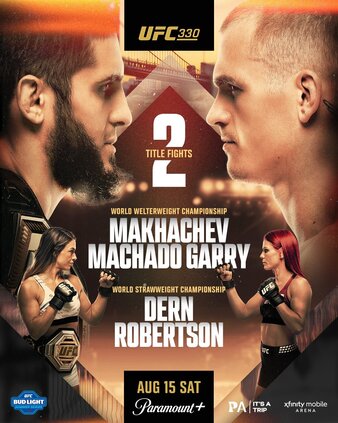
Islam Makhachev vs Ian Machado Garry
Welterweight Bout • UFC 330: Makhachev vs. Machado Garry
Saturday, August 15, 2026 • Xfinity Mobile Arena, Philadelphia, Pennsylvania, United States
Explore Detailed Fighter Profiles
Click on either the fighter's name or profile image for each fighter to access comprehensive UFC statistics including striking metrics, grappling data, clinch performance, complete fight history, offensive & defensive analytics, and round-by-round breakdowns.
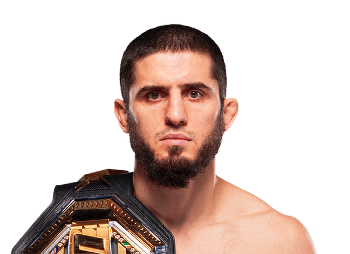
Islam Makhachev
Fighter Metrics
Victory Methods
Win Round Distribution

Ian Machado Garry
Fighter Metrics
Victory Methods
Win Round Distribution
📋 Last 5 Fights - Islam Makhachev
| Date | Opponent | Result | Method |
|---|---|---|---|
| Nov 2025 | Jack Della Maddalena | W | Decision — Unanimous (R5, 5:00) |
| Jan 2025 | Renato Moicano | W | SUB — Rear Naked Choke (R1, 4:05) |
| Jun 2024 | Dustin Poirier | W | SUB — Front Choke (R5, 2:42) |
| Oct 2023 | Alexander Volkanovski | W | KO/TKO — Head Kick (R1, 3:06) |
| Feb 2023 | Alexander Volkanovski | W | Decision — Unanimous (R5, 5:00) |
📋 Last 5 Fights - Ian Machado Garry
| Date | Opponent | Result | Method |
|---|---|---|---|
| Feb 2026 | Belal Muhammad | W | Decision — Unanimous (R3, 5:00) |
| Aug 2025 | Carlos Prates | W | Decision — Unanimous (R5, 5:00) |
| Dec 2024 | Shavkat Rakhmonov | L | Decision — Unanimous (R5, 5:00) |
| Jun 2024 | Michael Page | W | Decision — Unanimous (R3, 5:00) |
| Feb 2024 | Geoff Neal | W | Decision — Split (R3, 5:00) |
Technical Analysis
Technical Score
Cardio Score
Overall Rating
📊 Technical Score
Calculated as the average of Striking Composite (62 vs 59) and Grappling Composite (81 vs 40). Balances overall striking effectiveness with grappling ability to measure complete technical skills.
💪 Cardio Score
Based on average fight duration, striking rate per minute, takedown rate, and finish rate. Measures cardiovascular endurance and ability to maintain pace throughout fights.
🎯 Overall Rating
Simple average of Technical Score and Cardio Score. Provides a holistic view of fighter capabilities combining skill level with physical conditioning and fight performance.
Striking Composite
Grappling Composite
Technical Radar Comparison
Visual comparison of key performance metrics between both fighters
📊 Detailed Statistical Comparison
🥊 Fight Analysis Breakdown
🧩 Islam Makhachev Key Advantages
Makhachev's 3.20 takedowns per 15 minutes at 54% accuracy (roughly 4th of 54 welterweights) tower over Garry's estimated ~0.3 TD/15 and ~68% takedown defense — a number Shavkat Rakhmonov already cracked over five rounds. He chains entries: feint the strike, change levels, drive to the body-lock, and finish against the fence where his clinch wrestling lives. Garry's length makes each shot a longer journey, but across 25 championship minutes the cumulative probability of repeated successful entries is high, and every completed takedown resets the fight into the phase Makhachev owns.
This is the single most important trend in the fight: Makhachev's control time increases every round — 117 → 138 → 158 → 169 seconds — averaging roughly 135 seconds of control per round. He does not fade in the grappling; he intensifies. By rounds three and four he is holding dominant position for nearly three of every five minutes, banking rounds on the cards and draining the legs Garry needs for the late-round striking volume that is his only path to a decision.
Makhachev's game is not control-for-points — it is an active finish. His 1.13 submissions per 15 minutes and 13 career subs (including a fifth-round front choke on Dustin Poirier) mean the arm-triangle and rear-naked choke are live from every top position he reaches. On the feet he barely gives anything back: 1.55 strikes absorbed per minute is roughly 60% below the division average and the best mark in this matchup, so even a high-output Garry striking round lands fewer clean shots than it would on anyone else.
⚠️ Unfavorable Scenarios
Garry's calf kicks and front kicks land early and often, compromising Makhachev's drive base before he establishes his grappling rhythm — Volkanovski used exactly this attack to trouble Makhachev's legs in their first fight, and Garry throws it from a longer frame. Each takedown then comes slower and costs more energy, extending the striking phase where Garry's length and volume can bank rounds. If the leg damage accumulates before the wrestling takes hold, the champion's whole timeline slides in the challenger's favor.
The 6'3" frame proves genuinely hard to plant. Garry sprawls, frames, and circles off the fence, and the fight stays vertical where the striking is close to a coin flip. Makhachev's low striking volume (2.63 SLpM by design) then works against him on the scorecards, and a fresh 28-year-old out-lands a 34-year-old over the championship distance for a close, competitive decision — the one path where the champion's deliberate, control-first game becomes a liability rather than an asset.
📋 Likely Gameplan
Use level-change fakes and the southpaw straight to make Garry hesitate, then step inside the 74.5" reach where the kicks lose their power. In the open-stance configuration both power hands share the same lane, but Makhachev does not need to win that exchange — he needs it to be a credible enough threat to disguise the level change and get to the body-lock. Every feint that freezes Garry's feet is a half-step closer to the phase the champion controls.
Against a long, sprawling frame the highest-percentage entries are in the clinch and against the fence rather than reactive doubles in open space. Establish top position, accumulate the escalating control time, attack the body early to drain Garry's cardio, and hunt the submission once his hips tire. There is no reason to trade volume with a longer striker when the grappling gap is this wide — win the fight where the numbers are lopsided, and let the control curve compound through rounds three to five.
🚀 Ian Machado Garry Key Advantages
For once Makhachev is the smaller man. Garry is five inches taller and carries a four-inch reach edge (74.5" vs 70.5") plus a longer leg reach — a larger physical gap than the champion faced when he dethroned Jack Della Maddalena. If Garry fights long — spearing jab, front kick to the body, calf kicks to compromise the drive base — he can make every takedown entry a longer, more telegraphed, more costly journey and keep the fight in the one phase where he genuinely competes.
Zero finishes in 18 professional fights. Elite chin, elite cardio, and a proven ability to survive five hard rounds — including 25 minutes against Rakhmonov's grappling. This is the trait that most suppresses Makhachev's finish probability and keeps a five-round decision alive: if Garry can lose grappling exchanges without being stopped, every surviving round is a round he can try to steal back on the feet, where the striking composites (62 vs 59) are nearly level and his switch-stance craft, spinning attacks and calf kicks are real weapons.
⚠️ Unfavorable Scenarios
Makhachev closes distance behind feints, secures the body-lock, and the fight becomes the Rakhmonov film on hard mode — repeated takedowns, control time climbing from 117 to 169 seconds per round, and rounds Garry simply cannot win from his back. His counters to elite grappling have historically been survival and scrambling, not reversal or offense, and once on the ground his striking output drops to near zero while the champion accumulates control and hunts the finish — applied at a higher level than the man who first exposed this hole.
Garry's average takedown defense cannot handle elite volume; three takedowns in a round lead to top control, ground-and-pound, and a submission sequence — arm-triangle or rear-naked choke — somewhere between rounds two and five. His 25-minute cardio was built fighting at range; spent instead defending takedowns and wall-walking off the fence, it is taxed in a far more expensive currency. If he arrives at the championship rounds already down and drained, Makhachev's fifth-round finishing pedigree (Poirier) can turn a decision into a late stoppage.
📋 Likely Gameplan
Spear the jab, dig the front kick to the body, and teep to keep Makhachev at the end of the 74.5" reach and deny the level-change entry. Garry's round-winning mechanism is distance volume, and it only operates while he is standing and in space. His length and switch-stance angles keep the champion guessing; the discipline is to stay active enough to bank points without drifting into the clinch, where the body-lock and the fence do their work.
Chop the base with calf kicks to degrade the drive and balance that takedowns depend on, making every entry more expensive. Never accept bottom position or fence control — the round is lost the moment Makhachev settles on top, so wall-walk and scramble up on contact. Bank the early rounds while fresh, pick clean, hard counters as the champion enters — a knockdown or a cut changes the calculus — and survive standing into the championship rounds, where length and cardio keep a live path to a decision.
🎯 Fight Prediction Analysis
Data-driven prediction model based on statistical analysis
📊Detailed Analysis Summary
🏟️Range vs Grappling
This matchup is a referendum on one question: can Ian Garry stay standing for 25 minutes? At range, his five inches of height and four of reach make him a live problem — the spearing jab, front kick to the body and calf kicks are genuine round-winners while the fight is vertical. But Makhachev's control time grows every round (117 → 169 seconds), and once he closes behind feints and secures the body-lock, the space Garry needs disappears. The challenger's length is a lifeline only for as long as the fight stays on the feet; the champion's entire plan is to make sure it does not.
🎯Technical Breakdown
The statistical gap sits almost entirely on one axis. Makhachev's 3.20 takedowns per 15 minutes and 91% takedown defense tower over Garry's estimated ~0.3 TD/15 and defensively-cracked ~68% — the widest single-axis mismatch in the fight. On the feet the composites are nearly level (62 vs 59), and Makhachev's best-in-class 1.55 strikes absorbed per minute means even Garry's volume rounds land less than they would on anyone else. Six of seven key metrics favor the champion at a top-6-in-division, elite level; the only column he "loses" is raw striking volume, which is a stylistic choice rather than a weakness.
🧩Key Battle Areas
Three battles decide it: Garry's takedown defense versus Makhachev's chain-wrestling and body-lock entries; the calf kicks that troubled Makhachev's base against Volkanovski versus the level change they are meant to disrupt; and the currency of cardio in the championship rounds. Garry's engine is real, but it was built throwing volume at range — spent instead defending takedowns and wall-walking off the fence, it is taxed far harder, exactly as it was in the one grappling test he has faced. Makhachev's control climbing to 169 seconds in round four is the physical expression of that mismatch.
🏁Final Prediction
The most likely outcome is Islam Makhachev by Decision (34%) — a direct consequence of Garry's never-been-finished durability, which pushes more dominant grappling performances onto the cards than into finishes. His submission path (30%) is the signature route: 13 career subs, elite Sub/15, and a fifth-round finish of Poirier make the arm-triangle and rear-naked choke live from the top control he will accumulate. Garry's cleanest lanes are a competitive five-round decision if he keeps it standing (15%) or a counter / calf-kick KO (10%); his submission path is negligible (1%). The champion retains — most likely by decision or late submission.
💰 Betting Analysis: Model vs Market
Detailed value assessment in the betting market
📊Market Odds
🤖Analytical Model
💎Value Opportunities
MAXIMUM VALUE
Model: 30% | Fair: +233
GOOD VALUE
Model: 40% | Fair: +150
SLIGHT VALUE
Model: 49% | Fair: +104
⚠️Key Market Discrepancies
- • Overweights the "never finished" narrative – depresses Makhachev's fair submission price.
- • Undervalues escalating control – 117→169s of top time banks rounds the market underprices.
- • Reach-gap bias – the 5"/4" edge helps Garry standing, but the grappling gap decides the fight.
🎯 Comprehensive Probabilistic Analysis
100 hypothetical fight simulation based on statistical data
🏆Outcome Distribution - Islam Makhachev
Most likely path — durability pushes wins to the cards
Ground-and-pound on a drained opponent, not a standup KO
Signature path — arm-triangle / RNC from deep top control
💥Outcome Distribution - Ian Machado Garry
Counter shot or accumulated calf-kick damage
Keep it standing, out-land on volume and length over 25
Offensive grappling is not part of his game
⏰Fight Timeline Analysis
⚡Window of Opportunity - Ian Machado Garry
- • First 6–8 minutes: Bank rounds standing before control fatigue.
- • Calf kicks: Chop the drive base to slow the takedowns.
- • Sprawl & rise: Never accept bottom; scramble up on contact.
🎯Progressive Dominance - Islam Makhachev
- • Body-lock entries: Feint, close the reach gap, drive to the fence.
- • Escalating control: 117→169s per round banks the cards.
- • Deep-water hunt: Submission threat live into the championship fifth.
🎯 Final Confidence Assessment
Confidence level and uncertainty factors
Confidence Level
Strong grappling edge, but Garry's size and durability cap the finish rate
✅Supporting Factors
- • Widest single-axis edge: 3.20 vs ~0.3 TD/15, 91% TDDef
- • Control time escalates every round (117→169s)
- • Best-in-class absorption (1.55 SApM) blunts the volume
- • Already dethroned a rangy WW champ (JDM) over five rounds
⚠️Risk Factors
- • 5"/4" size-and-reach gap larger than anything at 170
- • Never been finished in 18 fights; elite cardio
- • Calf kicks troubled Makhachev before (Volkanovski I)
- • Garry has no analytics DB row — profile is estimated
🏁Executive Summary
Across 100 simulations the pattern is one-sided: in roughly 74, Islam Makhachev closes the reach gap behind feints, secures fence and body-lock takedowns against a frame he cannot always plant cleanly but wears down over time, and lets his escalating control curve (117→169 seconds per round) bank rounds while he hunts the submission. Because Ian Garry is exceptionally durable — never finished in 18 fights, with a proven five-round engine — more of those wins land on the cards (34) than in finishes (40 combined). In the other 26, Garry's calf kicks and length keep the fight vertical, his volume banks the early rounds, and either a clean counter drops the champion (10) or he survives the grappling well enough for a competitive decision (15). Makhachev's size disadvantage is real; his everything-else advantage is larger.
Prediction: Makhachev by decision or late submission most likely (34% decision, 30% submission); Garry's upset lane is a standing five-round decision (15%) or a counter / calf-kick KO (10%). The fight is decided by one variable — whether Ian Garry can stay standing for 25 minutes against the best control-and-submission system in the sport — and the number that tells the story is 169: the seconds of control Makhachev averages in round four.