
Jovan Leka vs Max Gimenis
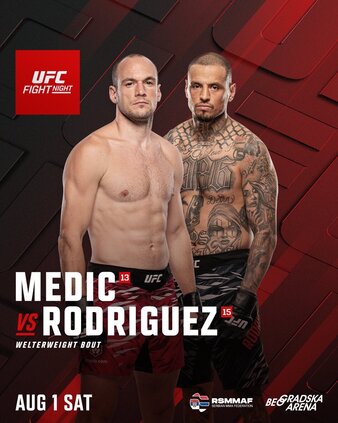
Heavyweight Bout • UFC Fight Night: Medic vs. Rodriguez
Saturday, August 1, 2026 • Belgrade Arena, Belgrade, Serbia
Explore Detailed Fighter Profiles
Click on either the fighter's name or profile image for each fighter to access comprehensive UFC statistics including striking metrics, grappling data, clinch performance, complete fight history, offensive & defensive analytics, and round-by-round breakdowns.

Jovan Leka
Fighter Metrics
Victory Methods
Win Round Distribution

Max Gimenis
Fighter Metrics
Victory Methods
Win Round Distribution
📋 Last 5 Fights - Jovan Leka
| Date | Opponent | Result | Method |
|---|---|---|---|
| 2026-04-11 | Danilo Suzart | W | KO/TKO (Punches) (R2, 1:20) |
| 2026-02-14 | Charlie Milner | W | Submission (Arm Triangle) (R1, 2:36) |
| 2025-10-14 | Azamat Nuftillaev | W | Decision (Unanimous) (R3, 5:00) |
| 2025-07-04 | Genadi Žoržoliani | W | KO/TKO (Punches) (R2, 4:30) |
| 2025-04-12 | Tiago Afonso | W | KO/TKO (Punches) (R1, 1:48) |
📋 Last 5 Fights - Max Gimenis
| Date | Opponent | Result | Method |
|---|---|---|---|
| 2025-11-08 | Josh Hokit | L | KO/TKO (R1, 0:56) |
| 2025-03-29 | Diego Peclat | W | KO/TKO (Punches) (R1, 1:27) |
| 2024-10-05 | John Ott | W | TKO (Punches) (R1, 1:45) |
| 2024-03-30 | Cameron Graham | W | Decision (Unanimous) (R3, 5:00) |
| 2023-10-07 | Derrick Bradley | W | Submission (Rear Naked Choke) (R1, 0:35) |
Technical Analysis
Technical Score
Cardio Score
Overall Rating
📊 Technical Score
Calculated as the average of Striking Composite (66.0 vs 66.0) and Grappling Composite (78.0 vs 55.0). Balances overall striking effectiveness with grappling ability to measure complete technical skills.
💪 Cardio Score
Based on average fight duration, striking rate per minute, takedown rate, and finish rate. Measures cardiovascular endurance and ability to maintain pace throughout fights.
🎯 Overall Rating
Simple average of Technical Score and Cardio Score. Provides a holistic view of fighter capabilities combining skill level with physical conditioning and fight performance.
Striking Composite
Grappling Composite
Technical Radar Comparison
Visual comparison of key performance metrics between both fighters
📊 Detailed Statistical Comparison
🥊 Fight Analysis Breakdown
🧩 Jovan Leka Key Advantages
This is the fight's central collision. Leka carries 7 KO/TKO wins and has never been stopped across 15 pro fights, while both of Gimenis's career defeats are first-round knockouts by strikes — most recently a 56-second blowout by Josh Hokit in his UFC debut, and a David White TKO before that. A power puncher who can't be put away, against a grappler whose chin keeps failing on the feet, is about as clean a stylistic edge as a data-poor matchup offers. His estimated ~55% striking accuracy and low absorption (~3.6 SApM) point the same way: he hits hard, cleanly, and doesn't get hurt while doing it. These are regional-level knockouts, but power travels — and Gimenis's estimated ~42% striking defense is the worst possible frame to bring into it.
Leka is 24 to Gimenis's 33, two inches taller, and the bigger-framed heavyweight at a listed 6'4"–6'5". More importantly, he has proven he can go the distance: a full five championship rounds against Anton Vinnikov and multiple three-round decisions, including the DWCS win over Nuftillaev that earned this contract. Gimenis has exactly one career fight that ever reached Round 2 — his entire body of work is a string of 60-second sprints. In a 3-round heavyweight fight, every minute past the first compounds in the younger, deeper, fresher man's favor, and it is all layered on top of a hometown UFC debut in Belgrade that swings the emotional and adrenaline edge one direction.
The tape that breaks Gimenis's game plan is Leka's R1 arm-triangle submission of fellow grappler Charlie Milner at Brave CF 104. Four of Leka's wins are submissions, three of them arm triangles finished from top position — side control or mount, not off his back. That profile, plus an estimated ~62% takedown defense and a career with zero submission losses, means the classic "striker walks onto a submission" upset path is largely closed. The archetype baselines make it concrete: a pure Striker vs. Submission Artist inverts to just 38.6% for the striker, but a Technical Striker vs. Submission Artist runs 59.4% — and Leka's own top-control grappling puts him firmly in the favorable lane rather than the trap.
⚠️ Unfavorable Scenarios
The cleanest path to a Leka loss runs through a single mistake on the mat. If he over-commits on a shot or a scramble breaks open, Gimenis — an IBJJF World brown-belt champion with a 35-second RNC and a sub-90-second arm triangle on his record — can latch a grip and end the night before Leka's size and youth ever matter. At heavyweight, one world-class submission attempt can erase every physical advantage in one motion. It is a narrow path because Leka grapples well himself, but against this level of finishing craft it is a sharp one.
Leka's entire résumé is regional and developmental — the Balkan/European circuit plus one vetted DWCS win — and his chin has never been tested by elite power, nor his composure by elite pace. If UFC-debut nerves make him tentative and he lets Gimenis, the more experienced top-level competitor, land first with real power, that untested chin meets a different tier of shot. The other version is subtler: he fights down to the level of his opposition, gets drawn into a grappling battle on Gimenis's terms, and a single positional error against a brown-belt world champ is fatal. The step up in competition is the great unknown, and it is where prospects most often disappoint.
📋 Likely Gameplan
Gimenis's chin is the target, and history says it is reachable. Leka should establish range, pressure behind the jab, and hunt the right hand — forcing the grappler to either eat clean heavyweight shots or shoot from distance. His finishing window is front-loaded (six career R1 finishes, five in R2), so the early minutes are exactly where his highest-percentage path lives. The estimated SLpM edge (~4.8 vs ~4.0) and accuracy advantage mean he can win the standing exchanges outright without ever needing to wrestle.
Expect Gimenis to seek the takedown the moment the striking turns dangerous. Leka should sprawl, stay heavy, and turn a stalled shot into his own arm triangle from top — the choke he has finished three times. If it does hit the mat, the instruction is discipline, not a guard-passing chess match with a world champ: control posture, threaten ground strikes, look to stand or finish. And if the early finish isn't there, banking rounds against a 33-year-old fader is a perfectly good Plan B he is uniquely equipped to execute — he gets safer with every minute that passes.
🚀 Max Gimenis Key Advantages
The great equalizer at heavyweight. Gimenis is an IBJJF World brown-belt champion (2016) with a 35-second rear-naked choke and a 1:14 arm triangle on his record — his estimated ~1.6 submissions per 15 minutes towers over the 0.45 heavyweight baseline. If this fight hits the mat in a position he controls, his finishing craft is genuinely elite and Leka's size matters far less. One slip, one scramble, one Leka over-commitment, and the night can end instantly regardless of every physical disadvantage he carries. This single number is where the entire upset case lives.
Gimenis is not harmless on the feet. Three of his six wins are punching TKOs — including quick regional stoppages of Diego Peclat and John Ott — and he carries genuine one-shot heavyweight power. Leka's estimated ~50% striking defense is not airtight, and in a heavyweight firefight anyone can land first. Add that Gimenis is the more experienced top-level competitor here — he has already fought in the Octagon and against nominally tougher opposition than Leka's regional slate — and if the step up exposes real holes in the favorite's game, the underdog's live equity is exactly this: land first, land clean, end it early.
⚠️ Unfavorable Scenarios
The worst case is also the most historically supported one: Gimenis eats a clean heavyweight shot inside the opening minutes, his vulnerable chin gives, and it becomes a third career first-round knockout loss — this time in front of a roaring Serbian crowd. David White did it in 2023 and Josh Hokit did it in 56 seconds in his UFC debut. Against a bigger, younger, harder-hitting man who has himself never been knocked out, "survive the first five minutes" is Gimenis's entire fight, and the data says getting there is the hard part.
The other failure mode has no knockout at all. Gimenis's takedown entries stall against the bigger, takedown- defending Leka, the fight stays standing, and he is simply out-struck and out-paced by the fresher man over fifteen minutes. At 33 with almost no deep-water data — a single career decision to his name — his estimated ~48 cardio score is the wrong tank to bank on a late surge. Or he drags it down but can't finish or hold Leka, who calmly defends, scrambles up, and finishes his own arm triangle from the resulting top position. Every version of the long fight belongs to the Serbian.
📋 Likely Gameplan
Survival depends on it. Every minute on the feet is a minute Gimenis's chin is in danger, so his gameplan is to close the distance, clinch, and drag Leka into the one world where he is the better man. He must weather the debut emotion — let the crowd-fueled Serbian over-extend early, slip the first storm, and counter into a body-lock or a panic-induced scramble where his jiu-jitsu takes over. The problem is that his estimated ~48% takedown accuracy and unproven entries against UFC-sized opposition make the "get it there" half of the plan far harder than the finishing half.
Gimenis's win equity is front-loaded, so his highest- percentage path is a quick rear-naked choke or arm triangle in Round 1 — the only kind of fight he has ever won. If he cannot get the takedown, his single standing hope is to catch Leka clean before Leka catches him: high-risk, but his power is real. A long fight favors the younger man in every phase, so everything hinges on ending it fast. Whatever the route, the clock is his enemy and the opening five minutes are the whole ballgame.
🎯 Fight Prediction Analysis
Data-driven prediction model based on statistical analysis
📊Detailed Analysis Summary
⏳The Clock Is the Whole Fight
Strip this matchup to one variable and it is a time fight. Gimenis's win equity is concentrated in the opening minutes — a fast submission or a first-strike KO — because that is the only kind of fight he has ever had, and because his chin and his age both punish the long version. Leka's win equity does the opposite: it grows with every minute. His power is live in every round, his cardio is proven to three and five rounds, and his durability means he does not have to respect a single Gimenis power shot the way Gimenis must respect his. The favorite gets safer as the fight gets longer; the underdog must win it early or not at all. Both men are data-dark to the analytical engine — one a complete void, the other a roster shell with a single 56-second UFC data point — but the inferences all point the same direction, which widens the error bars without moving the center.
🎯Technical Breakdown
Because neither man is computed, this is a comparison of estimates anchored to the heavyweight division average — and even with wide error bars, the picture is one-directional. Leka projects above the baseline on the feet (est. ~4.8 SLpM, ~55% accuracy, ~3.6 absorbed) and owns the two records that matter most: he hits hard (7 KO) and has never been knocked out (0 stoppage losses). Gimenis projects below the baseline defensively — an estimated ~42% striking defense against the 51.91% baseline — with a documented, repeated, fight-ending chin vulnerability. His single genuine edge is world-class submission skill (est. ~1.6 sub/15 vs the 0.45 baseline), but it is gated behind a takedown game unproven against UFC-sized opposition and a frame that may not survive the time it takes to deploy it. There are no measured numbers here; it is the shape of both careers that points the same way.
🧩The Archetype Trap That Doesn't Apply
The instinctive read — "striker vs. world-class grappler, beware the submission" — is exactly the Striker vs. Submission Artist 38.6% trap (DB, 223 fights) where one-dimensional punchers get tapped. But Leka is misfiled in that bucket. He is a Technical/Well-Rounded striker whose own signature is the arm triangle and who has never been submitted; the applicable baseline is the Technical Striker vs. Submission Artist 59.4% lane (DB, 352 fights). The grappler's primary upset path is real but narrower than it looks, because the man in front of him can grapple too. The one genuine unknown is whether the step up in competition exposes Leka — his regional/Balkan slate never tested his chin with elite power or his composure with elite pace — and that, more than anything Gimenis does, is the source of the underdog's live equity.
🏁Final Prediction
The most likely outcome is Jovan Leka by KO/TKO (38% probability) — his single largest and most history-supported path, walking a chin that has already failed twice onto a clean heavyweight shot inside the first two rounds. His submission path (18%) reflects the top-position arm triangle he has finished three times: if Gimenis pulls guard or a scramble breaks open, the choke is live even against a world-class grappler. His decision path (12%) is the "no finish, but clearly the fresher and busier man over fifteen minutes" route his DWCS and Vinnikov tape prove he can win. Gimenis's best route is his own submission craft (14%), discounted because he must first survive Leka's power and solve a takedown problem he has never solved at this size; his puncher's chance (12%) and a decision (6%) round out the 32%. Combined, roughly 82% of simulations end inside the distance — who finishes whom is the real uncertainty, not whether it ends early.
💰 Betting Analysis: Model vs Market
Detailed value assessment in the betting market
📊Market Odds
🤖Analytical Model
💎Value Opportunities
MAXIMUM VALUE
Model: 82% | Market implied: 72.2%
GOOD VALUE
Model: 38% | Market implied: 41.7%
SLIGHT VALUE
Model: 18% | Market implied: 27.8%
⚠️Key Market Discrepancies
- • Underprices the stacked finish – Two independent finish routes (Leka's power, Gimenis's subs) push the inside-distance line to ~82%.
- • Overvalues the decision – Neither man has a durable, deep-water profile; a scorecard is the least likely outcome for either.
- • Data-dark caution – Both fighters are estimate-only; the 68/32 line is a confident lean, not a lock, so stakes should reflect wide error bars.
🎯 Comprehensive Probabilistic Analysis
100 hypothetical fight simulation based on statistical data
🏆Outcome Distribution - Jovan Leka
Walks a twice-cracked chin onto a clean R1–R2 shot
Top-position arm triangle off a stalled takedown
Fresher, busier man over fifteen minutes
💥Outcome Distribution - Max Gimenis
Best lane — elite IBJJF craft if it hits the mat
One-shot heavyweight power lands first
Least likely — cardio and durability say no
⏰Fight Timeline Analysis
⚡Window of Opportunity - Max Gimenis
- • Round 1 or bust: Every career win is a R1 finish except one — front-load everything.
- • Get it to the mat fast: Clinch, drag it down, and hunt the RNC or arm triangle.
- • Puncher's chance: If it stays standing, land first — his one-shot power is real.
🎯Progressive Dominance - Jovan Leka
- • Walk him onto power: Pressure behind the jab; the chin has cracked twice already.
- • Sprawl and punish: Stuff the shot, then finish his own arm triangle from top.
- • Let the clock work: Younger and deeper — every passing minute belongs to him.
🎯 Final Confidence Assessment
Confidence level and uncertainty factors
Confidence Level
A clear lean on Leka, held with the humility that both men are data-dark and his résumé is untested at this level
✅Supporting Factors
- • Hits hard (7 KO) and has never been finished (0 stoppage L)
- • Opponent's only two losses are both first-round KOs
- • Nine years younger, two inches bigger, proven 3- and 5-round cardio
- • Arm-triangle game closes the grappler's primary upset lane
⚠️Risk Factors
- • Both fighters are estimate-only — wide error bars
- • Leka's competition is soft; his chin untested by elite power
- • Gimenis's IBJJF submission craft can end any round in one grip
- • Heavyweight variance is the highest in the sport
🏁Executive Summary
We run 100 simulations and see one story recur. In roughly 68 of them, Jovan Leka's combination of power, size, youth and durability decides the night — most often (38) by walking a chin that has already failed twice onto a clean heavyweight shot inside the first two rounds; sometimes (18) by turning a stalled Gimenis takedown or a loose scramble into the arm triangle he has finished three times; and the rest (12) by simply being the fresher, bigger, busier man across fifteen minutes the older grappler has rarely had to fight. He is younger, larger, harder to hurt, and at home. In the other 32, the grappler's craft or the heavyweight's eternal puncher's chance takes over — Gimenis survives the early storm and an IBJJF World champion's submission game ends it (14), or in the chaos of two heavyweights with real power he simply lands first (12), or, least likely, he steals a decision the cardio and durability numbers say he shouldn't (6). The whole fight is decided by the clock, and the clock belongs to Leka: Gimenis must finish early, while Leka can win in every round, by every method, and gets safer with each minute that passes.
Prediction: Jovan Leka wins ~68% of the time, most likely by KO/TKO (38%), with a genuine top-position submission path (18%) and a fresher-man decision (12%) behind it. Max Gimenis's live upset equity (32%) runs almost entirely through his elite jiu-jitsu (14%) and a heavyweight puncher's chance (12%). The data is thin on both men, but everything that can be read — power, size, youth, durability and a hometown crowd — points to the Serbian, and the only thing that beats him is a single grip from a world-class grappler he has the tools to deny.