
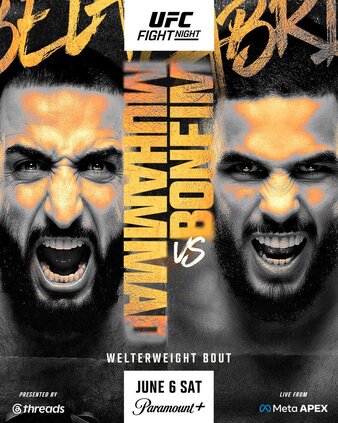
Belal Muhammad vs Gabriel Bonfim
Welterweight Bout • UFC Fight Night: Muhammad vs. Bonfim
Saturday, June 6, 2026 • Meta Apex — 25 ft octagon (small cage)
Explore Detailed Fighter Profiles
Click on either the fighter's name or profile image for each fighter to access comprehensive UFC statistics including striking metrics, grappling data, clinch performance, complete fight history, offensive & defensive analytics, and round-by-round breakdowns.

Belal Muhammad
Fighter Metrics
Victory Methods
Win Round Distribution

Gabriel Bonfim
Fighter Metrics
Victory Methods
Win Round Distribution
📋 Last 5 Fights - Belal Muhammad
| Date | Opponent | Result | Method |
|---|---|---|---|
| 2025-11-22 | Ian Machado Garry | L | Decision - Unanimous (R5, 5:00) |
| 2025-05-10 | Jack Della Maddalena | L | Decision - Unanimous (R5, 5:00) |
| 2024-07-27 | Leon Edwards | W | Decision - Unanimous (R5, 5:00) |
| 2023-05-06 | Gilbert Burns | W | Decision - Unanimous (R5, 5:00) |
| 2022-10-22 | Sean Brady | W | KO/TKO - Punches (R2, 4:47) |
📋 Last 5 Fights - Gabriel Bonfim
| Date | Opponent | Result | Method |
|---|---|---|---|
| 2026-02-14 | Randy Brown | W | KO/TKO - Clinch knee & follow-up (R2, 4:12) |
| 2025-07-12 | Stephen Thompson | W | Decision - Split (R3, 5:00) |
| 2025-02-15 | Khaos Williams | W | Submission - D'Arce Choke (R2, 4:58) |
| 2024-07-13 | Ange Loosa | W | Decision - Unanimous (R3, 5:00) |
| 2023-11-04 | Nicolas Dalby | L | TKO - Clinch knees to ground strikes (R2, 4:33) |
Technical Analysis
Technical Score
Cardio Score
Overall Rating
📊 Technical Score
Calculated as the average of Striking Composite (73 vs 77) and Grappling Composite (78 vs 84), benchmarked vs welterweight division averages. Bonfim grades slightly higher on pure toolbox; Belal's denial plus pacing shows up in cardio/overall.
💪 Cardio Score
Based on average fight duration, striking rate per minute, takedown rate, and finish rate. Measures cardiovascular endurance and ability to maintain pace throughout fights.
🎯 Overall Rating
Simple average of Technical Score and Cardio Score. Provides a holistic view of fighter capabilities combining skill level with physical conditioning and fight performance.
Striking Composite
Grappling Composite
Technical Radar Comparison
Visual comparison of key performance metrics between both fighters
📊 Detailed Statistical Comparison
🥊 Fight Analysis Breakdown
Below: how Belal's denial-and-clock DNA collides with Bonfim's finish-forward wrestling — anchored in UFC Stats-style rates, computed positional splits, targeting drift R1→R3, and RXR receipts (Leon, Burns, JDM, Thompson, Williams, Dalby). The through-line is minutes vs moments: Belal wins median time; Gabriel wins burst clusters early.
🧩 Belal Muhammad Key Advantages
Muhammad's historically massive 90% takedown defense directly intersects Bonfim's offensive identity (3.60 TD15, 55% TD accuracy). Belal's scramble rule — sprawl first, frame second, never donate front-head position — attacks the exact corridor Bonfim uses to chain into squeeze submissions. statistical record wrestling layers show Belal's offense is clinch-born, not reactive folkstyle shots; when he does wrestle, it tends to land as minute theft rather than a submission pipeline.
Contextualize entries with clinch wrestling volume: Belal's historical clinch-TD layer lands roughly 92 clinch TDs on ~238 tries (~39%) — lower raw completion than Bonfim's tagged ~55–56% clinch TD accuracy, but the matchup hinge isn't who shoots prettier — it's whether Gabriel can hold enough rides to drain Belal before neck threats expire. If stuffed entries pile up, Bonfim's thin decision equity (~11% career win share from decisions) surfaces fast.
Round logs describe a steady pace profile: offensive rounds cluster near 20–23 significant strikes landed across R1–R5 with momentum tagged Steady. His ~15:23 average fight time pairs with High pace tier imagery internally (~6.6 strikes/min engagement layer vs Bonfim's ~4.1). Recent receipts still show volume surviving adversity — e.g. 132 significant strikes across five in the JDM loss while pressing — validating minute governance even when optics dip.
Cross-check the treadmill vs receipts: vs Leon, logs emphasize eight landed TD chunks while still posting ~88 significant strikes — the archetype is distance governance + wrestling punctuation. vs Burns, a 132-strike distance grind with zero TDs shows Belal can trust his legs when he wants pure kickboxing minutes. Bonfim's thinner UFC minute library means late-round elasticity is less proven at Belal's depth.
The Meta Apex (25 ft) geometry rewards fence cycles: Muhammad's moderate pressure rate (~0.21) plus counter rate (~0.38) maps to compress → touch → reset → compress again rather than naked swarms. Bonfim's lower pressure rate (~0.14) often waits, then collapses space in one beat — Belal shrinking resets denies clean runway for Bonfim's preferred mid-range rhythm after early leg probes.
Phase-wide fingerprints reinforce both as standing-majority fighters (~ 77% standing time Belal vs ~82.6% Gabriel) — yet Belal's higher control-per-round (~68s vs ~52s) matters when rounds tighten. Distance strike shares sit ~86–88% for both; Bonfim owns the bigger clinch strike footprint (~10% vs ~5%), aligning with knee-first violence more than prolonged GNP (~2% ground strike volume for Gabriel — he's hunting chokes when horizontal).
⚠️ Unfavorable Scenarios
Bonfim's knee rate (~0.79) and double clinch strike share (~10% vs Belal ~5%) mean static over-unders are not Belal's world. The Randy Brown receipt — leg tax → clinch knee finish — is the structural fear: collar ties + downhill knees punish-posture lapses. Muhammad must score short and exit, avoiding lingered front-headlock zones where Bonfim's guillotine-frequency tag (~0.36) spikes.
If Belal ever gets pinned horizontally without an immediate submission escape hatch, note his stark accuracy splits by phase — computed layers put Belal's ground striking accuracy near ~78% on meaningful samples vs Gabriel's ~18% (tiny/noisy but directionally: Bonfim isn't padding rounds with GNP — he's hunting necks). That keeps Belal alive in short top exchanges but raises urgency to avoid extended hang duration in front-head scenarios.
The L2 vs Garry/JDM thread is real: mobile, sharp strikers who defended prolonged grappling forced Belal into range optics where 43% accuracy and 55% strike defense look mortal vs elite hands. Bonfim isn't a photocopy boxer, but his 63% strike defense + 46% accuracy can swing judges in rounds where Muhammad's pressure reads messy unless fence work stays disciplined.
Layer Bonfim's pacing tags: statistical record flags include ~50% slow-start fights yet Strong Finisher momentum — output spikes tend to coincide with kill windows rather than random brawls. Targeting evolution matters too: Bonfim's R3 output averages jump dramatically vs R1 in thin-sample logs when fights survive — but many Gabriel fights simply never arrive there, which keeps Belal's late-round simulation equity honest.
📋 Likely Gameplan
Lead with jab-dominant inventories (~0.67 tool rate) and body crosses to blunt Bonfim's R1 leg-heavy targeting (~40.9% leg share). Use collar frames, deny the second step, and chain fence pins → elbows (~0.44) without gifting neck exposure.
Tape-consistent combo anchors from tagging layers: jab → jab → body cross → lateral exit; fence pin → shoulder line → elbow → re-jab; level-change fake → straight off the break. Belal keeps spinning offense intentionally sparse (~0.13 spinning rate) — repeatability beats lottery kicks against a front-choke grappler.
Ride the computed head-targeting drift (+20.4 pts R1→R3): as Bonfim's leg share collapses late, escalate double-jab → cross bursts. Layer clinch TD attempts as scoring ballast — Belal historically lands chunks (e.g. 8 TD attempts vs Leon) without needing finisher submissions (Sub/15 ~0.1).
Round targeting math backs the script: Belal's model shifts roughly +20.4 pts toward head strikes from R1→R3 while leg volume collapses (~−14.6 pts) — the classic invest legs early, cash heads late when reads sharpen geometry. Maintain Belal's historical ~20+ sig strikes landed per offensive round baseline so judges never hunt a narrative bailout for Gabriel's cleaner single shots.
🚀 Gabriel Bonfim Key Advantages
Bonfim's 63% strike defense vs Belal's 55% is a loud optics lever — statistical record snapshots even flag him at #1 welterweight strike defense in-model. Combined with 46% accuracy vs 43%, he can win cleaner micro-exchanges when Muhammad's entries look sloppy. Distance accuracy splits (43.5% vs 39.3%) reinforce cleaner connections at range when samples stabilize.
Tie defense into absorption economics: Bonfim clocks slightly favorable strikes absorbed per minute (~3.68 vs Belal ~3.82) alongside cleaner optics — he's historically tougher to "cheap shot" at range in statistical terms. Clinch accuracy remains elite on both sides (~57–59%), so tie-ups aren't sloppy — they're high-leverage duels where Gabriel's knee/guillotine inventory matters more than clinch strike volume alone.
Bonfim carries elite TD throughput (3.60 TD15) with efficient completion and a submission roster clustered around D'arce/guillotine chains (Williams template: 3/4 TDs in R1). Submission timing tags emphasize Early Hunter behavior — 60% of tracked sub attempts in R1, 40% in R2, historically sparse afterward — exactly the danger window vs a deny-first veteran if neck discipline slips.
RXR receipts sharpen the threat tree: vs Thompson, Gabriel proved he could mix ~52 significant strikes with five TD attempts across three rounds without getting vaporized on entries — validating patience plus wrestling reads vs elite strikers. vs Williams, three of four first-round takedowns fed directly into the submission arc — the exact Belal nightmare script if posture drops during catches.
⚠️ Unfavorable Scenarios
Career envelopes skew ~7:58 average fight time — fine for blitzes, questionable vs Muhammad's 25-minute governance pedigree. Monte Carlo read: if Bonfim cannot cash early grappling spikes, Belal's R5 output bump (~22.7 sig landed per offensive R5 row avg) meets Bonfim's historical fade priors.
Extended-distance precedent exists but isn't Bonfim's median: vs Loosa he climbed toward 101 significant strikes with escalating output each round — proof he can ugly-manual a scorecard, yet also proof those lanes burn calories opposite Belal's relentless pacing cadence.
Selling wrestling waves into 90% TD defense burns entries on the card — Bonfim's ~11% decision win share becomes the surviving path if rides never stick. The Dalby template (heavy control minutes early) shows how durable grind can blunt Bonfim's kill rhythm.
RXR on Dalby showed Gabriel absorbing structural control — roughly 4:19 opponent control in R1 alone on one side of the ledger — before the finish cascade; Belal's pace-plus-denial cocktail aims to reproduce that soul-tax without gifting finishing grips.
📋 Likely Gameplan
Open outside/inside low lines (leg-kick tool rate ~0.57) to freeze Muhammad's forward rhythm, then snap step-in knees (~0.79) off hand wins — mirroring the Brown R2 clinch knee kill shot. Leverage 6'1" height for long knees without leaning into extended collar stagnation.
Sell strikes into level changes, hunt hand-trap → snap-down → D'arce/guillotine clusters while submission equity is front-loaded. If extended, avoid pure volume brawls — use #1-tier defensive striking to reset into selective clinch entries rather than trading evenly into Muhammad's treadmill.
Secondary chains echo broader roster receipts: jab → cross → collar tie → knee → trip layer; TD completion → top rides → mount transitions hunting RNC/guillotine when opponents turtle. Bonfim stays disciplined off circus spins (tagged ~0.00) — his variance is front-loaded wrestling IQ, not trick-shot dependence.
🔬 Deeper matchup collisions (statistical record + tape synthesis)
Collision A — Leg kicks vs late head-hunt escalation
Bonfim's opening posture leans leg-heavy (~40.9% of Sig strikes in R1) while Muhammad balances head/body/leg early then reallocates toward ~87% head volume by R3. If calves slow Belal's press, Gabriel earns easier level-change reads; if Belal shrinks second-step reactions with layered jabs and collar frames, Bonfim's entry rhythm dulls just as Belal's targeting climbs.
Collision B — Wrestling vs denial (scorecard physics)
Even pristine TD defense still taxes hips across five rounds — Belal must budget defensive wrestling bursts between offensive bursts. If stuffed-wave totals balloon early without payoffs, Bonfim pays cumulative cardio & optics penalties while Belal's steady strike totals quietly compound.
Collision C — Mutual knee arsenals, divergent intent
Both carry elite knee tags (~0.62 Belal, ~0.79 Gabriel), yet usage diverges: Bonfim hunts fight-ending clinch leverage more often; Muhammad knees more as punitive punctuation exiting stalemates. Who forces tie-ups on their terms decides whether knees score or finish.
Division rank context (snapshot intuition)
Model-derived WW buckets flagged Bonfim near #1 strike-defense tier while ranking his offensive wrestling & submission chase elite — Belal still grades highly on TD offense tier yet dominates narratively through TD defense and pacing composites. Translation: metrics disagree politely; clock architecture breaks ties toward Muhammad unless finishes intervene.
🎯 Fight Prediction Analysis
Data-driven prediction model based on statistical analysis
📊Detailed Analysis Summary
🏟️Cage Dynamics
The 25-foot Apex shrinks Bonfim's runway to reset after leg setups — it helps Muhammad touch → angle → re-press cycles — but it also magnifies one-beat clinch danger (knees + front headlocks). Early, Gabriel's height + step-in knees matter more in compressed geography; late, Belal's historical fence craft and steadier round curves tilt minutes if scrambles stay disciplined.
Practically: Belal wants repeatable fence resets that eat clock without camping — enough strikes per minute that judges never confuse patience for passivity. Bonfim wants corner traps where one collar tie becomes two knees. Who owns the second step after contact usually decides whether the small cage helps the grinder or the assassin.
🎯Technical Breakdown
Two statistical truths duel: Bonfim's offensive toolbox edge (better StrDef, accuracy, TD volume, submission threat) vs Muhammad's denial + duration advantage (90% TDDef, deeper round libraries, steadier sig-strike floors). The matchup resolves on whether Bonfim can convert early grappling spikes before Belal's minute treadmill compounds — especially once Belal's head-share climbs late while Bonfim's leg targeting evaporates in the model.
Neither fighter is a pure specialist: both spend majorities standing, both carry knee-layer tags, and both have credible clinch wrestling — so the tape reads less like "striker vs wrestler" and more like who pays fewer taxes per scramble. Belal taxes Bonfim with denied rides and steady totals; Bonfim taxes Belal with cleaner optics and sudden neck threats when posture dips.
🧩Key Battle Areas
Watch leg kick vs jab/body framing, static clinch vs short exits, sprawl discipline vs chained TDs, and judges' reads on clean counters vs pressure volume. Bonfim's Thompson win validates wrestling-plus-legs homework vs elite strikers; his Dalby loss validates the grind blueprint when kills don't land early.
Secondary reads that swing cards: who initiates clinch first (Bonfim profits when ties become knee corridors); TD attempts as optics even when stuffed (Belal has used wrestling as punctuation without needing finishes); and round-to-round targeting drift — if Belal's head-share spike arrives while Gabriel's calves are compromised, round optics can flip fast even without a knockdown.
🏁Final Prediction
Model median: Muhammad by decision-heavy paths (~44% absolute) inside a 62% aggregate win share, fueled by TD denial, R4–R5 pacing, and accumulation. Bonfim's live lanes concentrate in R1–R2 submission spikes (~18% absolute) plus clinch KO equity (~12%), with only ~8% decision upside historically. Leave bandwidth for volatile judging (~8–12%) of simulations when optics favor cleaner counters.
Scenario shorthand: Belal clears early neck variance → probability clock rises each clean reset; Bonfim banks minutes on top or repeats damaging knees → Belal's decision path thins. The uncomfortable middle is a competitive striking fight where Bonfim wins optics round-to-round — that's where confidence drops even if aggregate numbers still favor Muhammad.
💰 Betting Analysis: Model vs Market
Detailed value assessment in the betting market
📊Market Odds
🤖Analytical Model
💎Value Opportunities
MAXIMUM VALUE
Model: 44% absolute • aligns with distance + pacing spine
GOOD VALUE
Model: 18% absolute • front-choke clustering R1–R2
SLIGHT VALUE
Model ~52% (44% Belal dec + 8% Bonfim dec) vs ~48% finish
⚠️Key Market Discrepancies
- • Overweights flash submissions – Bonfim hype can distort prices vs Belal's decade of denial reps.
- • Under-layers Belal clinch craft – Minute theft TDs rarely pop market sheets but swing cards.
- • Strike optics bias – Bonfim's StrDef may inflate perceived gap unless fence cycles muddy judging reads.
🎯 Comprehensive Probabilistic Analysis
100 hypothetical fight simulation based on statistical data
🏆Outcome Distribution - Belal Muhammad
Primary median — pace + denial + fence governance
Attritional damage if Bonfim fades structurally
Rare — aligns with Sub/15 ~0.1 career threat vs choke-heavy foe
💥Outcome Distribution - Gabriel Bonfim
Early guillotine / D'arce chains — peak R1–R2
Clinch knee spikes when Muhammad overcommits to body locks
Narrow — requires optics edge without finishing
⏰Fight Timeline Analysis
⚡Window of Opportunity - Gabriel Bonfim
- • Rounds 1–2: Highest submission + clinch KO clustering before Belal's pacing compounds.
- • Leg-layer sequences: Outside/inside lows into collar ties set step-in knees.
- • Front-head traps: Sell strikes → snap-down entries when Muhammad raises posture.
🎯Progressive Dominance - Belal Muhammad
- • Fence governance: Compress resets; deny clean mid-range for Bonfim.
- • Denial tax: Stuff entries without gifting neck — scramble discipline is the backbone.
- • Late targeting shift: Double-jab → cross chains as Bonfim's leg share collapses in model.
🎯 Final Confidence Assessment
Confidence level and uncertainty factors
Confidence Level
Strong median on Muhammad — Bonfim variance keeps it sub-elite
✅Supporting Factors
- • Massive TD defense delta (90% vs waves of entries)
- • Proven five-round governance vs championship receipts
- • Round-output stability (~20+ sig strikes/rd averages in logs)
- • Small-cage reinforcement for fence cycling habits
⚠️Risk Factors
- • Clinch knee spikes + guillotine traps in scrambles
- • #1-tier defensive striking optics on paper
- • Recent sharp-striker losses on Muhammad invite judging volatility
🏁Executive Summary
This is a disciplined minutes vs moments welterweight puzzle: Bonfim owns many raw offensive/defensive MMA indicators (63% StrDef, efficient wrestling, 1.4 Sub/15) while Muhammad owns fight-location history through denial (90% TDDef) and repeatable pacing curves built for 25 minutes. The Monte Carlo read (~58–64 roll ranges for Belal clock control vs ~28–34 early-grappling spikes for Gabriel) matches why overall tilts Muhammad even when technical composites favor Bonfim on paper.
Market framing usually compresses this into a favorite price on Muhammad — fair when you weight five-round governance and thin Bonfim decision equity — but leaves Bonfim attractive as a live underdog if you believe his early submission/KO tails are underpriced relative to implied odds. The synthesis is not "Bonfim can't win"; it's his wins skew sharply toward shorter clock outcomes.
Prediction: Muhammad most likely via decision (~44% absolute) after surviving early neck/clinch variance; Bonfim's clearest lane is R1–R2 submission (~18%) or clinch KO (~12%). If the fight reaches the championship rounds with Belal's feet under him and stuffed-entry totals mounting, Bonfim's paths narrow toward hail-mary counters rather than steady scorecards — respect judging swings when Gabriel lands the cleaner shots in compressed exchanges.