
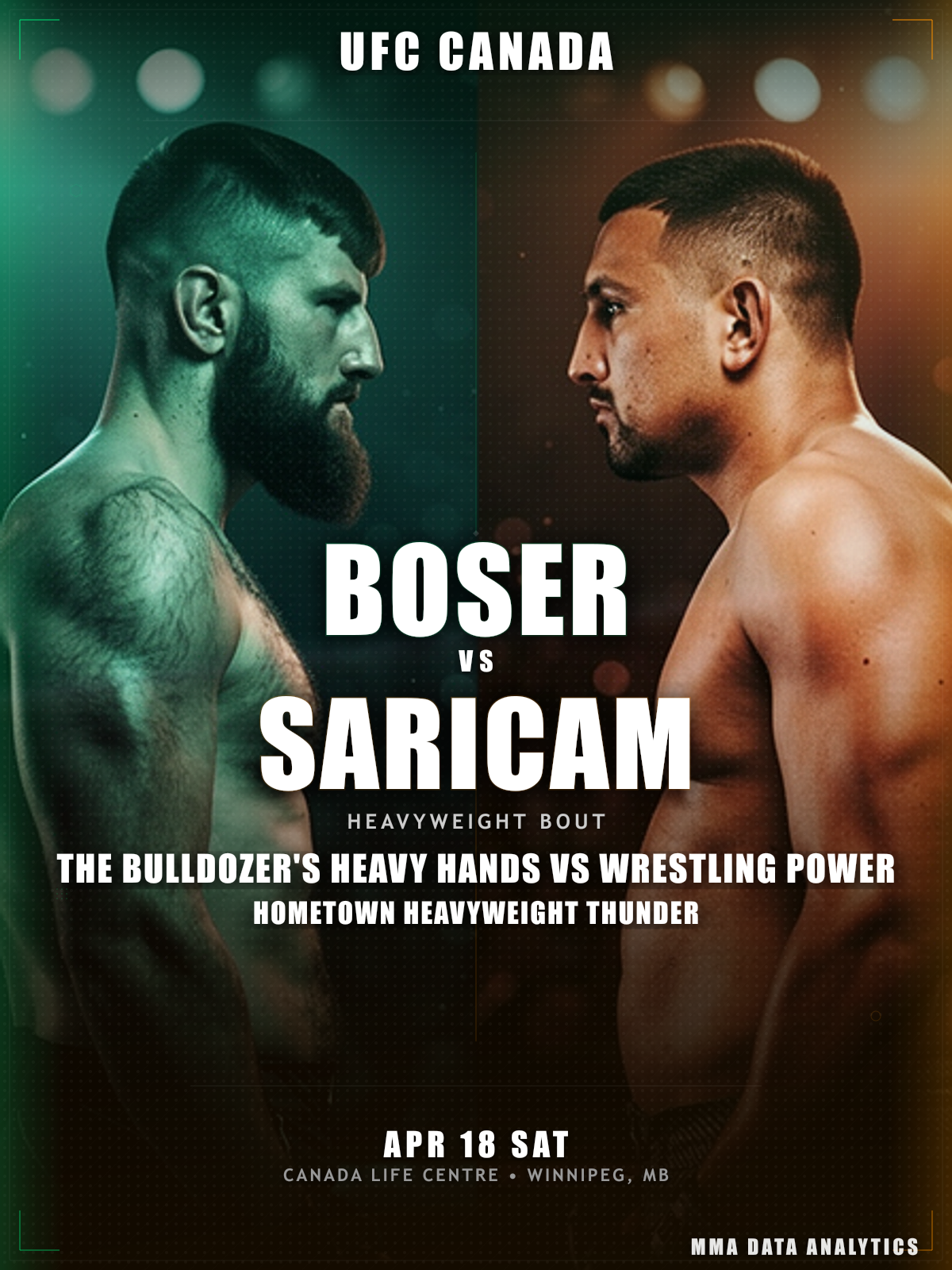
Tanner Boser vs Gokhan Saricam
Men's Heavyweight Bout • UFC Fight Night: Burns vs. Malott
Saturday, April 18, 2026 • 30ft Octagon (Large Cage) • Winnipeg, Canada
Explore Detailed Fighter Profiles
Click on either the fighter's name or profile image for each fighter to access comprehensive UFC statistics including striking metrics, grappling data, clinch performance, complete fight history, offensive & defensive analytics, and round-by-round breakdowns.

Tanner Boser
Fighter Metrics
Victory Methods
Win Round Distribution

Gokhan Saricam
Fighter Metrics
Victory Methods
Win Round Distribution
📋 Last 5 Fights - Tanner Boser
| Date | Opponent | Result | Method |
|---|---|---|---|
| 2025-06-13 | Vinicius Moreira | W | TKO - Retirement (R3, 1:55) |
| 2023-08-05 | Aleksa Camur | W | Decision - Unanimous (R3, 5:00) |
| 2023-04-15 | Ion Cutelaba | L | TKO - Ground & Pound (R1, 2:05) |
| 2022-09-17 | Rodrigo Nascimento | L | Decision - Split (R3, 5:00) |
| 2021-06-26 | Ovince St. Preux | W | TKO - Knee & Punches (R2, 2:31) |
📋 Last 5 Fights - Gokhan Saricam
| Date | Opponent | Result | Method |
|---|---|---|---|
| 2025-11-15 | Hyago Silva | W | TKO - Ground & Pound (R1, 1:36) |
| 2025-10-25 | Natalicio Filho | W | TKO - Punch (R1, 1:21) |
| 2023-06-16 | Daniel James | W | Decision - Unanimous (R3, 5:00) |
| 2023-02-25 | Oleg Popov | L | Decision - Unanimous (R3, 5:00) |
| 2022-08-12 | Said Sowma | W | Decision - Split (R3, 5:00) |
Technical Analysis
Technical Score
Cardio Score
Overall Rating
📊 Technical Score
Calculated as the average of Striking Composite (65.0 vs 54.0) and Grappling Composite (32.0 vs 44.0). Balances overall striking effectiveness with grappling ability to measure complete technical skills.
💪 Cardio Score
Based on average fight duration, striking rate per minute, takedown rate, and finish rate. Measures cardiovascular endurance and ability to maintain pace throughout fights.
🎯 Overall Rating
Simple average of Technical Score and Cardio Score. Provides a holistic view of fighter capabilities combining skill level with physical conditioning and fight performance.
Striking Composite
Grappling Composite
📊 Technical Radar Comparison
📊 Metrics Legend
📊 Detailed Statistical Comparison
🥊 Fight Analysis Breakdown
🧩 Tanner Boser Key Advantages
Boser brings 10 UFC fights of experience against high-level competition, while Saricam is making his UFC debut. This octagon familiarity provides Boser with significant advantages in managing distance, understanding cage dynamics, and performing under the bright lights. His wins over Ovince St. Preux and Aleksa Camur demonstrate he can handle the pressure of the big stage. The Canadian's ability to adapt mid-fight and make adjustments based on octagon experience creates a tangible edge that regional competition cannot replicate.
Boser's 4.70 significant strikes landed per minute at 52% accuracy represents a substantial volume and precision advantage over Saricam's estimated 3.50 SLpM at 45% accuracy. The Canadian's technical striking approach—utilizing a sharp jab, overhand right, and body kicks—allows him to outpoint opponents at range while maintaining defensive responsibility. His ability to maintain this pace over three rounds while landing at a higher clip creates a scoring framework that accumulates significant advantages on the judges' scorecards.
Boser's 58% striking defense and 63% takedown defense represent significantly better defensive metrics than Saricam's estimated 48% and 52% respectively. At heavyweight, where single shots can end fights, Boser's ability to avoid clean strikes while maintaining his own offensive output creates a damage economy advantage. His experience defending takedowns in the UFC against credentialed grapplers gives him a proven defensive foundation that Saricam's regional competition has never tested at this level.
⚠️ Unfavorable Scenarios
Saricam's 63.6% KO/TKO finish rate represents genuine one-punch power that can override any experience advantage. If Boser engages in prolonged exchanges at close range rather than maintaining his preferred technical striking distance, he exposes himself to the Turk's power shots. Boser has been stopped by KO/TKO 3 times in his career, showing vulnerability to heavy hitters. In the heavyweight division, Saricam's raw power means any clean shot could end the fight regardless of how the technical analysis reads on paper.
If Saricam can close the distance and establish clinch control, his 1-inch height advantage and 1.5-inch leg reach advantage allow him to use his frame effectively. Boser's 0.00 TD15 suggests he has no offensive wrestling to use in the clinch, making it difficult for him to escape or reverse position. Saricam's ability to dirty box and use his frame could neutralize Boser's technical striking advantage, especially against the fence where the Canadian's movement is restricted.
📋 Likely Gameplan
Boser should utilize his jab and movement to maintain distance, exploiting his superior striking accuracy (52% vs 45%) and volume (4.70 vs 3.50 SLpM). By staying at range and picking Saricam apart with combinations, Boser can accumulate points while avoiding the power exchanges where the Turk is most dangerous. The Canadian should focus on lateral movement and footwork to avoid getting cornered, using his experience to control the pace and distance of the fight.
With a cardio score advantage (62 vs 54), Boser should look to push the pace and make this a high-output fight. By forcing Saricam to work at an uncomfortable pace, Boser can exploit the Turk's potentially lower cardio conditioning—evidenced by his 8:02 average fight duration. If Boser can survive the early danger and push into the second and third rounds, Saricam's output may fade, creating more opportunities for the Canadian to land clean shots and potentially secure a late stoppage or clear decision.
🚀 Gokhan Saricam Key Advantages
Saricam's 7 KO/TKO wins out of 11 total victories (63.6%) demonstrates legitimate heavyweight power that can end fights at any moment. His two most recent wins—TKO of Hyago Silva at 1:36 and TKO of Natalicio Filho at 1:21—show a fighter who is currently finishing opponents quickly and decisively. At heavyweight, this kind of power is the great equalizer against more experienced opponents. Saricam's ability to end fights in the first round (5 of his wins) means Boser cannot afford any lapses in defensive concentration.
Saricam's 6'3" height and 43-inch leg reach provide him with physical advantages that can be difficult to overcome. His longer legs allow him to threaten with kicks from a distance where Boser's punches cannot reach, and his height creates angles for uppercuts and knees in the clinch. While the reach is even at 76 inches, Saricam's overall frame gives him the ability to fight effectively at range and in close, providing versatility in his attack approach that can keep Boser guessing.
Saricam enters this fight on a 3-fight win streak with consecutive first-round finishes, riding a wave of confidence and momentum. His overall 72.7% finish rate demonstrates he is not content to coast to decisions—he actively seeks to end fights. This aggressive, finish-oriented approach can be problematic for Boser, who has shown vulnerability to power punchers in his career. Saricam's willingness to press the action and look for finishes means this fight could end dramatically if Boser cannot maintain his defensive composure.
⚠️ Unfavorable Scenarios
If the fight settles into a technical, point-scoring affair at range, Boser's superior striking accuracy (52% vs 45%) and volume (4.70 vs 3.50 SLpM) will steadily accumulate advantages on the scorecards. Saricam's lower estimated accuracy and output mean he may struggle to keep pace in extended striking exchanges where precision matters more than power. The longer this fight remains standing without clinch engagement, the more Boser's technical advantages become apparent.
Saricam's 8:02 average fight duration and 54 cardio score suggest he may struggle to maintain intensity over three full rounds against a conditioned UFC veteran. His recent finishes have come in the first round, raising questions about his ability to fight at a high pace when opponents survive his early onslaught. If Boser can weather the initial storm and push the fight into the third round, Saricam's output may drop significantly, creating opportunities for the Canadian to take over with his superior cardio and volume.
📋 Likely Gameplan
Saricam should look to close distance aggressively and force exchanges in the pocket where his power advantage is most dangerous. Using his height and leg reach to set up entries with kicks before closing to punching range, the Turk can create opportunities for his heavy hands. His takedown ability (1.20 TD15) gives him a wrestling threat that Boser may not expect from a power puncher, adding another dimension to his pressure approach and keeping the Canadian guessing about what's coming next.
Saricam's best path to victory is a finish within the first two rounds when he's freshest and his power is most explosive. His recent track record of first-round finishes shows he understands this formula. The Turk should look to hurt Boser early and swarm with follow-up strikes, capitalizing on any defensive lapses. By front-loading his offense and seeking the finish before cardio becomes a factor, Saricam maximizes his chances of a spectacular UFC debut while minimizing the time Boser has to establish rhythm and implement his technical gameplan.
🎯 Fight Prediction Analysis
Data-driven prediction model based on statistical analysis
📊Detailed Analysis Summary
🏟️Cage Dynamics
The 30-foot octagon provides ample space for Boser to utilize his footwork and lateral movement, keeping Saricam at his preferred striking distance. The larger cage favors the more technical striker, allowing Boser to circle and reset after exchanges rather than getting trapped against the fence. However, Saricam's ability to cut off the cage and close distance will be critical—if he can consistently reduce the available space, his power becomes more dangerous. The cage dynamics create a tug-of-war between Boser's desire to maintain distance and Saricam's need to close it.
🎯Technical Breakdown
The statistical profile heavily favors Boser in technical metrics: 4.70 vs 3.50 SLpM, 52% vs 45% accuracy, and 58% vs 48% striking defense. These advantages translate to approximately 1.2 more significant strikes landed per minute while absorbing fewer shots. However, the heavyweight division is unique—Saricam's 63.6% KO rate means his lower volume carries disproportionate consequence. One clean shot from the Turk can render all statistical advantages irrelevant, making this a classic case of quality vs quantity at heavyweight.
🧩Key Battle Areas
Three critical battle areas will determine the outcome: distance management, power vs volume balance, and cardio sustainability. Boser needs to establish his jab and maintain his preferred striking range, where his accuracy and volume advantages are most effective. Saricam needs to close distance and create opportunities for his power shots, particularly in the first round when he's most explosive. The third round could be decisive—if Boser survives the early danger, his superior cardio (62 vs 54 score) and 10:30 average fight duration suggest he can push a pace that Saricam may struggle to match.
🏁Final Prediction
The most likely outcome is Tanner Boser by Decision (30% probability), achieved through consistent volume striking, superior accuracy, and cardio management over three rounds. Boser's KO/TKO path (15%) becomes viable if he accumulates damage through combinations and catches Saricam fading in the later rounds. Saricam's primary upset lane is KO/TKO (30%) via early power shots—his explosive finishing ability in the first round represents his single most dangerous asset. Saricam's decision path (12%) requires him to establish effective pressure and outwork Boser at close range—possible but difficult against a more experienced technical striker.
💰 Betting Analysis: Model vs Market
Detailed value assessment in the betting market
📊Market Odds
🤖Analytical Model
💎Value Opportunities
MAXIMUM VALUE
Model: 30% | Fair: +233
GOOD VALUE
Model: 30% | Fair: +233
SLIGHT VALUE
Model: 42% | Fair: +138
⚠️Key Market Discrepancies
- • Debut discount overpriced – Saricam's power transcends experience gap at heavyweight.
- • KO volatility underweighted – Heavyweight fights have the highest finish rate in MMA.
- • Experience premium inflated – Boser's UFC record is 5-5, not dominant.
🎯 Comprehensive Probabilistic Analysis
100 hypothetical fight simulation based on statistical data
🏆Outcome Distribution - Tanner Boser
Primary path via volume and accuracy advantage
Late accumulative damage as Saricam fades
Low probability given both fighters' profiles
💥Outcome Distribution - Gokhan Saricam
Best lane via early power shots and pressure
Requires sustained pressure and close-range work
Low historical submission profile
⏰Fight Timeline Analysis
⚡Window of Opportunity - Gokhan Saricam
- • First 5 minutes: Highest KO equity with fresh power.
- • Pressure entries: Close distance with kicks before swarming.
- • Power bursts: Commit to exchanges rather than point fighting.
🎯Progressive Advantage - Tanner Boser
- • Survive R1: Weather the storm, establish jab rhythm.
- • Volume pressure: Outwork Saricam with pace and combinations.
- • Late rounds: Cardio edge becomes decisive as Saricam fades.
🎯 Final Confidence Assessment
Confidence level and uncertainty factors
Confidence Level
Moderate confidence — UFC debut creates significant uncertainty
✅Supporting Factors
- • Significant UFC experience advantage (10 fights vs debut)
- • Superior striking volume and accuracy metrics
- • Better defensive numbers across the board
- • Cardio advantage should manifest in later rounds
⚠️Risk Factors
- • Saricam's KO power is the great equalizer at HW
- • UFC debut wildcards — unknown ceiling for Saricam
- • Boser's UFC record is 5-5 (not dominant)
- • Heavyweight volatility makes any prediction uncertain
🏁Executive Summary
Tanner Boser's technical striking approach and UFC experience provide a statistical edge over the debuting Gokhan Saricam, but the Turkish heavyweight's genuine knockout power creates significant upset equity. The statistical profile favors Boser in every measurable metric—volume (4.70 vs 3.50 SLpM), accuracy (52% vs 45%), and defense (58% vs 48% StrDef)—while his cardio advantage (62 vs 54) should become increasingly decisive if the fight reaches the third round. However, Saricam's 63.6% KO rate and recent momentum (consecutive first-round finishes) mean this fight could end dramatically before Boser's technical advantages take hold.
Prediction: Boser by Decision most likely (30% probability) through volume striking and defensive management; Saricam's primary upset lane is early KO/TKO (30%) via power shots in the first round. This is a classic heavyweight coin-flip where experience and technique face off against raw power and finishing instinct—the outcome likely hinges on whether Saricam can land clean in the first five minutes or whether Boser can weather the storm and dictate pace in the later rounds.