

Alexander Volkov vs Waldo Cortes-Acosta
Men's Heavyweight Bout • UFC 328: Chimaev vs. Strickland
Saturday, May 9, 2026 • 30ft Octagon (Large Cage)
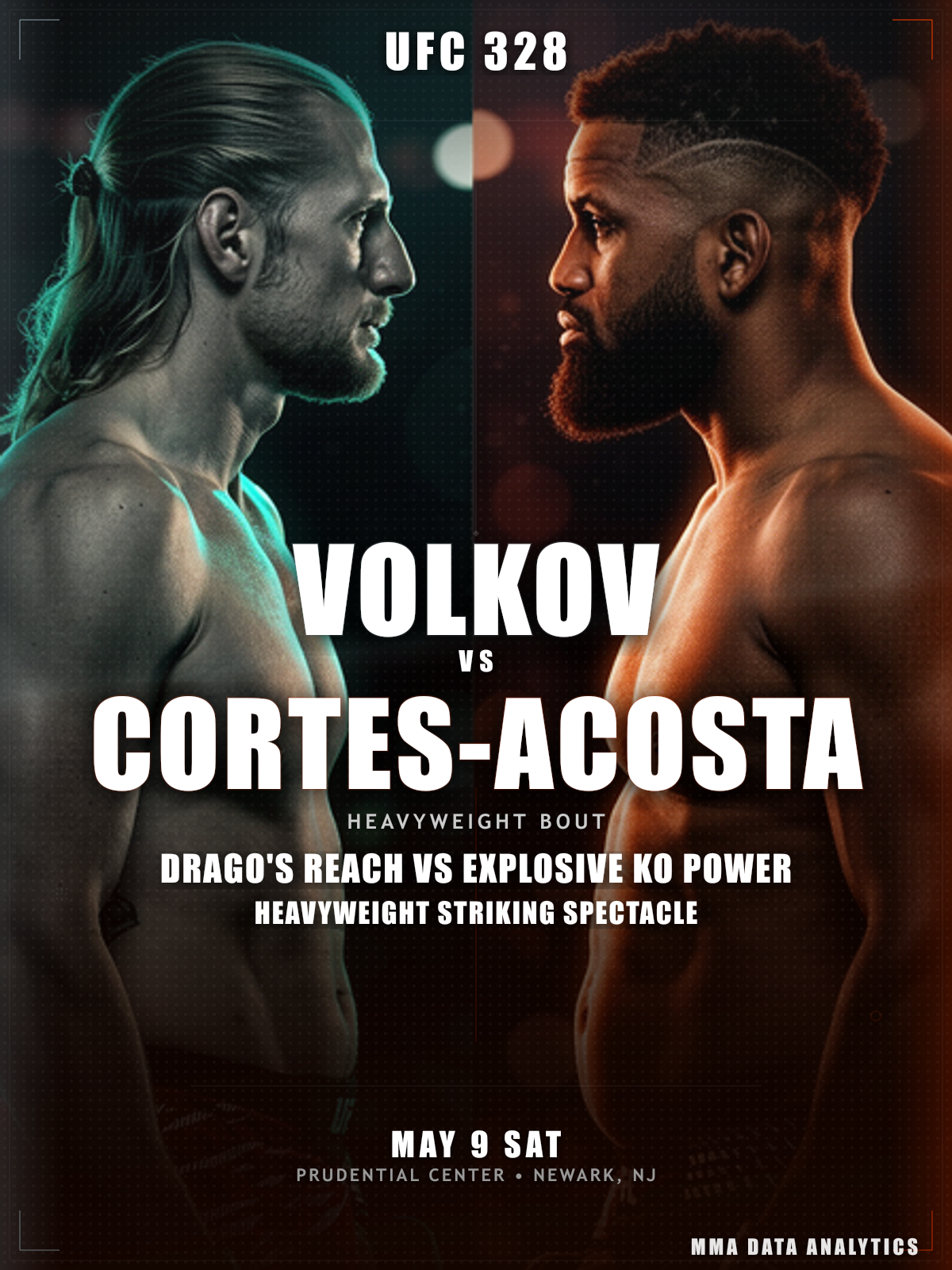
Explore Detailed Fighter Profiles
Click on either the fighter's name or profile image for each fighter to access comprehensive UFC statistics including striking metrics, grappling data, clinch performance, complete fight history, offensive & defensive analytics, and round-by-round breakdowns.

Alexander Volkov
Fighter Metrics
Victory Methods
Win Round Distribution

Waldo Cortes-Acosta
Fighter Metrics
Victory Methods
Win Round Distribution
Last 5 Fights - Alexander Volkov
| Date | Opponent | Result | Method |
|---|---|---|---|
| 2025-10-25 | Jailton Almeida | W | Decision - Split (R3, 5:00) |
| 2024-12-07 | Ciryl Gane | L | Decision - Split (R3, 5:00) |
| 2024-06-22 | Sergei Pavlovich | W | Decision - Unanimous (R3, 5:00) |
| 2023-09-09 | Tai Tuivasa | W | Submission - Ezekiel Choke (R2, 4:37) |
| 2023-03-11 | Alexandr Romanov | W | TKO - Punches From Back Control (R1, 2:16) |
Last 5 Fights - Waldo Cortes-Acosta
| Date | Opponent | Result | Method |
|---|---|---|---|
| 2026-01-24 | Derrick Lewis | W | TKO - Ground & Pound (R2, 3:14) |
| 2025-11-22 | Shamil Gaziev | W | TKO - Right Hook (R1, 1:22) |
| 2025-11-01 | Ante Delija | W | TKO - Jab-Cross to Ground Punches (R1, 3:59) |
| 2025-08-23 | Sergei Pavlovich | L | Decision - Unanimous (R3, 5:00) |
| 2025-06-07 | Serghei Spivac | W | Decision - Unanimous (R3, 5:00) |
Technical Analysis
Technical Score
Cardio Score
Overall Rating
Technical Score
Calculated as the average of Striking Composite (59.0 vs 67.9) and Grappling Composite (49.0 vs 43.7). Balances overall striking effectiveness with grappling ability to measure complete technical skills.
Cardio Score
Based on average fight duration, striking rate per minute, takedown rate, and finish rate. Measures cardiovascular endurance and ability to maintain pace throughout fights.
Overall Rating
Simple average of Technical Score and Cardio Score. Provides a holistic view of fighter capabilities combining skill level with physical conditioning and fight performance.
Striking Composite
Grappling Composite
Technical Radar Comparison
Visual comparison of key performance metrics between both fighters
Detailed Statistical Comparison
Fight Analysis Breakdown
Alexander Volkov Key Advantages
Volkov's 80-inch reach and 6'7" frame give him a significant range advantage over Cortes-Acosta's 78-inch reach and 6'4" height. The Russian's technical jab is one of the best in the heavyweight division—he uses it to establish distance, score points, and set up power shots behind it. His ability to fight at the end of his punches while keeping opponents at bay has been a hallmark of his career, allowing him to outpoint pressure fighters consistently. Against a forward-moving boxer like Cortes-Acosta, Volkov can use teeps, front kicks, and long straights to discourage entries and maintain his preferred fighting range throughout the 30-foot octagon.
Volkov's 57% striking accuracy significantly outpaces Cortes-Acosta's 49%, demonstrating superior shot selection and technical precision. While Cortes-Acosta throws more volume (5.98 SLpM vs 4.97), Volkov makes his shots count with cleaner, more impactful strikes. The 8-point accuracy gap means Volkov is landing with greater efficiency, reducing wasted energy and maintaining defensive positioning between strikes. His 18 UFC fights against elite competition have refined his timing and range-finding ability to a level that Cortes-Acosta has not yet been tested against.
Volkov has faced and defeated some of the best heavyweights in UFC history—Fabricio Werdum, Alistair Overeem, Sergei Pavlovich, and Jailton Almeida. His 18 UFC fights provide a deep reservoir of octagon intelligence that Cortes-Acosta's 12 UFC bouts cannot match. The Russian has seen every style, adapted to pressure fighters, and demonstrated the ability to make mid-fight adjustments. This experience gap becomes critical in a 3-round fight where early reads and tactical adjustments can determine the outcome.
Unfavorable Scenarios
Cortes-Acosta's 5.98 SLpM represents one of the highest striking outputs in the heavyweight division. If the Dominican can close the distance and maintain sustained pressure, his volume advantage could overwhelm Volkov's 54% striking defense. Volkov has historically struggled when opponents establish a high pace inside his reach—Derrick Lewis and Tom Aspinall both found success by closing distance aggressively.
At 37 years old, Volkov is entering the twilight of his career. While his technical skills remain sharp, the speed and reaction time advantages that once defined his counter-striking have diminished. His split decision loss to Ciryl Gane and narrow split decision win over Almeida suggest he's no longer able to dominate opponents he would have handled more convincingly in his prime.
Likely Gameplan
Volkov's optimal strategy is to control distance with his jab, utilize lateral movement to avoid Cortes-Acosta's forward pressure, and pick shots from the outside. His 80-inch reach allows him to land clean jabs and straights while staying out of the Dominican's power range. By keeping the fight at the end of his punches and mixing in teeps and front kicks to the body, Volkov can score points consistently while limiting Cortes-Acosta's ability to generate offense.
When Cortes-Acosta inevitably rushes in with combinations, Volkov should look to time counters—particularly the check hook and pull-counter right hand that have been effective throughout his career. His 57% accuracy suggests he can land clean counters against a less defensively refined opponent. After landing, Volkov should immediately circle off the fence and reset distance, avoiding extended pocket exchanges where Cortes-Acosta's volume and power become most dangerous.
Waldo Cortes-Acosta Key Advantages
Cortes-Acosta's 5.98 significant strikes landed per minute is among the highest in the heavyweight division, creating an overwhelming volume advantage that can drown opponents in output. His relentless forward pressure forces fighters to fight off their back foot, disrupting gameplans and creating scramble situations. Against Volkov's 54% striking defense, this volume translates to significant clean shots landing per round. His pressure style has proven particularly effective against technical strikers—he closed and finished Shamil Gaziev in just 82 seconds with a devastating right hook.
Cortes-Acosta enters this fight on a devastating 3-fight finishing streak—TKOs over Ante Delija (R1), Shamil Gaziev (R1), and Derrick Lewis (R2). His 53% career KO/TKO win rate demonstrates legitimate one-punch power that demands respect. At heavyweight, where one clean shot can end any fight, Cortes-Acosta's power advantage in close-range exchanges represents his most dangerous weapon against the taller Volkov.
At 33 years old, Cortes-Acosta is four years younger than Volkov and visibly improving with each performance. His 83.3% UFC win rate (10-2) demonstrates rapid ascent through the division, and his recent finishes show increasing confidence and technical refinement. After being outpointed by Pavlovich, he responded with three consecutive knockouts. His cardio score of 70 suggests better endurance than Volkov's 65, a critical factor in a 3-round fight where sustained pressure can decide close rounds.
Unfavorable Scenarios
If Volkov successfully maintains distance with his jab and teeps, Cortes-Acosta's volume advantage becomes muted. The Dominican's 49% striking accuracy drops further when forced to reach for a taller opponent, and his forward pressure becomes less effective against a fighter who can consistently reset distance. In the 30-foot cage, Cortes-Acosta may struggle to cut off the ring against Volkov's lateral movement.
Cortes-Acosta's two career losses both came by decision—against Marcos Rogerio de Lima and Sergei Pavlovich—suggesting he struggles in fights that go the distance against savvy veterans. If this fight becomes a tactical affair with close rounds, Volkov's 18-fight UFC experience and understanding of how judges score becomes a decisive advantage.
Likely Gameplan
Cortes-Acosta's optimal strategy is to aggressively close distance, cut off the cage, and force extended pocket exchanges where his volume and power are maximized. He should use head movement and feints to slip Volkov's jab while stepping inside, then unload combinations to the head and body. His 5.98 SLpM output becomes most dangerous in close range where Volkov's height advantage works against him—shorter fighters can generate upward angles with hooks and uppercuts that tall fighters struggle to defend.
Targeting Volkov's body with heavy hooks and uppercuts should be a priority. Volkov's tall, lean frame has shown vulnerability to body shots throughout his career, and sustained body work can slow his lateral movement and reduce his ability to maintain distance. By investing in body shots early, Cortes-Acosta can compromise Volkov's cardio and mobility in the later rounds, creating openings upstairs when Volkov drops his hands to protect the body.
Fight Prediction Analysis
Data-driven prediction model based on statistical analysis
📊Detailed Analysis Summary
🏟️Cage Dynamics
The 30-foot octagon creates an interesting dynamic in this heavyweight matchup. The larger cage initially favors Volkov's range-based game, giving him more space to circle, reset distance, and utilize his jab. However, Cortes-Acosta has shown improving cage-cutting ability in recent fights, particularly against Derrick Lewis where he effectively herded Lewis to the fence before finishing him. The key question is whether Cortes-Acosta can consistently close the distance against a taller, more mobile fighter in a cage that provides ample escape routes.
🎯Technical Breakdown
This fight presents a classic matchup between technical precision (Volkov) and volume pressure (Cortes-Acosta). Volkov's 57% striking accuracy and 4.97 SLpM output suggest efficient, measured striking, while Cortes-Acosta's 49% accuracy with 5.98 SLpM favors overwhelming opponents with sheer output. The damage economy slightly favors Volkov—he absorbs 2.99 strikes per minute vs Cortes-Acosta's 3.43, a meaningful gap that compounds over three rounds. Neither fighter brings significant grappling threat (0.61 vs 0.42 TD15), making this predominantly a striking contest.
🧩Key Battle Areas
Three critical battle areas will determine the outcome: distance management, pocket exchanges, and late-round durability. Volkov's ability to maintain his preferred range with the jab and front kicks is the primary battleground—if he controls distance for 60%+ of each round, he likely wins on points. Pocket exchanges favor Cortes-Acosta's volume and power. The third factor is late-round conditioning: Cortes-Acosta's superior cardio score (70 vs 65) suggests he can maintain pressure better as the fight progresses, while Volkov's movement may slow in Round 3.
🏁Final Prediction
The most likely outcome is Alexander Volkov by Decision (28% probability), achieved through consistent jab work, distance management, and superior shot selection over three rounds. Volkov's KO/TKO path (22%) materializes if he catches Cortes-Acosta entering with a clean counter. Cortes-Acosta's primary upset lane is KO/TKO (30%) via his heavy hooks and uppercuts inside—his power is real and dangerous enough to end any heavyweight fight. This is a highly competitive heavyweight matchup where the margin between the fighters is thin and the result could hinge on a single clean shot from either man.
Betting Analysis: Model vs Market
Detailed value assessment in the betting market
📊Market Odds
🤖Analytical Model
💎Value Opportunities
MAXIMUM VALUE
Model: 30% | Fair: +233
GOOD VALUE
Model: 28% | Fair: +257
SLIGHT VALUE
Model: 57% | Fair: -133
⚠️Key Market Discrepancies
- • Undervalues Cortes-Acosta's finishing power – Three consecutive TKO wins demonstrate real knockout threat.
- • Overweights Volkov's experience premium – Age-related decline narrows the gap more than odds suggest.
- • Heavyweight volatility – Close fights at HW carry inherent upset potential that thin margins don't capture.
Comprehensive Probabilistic Analysis
100 hypothetical fight simulation based on statistical data
🏆Outcome Distribution - Alexander Volkov
Primary path via jab control and range management
Counter strikes and accumulative damage
Low probability but has 4 career submissions
💥Outcome Distribution - Waldo Cortes-Acosta
Primary lane via heavy hooks and pressure finishes
Requires sustained volume output over 3 rounds
Minimal submission profile (1 career sub win)
⏰Fight Timeline Analysis
⚡Window of Opportunity - Waldo Cortes-Acosta
- • Rounds 2-3: Highest KO equity as Volkov slows and distance closes.
- • Cage pressure: Cut angles, herd to fence, unload combinations.
- • Body investment: Early body work pays dividends in Round 3.
🎯Early Control - Alexander Volkov
- • Round 1: Bank the round with jab control and clean striking.
- • Counter timing: Catch Cortes-Acosta entering with right hands.
- • Movement: Maintain lateral motion to avoid fence traps.
Final Confidence Assessment
Confidence level and uncertainty factors
Confidence Level
Highly competitive HW matchup with thin margins
✅Supporting Factors
- • Superior reach and height create range advantage
- • 57% striking accuracy vs 49% shows better precision
- • 18 UFC fights of experience vs 12
- • Lower absorption rate (2.99 vs 3.43 SApM)
⚠️Risk Factors
- • Cortes-Acosta's 5.98 SLpM volume can overwhelm
- • Three consecutive TKO finishes show real power
- • Volkov's age (37) and potential decline
- • Heavyweight volatility—one punch changes everything
🏁Executive Summary
This heavyweight matchup pits Alexander Volkov's technical precision and reach advantage against Waldo Cortes-Acosta's relentless volume and knockout power. Volkov's 80-inch reach and 6'7" frame allow him to fight at a distance where his 57% striking accuracy and measured approach are most effective, while Cortes-Acosta's 5.98 SLpM output and recent 3-fight TKO streak make him dangerous whenever the fight moves to close range. The statistical edge favors Volkov in accuracy (57% vs 49%), damage economy (2.99 vs 3.43 SApM), and experience (18 vs 12 UFC fights), but Cortes-Acosta holds advantages in volume, cardio (70 vs 65), and finishing momentum. At heavyweight, where any clean shot can end a fight, the margin between these two is razor-thin.
Prediction: Volkov by Decision is the most likely single outcome (28% probability) through consistent jab work and range control, but Cortes-Acosta by KO/TKO (30%) represents the highest individual outcome probability. This is a genuine pick'em fight where the method of victory matters more than the winner—if you're betting the method market, Cortes-Acosta by stoppage offers the best value given his recent finishing form and the inherent volatility of heavyweight combat.