

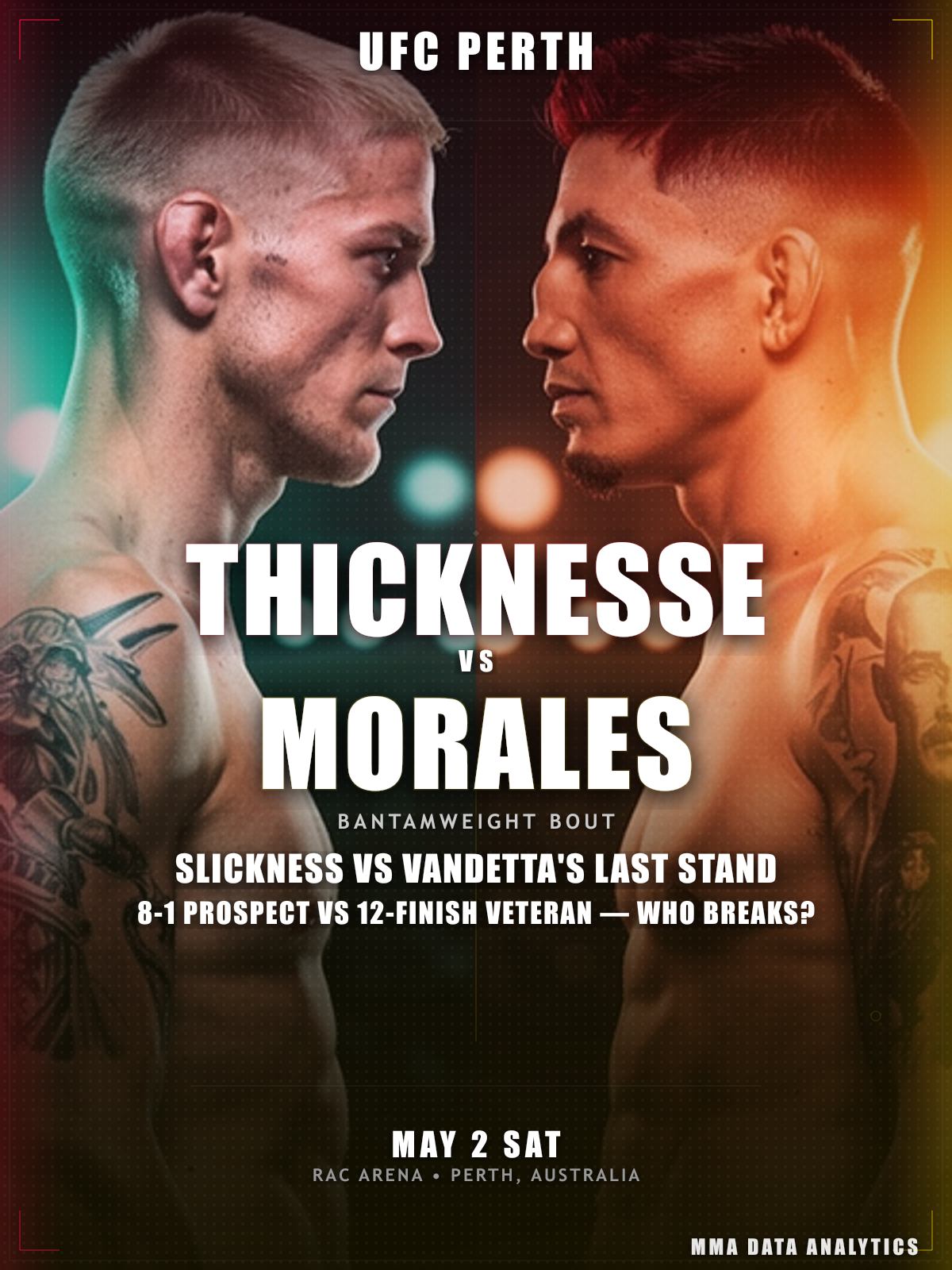
Colby Thicknesse vs Vince Morales
Men's Bantamweight Bout • UFC Perth: Della Maddalena vs. Prates
Saturday, May 2, 2026 • 30ft Octagon (Large Cage) • RAC Arena, Perth
Explore Detailed Fighter Profiles
Click on either the fighter's name or profile image for each fighter to access comprehensive UFC statistics including striking metrics, grappling data, clinch performance, complete fight history, offensive & defensive analytics, and round-by-round breakdowns.

Colby Thicknesse
Fighter Metrics
Victory Methods
Win Round Distribution
Vince Morales
Fighter Metrics
Victory Methods
Win Round Distribution
📋 Last 5 Fights - Colby Thicknesse
| Date | Opponent | Result | Method |
|---|---|---|---|
| Sep 27, 2025 | Josias Musasa | W | Decision (Unanimous) (R3, 5:00) |
| Feb 8, 2025 | Aleksandre Topuria | L | Decision (Unanimous) (R3, 5:00) |
| Nov 23, 2024 | Marvin Malunes | W | TKO (Elbows) (R1, 4:59) |
| Oct 27, 2024 | Norman Agcorpra | W | Submission (Rear Naked Choke) (R1, 2:38) |
| Jul 21, 2024 | Jufri Gobel | W | TKO (Ground & Pound) (R1, 1:50) |
📋 Last 5 Fights - Vince Morales
| Date | Opponent | Result | Method |
|---|---|---|---|
| Mar 29, 2025 | Raul Rosas Jr. | L | Decision (Unanimous) (R3, 5:00) |
| Feb 15, 2025 | Elijah Smith | L | Decision (Unanimous) (R3, 5:00) |
| Sep 28, 2024 | Taylor Lapilus | L | Decision (Unanimous) (R3, 5:00) |
| Aug 30, 2024 | Hunter Azure | W | Submission (Peruvian Necktie) (R3, 4:06) |
| May 24, 2024 | Luis Guerrero | W | Submission (D'arce Choke) (R2, 4:09) |
Technical Analysis
Technical Score
Cardio Score
Overall Rating
📊 Technical Score
Calculated as the average of Striking Composite (62.0 vs 58.0) and Grappling Composite (68.0 vs 35.0). Balances overall striking effectiveness with grappling ability to measure complete technical skills.
💪 Cardio Score
Based on average fight duration, striking rate per minute, takedown rate, and finish rate. Measures cardiovascular endurance and ability to maintain pace throughout fights.
🎯 Overall Rating
Simple average of Technical Score and Cardio Score. Provides a holistic view of fighter capabilities combining skill level with physical conditioning and fight performance.
Striking Composite
Grappling Composite
Technical Radar Comparison
Visual comparison of key performance metrics between both fighters
📊 Detailed Statistical Comparison
🥊 Fight Analysis Breakdown
🧩 Colby Thicknesse Key Advantages
Thicknesse enters this bout at just 26 years old with an 8-1 professional record, having gone 7-0 before joining the UFC. His only career loss came to undefeated prospect Aleksandre Topuria by unanimous decision, and he bounced back immediately with a decision win over Josias Musasa. In contrast, Morales is 35 years old and riding a 3-fight losing streak (all decisions to Rosas Jr., Smith, and Lapilus), with a 3-8 UFC record that suggests declining performance at the highest level. The 9-year age gap represents a significant athletic advantage—Thicknesse is still improving and has room to grow, while Morales may be physically and mentally past his prime. This momentum differential creates a psychological edge where Thicknesse fights with confidence while Morales fights with desperation.
Thicknesse absorbs only 2.80 significant strikes per minute compared to Morales' 4.00 SApM—a 30% reduction in damage intake that compounds over three rounds. While Thicknesse's striking defense percentage (48%) is lower than Morales' (54%), his lower output style means he engages in fewer exchanges overall, resulting in less total damage absorbed. Over 15 minutes, this translates to approximately 42 significant strikes absorbed for Thicknesse vs 60 for Morales—a significant gap that impacts late-round performance and decision scoring. Thicknesse's approach is fundamentally conservative: he picks his spots carefully rather than engaging in firefights, which preserves his cardio and keeps him sharp throughout the fight. This damage management advantage becomes increasingly important as the fight progresses into later rounds.
Thicknesse boasts an impressive 85% takedown accuracy, albeit from a small UFC sample size (2 fights). His 0.70 takedowns per 15 minutes shows he is selective with his shots, and when he commits, he converts at an elite rate. His grappling composite score (55) outpaces Morales' (40) significantly, reflecting stronger overall ground control and positional dominance. His pre-UFC career on the Australian regional circuit (HEX, CFN) demonstrated dangerous ground-and-pound, with TKO wins via elbows and ground strikes. Against Morales, whose TDDef sits at 59%, Thicknesse can use takedowns to dictate pace, control position, and accumulate damage from top—a strategy that neutralizes Morales' striking volume advantage while banking rounds on the scorecards.
⚠️ Unfavorable Scenarios
Morales has 5 career submission wins including exotic techniques like the D'arce Choke and Peruvian Necktie. If Thicknesse gets caught in a scramble during takedown exchanges, Morales has the technical ability to lock in a fight-ending choke. Thicknesse's grappling-heavy approach requires level changes and clinch engagements that can create the scramble situations where Morales' submission game is most dangerous. His 0.50 submissions per 15 minutes and 31% of career wins by submission demonstrate this is a consistent threat, not a one-off weapon.
Morales' 3.40 SLpM significantly outpaces Thicknesse's 2.53 SLpM, giving Morales a 34% volume advantage in standing exchanges. Morales' 36% striking accuracy, while not elite, generates higher total output that can overwhelm a young fighter who is still developing his UFC-level striking. Morales also has 7 career KO/TKO wins demonstrating genuine fight-ending power. If Thicknesse is unable to implement his grappling gameplan and gets drawn into sustained striking exchanges, Morales' higher volume and veteran timing could be the difference over three rounds.
📋 Likely Gameplan
Thicknesse should use his takedowns to control the pace of the fight while avoiding scrambles where Morales' submission game becomes dangerous. His 85% takedown accuracy (small sample) shows he converts when he commits, and his 0.70 TD15 means he is selective with his entries. The key is maintaining top position with ground-and-pound rather than allowing Morales to create the chaotic scramble situations where his D'arce and Peruvian Necktie become threats. Thicknesse's pre-UFC career showed devastating ground-and-pound (TKO via elbows against Malunes, GnP stoppage against Gobel), and he should lean on this proven finishing ability from top position. Maintaining heavy hips and controlling wrists prevents Morales from establishing the head control needed for his exotic submissions.
With only a 1-inch reach disadvantage (69" vs 70"), Thicknesse should use reach parity to pick his shots carefully rather than engaging in firefights where Morales' higher volume (3.40 SLpM) would dominate. Thicknesse's conservative striking approach (2.53 SLpM) reflects a patient fighter who waits for openings rather than forcing exchanges. By keeping the fight at range and using measured jabs to set up takedown entries, Thicknesse can avoid the pocket exchanges where Morales is most dangerous. His superior damage management (2.80 SApM vs 4.00) means even in striking exchanges, he accumulates less damage over time. This approach also allows Thicknesse to set up clinch transitions that lead to takedowns, using his striking as a tool to access his grappling rather than trying to win a volume war he is unlikely to win on the feet.
🚀 Vince Morales Key Advantages
Morales brings 26 professional fights of experience to the cage, with 12 finishes in 16 career wins (7 KO/TKO, 5 submissions). His finishing ability spans multiple disciplines—power striking with 7 knockouts, and dangerous submission techniques including the D'arce Choke and Peruvian Necktie. At any moment, Morales can end the fight, which creates constant pressure on the younger Thicknesse who has only 2 UFC fights to draw from. Training at Syndicate MMA, one of the top gyms in the sport, Morales has access to elite coaching and sparring partners that keep his finishing instincts sharp. Despite his poor UFC record, his ability to end fights makes him a dangerous opponent for any fighter who makes a mistake.
Morales' 3.40 SLpM output significantly outpaces Thicknesse's 2.53 SLpM—a 34% volume advantage that translates to approximately 13 more significant strikes landed per round. While Morales' 36% accuracy is not elite, his higher volume means he lands more total strikes and can overwhelm a young fighter who is still developing his UFC-level striking. Thicknesse's 29% striking accuracy is notably low, meaning in standing exchanges Morales is both more active and more accurate. His 59% takedown defense also provides a meaningful edge over Thicknesse's 50%, suggesting he can better defend against takedown attempts and keep the fight in the striking range where his volume advantage is maximized. In 3-round fights that go to decision, this volume differential can be the deciding factor on judges' scorecards.
Morales' 59% takedown defense gives him a 9-point edge over Thicknesse's 50%, meaning he can better resist takedown attempts and keep the fight standing where his volume and finishing power are most effective. Over 11 UFC fights, this defensive metric has been tested against varied competition, providing a more reliable sample than Thicknesse's 2-fight UFC dataset. If Morales can stuff early takedowns and establish confidence in his defensive wrestling, he can force the fight into standing exchanges where his advantages are clear.
⚠️ Unfavorable Scenarios
Morales is on a 3-fight losing streak, all by unanimous decision, against Rosas Jr., Elijah Smith, and Taylor Lapilus. At 35 years old with a 3-8 UFC record, the data suggests declining performance at the highest level. His inability to win recent fights—despite having finishing ability—raises questions about whether his physical attributes are deteriorating with age. The 3-fight skid may also impact his mental confidence and urgency in the cage. Morales may be fighting for his UFC career, which can either motivate a desperate performance or lead to tentative decision-making under pressure.
If Thicknesse secures takedowns, his top control and ground-and-pound from his HEX/CFN fights show dangerous finishing ability—TKO via elbows against Malunes and GnP stoppage against Gobel. Morales' grappling composite (40) is significantly lower than Thicknesse's (55), meaning once on the mat, Morales faces an uphill battle to return to his feet. Thicknesse's 85% takedown accuracy (albeit small sample) suggests when he commits to a shot, he converts, and Morales could find himself spending significant time on his back absorbing damage rather than implementing his striking gameplan.
📋 Likely Gameplan
Morales should push a high pace using his 3.40 SLpM volume advantage to outwork Thicknesse, whose 2.53 SLpM and 29% striking accuracy suggest he is vulnerable to sustained pressure on the feet. By diversifying his attacks across head, body, and legs, Morales can prevent Thicknesse from establishing a defensive rhythm and force him into reactive striking exchanges. Early damage is critical—Morales has 5 R1 and 4 R2 finishes in his career, and if he can hurt Thicknesse early, the young Australian's limited UFC experience may lead to panic-driven grappling entries that expose him to submission counters. Morales' 7 career KO/TKO wins demonstrate he can end fights from standing when he connects cleanly.
Morales should set traps off scrambles with his D'arce Choke and Peruvian Necktie—two exotic submissions that opponents rarely prepare for specifically. If Thicknesse commits to sloppy takedowns or leaves his head exposed during grappling exchanges, Morales can capitalize with fight-ending techniques he has demonstrated at the highest level (Peruvian Necktie against Hunter Azure, D'arce Choke against Luis Guerrero). His 0.50 submissions per 15 minutes shows consistent submission threat, and Thicknesse's grappling-heavy approach provides exactly the type of scramble situations where these techniques become viable. Making Thicknesse pay for careless entries could end the fight in dramatic fashion.
🎯 Fight Prediction Analysis
Data-driven prediction model based on statistical analysis
📊Detailed Analysis Summary
🏟️Cage Dynamics
The 30-foot octagon at RAC Arena creates an interesting dynamic for this bantamweight bout. The larger cage gives Morales more room to establish his higher striking volume (3.40 SLpM) and create angles to pepper Thicknesse with combinations. However, it also gives Thicknesse more space to manage distance with his patient striking approach and set up takedown entries from range. With only 1 inch of reach separating them (69" vs 70"), neither fighter has a significant distance management advantage.
The Perth crowd will be firmly behind their Australian fighter in Thicknesse, creating a home-crowd advantage that could boost his confidence and energy in later rounds. Morales will need to weather the hostile atmosphere while implementing his gameplan. In the clinch and cage work, Thicknesse can use the fence to load takedowns and pin Morales for ground-and-pound, while Morales will look to create separation and return to the open space where his volume advantage is maximized. The 3-round format slightly favors Thicknesse's conservative approach, as there is less time for Morales to accumulate enough volume to overwhelm on the scorecards.
🎯Technical Breakdown
This fight presents a rising prospect vs declining veteran dynamic. Thicknesse's grappling composite (55) vs Morales' (40) represents a significant ground control advantage, while his 85% takedown accuracy (small sample) suggests elite conversion when he commits. However, Morales' 59% takedown defense provides a reasonable barrier that could neutralize Thicknesse's grappling if he can stuff early attempts. Morales' 5 career submission wins with exotic techniques (D'arce Choke, Peruvian Necktie) create a counter-threat that makes grappling exchanges two-sided.
The striking comparison favors Morales in volume (3.40 SLpM vs 2.53) and accuracy (36% vs 29%), but Thicknesse's superior damage management (2.80 SApM vs 4.00) suggests he takes significantly less damage in exchanges. Over three rounds, this 30% reduction in damage absorbed compounds into a meaningful advantage for late-round performance. Thicknesse's lower output is by design— he picks his spots rather than engaging in firefights.
The fight will likely be decided by whether Thicknesse can use his grappling to control pace and avoid the sustained striking exchanges where Morales' volume advantage becomes decisive. Morales' path requires stuffing takedowns early, establishing confidence in his defensive wrestling, and pushing a high pace that overwhelms Thicknesse's limited UFC experience. Thicknesse's path is controlled grappling with patient striking, banking rounds while avoiding the scramble situations where Morales' submissions become dangerous.
🧩Key Battle Areas
1) Takedown Success Rate: This is the critical variable. Thicknesse's 85% takedown accuracy vs Morales' 59% takedown defense creates the central question of this fight. If Thicknesse can convert early takedowns and establish top control, he dictates the pace and neutralizes Morales' volume striking. However, with only 2 UFC fights, Thicknesse's accuracy may regress against a more experienced opponent who has defended takedowns across 11 UFC bouts.
2) Scramble Management: Morales' 5 career submission wins with exotic techniques mean that scramble situations during takedown exchanges become dangerous territory. If Thicknesse shoots and Morales can create a scramble rather than a clean takedown, the D'arce and Peruvian Necktie become live threats. Thicknesse must secure clean takedowns with heavy top control, avoiding the chaotic mid-range exchanges where Morales' submission instincts are sharpest.
3) Volume vs Efficiency: Morales' 3.40 SLpM at 36% accuracy vs Thicknesse's 2.53 SLpM at 29% accuracy. If the fight stays standing, Morales outworks Thicknesse with higher output. But Thicknesse's 2.80 SApM vs 4.00 shows he takes less damage in those exchanges, meaning even when losing the volume battle, he preserves his physical condition for later rounds.
Verdict: If Thicknesse can use his grappling to control pace and his defensive efficiency to minimize damage, his youth and momentum should carry him to a decision win. If Morales can stuff takedowns and push a high striking pace, his volume and finishing ability create genuine upset equity—particularly via submission if scrambles emerge.
🏁Final Prediction
Most Likely Outcome: Thicknesse by Decision (35%)— Thicknesse uses controlled grappling and patient striking to manage the pace over three rounds. His superior damage management (2.80 SApM vs 4.00) keeps him fresh in later rounds, while his takedown accuracy secures enough control time to win on the scorecards. The Perth crowd provides energy and motivation for the rising Australian prospect.
Morales by Submission (15%) — Morales catches Thicknesse in a scramble during a takedown exchange and locks in a D'arce Choke or Peruvian Necktie. His 5 career submission wins with exotic techniques demonstrate this is a developed skill, and Thicknesse's grappling-heavy approach creates the scramble situations where these techniques become live.
Thicknesse by KO/TKO (13%) — Thicknesse secures top position and unleashes ground-and-pound, as he demonstrated in his pre-UFC career with TKO wins via elbows and ground strikes. If Morales turtles up rather than scrambling intelligently, the referee may intervene.
Morales by KO/TKO (12%) — Morales catches Thicknesse clean in a standing exchange, exploiting his 29% striking accuracy and relative inexperience at the UFC level. With 7 career KO/TKO wins, Morales has genuine fight-ending power when he connects cleanly.
Assessment: Thicknesse's youth, defensive efficiency, and grappling control make him the rightful favorite in this bantamweight contest. However, his limited UFC experience (2 fights) against a veteran with 12 career finishes introduces meaningful uncertainty. Morales' 3-fight losing streak and 3-8 UFC record suggest declining performance, but his finishing ability ensures he remains a live underdog with clear paths to victory via submission or knockout.
💰 Betting Analysis: Model vs Market
Detailed value assessment in the betting market
📊Market Odds
🤖Analytical Model
💎Value Opportunities
MAXIMUM VALUE
Model: 35% | Fair: +186
GOOD VALUE
Model: 15% | Fair: +567
SLIGHT VALUE
Model: 52% | Fair: -108
⚠️Key Market Discrepancies
- • Small sample size warning – Thicknesse has only 2 UFC fights, making his stats less reliable than Morales' 11-fight dataset.
- • Morales' finishing ability – Despite a 3-8 UFC record, 12 career finishes (7 KO, 5 SUB) mean he can end fights at any moment.
- • Home crowd factor – Thicknesse fighting in Perth provides intangible energy and motivation not captured by statistics.
🎯 Comprehensive Probabilistic Analysis
100 hypothetical fight simulation based on statistical data
🏆Outcome Distribution - Colby Thicknesse
Primary path via controlled grappling and defensive striking
Ground-and-pound from top position, elbows and GnP
Rear naked choke from dominant grappling positions
💥Outcome Distribution - Vince Morales
Primary threat via D'arce Choke or Peruvian Necktie in scrambles
Volume striking and power shots in standing exchanges
Requires outworking Thicknesse with sustained volume
⏰Fight Timeline Analysis
R1: Feeling Out Round
Both fighters assess distance and timing in the opening round. Morales leads with his higher volume (3.40 SLpM), looking to establish dominance on the feet and test Thicknesse's striking defense early. Thicknesse will feel out the range and look for his first takedown opportunity—testing Morales' 59% takedown defense. If Thicknesse can secure an early takedown and establish top control, he sets the tone for the fight. If Morales stuffs the first shot and lands clean strikes, his experience advantage (26 pro fights vs 9) becomes a factor. This round is about information gathering— Thicknesse learning Morales' defensive patterns, Morales gauging whether Thicknesse's grappling threat is real at UFC level. The Perth crowd will be loud for their Australian fighter, providing early energy.
R2: Pressure & Accumulation
Thicknesse increases grappling pressure if R1 went well. His selective takedown approach (0.70 TD15) means he chooses his moments carefully, and R2 is where he should be more aggressive with entries. The damage management gap begins to show—Thicknesse absorbing 2.80 SApM vs Morales' 4.00 means the cumulative damage differential is already noticeable by mid-fight. Morales' cardio score (60) vs Thicknesse's (70) suggests the veteran may begin to slow. However, if Morales defended early grappling and landed power shots in R1, R2 becomes a battle of volume where his 3.40 SLpM advantage tries to overwhelm Thicknesse's lower output. This is also where Morales' submission danger peaks—if Thicknesse becomes desperate for takedowns, sloppy entries create scrambles for D'arce and Necktie attempts.
R3: Youth vs Experience
If the fight reaches R3 competitive, Thicknesse's youth (26 vs 35) and superior cardio score (70 vs 60) become decisive factors. His defensive efficiency means he enters the final round fresher, having absorbed significantly less damage over 10 minutes. Morales' 3-fight losing streak may weigh mentally in a close fight, while Thicknesse's momentum and home crowd support provide motivation. If Morales is ahead on the scorecards, Thicknesse must take greater risks—potentially leading to aggressive grappling entries that could either secure the takedowns he needs or expose him to Morales' submission counters. A competitive R3 favors the younger, fresher fighter, and judges typically reward consistent control over sporadic volume.
⚡Window of Opportunity - Vince Morales
- • First 5 minutes: Highest finishing equity before grappling control and age gap take effect.
- • Volume pressure: Push 3.40 SLpM pace to overwhelm Thicknesse's 29% striking accuracy.
- • Submission traps: Set up D'arce and Necktie opportunities off scrambles from takedown attempts.
🎯Progressive Dominance - Colby Thicknesse
- • Controlled grappling: Secure clean takedowns to control pace and avoid scrambles.
- • Damage management: Leverage 2.80 SApM advantage to stay fresher in later rounds.
- • Ground-and-pound: Accumulate control time and damage from top position with elbows.
🎯 Final Confidence Assessment
Confidence level and uncertainty factors
Confidence Level
Thicknesse's grappling edge and youth vs limited UFC sample size
✅Supporting Factors
- • Superior damage management (2.80 vs 4.00 SApM)
- • Morales' 3-fight losing streak and age decline (35)
- • Grappling control with 85% TDAcc (small sample)
- • Youth and momentum advantage (26 years old, 8-1 record)
⚠️Risk Factors
- • Only 2 UFC fights for Thicknesse, small sample size
- • Morales' finishing ability (12 career finishes, 7 KO + 5 SUB)
- • Morales' better TDDef (59% vs 50%)
- • Veteran experience in 3-round fights (26 pro bouts)
🏁Executive Summary
Thicknesse's youth, defensive efficiency, and grappling control should give him the edge in this bantamweight contest. His 2.80 SApM vs Morales' 4.00 shows significantly better damage management, and his 85% takedown accuracy (albeit small sample) suggests he can get fights to the ground when needed. Morales brings dangerous finishing ability with 12 career finishes including exotic submissions like the D'arce Choke and Peruvian Necktie, but his 3-fight losing streak and 3-8 UFC record suggest declining performance at 35. The primary risk is Thicknesse's limited UFC experience (2 fights) against a veteran who can still finish fights. The Perth crowd provides an intangible home advantage for the rising Australian prospect.
Prediction: Thicknesse by Decision most likely (35% probability) through controlled grappling and defensive striking; Morales' primary upset path is Submission (15%) via exotic choke techniques in scrambles. This fight hinges on whether Thicknesse can use his grappling to control pace, or whether Morales' finishing ability and veteran experience can overcome the age and momentum gap.