
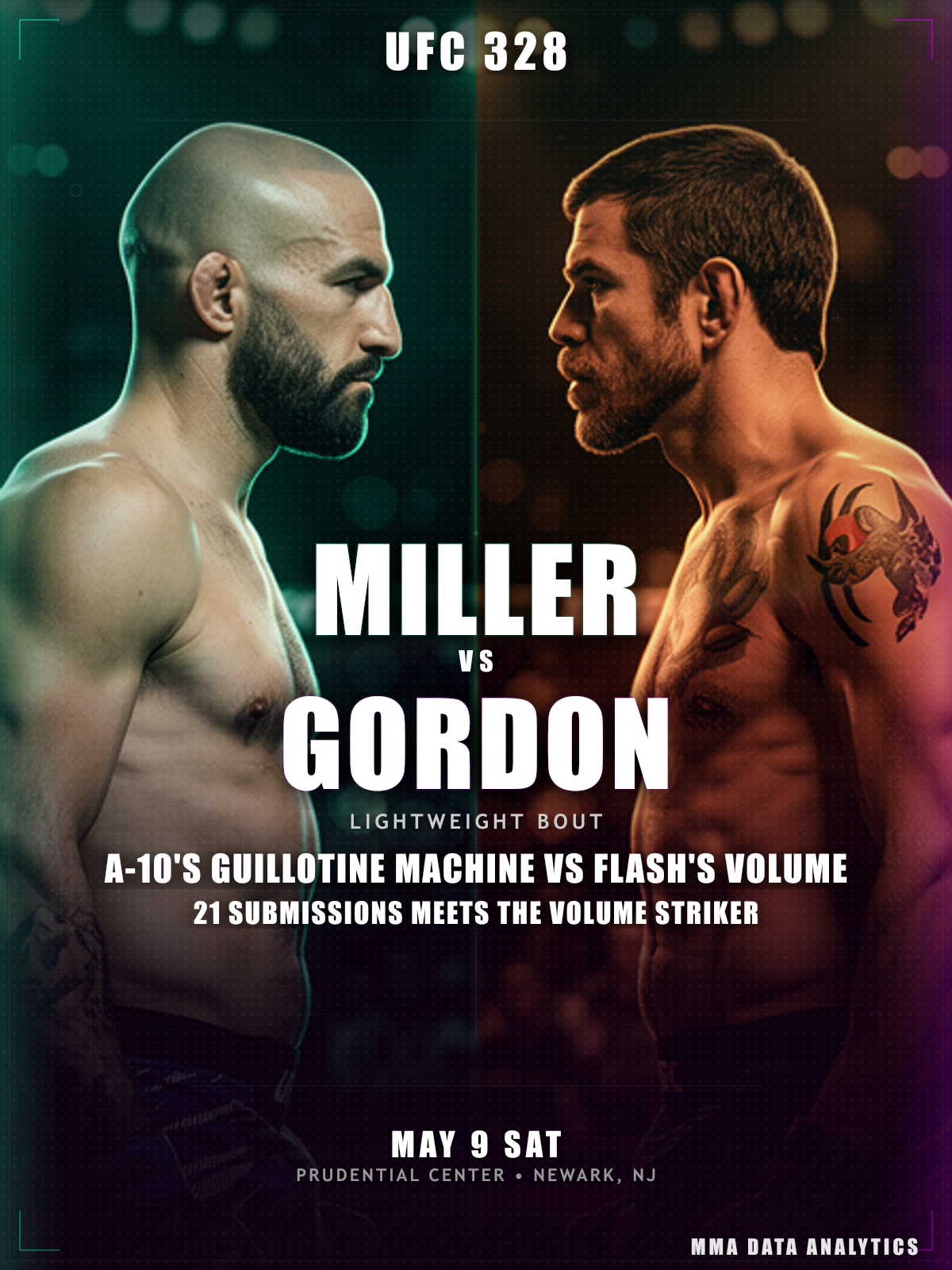
Jim Miller vs Jared Gordon
Lightweight Bout • UFC 328: Chimaev vs. Strickland
Saturday, May 9, 2026 • Prudential Center, Newark, NJ
Explore Detailed Fighter Profiles
Click on either the fighter's name or profile image for each fighter to access comprehensive UFC statistics including striking metrics, grappling data, clinch performance, complete fight history, offensive & defensive analytics, and round-by-round breakdowns.

Jim Miller
Fighter Metrics
Victory Methods
Win Round Distribution
Jared Gordon
Fighter Metrics
Victory Methods
Win Round Distribution
📋 Last 5 Fights - Jim Miller
| Date | Opponent | Result | Method |
|---|---|---|---|
| 2025-04-12 | Chase Hooper | L | Unanimous Decision (3, 5:00) |
| 2024-11-16 | Damon Jackson | W | Guillotine Choke (1, 2:44) |
| 2024-04-13 | Bobby Green | L | Unanimous Decision (3, 5:00) |
| 2024-01-13 | Gabriel Benítez | W | Rear Naked Choke (Face Crank) (3, 3:25) |
| 2023-06-03 | Jesse Butler | W | TKO (Left Hook & Uppercut) (1, 0:23) |
📋 Last 5 Fights - Jared Gordon
| Date | Opponent | Result | Method |
|---|---|---|---|
| 2025-09-13 | Rafa García | L | TKO (Ground & Pound) (3, 2:27) |
| 2025-05-17 | Thiago Moisés | W | TKO (Overhand Right to GnP) (1, 3:37) |
| 2024-06-22 | Nasrat Haqparast | L | Split Decision (3, 5:00) |
| 2023-11-11 | Mark Madsen | W | TKO (Right Hook to GnP) (1, 4:42) |
| 2023-04-22 | Bobby Green | NC | No Contest (1, 4:35) |
Technical Analysis
Technical Score
Cardio Score
Overall Rating
📊 Technical Score
Calculated as the average of Striking Composite (42 vs 68) and Grappling Composite (78 vs 32). Miller's BJJ-heavy profile drives his high grappling score; Gordon's volume striking elevates his striking composite.
💪 Cardio Score
Based on average fight duration, striking rate per minute, takedown rate, and finish rate. Measures cardiovascular endurance and ability to maintain pace throughout fights.
🎯 Overall Rating
Simple average of Technical Score and Cardio Score. Provides a holistic view of fighter capabilities combining skill level with physical conditioning and fight performance.
Striking Composite
Grappling Composite
Technical Radar Comparison
Visual comparison of key performance metrics between both fighters
📊 Detailed Statistical Comparison
🥊 Fight Analysis Breakdown
🧩 Jim Miller Key Advantages
Miller's 1.70 submission attempts per 15 minutes ranks among the highest marks ever recorded for a UFC lightweight, underpinned by 21 career tap-outs across a 57-fight career spanning every era of the modern sport. His guillotine choke is the signature weapon — secured from the clinch tie-up, off a sprawl defense, or even standing when opponents duck their head. The rear-naked choke from back-takes is his secondary threat whenever he establishes top control. What makes Miller genuinely dangerous is the speed of his transition chain: a single underhook becomes a takedown, the takedown becomes top control, the control becomes a submission attempt — all within seconds. Against Gordon specifically, the threat is amplified because Gordon's 0.00 SubPer15 and only 2 career submission wins reveal a fighter with essentially no mat offense and almost certainly limited submission defense drilling. There is no evidence Gordon has ever been tested by a practitioner of Miller's caliber on the mat, and that inexperience is a fight-ending vulnerability the moment contact is made.
The conventional assumption is that the striker always owns the reach advantage — not in this fight. Miller's 71-inch wingspan exceeds Gordon's 68 inches by 3 full inches, despite Gordon standing one inch taller. This is a meaningful physical edge most casual observers overlook entirely. In practical terms it means Miller can establish wrist control, collar ties, and underhook entries at a distance where Gordon believes he is still safely outside of clinch range. The extra reach also benefits Miller's jab — his 2.92 SLpM may look modest, but those strikes are deployed tactically to set up clinch transitions, not to score points. Miller feints the jab, reads Gordon's defensive reaction, and times his level changes behind it. Against a high-output striker who throws in straight lines and moves forward aggressively, this geometry creates a recurring entry opportunity every time Gordon loads up for combinations — and Gordon loads up constantly at 5.64 SLpM.
Miller's 47 UFC appearances are the all-time lightweight record — an encyclopedia of in-cage problem-solving built across three eras of the sport. He has shared the octagon with former champions, elite wrestlers, knockout artists, and precision grapplers. Every scenario exists in his memory bank. The critical attribute this generates is not just technical polish; it is the ability to stay composed when things go wrong. When Gordon lands a flush combination and staggers Miller, the veteran's response will be controlled and measured — he will clinch, create distance, or bite down and reset rather than panic and charge into more punishment. Miller has survived bad moments against far higher-level opponents than Gordon's resume suggests. His adversity management is tested and proven. Gordon has been finished five times by TKO in his career — a pattern that raises questions about his own composure under sustained pressure and accumulating damage. Miller also recognizes and exploits micro-openings that less experienced fighters miss: dropping hands after combinations, fatigue posture in round three, weight shifts before punches — the kind of tells that only decades of cage time reveal.
⚠️ Unfavorable Scenarios
Miller's 3.44 significant strikes absorbed per minute is above the lightweight average, and Gordon fires 5.64 per minute at 54% accuracy — a nearly 2:1 output ratio that favors Gordon in every upright exchange. When Miller's approach is telegraphed or stuffed, Gordon can run up significant strike differentials that score rounds clearly. Over three rounds, even modest clean shots per exchange accumulate into visible damage: cut risk, slowed movement, and increasingly desperate takedown attempts that are easier for Gordon to read and time his sprawl against. Miller's 42% striking accuracy means that in pure standup he lands less and absorbs more — the statistical definition of a losing exchange for a grappler trying to close distance. The scenario where Miller loses is almost certainly one where Gordon's footwork keeps the fight moving at range, the fence becomes unavailable as a trap because Gordon circles intelligently, and three rounds pass without Miller getting his hands on Gordon more than once or twice.
At 41, Miller is four years older than Gordon and arrives on a two-loss stretch — dropped by Bobby Green at UFC 300 and Chase Hooper at UFC 314. His submission grappling remains elite by any reasonable measure, but the first step — getting clean clinch contact against a fast, mobile striker — requires reflexes and explosiveness that naturally diminish with age and fight miles. Gordon's 60% takedown defense means he stuffs 6 in 10 Miller entry attempts outright. If Gordon stays disciplined with lateral movement, uses his jab to keep Miller honest at distance, and avoids walking into clinch range carelessly, he can render Miller's submission threat largely theoretical for long stretches of the fight. The younger man's reaction speed to Miller's telegraphed shots — Miller is a known quantity after 47 UFC fights — is the single most critical variable in determining how often Miller actually makes hand-to-hand contact. A Gordon who moves intelligently could keep this fight entirely at range.
📋 Likely Gameplan
Miller's game plan is built around one principle: reduce available space until contact is unavoidable. He will use his southpaw jab to manage distance and make Gordon respect the straight threat, while methodically walking him toward the fence. Once Gordon's back is within two steps of the cage, Miller looks for collar ties, double underhooks, or a blast double — whichever opening the defensive posture allows. His 45% takedown accuracy means roughly every other clean attempt becomes a successful takedown. From top position, Miller transitions immediately to submission attempts: arm-in guillotine from half guard, near-side RNC when back exposure is available, or the neck crank that finished Benitez in January 2024. The fence is Miller's primary ally — it eliminates Gordon's lateral movement and compresses the space Gordon needs to reset and create range. Every time Gordon gets pushed to the cage, the risk level spikes dramatically.
Miller's single most dangerous weapon is the high guillotine, and the optimal setup against Gordon is to invite the forward combination pressure that "Flash" naturally generates. When Gordon loads his overhand right or steps in with a left hook, Miller's counter is not a striking parry — it is a level change that puts his head on the outside of Gordon's lead shoulder and his arm under the chin. The guillotine can be locked standing before the takedown is even complete, meaning Gordon does not need to hit the mat for the choke to become fight-ending. Miller has demonstrated this technique at the highest level for over a decade, finishing world-class opponents with it. The mechanics favor him: he is longer-armed than Gordon, he has a southpaw stance that creates angles Gordon's camp may not have drilled extensively, and Gordon presses forward eagerly — exactly the movement that loads the trap. One clean bite of the guillotine ends this fight in any round.
🚀 Jared Gordon Key Advantages
Gordon's 5.64 significant strikes landed per minute is nearly double Miller's 2.92, creating an output superiority that dictates the pace and rhythm of every upright exchange. His 54% accuracy — substantially above the UFC lightweight average — means he is not just throwing volume blindly; he is landing clean shots consistently. Every minute Miller spends looking for a clinch entry is a minute Gordon is landing strikes at a 2:1 rate. Over three rounds that accumulation becomes visible: swelling around the eyes, slowed movement, hesitation before shots. Gordon's high-volume pressure style does not rely on singular power moments to be effective — it grinds opponents down through relentless output, which scores clearly on judges' cards and creates late-round KO windows when opponents are already compromised. Miller absorbs 3.44 strikes per minute even against average competition; against Gordon's 5.64 SLpM, that number climbs significantly and the damage compounds across all three rounds.
Gordon's 56% striking defense and 60% takedown defense provide a functional base to neutralize both of Miller's primary weapons. His head movement and footwork keep him from absorbing Miller's straight shots cleanly — 56% of Miller's strikes are slipped or blocked rather than landing flush. More importantly, Gordon's 60% TD defense creates a real wall against Miller's 1.50 TD15: in a 15-minute fight Miller might attempt 3-4 takedowns per round, and Gordon's defense stuffs 6 in 10 of those outright. Each stuffed attempt resets the fight back to the standup range where Gordon dominates on output. Combined with lateral footwork to avoid the fence, this defense profile gives Gordon a realistic pathway to making Miller's grappling threat largely theoretical while running up decisive striking volume on the scorecards. Gordon does not need to eliminate Miller's grappling entirely — he just needs to stuff more attempts than he concedes across 15 minutes.
⚠️ Unfavorable Scenarios
Gordon's 0.00 SubPer15 and only 2 career submission wins are the most alarming numbers on his stat sheet when facing a practitioner of Miller's caliber. They indicate a fighter who does not pursue submission attempts himself — which usually correlates with limited submission defense training overall. If Miller establishes clinch contact and drags the fight to the mat, Gordon enters territory he has almost no map for. Miller's guillotine from the clinch is the immediate threat: Gordon pressuring forward with punches is exactly the posture that loads Miller's snap-down entry and exposes the chin and neck. If the guillotine misses, Miller works from top position and hunts the rear-naked choke from back exposure. There is no evidence Gordon has ever trained a realistic counter to this specific grappling style. A single sustained clinch for Miller — even as short as 30 seconds — can end this fight via submission, and Gordon may not recognize the danger until it is too late.
Gordon has been stopped by KO/TKO five times — 62.5% of his losses end by knockout or technical stoppage, the highest finish-loss rate of any fighter in this matchup. While Miller is not a one-punch knockout artist, his TKO wins demonstrate he can stop fights from top position: the Madsen finish (TKO R1 via right hook to ground and pound) and the Benitez submission (face crank from top) both came from dominant grappling control rather than pure striking power. If Miller secures even one takedown and establishes top control in a round, his patient ground and pound accumulates damage that can force a referee stoppage — and Gordon's history of getting finished suggests he may not survive sustained pressure from top position. This is not a theoretical concern; Gordon has been stopped in the third round before (Garcia, via ground elbows), indicating a pattern of fading under sustained late pressure.
📋 Likely Gameplan
Gordon's blueprint centers on a single principle: keep moving, keep punching, never let Miller pin him to the fence. He will use his jab as a range-finder, body kicks to tax Miller's cardio and punish forward pressure, and constant lateral footwork to avoid the cage — always circling away from Miller's southpaw power hand to the right, which also takes him away from the guillotine entry angle. His 5.64 SLpM output means he can stay active every time Miller closes distance without taking finishing risks — land, reset, reload, repeat. By making Miller cover distance continuously and counter-punching every entry attempt, Gordon can accumulate significant strikes across three rounds while minimizing the clinch exposure that makes this fight dangerous. The key discipline is avoiding the temptation to stand and brawl when Miller stiffens up — that is exactly where the guillotine trap lives.
Gordon's best path to a decisive win is front-loading damage in round one before Miller finds his clinch rhythm. The first two minutes are when Gordon is freshest, Miller is still probing for distance, and submission attempts are least expected. Heavy combinations in the opening minute — jab-cross-hook sequences targeting Miller's chin and body simultaneously — put Miller on his back foot and force him into reactive mode rather than proactive clinch hunting. The counter right hand is particularly valuable: every time Miller tries to duck under for a tie-up, his head drops and the chin becomes exposed. A flush right hand during a level change attempt is Gordon's highest-equity KO window. Building a clear early lead also changes Miller's risk calculus — a fighter down on scorecards takes more desperate shots that are easier to time. Gordon winning round one clearly shifts the entire strategic dynamic of the fight in his favor.
🎯 Fight Prediction Analysis
Data-driven prediction model based on statistical analysis
📊Detailed Analysis Summary
🏟️Fight Dynamics
This is a classic striker-vs-grappler confrontation with an unusual physical wrinkle: the grappler holds the reach advantage. Miller's 71-inch wingspan exceeds Gordon's 68 by three inches, which disrupts the standard distance-management script. Gordon cannot simply extend his jab and feel safe — Miller can establish clinch grips at what feels like jab range. The fight hinges on a single central question: can Gordon's footwork, lateral movement, and 60% takedown defense keep Miller's hands off him long enough for three rounds of striking volume to accumulate? Or will Miller's relentless forward pressure, fence-walking game plan, and guillotine expertise create clinch contact that ends the fight early? There is very little middle ground here. Gordon dominates the rounds he wins decisively on striking output. Miller finishes the rounds he wins — the fight rarely goes the distance on his terms. This creates a high-variance binary structure where the result is likely either a clear Gordon decision or a Miller submission finish, with few scenarios where either man ekes out a close round-by-round win.
🎯Statistical Breakdown
The striking numbers favor Gordon dramatically on volume: 5.64 vs 2.92 SLpM (nearly 2x output), 54% vs 42% accuracy, and Miller absorbing 3.44 significant strikes per minute against Gordon's 4.14. In a pure standup fight across three rounds, Gordon lands roughly 85 significant strikes while Miller lands approximately 44 — nearly a 2:1 differential that wins rounds convincingly and builds toward late-fight finishes. The critical counter-stat is Miller's 1.70 SubPer15 versus Gordon's 0.00. Miller attempts submissions at a historically elite rate; Gordon essentially never attempts them and almost certainly has not drilled against a practitioner at Miller's level. This creates a starkly binary fight structure: Gordon wins points in every upright exchange, but Miller wins a round decisively — and potentially the fight — the moment he secures a submission position. The fight's outcome is not decided by who outstrikes whom across three rounds; it is decided by whether Miller can make clinch contact enough times for his submission threat to manifest. His 1.50 TD15 suggests he will get the fight down 2-3 times across 15 minutes — each of those moments is a legitimate finish threat that Gordon has no established track record of defending.
🧩Key Battle Areas
Three micro-battles will decide this fight. First: the fence trap vs. lateral escape. Miller's game plan is to walk Gordon into the fence; Gordon's counter is constant lateral movement to avoid being pinned. Every time Gordon gets his back to the cage, the submission risk escalates sharply. Every time Gordon circles off, he resets the fight to range and re-establishes his striking advantage. Second: the guillotine window. Gordon throws combinations in straight lines with his weight forward — this is the posture that feeds Miller's guillotine snap-down. Every time Gordon loads his overhand right or steps in with a left hook, Miller has an entry window. Gordon's camp will have drilled this scenario, but drilling a movement in camp and executing it under live output pressure are different things. Third: damage accumulation vs. submission finish urgency. If Gordon wins rounds one and two clearly, Miller becomes increasingly desperate in round three — his shots become more telegraphed and Gordon's counters become more dangerous. But if Miller lands even one submission attempt per round, the accumulated stress of defending breaks Gordon's rhythm and creates the striking openings Miller needs to stay competitive on the cards.
🏁Final Prediction
Gordon by Decision is the most likely single outcome (33%) — he wins three rounds on striking volume, his footwork limits Miller to one or two contested clinch entries per round, and the judges see clean output all night. Gordon's KO/TKO path (19%) is credible because Miller's 3.44 SApM absorption rate is above average, and accumulated damage from Gordon's pressure boxing can erode Miller's movement and chin over 15 minutes. Miller's submission path (30%) is the highest-probability single-finish outcome and represents the biggest market discrepancy — the guillotine or RNC threat against a fighter with 0.00 SubPer15 is a legitimate 30% finish probability that sportsbooks are unlikely to price correctly. Miller's decision path (12%) requires dominant grappling across all three rounds and an inability from Gordon to find his striking rhythm, which is possible but unlikely given the output differential. Net: Gordon is a slight favorite at 55% due to the striking volume edge and younger legs, but this fight carries significant submission volatility that makes live betting far more interesting than the pre-fight market suggests. If you're watching live, the moment Miller's hands touch Gordon's shoulders or neck in a clinch, treat it as a live finish candidate regardless of the round.
💰 Betting Analysis: Model vs Market
Detailed value assessment in the betting market
📊Market Odds
🤖Analytical Model
💎Value Opportunities
MAXIMUM VALUE
Model: 30% | Fair: +233 — market undervalues elite BJJ threat
GOOD VALUE
Model: 33% | Aligned — primary path for Gordon win
SLIGHT VALUE
Model: 45% | Fair: -122 — slight edge if subs are overpriced
⚠️Key Market Discrepancies
- • Underprices Miller submission threat – 1.70 SubPer15 vs Gordon's 0.00 makes sub line significant value.
- • Overvalues Gordon's TD defense – 60% TDDef means Miller will get takedowns; sub attempts follow quickly.
- • Age narrative clouds value – Miller at 41 still posts elite sub rates; market prices decline steeper than data shows.
🎯 Comprehensive Probabilistic Analysis
100 hypothetical fight simulation based on statistical data
🏆Outcome Distribution - Jim Miller
Primary path — guillotine & RNC off clinch entries
Requires dominant grappling control all 3 rounds
GNP accumulation from top position
💥Outcome Distribution - Jared Gordon
Primary path via striking volume & footwork
Accumulated striking damage on aging opponent
Extremely low historical submission profile
⏰Fight Timeline Analysis
⚡Window of Opportunity - Jared Gordon
- • First 3–5 minutes: Volume combinations to punish Miller's walk-forward approach.
- • Footwork: Lateral movement away from Miller's southpaw power hand and clinch range.
- • Counter right hand: Time Miller's clinch attempts with overhand right — KO equity window.
🎯Progressive Dominance - Jim Miller
- • Clinch entries: Use jab to close gap, then look for collar ties or blast doubles.
- • Guillotine trap: When Gordon punches forward, snap down for clinch guillotine — R1 finish window.
- • Ground control: Once down, use GNP and position to hunt RNC and build sub attempts.
🎯 Final Confidence Assessment
Confidence level and uncertainty factors
Confidence Level
Moderate confidence — Miller sub threat creates volatile live betting
✅Supporting Factors
- • Gordon's 5.64 SLpM vs Miller's 2.92 — near 2x striking output advantage
- • Higher striking accuracy (54% vs 42%) and better score-round ability
- • Miller absorbs 3.44 SApM — consistent damage accumulation
- • Younger at 37 vs 41, more recent activity
⚠️Risk Factors
- • Miller's guillotine is a one-submission fight-ender with zero warning
- • Gordon's 0.00 SubPer15 — no submission defense track record
- • Miller's 46-fight UFC experience reduces panic under pressure
🏁Executive Summary
Jared Gordon enters as a moderate favorite on the strength of his striking volume (5.64 SLpM, 54% accuracy)—nearly double Jim Miller's output—and his ability to keep the fight upright where his high-activity boxing can score three rounds clearly. Miller, at 41, is fighting his 47th UFC bout carrying the lightweight record for appearances, and recent activity has shown some slowing—though his submission game remains historically elite with 1.70 attempts per 15 minutes and 21 career tap-outs. The statistical case for Gordon is straightforward: if the fight stays standing, he dominates on the cards. The statistical case for Miller is equally clear: one clinch entry in three rounds opens his guillotine, and Gordon's 0.00 SubPer15 means no defense if Miller gets the grip.
Prediction: Gordon by Decision is the most likely outcome (33% probability) via striking volume and footwork. Miller's primary path is Submission (30%) — this fight has significant single-finish volatility. Slight value on Miller by submission if the line is above +350, as the market appears to underweight 21 career submission wins against a fighter with zero submission defense history.