

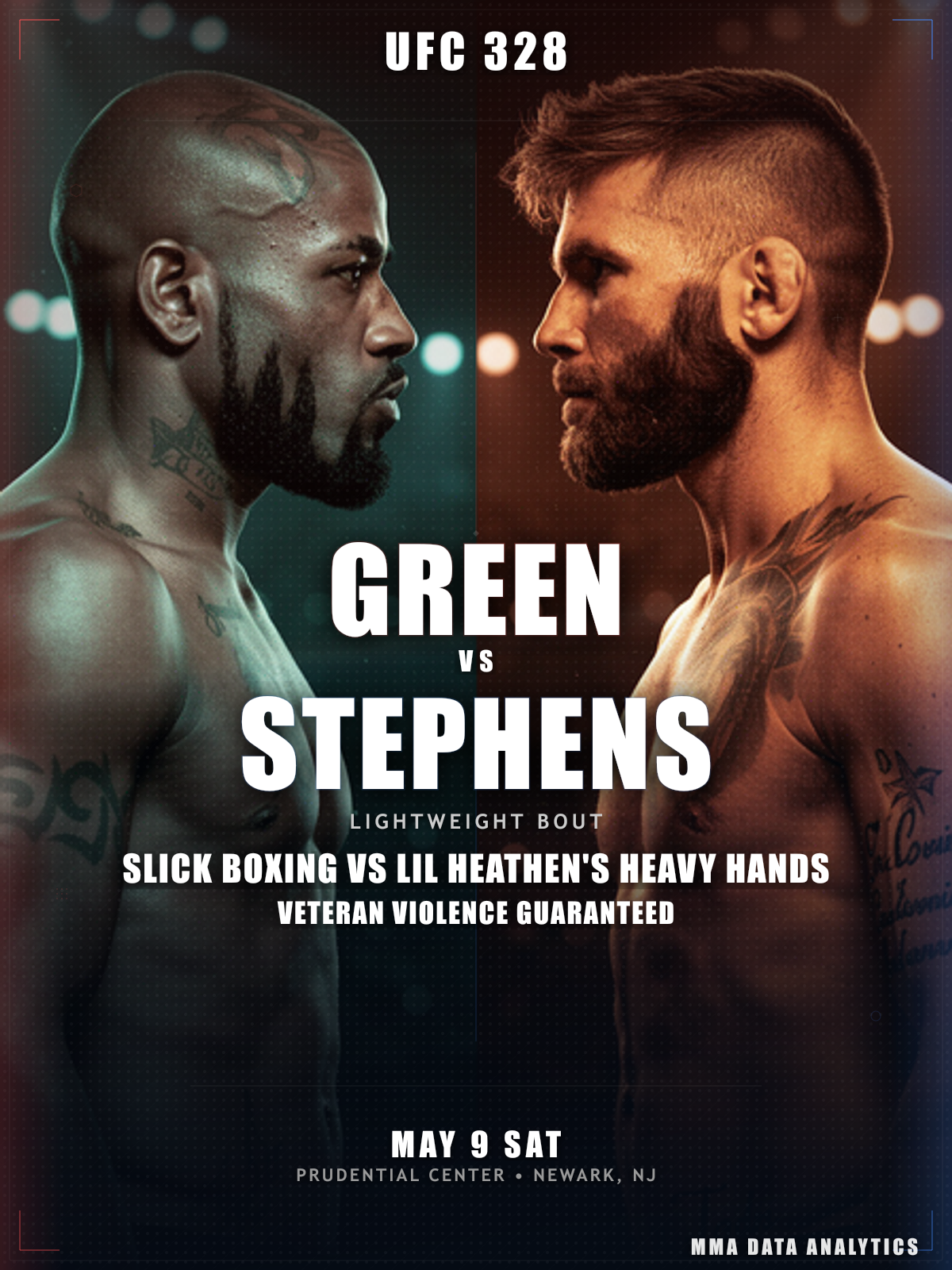
King Green vs Jeremy Stephens
Men's Lightweight Bout • UFC 328: Chimaev vs. Strickland
Saturday, May 9, 2026 • 30ft Octagon (Large Cage)
Explore Detailed Fighter Profiles
Click on either the fighter's name or profile image for each fighter to access comprehensive UFC statistics including striking metrics, grappling data, clinch performance, complete fight history, offensive & defensive analytics, and round-by-round breakdowns.

King Green
Fighter Metrics
Victory Methods
Win Round Distribution

Jeremy Stephens
Fighter Metrics
Victory Methods
Win Round Distribution
Last 5 Fights - King Green
| Date | Opponent | Result | Method |
|---|---|---|---|
| 2026-02-28 | Daniel Zellhuber | W | TKO - Punches (R2, 4:55) |
| 2025-12-13 | Lance Gibson Jr. | W | Decision - Split (R3, 5:00) |
| 2025-03-08 | Mauricio Ruffy | L | TKO - Spinning Heel Kick (R1, 2:07) |
| 2024-07-27 | Paddy Pimblett | L | Submission - Triangle Choke (R1, 3:22) |
| 2024-04-13 | Jim Miller | W | Decision - Unanimous (R3, 5:00) |
Last 5 Fights - Jeremy Stephens
| Date | Opponent | Result | Method |
|---|---|---|---|
| 2025-05-03 | Mason Jones | L | Decision - Unanimous (R3, 5:00) |
| 2022-11-25 | Natan Schulte | L | Submission - Rear Naked Choke (R2, 1:32) |
| 2022-06-17 | Myles Price | W | Decision - Split (R3, 5:00) |
| 2022-04-20 | Clay Collard | L | Decision - Unanimous (R3, 5:00) |
| 2021-07-17 | Mateusz Gamrot | L | Submission - Armbar (R1, 1:05) |
Technical Analysis
Technical Score
Cardio Score
Overall Rating
Technical Score
Calculated as the average of Striking Composite (75.8 vs 56.0) and Grappling Composite (39.9 vs 44.0). Balances overall striking effectiveness with grappling ability to measure complete technical skills.
Cardio Score
Based on average fight duration, striking rate per minute, takedown rate, and finish rate. Measures cardiovascular endurance and ability to maintain pace throughout fights.
Overall Rating
Simple average of Technical Score and Cardio Score. Provides a holistic view of fighter capabilities combining skill level with physical conditioning and fight performance.
Striking Composite
Grappling Composite
Technical Radar Comparison
Visual comparison of key performance metrics between both fighters
Detailed Statistical Comparison
Fight Analysis Breakdown
King Green Key Advantages
Green's 6.43 SLpM is more than double Stephens' 3.15, creating an enormous volume differential that dominates scorecards. Green's ability to maintain relentless output—jabs, hooks, body shots, and combination chains—overwhelms opponents who can't match his pace. His 53% striking accuracy means this volume isn't empty; he's landing clean, scoring shots at a rate Stephens hasn't faced in years. In the 30-foot cage, Green's ability to close distance quickly and unleash combinations while circling creates a non-stop striking puzzle that Stephens must solve to avoid being outworked across three rounds.
Green's 53% striking accuracy vs Stephens' 41% means Green is landing cleaner, more efficient strikes. This 12-point differential compounds over 15 minutes—Green lands roughly 1 in 2 shots while Stephens connects at less than 1 in 2.5. Green's technical boxing, including feints, level changes, and angle creation, allows him to find openings consistently. His ability to set up power shots with jab entries and body work creates compounding damage that wears opponents down while building insurmountable scoring advantages.
Green's 74% takedown defense vs Stephens' 62% means Green is significantly harder to take down and control. While neither fighter is primarily a wrestler, Green's superior ability to stay on his feet ensures the fight remains in his preferred striking range. His wrestling base from Strikeforce days gives him the defensive tools to stuff takedown attempts and immediately return to his boxing-heavy offense. This defensive advantage eliminates Stephens' potential grappling paths and keeps the fight in the striking domain where Green holds clear statistical edges.
Unfavorable Scenarios
Stephens' legendary knockout power—18 KO/TKO wins with a 0.67 knockdown average—represents a constant fight-ending threat. Despite Green's volume and activity, one clean overhand right or left hook from Stephens can end the fight instantly. Green's aggressive forward pressure and willingness to engage in exchanges occasionally exposes his chin, and Stephens has historically capitalized on such moments against technically sound strikers. The danger compounds when Green plants his feet to throw combinations, creating brief windows where Stephens' counter-punching power becomes most lethal.
Green has been stopped 6 times by KO/TKO in his career, including recent losses to Ruffy and Dober, suggesting potential vulnerability when facing heavy-handed opponents. Stephens' natural power at 155 could test Green's chin durability, especially if the fight devolves into a phone-booth brawl. Green's high-output style requires him to stay in range, which inevitably exposes him to Stephens' power shots. If Green absorbs early damage that affects his movement and output, the fight dynamics could shift dramatically in Stephens' favor.
Likely Gameplan
Green should leverage his massive volume advantage by maintaining constant output throughout all three rounds. His boxing combinations—jab-cross-hook sequences, body-head switches, and angle changes—should keep Stephens on the defensive and unable to set up his power shots. By maintaining a high pace and keeping Stephens reacting rather than loading up, Green can control the scoring narrative while minimizing the windows Stephens needs to land fight-ending power strikes.
Green should avoid standing directly in front of Stephens where his power is most dangerous. Instead, he should use lateral movement, pivots, and angle changes to create off-angle striking opportunities. By circling and resetting constantly, Green can land combinations from angles that reduce Stephens' ability to counter with power. The 30-foot cage provides ample space for this movement-heavy approach, allowing Green to dictate range and engagement terms throughout the fight.
Jeremy Stephens Key Advantages
Stephens' 18 KO/TKO wins (62% of victories) and 0.67 knockdown average make him one of the most dangerous punchers in lightweight history. His ability to end fights with single shots—overhand rights, left hooks, and uppercuts—creates a perpetual finish threat regardless of how the fight is going on the scorecards. Against Green, who absorbs 3.73 strikes per minute and has been stopped 6 times, Stephens' power becomes even more significant. Every exchange carries implicit KO equity, forcing Green to manage risk while maintaining output.
Both fighters share identical 71-inch reaches, eliminating any range advantage for Green. Stephens' ability to operate at the same distance as Green means he can engage in exchanges without being outranged. Additionally, Stephens' iron chin—only 3 KO/TKO losses in 51 MMA bouts—suggests he can absorb Green's volume without being hurt. His durability allows him to walk through combinations looking for the one clean shot he needs, a strategy that has served him well throughout his 19-year career against elite competition.
Unfavorable Scenarios
Stephens' 3.15 SLpM output is less than half of Green's 6.43, creating a massive volume deficit that becomes increasingly difficult to overcome on the scorecards. If the fight goes to decision, Stephens is almost certainly losing unless he lands significantly more impactful shots. His 41% striking accuracy means he's missing more than he's landing, and against Green's 62% striking defense, his already low output may be further reduced. The volume gap creates a scenario where Stephens must finish the fight or face near-certain defeat on the cards.
Stephens has historically struggled to maintain pace in later rounds, with 14 of his 22 losses coming by decision—suggesting he gets outworked when fights go the distance. Against Green's relentless pace and superior cardio (higher output sustained over time), Stephens risks falling behind in rounds 2 and 3. His tendency to wait for counter-punching opportunities rather than initiating creates passive stretches where Green banks scoring minutes through volume and activity.
Likely Gameplan
Stephens' optimal strategy involves patience and shot selection—waiting for Green to overcommit on combinations and then countering with heavy single shots. Rather than trying to match Green's volume, Stephens should focus on landing fewer but more impactful strikes that catch judges' attention and threaten stoppages. His ability to time counters—particularly overhand rights as Green exits combinations—represents his highest-percentage path to victory.
Stephens should look to close distance and engage in pocket exchanges where his power advantage is maximized. By walking forward and cutting off the cage, Stephens can reduce Green's ability to use lateral movement and force the fight into phone-booth range. In tight exchanges, Stephens' heavier hands and durability give him an edge, and his ability to absorb shots while landing counters creates opportunities for momentum-shifting moments that can alter the fight's trajectory.
Fight Prediction Analysis
Data-driven prediction model based on statistical analysis
📊Detailed Analysis Summary
🏟️Cage Dynamics
The 30-foot octagon at Prudential Center creates an interesting dynamic for this veteran clash. The extra space initially benefits Green's lateral movement and ability to circle away from Stephens' power, but it also means Stephens has more room to load up on power shots when he catches Green. Green's high-volume approach works best when he can control distance and dictate the pace—the large cage gives him the space to move and reset between combinations. However, Stephens has shown the ability to cut off the cage and force exchanges in tighter spaces, where his power becomes most dangerous.
🎯Technical Breakdown
The statistical analysis reveals a classic volume-vs-power dynamic. Green's 6.43 SLpM vs Stephens' 3.15 represents a 2x output differential that typically dominates scorecards—Green will likely outlander Stephens significantly in total significant strikes. However, Stephens' 0.67 knockdown average and 18 KO/TKO wins mean his lower-volume approach carries implicit finish equity in every exchange. Green's 53% striking accuracy vs Stephens' 41% creates an additional scoring layer, but Stephens' 59% striking defense and iron durability (only 3 KO losses) suggest he can absorb Green's output without being significantly hurt.
🧩Key Battle Areas
Three critical battle areas will determine the outcome: volume management, power shot timing, and late-round durability. Green's ability to maintain his 6.43 SLpM pace while avoiding Stephens' heaviest shots will be decisive—if he can sustain output without getting caught clean, he should control the scorecards comfortably. Stephens' timing on counter-punching, particularly overhand rights and left hooks as Green exits combinations, represents his highest-percentage path to an upset. As the fight progresses, Green's superior conditioning and ability to maintain pace should become increasingly apparent, making rounds 2 and 3 progressively more difficult for Stephens.
🏁Final Prediction
The most likely outcome is King Green by Decision (32% probability), achieved through relentless volume striking, superior accuracy, and consistent activity across all three rounds. Green's KO/TKO path (20%) becomes viable through accumulative damage via combinations and body work. Stephens' best upset lane is KO/TKO (25%) via a well-timed power shot—his history of fight-ending knockouts means this threat persists throughout. Stephens' decision path (10%) requires him to significantly reduce Green's output while landing cleaner, more impactful strikes—a difficult but not impossible task against a fighter who has been outworked in the past.
Betting Analysis: Model vs Market
Detailed value assessment in the betting market
📊Market Odds
🤖Analytical Model
💎Value Opportunities
MAXIMUM VALUE
Model: 32% | Fair: +213
GOOD VALUE
Model: 25% | Fair: +300
SLIGHT VALUE
Model: 52% | Fair: -108
⚠️Key Market Discrepancies
- • Underprices Green's volume dominance – 2x SLpM gap drives scoring.
- • Overweights Stephens' KO power – Green's movement limits clean shots.
- • Decision probability undervalued – Both veterans know how to survive.
Comprehensive Probabilistic Analysis
100 hypothetical fight simulation based on statistical data
🏆Outcome Distribution - King Green
Primary path via volume striking and accuracy
Accumulative damage via combinations and body work
Opportunistic grappling if Stephens is hurt
💥Outcome Distribution - Jeremy Stephens
Best lane via well-timed counter-punching
Requires reducing Green's output significantly
Low historical submission profile
⏰Fight Timeline Analysis
⚡Window of Opportunity - Jeremy Stephens
- • First 5 minutes: Highest KO equity while both fighters are fresh.
- • Counter-punching: Overhand rights as Green exits combinations.
- • Pocket exchanges: Close distance to maximize power advantage.
🎯Progressive Dominance - King Green
- • Volume: Maintain 6+ SLpM to dominate scorecards.
- • Movement: Circle and create angles to neutralize power.
- • Body work: Target Stephens' midsection to slow him further.
Final Confidence Assessment
Confidence level and uncertainty factors
Confidence Level
Close veteran matchup with contrasting styles—volume vs power
✅Supporting Factors
- • Massive volume advantage (6.43 vs 3.15 SLpM)
- • Superior striking accuracy (53% vs 41%)
- • Better takedown defense (74% vs 62%)
- • Recent momentum with 2-fight win streak
⚠️Risk Factors
- • Stephens' legitimate one-punch KO power (18 KO/TKO wins)
- • Green's 6 career KO/TKO losses show chin vulnerability
- • Equal reach eliminates Green's range management advantage
🏁Executive Summary
King Green's relentless boxing volume should steadily outwork Jeremy Stephens across three rounds, but Stephens' legendary one-punch power means this fight carries legitimate upset potential throughout. The statistical differentials heavily favor Green: his 6.43 SLpM vs Stephens' 3.15 represents a 2x volume advantage, while his 53% accuracy vs 41% ensures those strikes are landing clean and scoring consistently. Green's 74% takedown defense keeps the fight standing where he holds clear advantages, and his recent momentum—TKO over Zellhuber and decision over Gibson Jr.—suggests he's performing at a high level. However, Stephens' 18 KO/TKO career wins and 0.67 knockdown average represent a constant fight-ending threat that Green cannot ignore. Green's 6 career KO/TKO losses, including recent stoppages against Ruffy and Dober, suggest vulnerability against heavy-handed opponents. The fight's outcome likely hinges on whether Green can maintain his volume while avoiding Stephens' cleanest power shots—a balancing act he's managed against elite competition throughout his UFC career.
Prediction: Green by Decision most likely (32% probability) through volume dominance and accurate striking; Stephens' upset lane is KO/TKO (25%) via well-timed counter-punching. The fight's character should feature high-paced exchanges in the early rounds with Green gradually pulling away on the scorecards as his conditioning and output advantage become decisive.