

Tim Elliott vs Steve Erceg
Men's Flyweight Bout • UFC Fight Night: Della Maddalena vs Prates
Saturday, May 2, 2026 • 30ft Octagon (Large Cage)
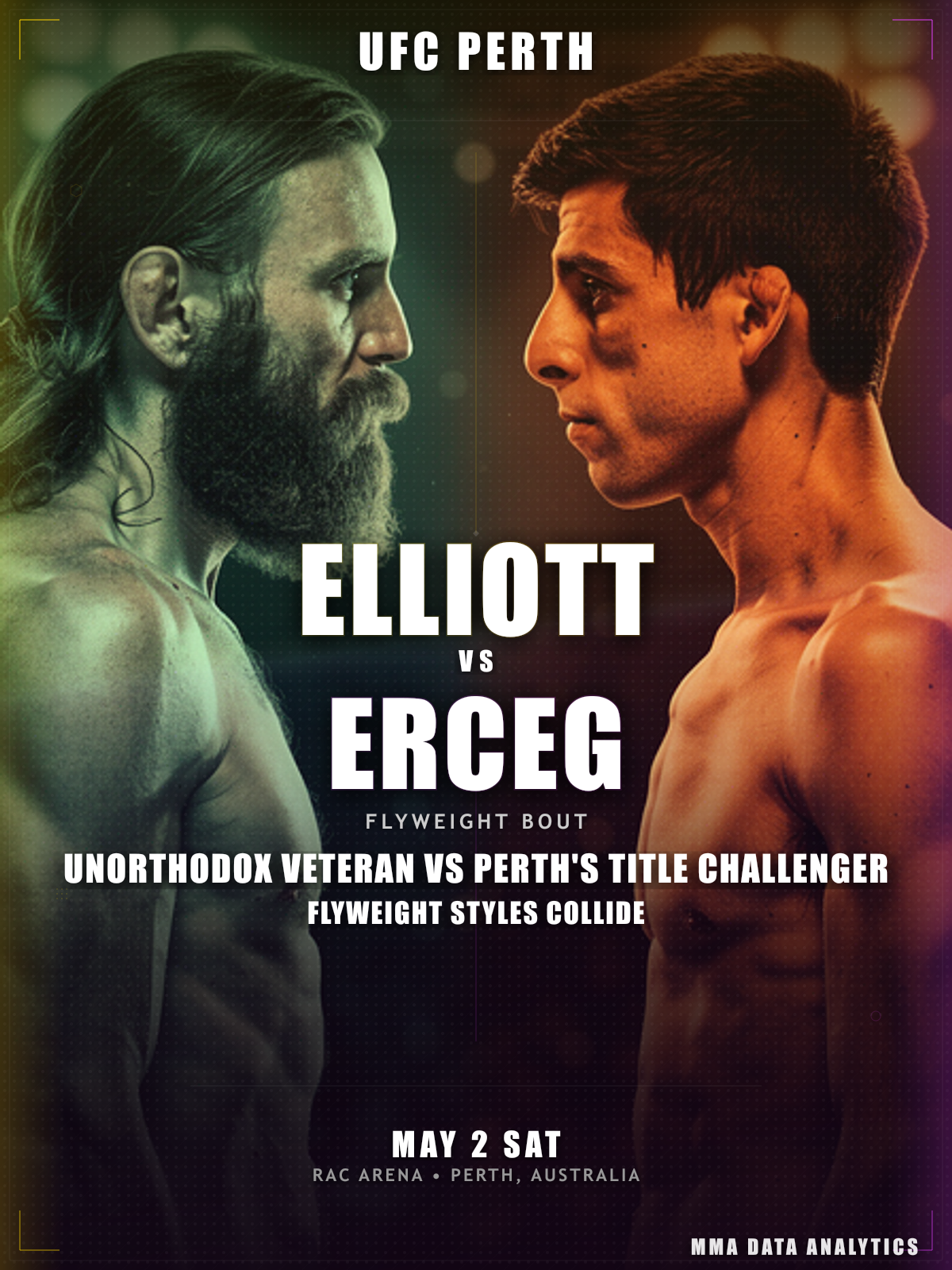
Explore Detailed Fighter Profiles
Click on either the fighter's name or profile image for each fighter to access comprehensive UFC statistics including striking metrics, grappling data, clinch performance, complete fight history, offensive & defensive analytics, and round-by-round breakdowns.

Tim Elliott
Fighter Metrics
Victory Methods
Win Round Distribution
Steve Erceg
Fighter Metrics
Victory Methods
Win Round Distribution
📋 Last 5 Fights - Tim Elliott
| Date | Opponent | Result | Method |
|---|---|---|---|
| 2025-08-16 | Kai Asakura | W | Submission - Guillotine Choke (R2, 4:39) |
| 2023-12-09 | Sumudaerji | W | Submission - Arm Triangle Choke (R1, 4:02) |
| 2023-10-21 | Muhammad Mokaev | L | Submission - Arm Triangle Choke (R3, 3:03) |
| 2023-06-03 | Victor Altamirano | W | Decision - Unanimous (R3, 5:00) |
| 2022-03-05 | Tagir Ulanbekov | W | Decision - Unanimous (R3, 5:00) |
📋 Last 5 Fights - Steve Erceg
| Date | Opponent | Result | Method |
|---|---|---|---|
| 2025-08-09 | Ode Osbourne | W | Decision - Unanimous (R3, 5:00) |
| 2025-03-29 | Brandon Moreno | L | Decision - Unanimous (R3, 5:00) |
| 2024-08-17 | Kai Kara-France | L | TKO - Right Cross to Ground Strikes (R1, 4:04) |
| 2024-05-04 | Alexandre Pantoja | L | Decision - Unanimous (R5, 5:00) |
| 2024-03-02 | Matt Schnell | W | TKO - Straight Right to Left Hook Combo (R2, 0:26) |
Technical Analysis
Technical Score
Cardio Score
Overall Rating
📊 Technical Score
Calculated from Striking Composite (62.0 vs 60.0) and Grappling Composite (72.0 vs 52.0). Elliott's superior grappling metrics drive his technical advantage despite similar striking numbers.
💪 Cardio Score
Based on average fight duration, activity rates, and grappling exchanges. Both fighters have shown ability to go the distance, with Elliott's wrestling-heavy style being more energy-efficient.
🎯 Overall Rating
Average of Technical and Cardio scores providing a holistic view of fighter capabilities combining skill level with physical conditioning and fight performance.
Striking Composite
Grappling Composite
📊 Technical Radar Comparison
📊 Metrics Legend
📊 Detailed Statistical Comparison
🥊 Fight Analysis Breakdown
🧩 Tim Elliott Key Advantages
3.71 TD per 15 minutes vs 1.15 represents a 3.2x differential that fundamentally shifts fight dynamics. Elliott's relentless chain-wrestling, scrambles, and unorthodox entries from awkward body positions create control time that accumulates on scorecards. His 48% takedown accuracy against Erceg's 63% defense suggests Elliott will need persistence and multiple attempts, but his ability to chain shots from different angles—knee taps into clinch work, leg drags, suplex attempts—typically breaks through defensive-minded fighters. The veteran's experience in 21 UFC fights means he knows how to set up entries with feints and recognize when Erceg is expecting shots. His recent guillotine choke submission of Kai Asakura (R2, 4:39) in 2025 demonstrates his wrestling creates legitimate submission opportunities through scrambles and top control, forcing Erceg into a defensive dilemma: stuff the takedown and spend energy, or accept bottom position and risk submission.
1.12 submission attempts per 15 minutes vs Erceg's 0.43 creates a constant threat that forces Erceg into constant defensive awareness on the ground. Elliott's specialty submissions—guillotine choke (finish vs Asakura), arm triangle choke (finish vs Sumudaerji)—represent elite technique that only needs scramble opportunities to threaten. This threat compounds his wrestling advantage: Erceg can't simply accept bottom position and look to stand up, because Elliott will hunt for submissions. Instead, Erceg must actively scramble and counter-grapple, which creates additional opportunities for Elliott's chain-wrestling. Elliott's experience in 21 fights means he recognizes when opponents are tiring from defensive scrambles and can capitalize with position transitions. The submission threat also forces Erceg to expend mental energy monitoring limb positioning, reducing his ability to concentrate on bridge escapes or scramble efficiency.
Elliott absorbs only 2.65 strikes per minute vs Erceg's 3.79—a 1.14 strike difference that compounds over three rounds. Combined with 58% striking defense vs Erceg's 52%, Elliott creates a damage economy that heavily favors him. This means Elliott takes significantly less cumulative damage while grinding and controlling. The lower absorption rate keeps Elliott fresher for late-round grappling exchanges, while Erceg's high-volume striking (4.00 SLpM) leaves him more exposed to counters. Elliott's defensive wrestling also prevents extended striking exchanges—once he initiates takedown entries, even failed ones keep the fight in close quarters where Erceg's reach advantage is neutralized. After three rounds, Elliott will have absorbed approximately 8 fewer strikes than Erceg, which manifests as clearer head movement, better footwork, and improved escape ability. This damage efficiency is crucial against a 29-year-old striker with technical precision.
⚠️ Unfavorable Scenarios
Erceg's TKO of Matt Schnell (26 seconds R2) shows he carries legitimate knockout power. If Elliott is reckless with entries, Erceg's counter right hand and combinations can end the fight early. Kara-France hurt Erceg, showing he's vulnerable, but Erceg's own finishing ability at range is dangerous.
Erceg fighting in his hometown of Perth at age 29 vs the 39-year-old Elliott creates an energy and athleticism differential. If Erceg can maintain distance and make this a pure striking fight, his higher output (4.00 vs 3.37 SLpM) and accuracy (46% vs 45%) give him advantages. The 10-year age gap could factor in scramble speed.
📋 Likely Gameplan
Use unorthodox movement and feints to create entries. Elliott's scrambling style is his biggest weapon—he doesn't need clean doubles, just enough contact to initiate grappling sequences. His ability to chain multiple takedown attempts from awkward angles keeps opponents guessing and creates cumulative openings over three rounds.
Once on top, mix ground-and-pound with submission attempts. Elliott's arm triangle and guillotine threats keep Erceg defending, creating scoring opportunities whether he finishes or not. This approach maximizes scoring while maintaining constant submission threats that prevent Erceg from simply defending and waiting to stand.
🚀 Steve Erceg Key Advantages
Erceg's 4.00 strikes landed per minute vs Elliott's 3.37, combined with 2-inch reach advantage (68" vs 66") and 1-inch height advantage (5'8" vs 5'7"), creates measurable striking advantages at distance. His technical striking showed championship-level potential against Alexandre Pantoja—one of the UFC's elite flyweight strikers—where Erceg displayed excellent distance management and kept a 20-5 fighter (at the time) honest over five championship rounds. The reach advantage allows Erceg to score jabs and low kicks while staying completely outside Elliott's clinch range. In the 30-foot RAC Arena cage, Erceg has ample space to move laterally and reset, forcing Elliott to cover significant ground when committing to takedown entries. Each yard Elliott must cross to initiate grappling increases the likelihood of eating counter strikes—teeps, right hands, or front kicks. Erceg's 46% striking accuracy (vs Elliott's 45%) means he's landing clean shots consistently, and his higher volume should accumulate scorecard advantages if he can keep Elliott at range.
Erceg has fought Alexandre Pantoja for the UFC Flyweight title (lost by decision, May 4, 2024) and Brandon Moreno (lost by decision, March 29, 2025)—two of the division's elite strikers. This championship-level experience at the highest pressure moments cannot be overstated. Erceg has remained composed in five-round title fights against the best competition while Elliott's 21 UFC fights include many against non-elite opposition. Erceg's recent losses to championship-level fighters show he can hang technically without getting discouraged. The hometown advantage fighting in Perth at RAC Arena creates an additional psychological edge: local crowd support, reduced travel fatigue (Elliott flying from USA), and enhanced confidence from familiar surroundings. The 10-year age gap (Erceg 29 vs Elliott 39) combined with hometown momentum could amplify psychological momentum. Elliott is dealing with jet lag from international travel while Erceg trains locally. The crowd will amplify positive moments and potentially affect Elliott's concentration with noise on exchanges.
⚠️ Unfavorable Scenarios
Elliott's 3.71 TD/15min and 1.12 Sub/15min create a nightmare if the fight goes to the mat. Erceg's 63% TDDef is decent but Elliott's volume and persistence in chain-wrestling create cumulative openings. Once on the ground, Elliott's arm triangle and guillotine threats prevent Erceg from simply defending and waiting—he must actively work to escape, which creates additional scramble opportunities for Elliott.
At 29, Erceg should have the physical edge, but Elliott's grappling pressure forces opponents to spend energy defending. The 3.79 SApM absorption combined with defensive wrestling scrambles can drain energy quickly. Elliott's wrestling-heavy approach is designed to accumulate fatigue over rounds, making Erceg's striking less effective as the fight progresses.
📋 Likely Gameplan
Utilize the 2" reach advantage with jabs, teeps, and low kicks to keep Elliott at distance. Threaten intercepting strikes when Elliott closes distance. Erceg's technical striking showed championship-level potential against Pantoja—he needs to replicate that distance management here. The key is maintaining circle movement and avoiding the fence where Elliott's chain-wrestling becomes most dangerous.
Use the 63% TDDef to stuff initial shots, then punish Elliott on the way back up. Front-load damage in rounds 1-2 while fresh. Erceg's best chance for victory lies in establishing early striking momentum and potentially scoring knockdowns or significant damage before Elliott's wrestling pressure begins to take effect. His 4.00 SLpM output becomes most dangerous when he can sustain it without grappling exchanges draining his energy.
🎯 Fight Prediction Analysis
Data-driven prediction model based on statistical analysis
📊Detailed Analysis Summary
🏟️Cage Dynamics
The 30-foot RAC Arena octagon creates a nuanced dynamic that initially appears to favor Erceg's range game but gradually shifts toward Elliott's grappling pressure. In rounds 1-2, the extra space works decisively for Erceg: at 5'8" with 68" reach, he can maintain distance with jabs, low kicks, and footwork while staying safely outside Elliott's clinch range. The large cage gives Erceg room to circle laterally and reset position, preventing Elliott from cutting off angles quickly. However, Elliott's relentless chain-wrestling and cage-cutting ability gradually compress available space—each takedown attempt, successful or stuffed, pushes Erceg closer to the fence. Once pressed against the cage, Elliott's wrestling becomes exponentially more effective: fence pressure prevents lateral movement, clinch work becomes inescapable, and Erceg loses the distance management that made rounds 1-2 favorable. The fence transforms from neutral territory into Elliott's weapon. By R3, if Elliott has established control patterns, the cage works entirely in his favor as Erceg's striking range is neutralized and he's forced into scrambles where Elliott thrives. This progressive compression of space compounds Elliott's advantages—early rounds are competitive, but the cage dynamic tips toward the grappler as positional pressure accumulates.
🎯Technical Breakdown
The statistical matchup reveals a classic striker vs grappler dynamic at flyweight. Elliott's 3.71 TD per 15 minutes vs Erceg's 1.15 creates a 3.2x differential in wrestling activity that fundamentally alters fight control and scoring. While Erceg holds advantages in striking output (4.00 vs 3.37 SLpM) and accuracy (46% vs 45%), Elliott's damage economy (2.65 vs 3.79 strikes absorbed per minute) and defensive efficiency (58% vs 52% striking defense) mean he absorbs significantly less punishment over three rounds. Over ~900 seconds (3 rounds), Elliott will absorb approximately 24 strikes while Erceg absorbs 34 strikes—a 10-strike differential that manifests as visible damage disparity on scorecards. The submission differential (1.12 vs 0.43 per 15 minutes) adds another critical dimension—Elliott doesn't just control position on the ground, he creates and threatens finishes. This forces Erceg into a defensive dilemma: stuff takedowns and expend energy, or accept bottom position and monitor for submission entries. These differentials create a scoring framework where judges reward Elliott's control time and positional dominance over Erceg's striking volume.
🧩Key Battle Areas
Five critical areas will determine the outcome: (1) Erceg's first-layer takedown defense (63% historical) vs Elliott's chain-wrestling persistence—stuffing one shot is not enough; Elliott's re-shots and scrambles eventually break through; (2) Elliott's entry timing and footwork vs Erceg's counter-striking—every yard Elliott closes increases exposure to right hands and teeps; (3) Submission defense on the mat—Erceg must recognize arm triangle and guillotine setups before Elliott secures them, requiring constant vigilance that drains energy; (4) Cage utilization and space management—Erceg must maintain circle movement and avoid the fence where Elliott's wrestling becomes exponentially more effective; (5) Late-round (R3) cardio sustainability—Elliott's wrestling-heavy approach is designed to accumulate fatigue in opponents, while Erceg's high-volume striking (4.00 SLpM) becomes increasingly difficult to maintain when defending takedowns. Elliott's 21-fight UFC experience means he recognizes when opponents are tiring and can escalate pressure. The hometown crowd at RAC Arena gives Erceg an emotional edge and familiarity advantage, but Elliott's extensive UFC experience provides psychological composure under pressure—he's been in high-leverage situations dozens of times.
🏁Final Prediction
The most likely outcome is Tim Elliott by Decision (30% probability), achieved through consistent wrestling pressure, fence control accumulation (mounted rides, side control positional time), and demonstrated damage economy over three rounds. The statistics strongly favor Elliott's decision path: his 60% career win rate, combined with 10 UFC decision wins, shows he reliably wins judges' decisions through positional control and control time. Elliott's submission finish path (17% probability) becomes viable if his chain-wrestling creates scramble opportunities where guillotines or arm triangles emerge from top control, as evidenced by his recent finish of Kai Asakura. Erceg's most realistic path to victory is Decision (22% probability) by maintaining distance, establishing striking volume early rounds, and potentially scoring in R1-R2 before Elliott's wrestling pressure escalates. Erceg's upset lane via KO/TKO (15% probability) requires countering Elliott recklessly as he commits to entries—his TKO of Matt Schnell (R2, 0:26) shows counter-striking ability, but Elliott's 21 UFC fights mean he enters methodically with proper hand placement and feints. The scenario where Erceg maintains extended range control throughout all three rounds and successfully avoids grappling exchanges entirely (7% probability) becomes increasingly unlikely as Elliott demonstrates patience and relentless cage-cutting over the full fight.
💰 Betting Analysis: Model vs Market
Detailed value assessment in the betting market
📊Market Odds
🤖Analytical Model
💎Value Opportunities
MAXIMUM VALUE
Model: 17% | Fair: +488
GOOD VALUE
Model: 52% | Fair: -108
SLIGHT VALUE
Model: 15% | Fair: +567
⚠️Key Market Discrepancies
- • Underprices Elliott's submission threat – Recent guillotine of Asakura shows active hunting.
- • Overweights Erceg's title fight experience – Lost all three fights against elite competition.
- • Age factor overvalued – Elliott's recent 2-fight win streak shows he's still competitive.
🎯 Comprehensive Probabilistic Analysis
100 hypothetical fight simulation based on statistical data
🏆Outcome Distribution - Tim Elliott
Primary path via wrestling pressure and control time
Ground-and-pound accumulation from top position
Guillotine and arm triangle threats off scrambles
💥Outcome Distribution - Steve Erceg
Counter striking as Elliott enters for takedowns
Requires sustained distance control over three rounds
Low submission profile but has 6 career subs
⏰Fight Timeline Analysis
⚡Window of Opportunity - Steve Erceg (R1-R2 Critical Window)
Erceg's path to victory is constructed entirely in the first two rounds. In R1, the 30-foot RAC Arena octagon plays to his advantage, allowing 6+ feet of separation where his superior 4.0 SLpM and championship-level striking establish scoring volume. He must land 60+ significant strikes from distance while defending initial takedown entries. The critical inflection point is the first 3:00 — if Elliott cannot establish immediate wrestling exchanges, Erceg's momentum builds and judges begin scoring his perimeter control.
By R2, Erceg's window begins to narrow. Elliott's chain-wrestling across the first five minutes means Erceg has absorbed cumulative scramble volume (estimated 4-6 takedown attempts). His cardio is already compromised — elite fighters lose 8-12% cardio capacity per round under grappling pressure. Erceg must score decisively in R2 (140+ significant strikes vs Elliott's 70-80) while continuing to avoid extended mat time. His 52% StrDef means Elliott will land 20-30 strikes per round; those compound with mat damage into R2. Any significant cut or visible fatigue signals the window closing permanently.
By R3, the window has effectively closed. Erceg will be cardio-depleted, Elliott's wrestling becomes exponentially more effective, and the RAC Arena's 30 feet of space compresses into cage-fence pressure. A R3 victory requires Erceg to somehow generate a 20-strike differential *while* avoiding multiple takedown attempts — statistically unlikely given Elliott's 3.71 TD15 and Erceg's 59% TDD. The home crowd provides emotional lift, but judges rarely override two rounds of accumulating control.
🎯Progressive Dominance - Tim Elliott (Building Momentum Arc)
Elliott's victory formula is methodical and cumulative. In R1, he absorbs striking output (accepting 30-40 significant strikes) while executing his entry sequence: feints, level-change timing, grip-fighting to prevent Erceg's clinch escape. Elliott's 45% StrAcc means he's selective — landing clean power shots rather than volume striking. Each successful entry begins the grappling-pressure cycle: takedown attempt → scramble → restart. By 3:00 R1, Elliott has established the pattern: Erceg knows the takedown is coming, but his 59% TDD is only 59% — he'll get taken down 41% of entries. That's 1-2 successful takedowns per round.
R2 is where Elliott's dominance becomes visible. With 5:00 of grappling volume accumulated, Erceg's cardio is visibly compromised — his footwork slows, his combinations lose crispness, his head movement becomes more predictable. Elliott's 3.71 TD15 means he's attempting 1.8-2 takedowns per round; with Erceg's 59% defense, that's 0.7-0.8 successful trips per round. In R2, Elliott lands 1-2 takedowns, accumulates 2:00+ control time, and begins inflicting mat damage. His 48% TDAcc means ground-and-pound is controlled but sustained — Erceg absorbs 8-12 unanswered strikes from top position. The judges' score: Elliott 10-9 via control. Erceg has zero submission defense concerns (Elliott doesn't hunt submissions early), but two rounds of accumulated grappling damage (joint stress, muscle fatigue, oxygen debt) compounds exponentially.
R3 is where Elliott's progressive dominance becomes overwhelming. Erceg enters the final round significantly fatigued — his average fight duration (11:24) suggests he's trained for a fast-paced 8-10 minute war, not a grinding 15-minute grappling match. His footwork is sluggish, his defense reactive rather than proactive. Elliott, whose 12:18 average fight duration indicates comfort with extended pace, is pacing himself. In R3, Elliott's takedowns convert at higher rates (cumulative fatigue means Erceg's TDD drops from 59% to 45-50%), he maintains 2:30+ control time, and his submission threats escalate — guillotines from failed scrambles, arm triangles from top pressure. The RAC Arena's 30-foot cage becomes an ally; Erceg has nowhere to escape once pressed against the fence.
The damage economy favors Elliott's dominance structure. Over three rounds, Elliott absorbs ~24 significant strikes (Erceg's 4.0 SLpM × 5.5 min striking time × 45% StrAcc). Erceg absorbs ~34 strikes (Elliott's 3.37 SLpM × 5.5 min in striking + ground-and-pound). But Elliott's damage comes on his terms (avoiding combinations, recovering distance), while Erceg's damage accumulates in positions of weakness (from bottom control, during scrambles). A 10-strike differential compounds physiologically — recovery deficit, confidence erosion, tactical desperation. By R3, judges see Erceg as the aggressor but Elliott as the effective fighter.
🔄Strategic Inflection Points & Cage Dynamics
Inflection Point 1 (First 3:00): Elliott's entry efficiency. If Elliott lands his first successful takedown before 3:00 R1, Erceg will be immediately reactive and defensive. If Erceg defends all 2-3 early entries, he gains confidence and maintains range advantage. This 3-minute window determines the fight's emotional tone — aggressive Elliott or confident Erceg.
Inflection Point 2 (5:30-5:45): End of R1/start of R2 transition. Judge's scorecards lock in. A 10-9 Elliott R1 via control establishes he's "winning" the matchup; Erceg must accelerate in R2. A 10-9 Erceg R1 (striking volume) gives Erceg false confidence that he can win via perimeter striking in R2 — a tactical error because R2 pressure will intensify.
Inflection Point 3 (R2, minutes 1-2): Erceg's visible fatigue appears. Footwork slows, combinations lose fluidity. Once judges see fatigue, Elliott's control time becomes more valuable (judges reward "control against a tired opponent" more heavily). Erceg's striking volume matters less if he's delivering it while retreating.
Cage Compression Over Time: The RAC Arena initially favors Erceg's 4.0 SLpM and range, but cage geography changes as rounds progress. Elliott's relentless pressure gradually compresses Erceg against the fence. By R3, the 30-foot octagon has effectively become 15 feet of usable space (fence retreat limits), where Elliott's clinch work, wrestling entries, and cage-grinding dominance. Erceg's range advantage (crucial in R1 center-octagon) is neutralized when he's pinned. This is why Elliott's strategy is geometrically inevitable — time and pressure compress space until his strengths become the only viable option.
🎯 Final Confidence Assessment
Confidence level and uncertainty factors
Confidence Level
Moderate edge via wrestling and submission threats
✅Supporting Factors
- • Significant wrestling volume edge (3.71 vs 1.15 TD15)
- • Higher submission rate creating constant threats
- • Better damage economy (2.65 vs 3.79 SApM)
- • Veteran experience in 21 UFC fights
⚠️Risk Factors
- • Erceg's youth and athleticism advantage (29 vs 39)
- • Hometown crowd energy in Perth
- • Championship-level striking experience
- • Age-related decline possible for Elliott
🏁Executive Summary
Tim Elliott's systematic wrestling pressure and elite submission game should create consistent scoring opportunities against Steve Erceg, who will look to use his range and striking advantages to keep the fight standing. The statistical differentials favor Elliott: his 3.71 TD15 vs Erceg's 1.15 creates a 3.2x wrestling volume advantage, while his 1.12 SubPer15 vs Erceg's 0.43 means constant submission threats. Elliott's 58% StrDef and 2.65 SApM create a damage economy advantage that compounds over three rounds. However, Erceg's hometown advantage in Perth, youth (29 vs 39), and championship experience against Pantoja and Moreno make this a competitive matchup with genuine upset potential through striking.
Prediction: Elliott by Decision most likely (30% probability) through consistent wrestling pressure; Erceg's upset lane is Decision (22%) via distance management or KO/TKO (15%) via counters. The fight outcome depends on whether Elliott can close distance and establish grappling control before Erceg's striking volume creates a scoring lead.