
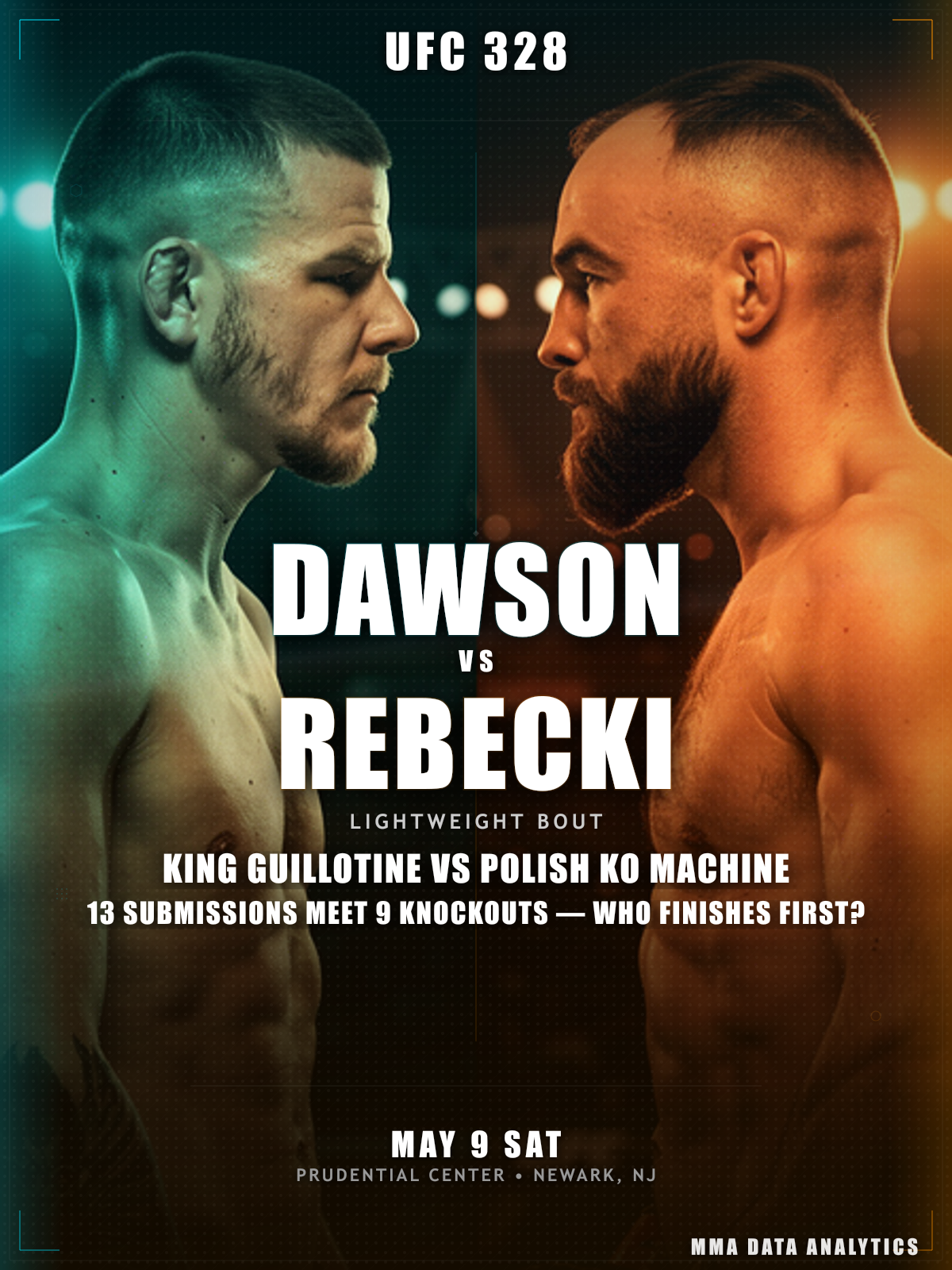
Grant Dawson vs Mateusz Rebecki
Men's Lightweight Bout • UFC 328
Saturday, May 9, 2026
Explore Detailed Fighter Profiles
Click on either the fighter's name or profile image for each fighter to access comprehensive UFC statistics including striking metrics, grappling data, clinch performance, complete fight history, offensive & defensive analytics, and round-by-round breakdowns.
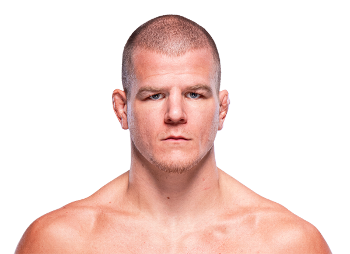
Grant Dawson
Fighter Metrics
Victory Methods
Win Round Distribution

Mateusz Rebecki
20-4-0
Mateusz Rebecki
Fighter Metrics
Victory Methods
Win Round Distribution
📋 Last 5 Fights - Grant Dawson
| Date | Opponent | Result | Method |
|---|---|---|---|
| 2025-12-06 | Manuel Torres | L | TKO - Uppercut to Ground Punches (R1, 2:25) |
| 2025-01-18 | Diego Ferreira | W | Decision - Unanimous (R3, 5:00) |
| 2024-10-12 | Rafa García | W | TKO - Ground & Pound (R2, 1:42) |
| 2024-06-01 | Joe Solecki | W | Decision - Unanimous (R3, 5:00) |
| 2023-10-07 | Bobby Green | L | TKO - Straight Left to Ground Strikes (R1, 0:33) |
📋 Last 5 Fights - Mateusz Rebecki
| Date | Opponent | Result | Method |
|---|---|---|---|
| 2025-10-25 | Ľudovít Klein | L | Decision - Majority (R3, 5:00) |
| 2025-08-02 | Chris Duncan | L | Decision - Unanimous (R3, 5:00) |
| 2024-10-26 | Myktybek Orolbai | W | Decision - Split (R3, 5:00) |
| 2024-05-11 | Diego Ferreira | L | TKO - Ground & Pound (R3, 4:51) |
| 2023-11-11 | Roosevelt Roberts | W | Submission - Armbar (R1, 3:08) |
Technical Analysis
Technical Score
Cardio Score
Overall Rating
📊 Technical Score
Calculated as the average of Striking Composite (52 vs 62) and Grappling Composite (81 vs 55). Balances overall striking effectiveness with grappling ability to measure complete technical skills.
💪 Cardio Score
Based on average fight duration, striking rate per minute, takedown rate, and finish rate. Measures cardiovascular endurance and ability to maintain pace throughout fights.
🎯 Overall Rating
Simple average of Technical Score and Cardio Score. Provides a holistic view of fighter capabilities combining skill level with physical conditioning and fight performance.
Striking Composite
Grappling Composite
Technical Radar Comparison
Visual comparison of key performance metrics between both fighters
📊 Detailed Statistical Comparison
🥊 Fight Analysis Breakdown
🧩 Grant Dawson Key Advantages
Grant Dawson has finished 13 of his 23 career wins via submission—one of the highest rates among active UFC lightweights in this bracket. His 1.5 submission attempts per 15 minutes reflect a constant threat hunting for the neck, wrist, and back. Known especially for his guillotine and anaconda chokes off leg-kick clinches and failed takedown entries, Dawson creates finish danger from scrambles that most grapplers ignore. Rebecki has never been submitted in 24 professional fights, but Dawson's chain submission sequences—hunting one choke off a re-shot, pivoting to another off a scramble—represent the deepest submission game Rebecki has faced in the UFC.
Dawson's 3.4 takedowns per 15 minutes dwarfs Rebecki's 1.4, creating a fundamental control differential. His wrestling sequences—double-leg entries off striking feints, fence clinch to double, and knee-pick setups—generate sustained pressure that limits Rebecki's ability to reset and establish rhythm. Rebecki's 63% takedown defense will face constant testing, and Dawson's persistence through re-shots means even defended attempts shift energy and scoring dynamics. Once Dawson establishes top position, his 74% takedown defense ensures he can dictate the pace of the fight.
Dawson absorbs only 2.3 strikes per minute—1.3 fewer than Rebecki's 3.6—reflecting a grappling-first style that prioritizes control over exchanges. His 58% striking defense and low absorption profile mean the fight's damage ledger consistently favors him in rounds that reach the judges. Rebecki's 3.9 SLpM striking volume can hurt Dawson on the feet, but Dawson's deep submission arsenal and 88.5% career win rate demonstrate consistent high-level output. Every round Dawson spends controlling the cage is a round Rebecki cannot score via striking.
⚠️ Unfavorable Scenarios
All three of Dawson's career losses have come by TKO/KO—none by decision or submission—revealing a susceptibility to clean power strikes when caught off rhythm or forced into exchanges. Rebecki has scored 9 KO/TKO victories, including a TKO finish over Diego Ferreira (who Dawson defeated by decision), demonstrating legitimate stopping power. The 0:33 stoppage by Bobby Green shows Dawson can be put away quickly when a big shot lands at the wrong moment. If Rebecki can time a clean counter as Dawson shoots or pressures forward, his KO power makes this fight dangerous in early exchanges.
Dawson's 2.4 SLpM is significantly lower than Rebecki's 3.9, meaning rounds that stay on the feet allow Rebecki to control the scoring narrative. With a 2-inch reach advantage (74" vs 72"), Rebecki can maintain distance, land jabs and front kicks, and accumulate striking volume on the scorecards. If Dawson's takedown entries are consistently stuffed, judges will reward Rebecki's higher output. Dawson has only 5 career decision wins compared to 18 finishes, suggesting his scoring floor when grappling is neutralized is lower than most fighters at this level.
📋 Likely Gameplan
Dawson's optimal path is to close distance quickly using body-lock clinches and double-leg entries off jab feints, removing Rebecki's striking space before his power game warms up. Once in the clinch or on top, Dawson should hunt for the guillotine off underhook battles and anaconda off failed sprawls. His 44% takedown accuracy combined with re-shot persistence means he doesn't need to land every attempt—the cumulative pressure from takedown attempts alone drains Rebecki's energy and disrupts his rhythm. Securing even two minutes of cage control per round builds a decisive scoring framework for the judges.
After establishing top position, Dawson should work through submission chains rather than resting in control. His guillotine threat off a re-shot is his most dangerous weapon—setting it up early forces Rebecki to hesitate on sprawls and creates openings that turn defensive reactions into submissions. If Rebecki turtles defensively, Dawson should transition to the back to hunt for the rear naked choke. His 74% takedown defense means even if Rebecki scrambles to his feet, Dawson can reset and re-shoot while maintaining the pace he prefers.
🚀 Mateusz Rebecki Key Advantages
Rebecki's 74-inch reach advantage (vs Dawson's 72") and 5'11" height create meaningful striking opportunities at range. His arsenal includes long jabs, body kicks, and front kicks that can score points while keeping Dawson from closing distance. The Polish fighter's 41% striking accuracy reflects high output that accumulates volume on cards. In the early rounds when Rebecki is fresh, his reach and mobility allow him to maintain distance and land clean shots, forcing Dawson to cover ground and commit to entries that expose him to counters.
Rebecki's 9 career KO/TKO victories at a 45% finish rate represent genuine stopping power in a division often decided by decision. His ability to hurt opponents has been demonstrated across multiple UFC fights, and his TKO finish over Diego Ferreira (whom Dawson beat by unanimous decision) shows he can finish top-tier competition. Dawson's three career losses all came by TKO/KO, making Rebecki's power game a credible threat. If Rebecki can keep Dawson at range and land clean shots as he enters, his finish rate makes an early stoppage entirely plausible.
⚠️ Unfavorable Scenarios
Dawson's chain-wrestling sequences create a nightmare scenario for Rebecki—once the American secures takedowns, his ability to chain shots, apply submission pressure, and execute mat returns prevents Rebecki from regaining his feet or establishing striking rhythm. Rebecki's 63% takedown defense means Dawson will land a meaningful portion of his 3.4 TD/15min attempts. Once on the ground, Rebecki's striking output drops near zero while Dawson's 1.5 submission attempts per 15 minutes threaten finishes from multiple positions. This scenario becomes increasingly likely as the fight progresses and Rebecki's energy depletes from defending takedowns.
Rebecki has never been submitted in his career, but he has also rarely faced a submission specialist of Dawson's caliber. As the fight progresses into round 3 and Rebecki's energy depletes from defending takedowns, the submission danger compounds. Dawson's ability to hunt guillotines off re-shots and transition to the back when opponents attempt to get up creates finish opportunities that are harder to avoid when fatigued. Rebecki's 3.6 SApM absorption rate combined with grappling scrambles means he accumulates fatigue faster than Dawson, making late-round submission attempts the most dangerous phase.
📋 Likely Gameplan
Rebecki's optimal strategy involves maintaining perimeter control while threatening power counters. His front kicks and long jabs should target Dawson's base and slow his forward pressure, making takedown entries more costly. When Dawson commits to shots, Rebecki should threaten uppercuts and knees to deter entries and create KO opportunities—the scenario most likely to end this fight early in Rebecki's favor. The key is staying active enough to score points and landing clean shots that accumulate damage, potentially swaying judges if Dawson's grappling is neutralized.
Rebecki's best chance for victory lies in front-loading damage during the first two rounds when he's fresh and Dawson hasn't yet established his wrestling rhythm. The Polish fighter should capitalize on his early energy advantage by maintaining high striking output and landing clean shots before Dawson's takedown pressure takes hold. His 3.9 SLpM becomes most dangerous when sustained without grappling exchanges draining his energy. By establishing early momentum and potentially scoring knockdowns or significant damage in rounds 1-2, Rebecki can force Dawson to fight from behind and potentially disrupt his grappling gameplan for round 3.
🎯 Fight Prediction Analysis
Data-driven prediction model based on statistical analysis
📊Detailed Analysis Summary
🏟️Cage Dynamics
This lightweight matchup pits two fighters with sharply contrasting game plans. The early rounds favor Rebecki's striking tools—his 74-inch reach and 3.9 SLpM create range advantages when Dawson hasn't yet established wrestling rhythm. However, Dawson's relentless takedown pressure gradually compresses Rebecki's space, forcing exchanges in the clinch and on the mat where Dawson's 56% submission win rate becomes the dominant factor. The critical question is whether Rebecki can land enough early damage to deter Dawson's entries, or whether Dawson can secure early takedowns before Rebecki's striking confidence builds.
🎯Technical Breakdown
The statistical analysis reveals two primary battlefields: grappling control and damage exchange. Dawson's 3.4 TD/15min vs Rebecki's 1.4 represents a 2.4x differential that fundamentally alters fight control. While Rebecki's striking moments (3.9 SLpM) create volume, Dawson's damage economy (2.3 SApM vs 3.6) means he absorbs significantly less damage while maintaining grappling pressure. Dawson's 58% striking defense combined with his wrestling threat forces Rebecki into uncomfortable exchanges where his output becomes less effective. These differentials create a scoring framework where Dawson's control time and submission depth consistently compete with Rebecki's striking output in judges' eyes.
🧩Key Battle Areas
Three critical battle areas will determine the outcome: takedown defense vs grappling persistence, early KO threat vs wrestling clinch entries, and round 3 submission danger vs Rebecki's closing speed. Rebecki's 63% takedown defense suggests he can stuff some attempts, but Dawson's re-shot ability and submission chains typically break through over time. Rebecki's KO power represents his most dangerous tool against Dawson's entries, but Dawson's ability to vary clinch, shot, and feint combinations makes counters less reliable. As the fight progresses, Dawson's superior grappling composite (81 vs 55) becomes increasingly decisive, especially when combined with submission pressure that forces Rebecki to spend energy defending choke attempts from disadvantaged positions.
🏁Final Prediction
The most likely outcome is Grant Dawson by Submission (32% probability) in round 2 or 3, achieved through sustained grappling pressure and guillotine/choke chains. Dawson's decision path (28%) becomes the second-most likely scenario if Rebecki's takedown defense holds early and forces the fight to the scorecards. Rebecki's best win path centers on early KO/TKO (22%) via counter strikes as Dawson commits to takedown entries in rounds 1-2. Rebecki's decision path (18%) requires consistent round wins on the feet and stuffing Dawson's grappling across all three rounds—a scenario that becomes harder to sustain as Dawson's persistence and submission depth compound.
💰 Betting Analysis: Model vs Market
Detailed value assessment in the betting market
📊Market Odds
🤖Analytical Model
💎Value Opportunities
MAXIMUM VALUE
GOOD VALUE
SLIGHT VALUE
⚠️Key Market Discrepancies
- • Overweights early KO volatility – Underprices Dawson's submission finishing rate.
- • Undervalues grappling composite gap – 81 vs 55 creates sustained control advantage.
- • Recency bias on Rebecki's 2-loss streak – Both losses by decision, not finishing power.
🎯 Comprehensive Probabilistic Analysis
100 hypothetical fight simulation based on statistical data
🏆Outcome Distribution - Grant Dawson
Primary path via fence control and rides
Attritional GNP and accumulative pressure
Back-takes off rides create RNC chances
💥Outcome Distribution - Mateusz Rebecki
Best lane via intercepts and counters
Requires extended range control in big cage
Low historical submission profile
⏰Fight Timeline Analysis
⚡Window of Opportunity - Mateusz Rebecki
- • First 5–8 minutes: Highest KO equity before Dawson's rhythm builds.
- • Perimeter control: Jabs + front kicks to slow forward pressure.
- • Power counters: Uppercuts as Dawson shoots; avoid extended clinch.
🎯Progressive Dominance - Grant Dawson
- • Chain shots: Re-shots and submission chains bank control and sap Rebecki's energy.
- • Damage economy: Limit striking exchanges; minimize KO exposure.
- • Late R3: Submission chains from accumulated fatigue.
🎯 Final Confidence Assessment
Confidence level and uncertainty factors
Confidence Level
Strong edge via submission depth and grappling volume
✅Supporting Factors
- • Significant takedown volume edge (3.4 vs 1.4 TD15)
- • Lower SApM and better damage economy (2.3 vs 3.6)
- • 13 submission wins; deepest sub game Rebecki has faced
- • 88.5% career win rate; 13 submission wins
⚠️Risk Factors
- • Rebecki's KO power when Dawson shoots
- • All 3 Dawson losses by TKO/KO
- • Rebecki's early striking volume if takedowns stall
🏁Executive Summary
Grant Dawson's systematic approach to fight control should steadily compress Rebecki's striking space through chain-wrestling and submission chains, while Rebecki's best equity centers on early KO strikes and range control before Dawson's grappling rhythm establishes. The statistical differentials favor Dawson: his 3.4 TD15 vs Rebecki's 1.4 creates a 2.4x takedown volume advantage, while his 2.3 SApM vs Rebecki's 3.6 represents superior damage economy. Dawson's 13 submission wins in 23 career victories (56%) demonstrate exceptional finishing depth, while Rebecki's 2-loss streak by decision suggests he struggles to control pace against wrestlers. Dawson's ability to minimize damage while maximizing control time creates a scoring framework that judges consistently reward, especially in later rounds where submission danger makes every scramble consequential.
Prediction: Dawson by Submission most likely (32% probability) through guillotine/choke chains off wrestling pressure; Decision path (28%) if Rebecki's takedown defense holds. Rebecki's upset lane is early KO/TKO (22%) via counter strikes as Dawson commits to shots. The fight's outcome hinges on whether Rebecki can land early damage to deter Dawson's wrestling before grappling control and submission depth become the decisive factors in rounds 2 and 3.