

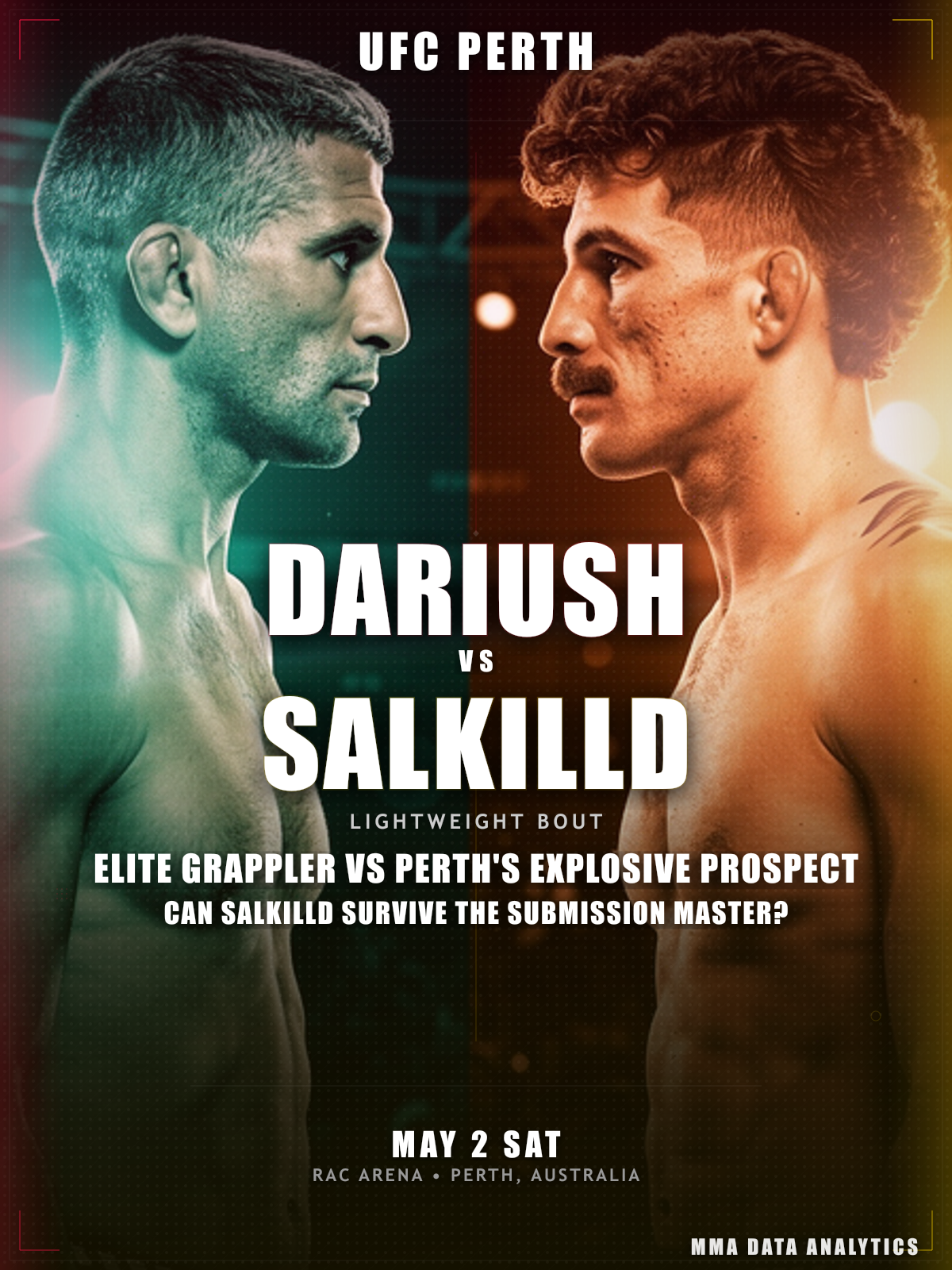
Beneil Dariush vs Quillan Salkilld
Men's Lightweight Bout • UFC Fight Night: Della Maddalena vs Prates
Saturday, May 2, 2026 • Perth, Australia • RAC Arena • 30ft Octagon (Large Cage)
Explore Detailed Fighter Profiles
Click on either the fighter's name or profile image for each fighter to access comprehensive UFC statistics including striking metrics, grappling data, clinch performance, complete fight history, offensive & defensive analytics, and round-by-round breakdowns.
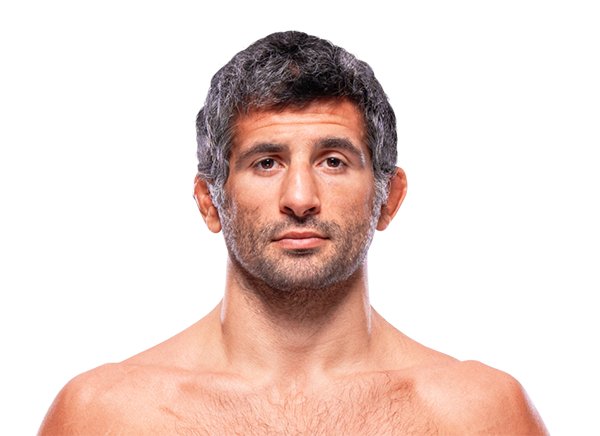
Beneil Dariush
Fighter Metrics
Victory Methods
Win Round Distribution
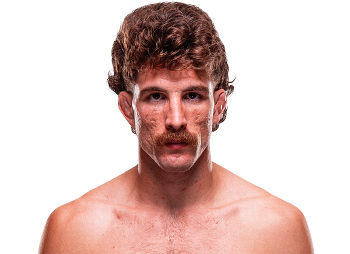
Quillan Salkilld
Fighter Metrics
Victory Methods
Win Round Distribution
📋 Last 5 Fights - Beneil Dariush
| Date | Opponent | Result | Method |
|---|---|---|---|
| 2025-11-15 | Benoit Saint-Denis | L | TKO - Left Hook (R1, 0:16) |
| 2025-06-28 | Renato Moicano | W | Decision - Unanimous (R3, 5:00) |
| 2023-12-02 | Arman Tsarukyan | L | TKO - Straight Right & Punches (R1, 1:04) |
| 2023-06-10 | Charles Oliveira | L | TKO - Ground & Pound (R1, 4:10) |
| 2022-10-22 | Mateusz Gamrot | W | Decision - Unanimous (R3, 5:00) |
📋 Last 5 Fights - Quillan Salkilld
| Date | Opponent | Result | Method |
|---|---|---|---|
| 2026-01-31 | Jamie Mullarkey | W | Submission - Rear Naked Choke (R1, 3:02) |
| 2025-10-25 | Nasrat Haqparast | W | TKO - Head Kick (R1, 2:30) |
| 2025-06-07 | Yanal Ashmouz | W | Decision - Unanimous (R3, 5:00) |
| 2025-02-08 | Anshul Jubli | W | TKO - Right Cross (R1, 0:19) |
| 2024-09-03 | Gauge Young | W | Decision - Unanimous (R3, 5:00) |
Technical Analysis
Technical Score
Cardio Score
Overall Rating
📊 Technical Score
Calculated as the average of Striking Composite (63.0 vs 66.0) and Grappling Composite (75.0 vs 80.0). Balances overall striking effectiveness with grappling ability to measure complete technical skills.
💪 Cardio Score
Based on average fight duration, striking rate per minute, takedown rate, and finish rate. Measures cardiovascular endurance and ability to maintain pace throughout fights.
🎯 Overall Rating
Simple average of Technical Score and Cardio Score. Provides a holistic view of fighter capabilities combining skill level with physical conditioning and fight performance.
Striking Composite
Grappling Composite
📊 Technical Radar Comparison
📊 Metrics Legend
📊 Detailed Statistical Comparison
🥊 Fight Analysis Breakdown
🧩 Beneil Dariush Key Advantages
Dariush's 0.82 submissions per 15 minutes represents one of the most active submission games in the lightweight division. His BJJ black belt credentials back up the numbers—8 career submission victories demonstrate a legitimate finishing threat from any position. Against a young prospect like Salkilld who has shown willingness to engage on the ground with his 8.41 TD15 volume, Dariush's guard game becomes particularly dangerous. The veteran's ability to threaten sweeps, armbars, triangles, and chokes from bottom position could transform Salkilld's aggressive wrestling into a liability, forcing the Australian to reconsider his takedown-heavy approach and potentially fight in less comfortable standing exchanges. Critically, Dariush's submission entries don't require top position—he's historically most dangerous off his back, where opponents who dive into his guard expecting easy control time find themselves trapped in guillotine attempts or armbar sequences. This inverted threat dynamic means Salkilld must exercise extreme caution with his wrestling entries, breaking his rhythm and potentially slowing his otherwise relentless pace. The Californian's submissions against Drakkar Klose, Scott Holtzman, and Frank Camacho all came from positions where his opponents thought they had the advantage—a pattern that should concern Salkilld's corner.
Dariush's 82% takedown defense is elite-tier and represents the most significant statistical barrier to Salkilld's primary path to victory. While Salkilld's 8.41 TD15 volume is extraordinary, it was built against fighters with far less defensive wrestling experience—Anshul Jubli, Yanal Ashmouz, and Nasrat Haqparast don't possess the defensive wrestling pedigree that Dariush has honed over 25 UFC bouts. Dariush has defended takedowns from elite grapplers including Arman Tsarukyan (3.25 TD15) and Mateusz Gamrot throughout his career, demonstrating that high-volume wrestlers don't automatically overwhelm his base. His ability to stuff shots at the initial point of contact, establish dominant underhooks in the clinch, and scramble back to his feet has been battle-tested at the highest level. This defensive wrestling forces Salkilld into extended striking exchanges where Dariush's experience, fight IQ, and lower absorption rate (2.61 SApM) may level the playing field. Additionally, Dariush's hip positioning and cage awareness allow him to deny wall-walking takedowns that many young wrestlers rely on, potentially frustrating Salkilld into overcommitting on entries that expose him to counter-grappling.
With 25 UFC fights across 10+ years, Dariush brings an invaluable experience advantage into this matchup. He has faced multiple champions and top-5 contenders including Charles Oliveira, Arman Tsarukyan, Tony Ferguson, and Mateusz Gamrot—a murderer's row of lightweight talent that no 4-fight UFC veteran can match. This wealth of experience translates into superior cage awareness, round management, and the ability to make mid-fight adjustments that can shift momentum. Against a 25-year-old prospect with only 4 UFC bouts, Dariush's veteran savvy could manifest in subtle but decisive advantages: better understanding of octagon positioning to avoid power shots, superior ability to dictate pace through clinch entries and grappling exchanges, and knowing exactly when to push the action versus when to conserve energy across three rounds. Dariush has also shown the ability to perform well in hostile environments—fighting in Perth against a local favorite won't faze a veteran who competed in Abu Dhabi, Qatar, and across the United States. His composure under pressure, honed through years of championship-level competition, gives him a psychological edge that doesn't show up in the stat sheets but often decides close fights.
⚠️ Unfavorable Scenarios
At 36 years old with 6 career KO/TKO losses, Dariush faces a significant speed and explosiveness gap against the 25-year-old Salkilld. The Australian's first-round finishes of Anshul Jubli (19 seconds via right cross) and Nasrat Haqparast (devastating head kick at 2:30) demonstrate fight-ending power and speed that Dariush may struggle to match at this stage of his career. The veteran's recent R1 TKO loss to Benoit Saint-Denis at just 16 seconds raises serious durability concerns—his chin has shown increasing vulnerability to fast starters who can land clean power shots early. Three of Dariush's last four losses came by first-round stoppage (Saint-Denis 0:16, Tsarukyan 1:04, Oliveira 4:10), establishing a troubling pattern that Salkilld is perfectly positioned to exploit. The Australian is exactly that type of explosive, aggressive finisher who loads up on power in the opening minutes—a fighter profile that has historically given Dariush his worst results.
Salkilld holds a 3-inch reach advantage (75" vs 72") and stands 2 inches taller at 6'0". Combined with his high striking accuracy (60% vs 49%), these physical tools allow Salkilld to control distance and land clean shots from range while Dariush struggles to close the gap. In the 30-foot Perth octagon, these physical advantages become even more pronounced—Salkilld can use the extra space to maintain his preferred range, deploy long jabs, front kicks to the body, and calf kicks that chip away at Dariush's mobility without exposing himself to counter-grappling. Dariush historically struggles against taller, rangier fighters who can use length to keep him at the end of their reach, preventing the clinch entries and body lock takedowns that form the foundation of his game. The 11-year age gap compounds these physical disadvantages: Salkilld's reaction times, footwork speed, and ability to reset after exchanges all benefit from his youth, making Dariush's distance-closing attempts increasingly predictable and punishable.
📋 Likely Gameplan
Dariush should look to close distance quickly, engage in clinch battles, and drag the fight to the mat where his BJJ black belt becomes the dominant factor. His 0.82 submissions per 15 minutes and 8 career submission wins suggest he's most dangerous when he can work from close range—specifically the clinch and mat exchanges where reach becomes irrelevant. Rather than matching Salkilld's striking output (a losing proposition given the 5.48 vs 3.78 SLpM gap), Dariush should use feints, level changes, and forward pressure to create clinch entries, then work for body lock takedowns and back takes. Once on the mat, his submission threat becomes the great equalizer against Salkilld's youth and athleticism. The key chain is jab feint → level change → body lock → trip → back exposure → rear naked choke or arm triangle attempts. Even unsuccessful submission attempts force Salkilld to defend rather than attack, burning his energy reserves and blunting the explosive pace that makes him so dangerous.
In a three-round fight, Dariush should focus on surviving early exchanges and settling into a grinding pace that neutralizes Salkilld's explosiveness. His experience fighting five-round main events gives him superior conditioning knowledge and understanding of how to manage energy across extended grappling exchanges. Banking rounds through clinch control, body lock positions, and top-position ground-and-pound could secure a decision victory even without finishes. The key is avoiding early damage while establishing his grappling rhythm—if Dariush can make this a grindy, clinch-heavy fight with extended mat sequences, he removes Salkilld's biggest weapons: speed and explosive striking. The veteran should also look to exploit the Perth crowd factor—Salkilld fighting at home could either inspire him or create pressure to perform that leads to overcommitment. Dariush's path to victory requires patience and discipline: survive R1, establish the clinch game in R2, and grind out R3 with top control. His 09:10 average fight duration suggests he knows how to pace himself, and if he can force Salkilld into energy-draining grappling exchanges early, the younger fighter's explosive advantage diminishes significantly by the third round.
🚀 Quillan Salkilld Key Advantages
Salkilld's 8.41 takedowns per 15 minutes is among the highest in the entire UFC lightweight division, representing a grappling pressure that can overwhelm even experienced defenders through sheer attrition. His ability to chain multiple takedown attempts—shooting from different angles, distances, and setups—creates a constant threat that drains opponents' energy even when individual shots are defended. Against Dariush's elite 82% takedown defense, the math still works in Salkilld's favor: at 8.41 attempts per 15 minutes with 38% accuracy, that's approximately 3.2 successful takedowns per fight, each one creating opportunities for ground-and-pound, control time accumulation, and positional dominance. What makes Salkilld's wrestling particularly dangerous is the variety of his entries—he shoots from distance, clinches into trips along the fence, and uses snap-downs to create front headlock positions. This versatility means Dariush can't simply prepare for one type of entry; he must defend multiple vectors of attack while also managing Salkilld's 5.48 SLpM striking output. The cumulative effect of defending this volume is exhausting—even elite takedown defenders find their percentages dropping as their legs tire from constant sprawling and scrambling.
Salkilld's 72.7% finish rate across his career demonstrates elite-level fight-ending ability from multiple positions and ranges. His UFC highlights tell the story of a multi-dimensional finisher: a 19-second KO of Anshul Jubli via right cross showed pure hand speed and power, a devastating head kick TKO of Nasrat Haqparast at 2:30 displayed elite kicking technique, and a first-round rear naked choke of Jamie Mullarkey proved he can finish on the ground as well. This versatility—finishing by hands, kicks, and submissions—makes him exceptionally difficult to prepare for because opponents cannot simply take away one weapon. Against a 36-year-old veteran with 6 career KO/TKO losses, Salkilld's explosive power in the first round represents a legitimate fight-ending threat. His 5 first-round finishes from 11 career wins (45%) suggest he's most dangerous in the opening five minutes when his speed, timing, and power advantages are at their peak. The right cross that flatlined Jubli in 19 seconds and the head kick that dropped Haqparast are both techniques that could trouble Dariush, who has shown vulnerability to power shots from southpaw and orthodox stances alike. Salkilld's finishing instinct—the ability to recognize when an opponent is hurt and immediately pour on damage—separates him from typical prospects at this stage.
At 25 years old, Salkilld represents the new generation of UFC lightweight—explosive, well-rounded, and physically imposing at 6'0" with a 75-inch reach. His 11-year age advantage over Dariush translates directly to measurable performance differences: faster reaction times, better recovery between explosive exchanges, superior explosiveness in scrambles, and the ability to maintain a higher pace without the compounding fatigue that affects older fighters. The 3-inch reach advantage combined with a remarkably high 60% striking accuracy (vs Dariush's 49%) means he can land clean shots from range while avoiding return fire—an 11-percentage-point accuracy gap that compounds over 15 minutes of fighting. In a sport where physical prime typically peaks in the mid-to-late twenties, Salkilld is entering his best years while Dariush is navigating the back end of his career with increasing mileage on his body. Fighting at home in Perth adds another dimension—the RAC Arena crowd will be firmly behind the local product, creating an atmosphere that can energize a young fighter while adding psychological pressure to the visiting veteran. Salkilld's confidence, bolstered by an 11-fight win streak and 4-0 UFC run, gives him a self-belief that can be decisive in moments where the fight hangs in the balance.
⚠️ Unfavorable Scenarios
Salkilld's aggressive wrestling approach—8.41 TD15—could paradoxically become a liability against Dariush's elite Brazilian Jiu-Jitsu. The veteran's 8 career submission victories and 0.82 sub/15 rate mean every takedown carries risk that most fighters simply don't present. Dariush is exceptionally dangerous from bottom position with triangle chokes, armbars, guillotines, and kimuras—his guard is an offensive weapon, not a defensive position. His ability to threaten sweeps from half-guard and attack submissions from full guard can instantly transform Salkilld's dominant top position into a desperate scramble. If the Australian shoots without proper setup, dives into Dariush's guard carelessly, or leaves his neck exposed during takedown entries, he could find himself caught in a submission that ends his unbeaten UFC run. The guillotine is particularly concerning—Dariush's ability to snap down on overcommitted shots and lock in standing guillotines means Salkilld's explosive double-leg entries carry more risk than they would against almost any other lightweight. This threat creates a psychological dilemma: wrestling is Salkilld's best path to victory, but every shot is a calculated gamble against one of the division's most dangerous grapplers.
With only 4 UFC fights against opponents ranked outside the top-15, Salkilld faces a significant step up in competition against Dariush—a former top-5 contender who was once on a seven-fight winning streak in the division. His most notable wins—Jamie Mullarkey (#58 ranked), Nasrat Haqparast (#21), Yanal Ashmouz (#67), and Anshul Jubli (#80)—while impressive in their finishing quality, don't represent the same caliber of opposition that Dariush has faced throughout his career. None of those opponents possessed Dariush's combination of elite grappling credentials, defensive wrestling, and veteran composure. The Australian has never encountered a fighter who can threaten submissions from bottom position, neutralize takedowns at an 82% clip, and make strategic adjustments between rounds based on a decade of top-level experience. Championship-level fighters are defined by how they handle adversity—getting hurt, having their gameplan neutralized, facing hostile environments (which ironically won't apply here)—and we simply don't have data on how Salkilld responds when faced with elite-level resistance. His only career loss came pre-UFC, offering no insight into how he handles high-level setbacks. This unknown is the single biggest risk factor in backing Salkilld at short odds.
📋 Likely Gameplan
Salkilld should utilize his physical advantages to maintain a high output striking game, using his 5.48 SLpM rate and 60% accuracy to overwhelm Dariush's 58% striking defense. His height and reach allow him to work from distance with jabs, front kicks to the body, and calf kicks before mixing in explosive power combinations that test Dariush's chin. The ideal striking rhythm involves establishing the jab to measure distance, deploying calf kicks to compromise Dariush's base and takedown defense, then detonating right crosses and head kicks when the veteran steps forward. By maintaining this striking pressure, Salkilld forces Dariush into an impossible choice: absorb mounting damage at range or shoot for takedowns from compromised positions—both options play into the Australian's strengths. His 100% takedown defense (small sample but indicative) and superior wrestling volume mean he can stuff Dariush's entries and immediately punish from the clinch. The key is variety: mixing strikes to all three levels, switching between orthodox and southpaw stances if comfortable, and never allowing Dariush to time the rhythm of his attacks. Predictability is the only thing that gives the veteran a chance.
With a 45% first-round finish rate and Dariush's alarming recent chin trajectory (TKO loss to Saint-Denis in 16 seconds, TKO loss to Tsarukyan at 1:04, TKO loss to Oliveira at 4:10), Salkilld should look to test the veteran's durability early and aggressively. His best approach involves explosive entries—right crosses, head kicks, and flying knees—that target Dariush before he can establish his grappling game and settle into the fight's rhythm. The Australian's combination of speed and power creates genuine first-round KO equity, and forcing Dariush to fight defensively early prevents the veteran from implementing his preferred clinch-and-grind approach. The gameplan should mirror how he finished Jubli (19 seconds) and Haqparast (2:30)—immediate forward pressure, explosive combinations, and the killer instinct to swarm when he senses vulnerability. Salkilld should also mix in early takedowns to establish his wrestling threat, which opens up the striking game further by forcing Dariush to defend multiple attacks simultaneously. The worst outcome for Salkilld is a cautious, tentative first round that allows Dariush to build confidence and establish his veteran pace—the Perth crowd will demand aggression, and Salkilld should deliver it.
🎯 Fight Prediction Analysis
Data-driven prediction model based on statistical analysis
📊Detailed Analysis Summary
🏟️Cage Dynamics
The 30-foot octagon at RAC Arena creates an interesting dynamic for this veteran-versus-prospect matchup. The larger cage initially favors Salkilld's rangey striking and explosive entries, giving him ample space to utilize his 75-inch reach and 5.48 SLpM output without being cornered or trapped against the fence. In a smaller 25-foot cage, Dariush's clinch work and cage-cutting would compress available space much faster—but the extra five feet of diameter means Salkilld can circle, reset, and re-establish distance after exchanges. However, Dariush's veteran cage-cutting ability shouldn't be underestimated: he's spent 25 UFC fights learning how to systematically reduce available space through angled footwork and pressure walking. The key tactical battle is whether Salkilld can maintain distance and use the open space to land clean shots from range, or whether Dariush can close the gap, establish dirty boxing and clinch entries, and negate the reach differential entirely. In a three-round fight, the larger cage slightly favors the younger, more athletic fighter who can use movement and distance management more effectively—Dariush simply has fewer rounds to implement his grinding approach before the judges render their verdict.
🎯Technical Breakdown
The statistical analysis reveals a fascinating contrast between veteran craft and rising talent that makes this matchup uniquely difficult to predict. Salkilld's 8.41 TD15 is the dominant statistical feature—one of the highest rates in the entire UFC across all divisions—but Dariush's 82% takedown defense represents an elite counter developed over a decade of facing the division's best wrestlers. The striking differential also tells a compelling story: Salkilld's 5.48 SLpM and 60% accuracy versus Dariush's 3.78 SLpM and 49% accuracy suggests the Australian controls standing exchanges by a significant margin, landing approximately 45% more strikes per minute at 11 percentage points higher accuracy. However, Dariush's significantly lower absorption rate (2.61 vs 3.46 SApM) and superior striking defense (58% vs 45%) reveal a fighter who minimizes damage through head movement, guard work, and positional awareness—he may get out-struck on volume but takes far less clean damage. The submission dimension adds another layer of complexity: Dariush's 0.82 sub/15 means every grappling exchange carries meaningful risk for Salkilld, creating a feedback loop where the Australian's best offensive weapon (wrestling) simultaneously exposes him to the veteran's best counter-weapon (submissions). This mutual threat dynamic is what makes the fight so analytically interesting—each fighter's strength feeds into the other's counter-strength.
🧩Key Battle Areas
Three critical battle areas will determine the outcome of this fight. First, the wrestling chess match: whether Salkilld's extraordinary 8.41 TD15 volume can overcome Dariush's elite 82% takedown defense—if the Australian can secure even 2-3 takedowns per round while avoiding submission traps, the fight tilts heavily in his favor through control time and ground-and-pound; but if Dariush stuffs the majority and threatens from bottom position, Salkilld's confidence in his primary weapon erodes. Second, the striking exchanges where Salkilld's speed, 3-inch reach advantage, and 60% accuracy meet Dariush's defensive experience, lower absorption rate, and veteran ability to read patterns—early rounds favor Salkilld's explosiveness while later rounds could see Dariush's defensive timing improve as he downloads the younger fighter's tendencies. Third, the transition and scramble game where Dariush's submission threat could catch the aggressive Salkilld in moments of overcommitment—guillotines off takedown entries, armbars during ground-and-pound, and back-takes during scrambles all represent flash-finish opportunities for the veteran. The fight's trajectory will likely be determined in the first round: if Salkilld establishes his wrestling or hurts Dariush early, his physical advantages compound as the fight progresses; if Dariush survives the initial storm, makes the fight ugly through clinch work, and drags the pace into grappling exchanges, his veteran craft and submission danger become increasingly relevant.
🏁Final Prediction
The most likely single outcome is Quillan Salkilld by KO/TKO (25% probability), reflecting his explosive finishing ability and Dariush's recent chin vulnerability—three first-round TKO losses in his last four defeats suggest declining durability that Salkilld's power can exploit. Salkilld by Decision (22%) represents his highest-probability non-finish path, achieved through consistent wrestling pressure, control time accumulation, and striking volume that overwhelms Dariush over three rounds. His submission path (11%) emerges from dominant grappling positions where he can transition to rear naked chokes as he did against Mullarkey. On the other side, Dariush's best upset lane is by Submission (16%), capitalizing on Salkilld's aggressive wrestling entries to catch the young prospect in guillotines, triangles, or armbars during transitions—this is the outcome that keeps Salkilld's corner up at night. The veteran's decision path (18%) requires successfully neutralizing Salkilld's output through clinch control, dirty boxing, and veteran round management while avoiding the power shots that have ended his recent fights. Dariush's KO/TKO upset path (8%) is the lowest-probability outcome but possible through precise counter-striking if Salkilld overcommits on entries.
💰 Betting Analysis: Model vs Market
Detailed value assessment in the betting market
📊Market Odds
🤖Analytical Model
💎Value Opportunities
MAXIMUM VALUE
Model: 25% | Fair: +300
GOOD VALUE
Model: 16% | Fair: +525
SLIGHT VALUE
Model: 53% | Fair: -113
⚠️Key Market Discrepancies
- • Overweights Dariush's name value – Veteran record inflates market confidence despite recent losses.
- • Undervalues Salkilld's wrestling pressure – 8.41 TD15 creates overwhelming control in three rounds.
- • Small sample discount – Market discounts Salkilld's 4-fight UFC record, but quality of performances suggests elite trajectory.
🎯 Comprehensive Probabilistic Analysis
100 hypothetical fight simulation based on statistical data
🏆Outcome Distribution - Quillan Salkilld
Explosive power striking and ground-and-pound
Wrestling control and striking volume over 3 rounds
Dominant grappling position to choke finish
💥Outcome Distribution - Beneil Dariush
Clinch control and veteran round management
BJJ traps from guard or scramble transitions
Counter-striking and ground-and-pound
⏰Fight Timeline Analysis
⚡Window of Opportunity - Beneil Dariush
- • Survive first 5 minutes: Weather Salkilld's explosive opening, avoid clean power shots that have ended recent fights
- • Clinch entries in R2: Body lock takedowns and dirty boxing to establish grinding pace and negate reach
- • Submission traps: Threaten guillotines off takedown entries, armbars from guard, back-takes from scrambles
- • Round 3 grind: If tied on cards, veteran pace control and clinch work can steal the decisive round
- • Test composure: Force adversity early to see if the 25-year-old maintains composure under pressure
🎯Progressive Pressure - Quillan Salkilld
- • Explosive R1 blitz: Target Dariush's chin immediately with power right crosses and head kicks — highest KO equity window
- • Volume striking: Maintain 5+ SLpM with 60% accuracy to overwhelm defense and build scorecards
- • Smart wrestling: Chain takedowns to accumulate control time but avoid settling into Dariush's guard — ground-and-pound from distance, not passing
- • Pace escalation: Push tempo to exploit the 11-year age gap and make Dariush's legs heavy for takedown defense
- • Hometown energy: Feed off RAC Arena crowd to maintain intensity through all three rounds
🎯 Final Confidence Assessment
Confidence level and uncertainty factors
Confidence Level
Moderate confidence due to Salkilld's limited UFC sample and Dariush's inconsistency
✅Supporting Factors
- • Salkilld's elite takedown volume (8.41 TD15)
- • Significant physical advantages (height, reach, age)
- • 4-0 UFC with 3 finishes shows legitimate talent
- • Dariush coming off a 16-second TKO loss
⚠️Risk Factors
- • Salkilld untested against elite competition
- • Dariush's submission threat from any position
- • Only 4 UFC fights for meaningful statistical analysis
- • Hometown crowd could inspire or pressure Salkilld
🏁Executive Summary
Quillan Salkilld's explosive combination of wrestling volume, striking power, and youth presents a formidable challenge for the veteran Beneil Dariush. The statistical differentials favor Salkilld: his 8.41 TD15 represents elite-level grappling pressure, while his 5.48 SLpM and 60% accuracy create significant advantages in standing exchanges. At 25 years old with a 75-inch reach, the Australian holds every physical advantage. However, Dariush's 82% takedown defense and 0.82 submissions per 15 minutes create genuine danger—the veteran's BJJ black belt means every grappling exchange carries submission risk for the aggressive young prospect. In a three-round fight at the 30-foot Perth cage, the matchup hinges on whether Salkilld can overwhelm Dariush's experience with volume and athleticism, or whether the veteran can weather the storm and catch the rising star in a submission trap.
Prediction: Salkilld by KO/TKO or Decision most likely (47% combined probability) through explosive striking and wrestling pressure; Dariush's best upset lane is by Submission (16%) capitalizing on Salkilld's aggressive grappling approach. The fight's outcome likely depends on whether Salkilld can impose his physical advantages before Dariush's veteran craft and submission threat become factors.