

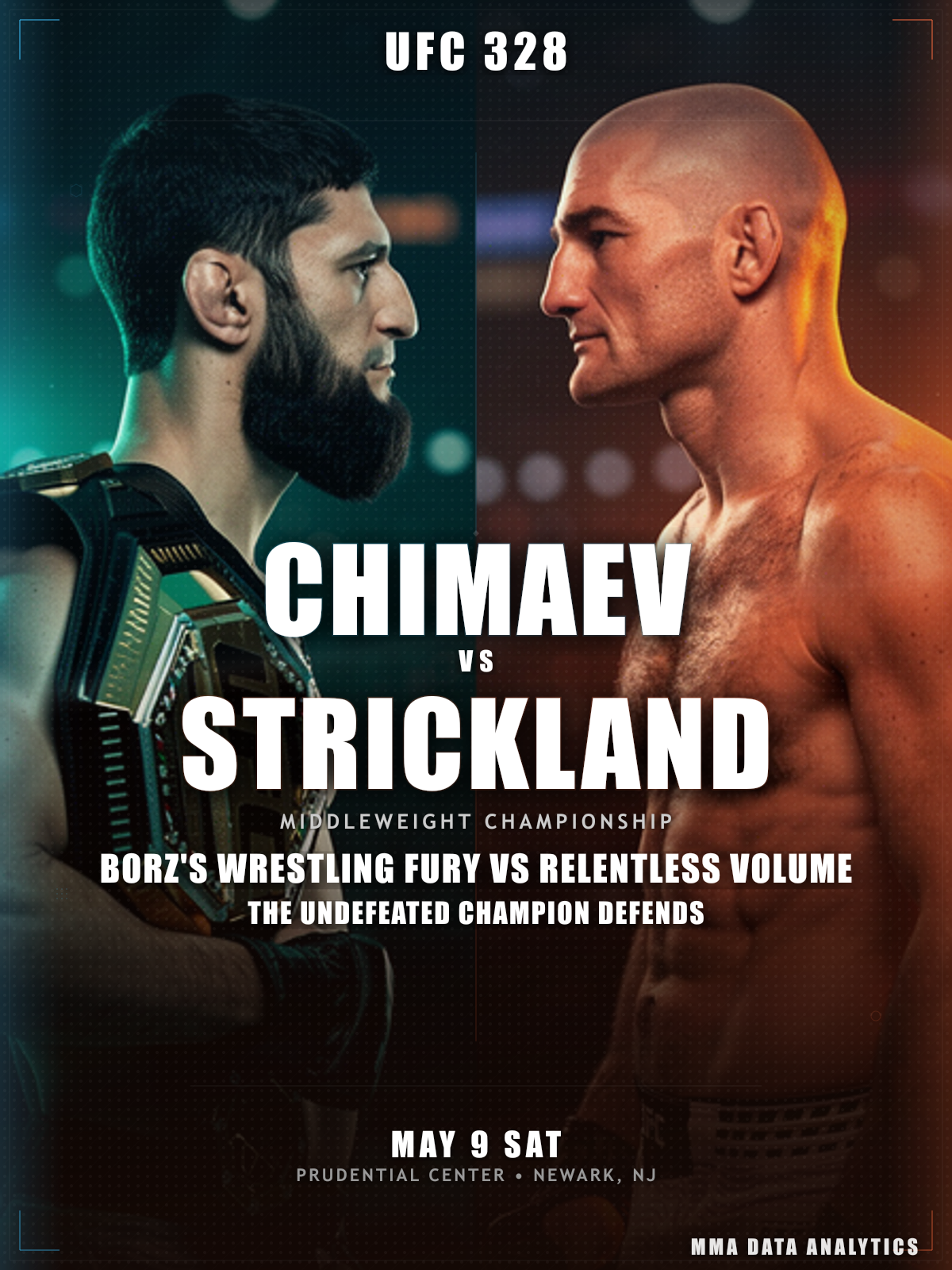
Khamzat Chimaev vs Sean Strickland
Men's Middleweight Title Bout • UFC 328
Saturday, May 9, 2026 • 30ft Octagon (Large Cage)
Explore Detailed Fighter Profiles
Click on either the fighter's name or profile image for each fighter to access comprehensive UFC statistics including striking metrics, grappling data, clinch performance, complete fight history, offensive & defensive analytics, and round-by-round breakdowns.
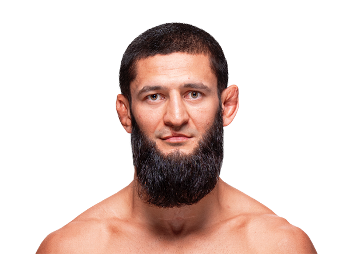
Khamzat Chimaev
Fighter Metrics
Victory Methods
Win Round Distribution
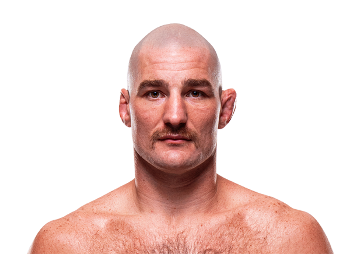
Sean Strickland
Fighter Metrics
Victory Methods
Win Round Distribution
📋 Last 5 Fights - Khamzat Chimaev
| Date | Opponent | Result | Method |
|---|---|---|---|
| 2025-08-16 | Dricus Du Plessis | W | Decision - Unanimous (R5, 5:00) |
| 2024-10-26 | Robert Whittaker | W | Submission - Face Crank (R1, 3:34) |
| 2023-10-21 | Kamaru Usman | W | Decision - Majority (R3, 5:00) |
| 2022-09-10 | Kevin Holland | W | Submission - D'arce Choke (R1, 2:13) |
| 2022-04-09 | Gilbert Burns | W | Decision - Unanimous (R3, 5:00) |
📋 Last 5 Fights - Sean Strickland
| Date | Opponent | Result | Method |
|---|---|---|---|
| 2026-02-21 | Anthony Hernandez | W | TKO - Knee and Punches (R3, 2:23) |
| 2025-02-08 | Dricus Du Plessis | L | Decision - Unanimous (R5, 5:00) |
| 2024-06-01 | Paulo Costa | W | Decision - Split (R3, 5:00) |
| 2024-01-20 | Dricus Du Plessis | L | Decision - Split (R5, 5:00) |
| 2023-09-09 | Israel Adesanya | W | Decision - Unanimous (R5, 5:00) |
Technical Analysis
Technical Score
Cardio Score
Overall Rating
📊 Technical Score
Calculated as the average of Striking Composite (88.0 vs 88.0) and Grappling Composite (95.0 vs 80.0). Balances overall striking effectiveness with grappling ability to measure complete technical skills.
💪 Cardio Score
Based on average fight duration, striking rate per minute, takedown rate, and finish rate. Measures cardiovascular endurance and ability to maintain pace throughout fights.
🎯 Overall Rating
Simple average of Technical Score and Cardio Score. Provides a holistic view of fighter capabilities combining skill level with physical conditioning and fight performance.
Striking Composite
Grappling Composite
📊 Technical Radar Comparison
📊 Metrics Legend
📊 Detailed Statistical Comparison
🥊 Fight Analysis Breakdown
🧩 Khamzat Chimaev Key Advantages
Chimaev's 4.25 takedowns per 15 minutes versus Strickland's 1.0 represents a staggering 4.25x differential that fundamentally shifts fight control. Chimaev's chain-wrestling sequences—double-leg entries into body locks, mat returns off the fence, and relentless re-shots—create minute-winning cycles that accumulate control time rapidly. His ability to submit elite grapplers like Robert Whittaker via face crank and Kevin Holland via D'arce choke demonstrates that his wrestling isn't just positional—it leads to finishing opportunities. Strickland's 84% takedown defense is respectable, but Chimaev's chain-wrestling pressure and 58% takedown accuracy create a volume problem that even elite defenders struggle to manage across five rounds.
Chimaev's 1.5 submissions per 15 minutes and six career submission victories—including D'arce chokes, face cranks, and neck cranks—create a constant finishing threat from top control. His ability to submit former middleweight champion Robert Whittaker with a face crank in just 3:34 and Kevin Holland with a D'arce choke in 2:13 demonstrates elite-level submission finishing ability against high-caliber opposition. When Chimaev secures top position, opponents must simultaneously defend strikes and submission attempts, creating a multi-threat problem that compounds as fatigue accumulates. Strickland's 0.0 submissions per 15 minutes means the grappling exchanges are entirely one-directional in terms of finishing equity.
Chimaev's 88% takedown defense ensures that the grappling exchanges will be entirely on his terms—Strickland cannot reverse the dynamic and use wrestling as a neutralizer. Additionally, Chimaev's 3.12 strikes absorbed per minute compared to Strickland's 4.2 demonstrates superior defensive efficiency on the feet. This damage economy differential compounds over five championship rounds: Chimaev takes less punishment while landing at a higher accuracy rate (52% vs 41%), creating a scoring framework that favors him in judges' eyes. His 61% striking defense combined with wrestling pressure means he can control where the fight takes place while minimizing the damage he absorbs in striking exchanges.
⚠️ Unfavorable Scenarios
If Strickland can keep the fight standing and utilize his 5.9 SLpM volume to outpoint Chimaev in pure boxing exchanges, the fight dynamics shift considerably. Strickland's constant jab pressure and 76-inch reach create a steady stream of scoring strikes that can sway judges' scorecards. His ability to maintain distance with his long jab while never stopping his output makes him dangerous in extended standing sequences. If Chimaev's takedown attempts are stuffed early and he becomes hesitant to shoot, Strickland's volume advantage becomes the primary scoring mechanism.
Chimaev has only gone five rounds once in his career—the unanimous decision over Dricus Du Plessis at UFC 319. His 8:30 average fight duration raises legitimate questions about how his wrestling-heavy approach scales across 25 minutes if takedown attempts fail. Strickland's proven five-round cardio—demonstrated across multiple title fights including the Adesanya victory and two Du Plessis bouts—could become decisive if Chimaev's wrestling pressure doesn't create finishes or clear round wins in the first three rounds. The energy expenditure of unsuccessful takedown attempts can compound rapidly, potentially leaving Chimaev vulnerable in rounds four and five.
📋 Likely Gameplan
Chimaev should utilize his jab to close distance and establish range before chaining into level changes and takedown attempts. His ability to mix striking entries with wrestling—sometimes feinting shots to land punches, sometimes using punches to set up takedowns—keeps Strickland guessing and prevents him from settling into his preferred boxing rhythm. Once against the fence, Chimaev's body lock trips and mat returns create scoring opportunities while accumulating control time. The key is maintaining relentless forward pressure that compresses Strickland's operating space and forces him to defend multi-level attacks simultaneously.
Once Chimaev establishes top control, his priority should be advancing position to hunt for chokes and neck cranks. His D'arce choke proficiency and face crank finishing ability create legitimate submission threats that force opponents to make defensive choices that expose them to ground-and-pound. By threatening submissions from top position, Chimaev can force Strickland to open his guard and expose himself to strikes, or maintain a defensive posture that allows Chimaev to advance to back control where rear-naked choke opportunities arise. This multi-threat top game is what separates Chimaev from typical wrestle-and-hold fighters.
🚀 Sean Strickland Key Advantages
Strickland's 5.9 SLpM output is among the highest in the middleweight division, creating a relentless volume pressure that can overwhelm opponents who struggle to match his pace. His constant jab pressure—thrown from both orthodox and southpaw stances—creates a steady stream of scoring strikes that accumulate on judges' scorecards. The jab also serves as a range-finder and distance-management tool, keeping opponents at his preferred fighting distance. Strickland's ability to maintain this output across five full rounds without significant pace degradation makes him uniquely dangerous in championship-distance fights where he can simply outwork opponents through sheer volume and consistency.
Strickland has been battle-tested in the highest-pressure situations the middleweight division has to offer. His upset victory over Israel Adesanya to claim the UFC middleweight championship demonstrated his ability to execute a perfect gameplan against an elite striker under the brightest lights. Two five-round title fights against Dricus Du Plessis—including a razor-thin split decision loss—prove his durability and championship-level cardio. With 24 UFC fights and 37 professional bouts, Strickland brings an experience advantage that cannot be replicated in the gym. This veteran poise becomes particularly valuable in the later championship rounds where mental toughness and fight IQ often decide close contests.
⚠️ Unfavorable Scenarios
If Chimaev establishes consistent top control, Strickland's striking output drops to near zero. His entire gameplan depends on keeping the fight standing where his volume advantage translates to scoring. On the mat, Strickland offers no submission threat (0.0 SubPer15) and limited offensive grappling, meaning every minute of control time Chimaev banks is essentially dead time for Strickland on the scorecards. The face crank and D'arce choke threats from Chimaev mean that Strickland must expend defensive energy even on the ground, further depleting his reserves for the standing exchanges he needs to win rounds.
Chimaev's explosive entries in the first round could catch Strickland before he establishes his jab rhythm and footwork patterns. With 8 of his 15 career wins coming in the first round, Chimaev is at his most dangerous in the opening minutes when his explosive athleticism and wrestling entries are at peak intensity. Strickland's methodical approach—building rhythm gradually and increasing output as fights progress—means he's potentially most vulnerable in the early exchanges before his timing and distance management calibrate to Chimaev's speed and pressure.
📋 Likely Gameplan
Strickland's optimal strategy involves using his 76-inch reach advantage and constant jab to keep Chimaev at distance, scoring points while disrupting wrestling entries. His ability to maintain a high-volume jab from both stances creates a wall of activity that makes level changes more difficult to time. By circling off the fence and maintaining center cage position, Strickland can maximize the space available for his footwork while minimizing Chimaev's ability to trap him against the cage where his wrestling is most effective. The key is staying active enough to score while never overcommitting in ways that create easy takedown entries.
Strickland's 84% takedown defense provides a legitimate foundation for keeping the fight standing where his volume advantage is decisive. By combining sharp sprawls with immediate return fire—punishing Chimaev for unsuccessful takedown attempts—Strickland can progressively discourage wrestling entries and force the fight into a boxing match. His ability to get back to his feet quickly after any successful takedowns limits Chimaev's control time per sequence, making the wrestling investment less efficient over five rounds. If Strickland can deny takedowns at a 50%+ clip, his 5.9 SLpM volume becomes the primary scoring mechanism.
🎯 Fight Prediction Analysis
Data-driven prediction model based on statistical analysis
📊Detailed Analysis Summary
🏟️Cage Dynamics
The 30-foot octagon creates an interesting dynamic in this matchup—initially providing Strickland space to utilize his jab and footwork, but gradually favoring Chimaev's pressure as the fight progresses and cage cutting narrows the available space. Strickland's 76-inch reach and constant volume output give him early advantages when he can maintain distance and circle freely. However, Chimaev's relentless forward pressure and fence-trapping sequences progressively compress the available space, forcing Strickland into increasingly uncomfortable positions where wrestling entries become more effective. The Chechen's ability to cut off angles and force exchanges against the cage transforms the octagon from Strickland's ally into Chimaev's weapon.
🎯Technical Breakdown
The statistical analysis reveals two primary battlefields where this fight will be decided: wrestling activity and striking volume. Chimaev's 4.25 TD15 vs Strickland's 1.0 represents a 4.25x differential that fundamentally alters fight control and scoring dynamics. While Strickland's striking volume (5.9 SLpM, 41% accuracy) creates impressive output numbers, Chimaev's damage economy (3.12 SApM vs 4.2) and higher accuracy (52% vs 41%) mean he absorbs less damage while landing more efficiently. The grappling composite gap (95.0 vs 80.0) highlights Chimaev's significant advantage on the mat, while their identical striking composites (88.0 vs 88.0) suggest the standing exchanges will be competitive— making the wrestling differential the decisive factor.
🧩Key Battle Areas
Three critical battle areas will determine the outcome: first-layer takedown defense vs chain wrestling at the fence, jab volume vs level changes, and late-round pace sustainability. Strickland's 84% takedown defense suggests he can stuff initial attempts, but Chimaev's persistence and re-shot ability—backed by 58% takedown accuracy— typically break through over time. Strickland's jab represents his most dangerous tool for disrupting wrestling entries and scoring points, but Chimaev's ability to vary his approach—sometimes feinting shots to land strikes, sometimes using strikes to set up takedowns—makes these counters less predictable. The championship-round question cuts both ways: Strickland has proven five-round durability, while Chimaev's wrestling pressure creates cumulative fatigue that could override Strickland's cardio advantage.
🏁Final Prediction
The most likely outcome is Khamzat Chimaev by Decision (25% probability), achieved through consistent wrestling pressure, control time accumulation, and superior damage economy over five rounds. Chimaev's Submission path (20%) creates legitimate finishing equity via D'arce chokes and neck cranks from top control, particularly as Strickland fatigues from defending takedowns. Strickland's best lane centers on Decision (30%) via sustained volume striking and takedown defense that keeps the fight standing—a scenario that becomes viable if his 84% TDDef holds up and his 5.9 SLpM output dominates the scorecards. The fight's outcome hinges on whether Chimaev can establish mat control before Strickland's volume builds an insurmountable scoring lead.
💰 Betting Analysis: Model vs Market
Detailed value assessment in the betting market
📊Market Odds
🤖Analytical Model
💎Value Opportunities
MAXIMUM VALUE
Model: 20% | Fair: +400
GOOD VALUE
Model: 30% | Fair: +233
SLIGHT VALUE
Model: 60% | Fair: -150
⚠️Key Market Discrepancies
- • Overweights Strickland's volume – Market underprices wrestling control time in scoring.
- • Undervalues submission threat – Chimaev's grappling credentials create finishing equity.
- • Championship-round uncertainty – Chimaev's limited 5-round data introduces variance.
🎯 Comprehensive Probabilistic Analysis
100 hypothetical fight simulation based on statistical data
🏆Outcome Distribution - Khamzat Chimaev
Primary path via wrestling control and damage economy
D'arce chokes and neck cranks from top control
Ground-and-pound accumulation and pressure strikes
💥Outcome Distribution - Sean Strickland
Best lane via sustained volume and takedown defense
Counter opportunities during wrestling transitions
Very unlikely given Chimaev's grappling
⏰Fight Timeline Analysis
⚡Window of Opportunity - Sean Strickland
- • First 10 minutes: Highest volume striking equity before wrestling pressure compounds.
- • Jab range: Constant output to discourage level changes.
- • Takedown defense: Must stay off the mat to stay in the fight.
🎯Progressive Dominance - Khamzat Chimaev
- • Chain wrestling: Fence pressure and mat returns bank control time.
- • Submission threats: Advancing position creates finishing opportunities.
- • Late rounds: Wrestling conditioning creates decisive advantages.
🎯 Final Confidence Assessment
Confidence level and uncertainty factors
Confidence Level
Strong grappling edge tempered by Strickland's proven durability
✅Supporting Factors
- • Significant takedown volume edge (4.25 vs 1.0 TD15)
- • Active submission game creates finishing equity
- • Undefeated record demonstrates elite adaptability
- • Proved championship-level at UFC 319 vs Du Plessis
⚠️Risk Factors
- • Strickland's 84% TDDef may neutralize wrestling
- • Limited 5-round data for Chimaev (only one fight)
- • Strickland's volume striking can dominate standing exchanges
🏁Executive Summary
Khamzat Chimaev's wrestling and submission game should gradually compress the octagon space and bank control time through chain-wrestling sequences, while Sean Strickland's best equity centers on maintaining distance and using his 5.9 SLpM volume to outpoint on the scorecards. The statistical differentials highlight Chimaev's advantages: his 4.25 TD15 vs Strickland's 1.0 creates a dominant takedown volume edge, while his 3.12 SApM vs Strickland's 4.2 represents superior damage economy. The grappling composite gap (95.0 vs 80.0) confirms Chimaev's mat superiority, while their identical striking composites (88.0 vs 88.0) indicate the standing exchanges will be competitive. Chimaev's 88% takedown defense ensures the grappling dynamic is entirely one-directional, while his 1.5 submissions per 15 minutes creates constant finishing threats from top position.
Prediction: Chimaev by Decision or Submission is the most likely path (45% combined probability) through consistent wrestling pressure, control time accumulation, and submission threats from top position. Strickland's lane is outpointing through volume (30% by Decision) if he can keep the fight standing and leverage his 84% takedown defense to deny mat time. The fight's outcome ultimately hinges on whether Chimaev can establish wrestling control before Strickland's relentless volume builds an insurmountable scoring lead on the judges' scorecards.