
Joel Alvarez vs Yaroslav Amosov
Men's Welterweight Bout • UFC 328: Chimaev vs. Strickland
Saturday, May 9, 2026 • Prudential Center, Newark, NJ
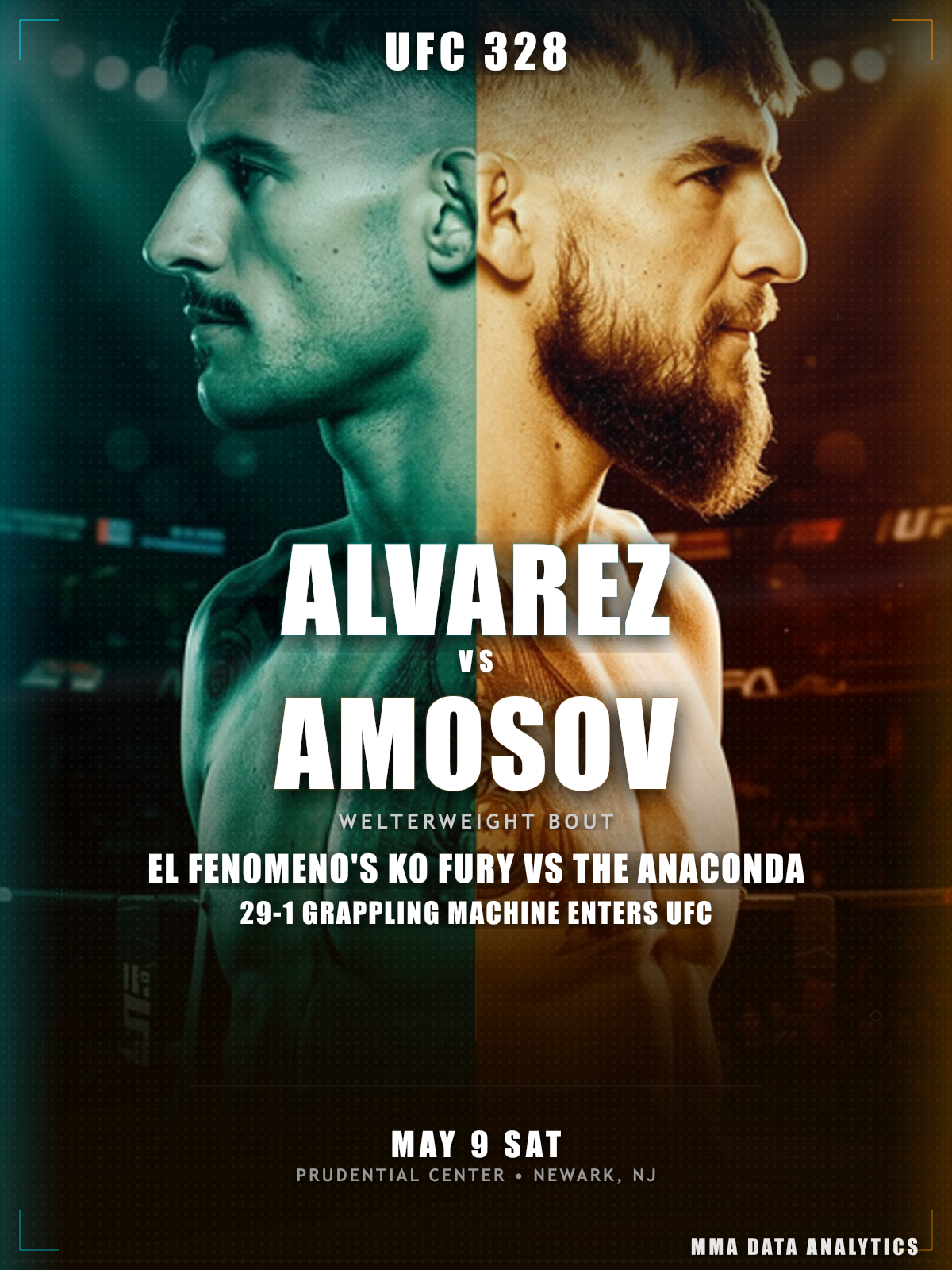
Explore Detailed Fighter Profiles
Click on either the fighter's name or profile image to access comprehensive UFC statistics including striking metrics, grappling data, clinch performance, complete fight history, and round-by-round breakdowns.

Joel Alvarez
Fighter Metrics
Victory Methods
Win Round Distribution
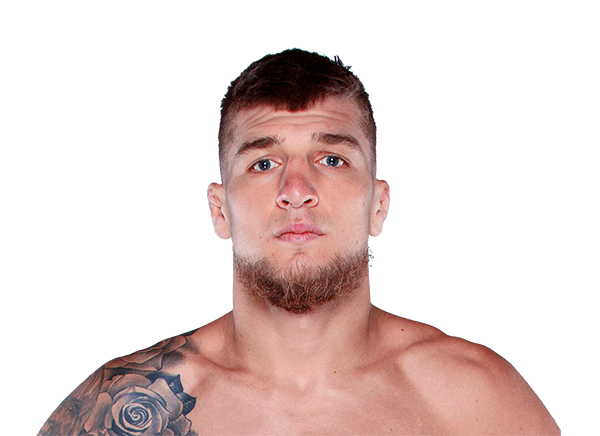
Yaroslav Amosov
Fighter Metrics
Victory Methods
Win Round Distribution
Last 5 Fights - Joel Alvarez
| Date | Opponent | Result | Method |
|---|---|---|---|
| 2025-10-11 | Vicente Luque | W | Decision (Unanimous) (R3, 5:00) |
| 2024-12-14 | Drakkar Klose | W | TKO (Flying Knee) (R1, 2:48) |
| 2024-08-03 | Elves Brener | W | TKO (Knees) (R3, 3:36) |
| 2023-07-22 | Marc Diakiese | W | SUB (D'arce Choke) (R2, 4:26) |
| 2022-02-26 | Arman Tsarukyan | L | TKO (Ground & Pound) (R2, 1:57) |
Last 5 Fights - Yaroslav Amosov
| Date | Opponent | Result | Method |
|---|---|---|---|
| 2025-12-13 | Neil Magny | W | Submission (Anaconda Choke) (R1, 3:14) |
| 2025-03-14 | Curtis Millender | W | Submission (Anaconda Choke) (R1, 4:18) |
| 2023-11-17 | Jason Jackson | L | TKO (R3, 2:08) |
| 2023-02-25 | Logan Storley | W | Decision - Unanimous (R3, 5:00) |
| 2021-06-11 | Douglas Lima | W | Decision - Unanimous (R3, 5:00) |
Technical Analysis
Technical Score
Cardio Score
Overall Rating
Technical Score
Calculated from striking composite (62 vs 45) and grappling composite (35 vs 82). Alvarez holds a clear striking edge, while Amosov's elite grappling composite — built on 4.2 TD/15min, 58% TD accuracy, and 1.8 submissions per 15 minutes — gives him the overall technical advantage.
Cardio Score
Alvarez has an 8:42 average fight duration across a deep UFC run, demonstrating he can operate over three rounds. Amosov's 7:15 average reflects a preference for early finishes, though his 16-fight Bellator win streak shows he can manage pace when needed.
Overall Rating
Simple average of Technical and Cardio scores. Amosov leads overall owing to dominant grappling metrics; Alvarez counters with superior striking volume and the KO threat that defines every welterweight striker vs grappler matchup.
Striking Composite
Grappling Composite
Composite Score Methodology
Scores go beyond raw stats — they factor in finishing quality, opponent calibre, and contextual performance
- ↑5.42 SLpM — top-tier WW volume, top ~12% of UFC roster
- ↑50% KO rate in UFC — 4 stoppages in 8 wins, elite finishing power
- ↑Luque win — outpointed a former top-5 striker on the feet over 3 rounds
- ↑Variety — flying knee KO, elbows, Muay Thai clinch, body kicks
- ↓4.21 SApM — high absorption rate, genuine defensive vulnerability penalised
- ↑17 career submission wins (74%) — primary finishing method across 23-3 career; more sub wins than Amosov
- ↑Dual threat confirmed — wins by both KO and submission; opponent cannot gameplan for one dimension
- ↑71% TDDef — can also defend the mat, not just attack it
- ↓0.4 TD/15 in UFC — rarely initiates grappling in octagon; operates standing by choice, not necessity
- ↓UFC sample (3 sub wins) — submission rate lower in UFC than career suggests style evolution
- ↑65% StrDef — only absorbs 1.42 SApM despite facing high-output strikers
- ↑Neutralised Lima & Storley — both legitimate strikers, controlled on the feet
- ↑Smart distance — uses level changes to limit opponent striking lanes
- ↓2.81 SLpM — low output; striking is suppression-focused, not finishing-focused
- ↓0 striking finishes in UFC — confirmed not a KO threat standing
- ↑Bellator WW Champion — held title with 16-fight unbeaten run at elite level
- ↑2/2 UFC submissions — anaconda system is a repeatable, systematic weapon
- ↑Beat Storley by decision — outgrappled one of the most decorated NCAA wrestlers in MMA
- ↑4.2 TD/15 @ 58% acc — elite volume AND efficiency simultaneously
- ↑82% TDDef — can take the fight down and deny the opponent the same privilege
Technical Radar Comparison
Visual comparison of key performance metrics between both fighters
Detailed Statistical Comparison
Fight Analysis Breakdown
Joel Alvarez Key Advantages
Alvarez's 5.42 significant strikes per minute is nearly double Amosov's 2.81, and that volume is built on elite Muay Thai — elbows in tight, body kicks that erode engines, and concussive overhand rights. What the raw stats obscure is that Alvarez is not just a striker: 17 of his 23 career wins (74%) came by submission, giving him more submission finishes than Amosov. He operates standing by choice, not necessity. That dual-threat reality makes him a fundamentally more dangerous opponent for Amosov than a pure striker would be.
Alvarez's 71% takedown defense is a critical metric in this matchup. Amosov's entire gameplan depends on wrestling to mat position; if Alvarez denies even half of those attempts, the fight stays in striking range where his advantages compound. Against a fighter who likes anaconda chokes off scrambles, Alvarez must avoid giving up front headlock positions during takedown attempts. His Muay Thai clinch work — knees and elbows — can be weaponized when Amosov dives for legs.
Alvarez's 23-3 record includes 17 submission finishes and 5 KO/TKOs — he is a genuine dual threat that no opponent can gameplan for in one dimension. In the UFC he has leaned more heavily into striking (3 UFC subs, 4 UFC KOs), but the submission infrastructure is fully there: D'arce choke on Diakiese, anacondas, guillotines across his career. Against a wrestler like Amosov whose anaconda triggers off scrambles, Alvarez's own submission awareness in those exact positions makes him far more dangerous on the mat than his UFC ground stats suggest. He can win by submission or KO — Amosov cannot fully commit to either takedown or stand-up without facing the other threat.
Alvarez arrives on the back of four consecutive wins — finishing Diakiese by D'arce choke, stopping Elves Brener with knees, TKO'ing Drakkar Klose with a flying knee, and outpointing Vicente Luque by unanimous decision. That Luque win is significant: Luque is a former top-5 welterweight finisher, and beating him on points demonstrates Alvarez has developed the discipline and game management to complement his natural finishing instincts. He is entering this fight at peak confidence and form.
Unfavorable Scenarios
Amosov's 4.2 takedowns per 15 minutes and 58% accuracy represent a volume grappling threat that could overwhelm Alvarez's defense over three rounds. Even with 71% TD defense, Amosov is good enough to land multiple per round. Once on the mat, Alvarez's striking loses its primary advantage and Amosov's 1.8 submissions per 15 minutes — anchored by a devastating anaconda choke that finished both Magny and Millender — becomes an immediate finishing threat from near any scramble position.
Alvarez absorbs 4.21 significant strikes per minute — one of the highest rates in the welterweight division. Against a wrestler like Amosov who also carries real submission grappling, Alvarez must walk a fine line: staying active enough to deter takedowns without over-committing and leaving himself exposed to level changes. His two UFC stoppages both came from heavy exchanges, suggesting his chin has been tested. A gassed Alvarez in round three is the most dangerous scenario.
Likely Gameplan
Alvarez should come out fast and establish striking authority in Round 1, forcing Amosov to respect the power before he finds his takedown rhythm. Body kicks to slow Amosov's explosive wrestling entries, combined with level-change feints to draw out premature shots, can disrupt Amosov's timing. The goal is to land something significant before Amosov settles into his grappling groove — because once he does, the fight moves to a domain that heavily favors the Ukrainian.
Alvarez's Muay Thai training should be weaponized specifically against Amosov's shots. Timing a knee to the face on a diving double-leg attempt — or catching a front headlock when Amosov shoots high — can be the fight-ending sequence. Every failed Amosov takedown is an Alvarez counter opportunity. Making the Ukrainian pay for his grappling entries disincentivizes further attempts and creates cumulative damage that compounds over three rounds.
Alvarez's biggest tactical vulnerability is the scramble — chaotic transitions where Amosov's front headlock materialises. He must avoid giving up head position in any exchange: stand with his back against the cage rather than giving up his back in the open mat, get back to his feet immediately rather than engaging in ground-and-pound duels, and resist the temptation to follow Amosov to the mat out of pride. Three rounds of disciplined cage work and controlled distance is more valuable than any single explosive exchange.
Yaroslav Amosov Key Advantages
Amosov's 4.2 takedowns per 15 minutes at 58% accuracy is the most dangerous stat in this matchup. Even against Alvarez's 71% TD defense, the sheer volume means Amosov should convert multiple times per round, giving him repeated opportunities to execute his submission game. His wrestling style is persistent and positional — he doesn't just dump opponents, he works to control and chain transitions. Against a striker who wants to stay on the feet, this wrestling volume is the primary force multiplier.
Amosov has submitted both UFC opponents — Neil Magny and Curtis Millender — with anaconda chokes in Round 1. The pattern is clear: he shoots for a takedown, the opponent turtles or posts, he wraps the anaconda from a front headlock, and the fight is over in minutes. At 1.8 submissions per 15 minutes, this is not opportunistic finishing — it is a systematic offensive weapon. Alvarez's Muay Thai stance and sprawl-based TD defense creates exactly the front headlock scenarios Amosov exploits.
Amosov's 65% striking defense — absorbing only 1.42 significant strikes per minute despite Alvarez's 5.42 output — means the matchup is not as lopsided standing as the volume numbers suggest. He moves intelligently, closes distance quickly to limit Alvarez's power range, and uses his wrestling level changes to disrupt striking rhythm. His 29-1 record includes wins over Douglas Lima and Logan Storley, fighters with legitimate striking threats, demonstrating he can neutralize offense while building his own offensive pressure.
Amosov carried the Bellator Welterweight Championship with a 16-fight unbeaten run before the Jason Jackson loss — and then responded by winning his next two fights, including his devastating UFC debut submission of Neil Magny. His record is not inflated by regional opponents: Lima and Storley are legitimate world-class welterweights. The 29-1 mark with 72% finish rate demonstrates that his dominant style translates across promotions and opponent calibres. Alvarez is the stiffest test of his UFC tenure, but Amosov has championship-level experience that the record reflects.
Unfavorable Scenarios
Amosov's only loss — a TKO by Jason Jackson — came from strikes, confirming he can be hurt when opponents catch him in poor positions. Against Alvarez's concussive Muay Thai power and excellent counter-striking timing, a well-timed flying knee or overhook elbow during a takedown entry could be fight-changing. At 5.42 SLpM, Alvarez creates multiple counter opportunities every round, and Amosov's aggressive wrestling stance naturally exposes his head on level changes.
With only one UFC fight, Amosov's game has not been stress-tested at the top of the welterweight division. Neil Magny, while experienced, is not the same threat level as Alvarez. Coaching adjustments between rounds, UFC referee rule sets, and the pace escalation that comes from fighting a high-volume Muay Thai striker are all unknowns. Alvarez has 11 UFC fights of adaptation experience; Amosov is still establishing his UFC identity, and that asymmetry adds variance to all outcome probabilities.
Likely Gameplan
Amosov should not wait for Alvarez to establish his striking rhythm. Pressing forward from the opening bell with constant level-change threats prevents Alvarez from setting his feet and loading up his power shots. Mixing in jab-to-single leg and body-lock attempts from the clinch obscures his takedown timing, making it harder for Alvarez to anticipate and stuff shots. The goal is to eliminate the striking game before it can be established — which is exactly what Amosov did against both Magny and Millender.
Amosov's anaconda choke triggers off sprawl-and-scramble scenarios — when opponents post on their hands after a failed takedown or during a stand-up. Alvarez's Muay Thai-based defensive stance (sprawl, get up, knee) naturally creates these front headlock positions. Amosov should shoot high and force the scramble rather than hunting low singles, knowing that even a failed attempt often generates the head position he needs. Patience on the ground, chaining submission attempts without rushing, is the key to closing the show.
Alvarez is at his most dangerous when he is stationary and loading up. Amosov's tactical priority should be constant movement and level-change threats that prevent Alvarez from planting his feet. A jab-level change-clinch sequence disrupts striking posture more effectively than waiting for a clean takedown opening. Even failed level changes force Alvarez to reset mentally, eat awkward angles, and second-guess his footwork — cumulative tactical disruption that compounds over three rounds and eventually creates a clean takedown entry in Amosov's favour.
Fight Prediction Analysis
Data-driven prediction model based on statistical analysis
📊Detailed Analysis Summary
🏟️Stylistic Dynamics
This is not a striker vs wrestler matchup — it is a dual-threat vs dual-threat collision. Alvarez has won 74% of his career fights by submission (17 of 23), making him one of the most accomplished submission artists at welterweight; Amosov has built his entire UFC identity on the anaconda choke system. On the feet, Alvarez's 5.42 SLpM and striking composite (71) lead; on the mat, Amosov's volume and composites (90) dominate. The difference between this fight and a simple striker-vs-grappler narrative is Alvarez's own mat competence — he cannot be taken down and neutralised the way a pure Muay Thai fighter can, because he has the submission awareness to scramble and attack in those exact positions Amosov hunts.
🎯Key Statistical Battle
The most telling split is grappling composite: Amosov 82 vs Alvarez 35. This is not a grappling-competitive matchup — it is a question of whether Alvarez can prevent grappling from happening. His 71% TD defense is solid but not elite enough to negate 4.2 attempts per 15 minutes over three rounds. If Amosov converts even two takedowns per round, he gets repeated anaconda hunting positions. Conversely, Alvarez's 62 striking composite vs Amosov's 45 means standing exchanges favor Alvarez decisively — which is why the fight location is the primary determinant of outcome.
🧩Key Battle Areas
Three critical battlefields: (1) The sprawl — Alvarez's Muay Thai sprawl and front headlock awareness will determine whether Amosov's shots create anaconda positions or cost him knees and elbows. (2) First two minutes — both fighters' most recent fights ended in Round 1; whoever establishes early control sets the tone for the entire fight. (3) Clinch vs distance — Amosov wants to close range and tie up; Alvarez wants to operate at mid-range where his elbows and knees are most dangerous and where Amosov's wrestling setups are most visible.
🏁Final Prediction
Most likely outcome: Amosov by Submission (anaconda choke) in Round 1 or 2 (38% probability) if he can replicate his Magny/Millender template against Alvarez's sprawl-heavy defense. Alvarez by KO/TKO (27%) is the primary upset path — landing something clean while Amosov shoots — a scenario that has ended Amosov's undefeated run before (Jackson). Amosov by Decision (22%) if Alvarez survives early and Amosov controls via volume wrestling. Alvarez by Decision (13%) if he answers all takedowns and outworks Amosov on the feet over three rounds. The edge goes to Amosov given grappling superiority, but this is a dangerous fight for both men — Alvarez's finishing power makes any exchange potentially pivotal.
📚Historical Precedent
Elite-grappler vs high-volume-striker matchups at welterweight historically produce a clear pattern: if the grappler can land two or more takedowns in Round 1, the striker rarely recovers their striking dominance. Examples include Kamaru Usman's early UFC career dismantling of strikers, and Khabib Nurmagomedov's systematic neutralization of McGregor's striking. Amosov's template mirrors this: volume wrestling to set up the anaconda off scrambles. The critical data point — Alvarez lost to Tsarukyan (an elite wrestler-striker hybrid) by TKO when taken down and ground-and-pounded — and Amosov is a far superior grappler with a more systematic finishing sequence. The historical base rate for strikers who absorb 4+ takedowns against elite submission grapplers winning by finish is under 20%.
⚡Upset Condition Analysis
For Alvarez to win, three conditions must be true simultaneously: (1) his 71% TD defense holds — meaning he denies the majority of Amosov's 4.2 attempts per 15 minutes, keeping the fight standing; (2) he avoids giving up front headlock position after any contact, denying the anaconda trigger; and (3) he lands something clean during Amosov's entries before Amosov can establish body control. All three must be sustained across 15 minutes. The most realistic upset scenario is a flying knee counter in Round 1 — Alvarez landed this exact finish against Drakkar Klose — if Amosov shoots predictably. If Alvarez can hurt Amosov early, the psychological dynamic shifts dramatically. Amosov has shown he can be stopped (Jackson, R3), meaning his chin and damage resistance are not untested wildcards — they are a confirmed vulnerability against sharp counter-strikers.
Betting Analysis: Model vs Market
Detailed value assessment in the betting market
📊Market Odds
🤖Analytical Model
💎Value Opportunities
MAXIMUM VALUE
Model: 38% | Anaconda system is repeatable
GOOD VALUE
Model: 27% | Counter-striking upset path
SLIGHT VALUE
Model: 65% | Both fighters finish at high rates
⚠️Key Market Considerations
- • Alvarez underdog value – Market may overlook that a high-volume Muay Thai striker with a 4-fight win streak including Vicente Luque is the most dangerous type of opponent for a wrestling specialist. Alvarez's sprawl-based defense creates exactly the front headlock positions Amosov finishes from, but also the knees and elbows counter opportunities Amosov has never faced consistently.
- • Submission line value – Amosov finishing by anaconda in Round 1 (as he has done twice in the UFC) likely offers the best line value. The method/round prop on Amosov sub R1 may be priced favorably given the repeatable pattern of his UFC finishes.
- • UFC sample size caveat – Amosov is 1-0 in the UFC. Market lines on fighters making their second UFC appearance often lag behind ELO-adjusted models. His 29-1 career record and Bellator title reign suggest his true probability is higher than betting markets may price him, but verify current lines before betting.
🎯 Comprehensive Probabilistic Analysis
100 hypothetical fight simulation based on statistical data
🏆Outcome Distribution — Joel Alvarez
Primary upset path — flying knee or overhand right catching Amosov mid-shot
Requires denying all takedowns across 15 minutes — improbable but achievable
Effectively zero — Alvarez has no submission grappling profile
💥Outcome Distribution — Yaroslav Amosov
Primary path — anaconda choke off sprawl or scramble, R1–R2
Dominant wrestling control if Alvarez survives submission attempts
Effectively zero — Amosov's 2.81 SLpM output is not KO-threat volume
⏰Fight Timeline Analysis
⚡Window of Opportunity — Joel Alvarez
- • Intercept the entry (R1): A flying knee or right hand landing clean as Amosov dives for a takedown is Alvarez's highest-percentage finish path — exactly how he stopped Klose.
- • Punish sprawl positions: When Amosov shoots and Alvarez sprawls, the clinch knee and elbow must be automatic — making Amosov bleed for every takedown attempt.
- • Survive to Round 3: If Amosov hasn't finished by then, Alvarez's volume and Muay Thai output can swing the scorecards decisively in the championship frame.
🎯Progressive Pressure — Yaroslav Amosov
- • First takedown ASAP: Establish mat time before Alvarez finds his rhythm — first grappling exchange in Round 1 sets the tone for the whole fight.
- • High-to-low combinations: Jab-level change removes Alvarez's ability to time the knee counter by disguising the shot setup.
- • Scramble patience: Never rush the anaconda — wait for the opponent's head to drop naturally into the position rather than forcing it and losing control.
🎯 Final Confidence Assessment
Confidence level and uncertainty factors
Confidence Level
Amosov's grappling edge is clear and significant, but Alvarez's KO power and 4-fight win streak including Luque introduce genuine two-way finish variance that prevents high confidence.
✅Supporting Factors
- • Anaconda system is 2-for-2 in the UFC — a proven, repeatable blueprint
- • Grappling composite gap: 82 vs 35 — the largest possible stylistic edge
- • Alvarez absorbs 4.21 SApM — feeds Amosov's wrestling entry windows
- • Alvarez's only UFC losses came against elite wrestlers/grapplers (Tsarukyan)
- • Amosov's 29-1 record includes Bellator-level welterweight champions
⚠️Risk Factors
- • Alvarez on a 4-fight win streak including a Luque UD — peak form and confidence
- • 71% TD defense can realistically limit Amosov to 1–2 takedowns per round
- • Amosov has been stopped before (Jackson R3) — chin is not invulnerable
- • Only 2 UFC fights total for Amosov — limited sample at this level
- • Flying knee KO (Klose finish) is live against any shooting opponent
🏁Executive Summary
Yaroslav Amosov enters as the statistical favourite on the strength of his elite grappling composite (82 vs 35), a 4.2 TD/15min volume that creates repeated anaconda hunting positions, and an undefeated submission template in the UFC — replicating his anaconda choke system against both Magny and Millender in Round 1. His 29-1 career record with Bellator championship pedigree against legitimate welterweights confirms this is not resume inflation.
Prediction: Amosov by Submission (anaconda choke) R1–R2 is the primary path at 38% probability, with Decision at 22% as the secondary. Alvarez's upset route — KO/TKO at 27% — is the highest-equity counter play in the market; his 4-fight win streak, flying knee finishing ability, and 71% TD defense make him significantly more dangerous than his underdog price typically reflects. If you see Alvarez at +150 or better, the counter-KO equity warrants serious consideration. This is a compelling 60/40 fight that could end at any moment for either man.