

Luke Riley vs Michael Aswell Jr.
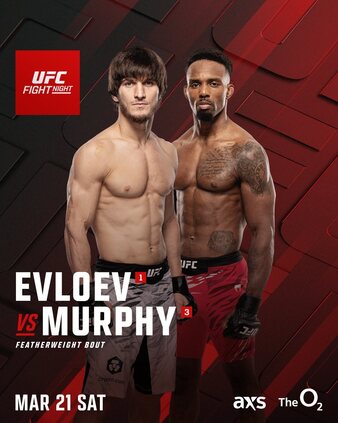
Featherweight Bout • UFC Fight Night: Evloev vs. Murphy
Saturday, March 21, 2026 • 30ft Octagon (Large Cage) • The O2, London
Explore Detailed Fighter Profiles
Click on either the fighter's name or profile image for each fighter to access comprehensive UFC statistics including striking metrics, grappling data, clinch performance, complete fight history, offensive & defensive analytics, and round-by-round breakdowns.

Luke Riley
12-0-0
Luke Riley
Fighter Metrics
Victory Methods
Win Round Distribution

Michael Aswell Jr.
Fighter Metrics
Victory Methods
Win Round Distribution
📋 Last 5 Fights - Luke Riley
| Date | Opponent | Result | Method |
|---|---|---|---|
| Nov 22, 2025 | Bogdan Grad | W | KO/TKO (R2, 0:30) |
| Mar 15, 2025 | Tariel Abbasov | W | KO/TKO (R2, 3:09) |
| Sep 21, 2024 | Alexandre Junior | W | KO/TKO (R1, 2:05) |
| Mar 16, 2024 | John De Jesus | W | U-DEC (R3, 5:00) |
| Sep 29, 2023 | Alexander Lööf | W | KO/TKO (R3, 0:58) |
📋 Last 5 Fights - Michael Aswell Jr.
| Date | Opponent | Result | Method |
|---|---|---|---|
| Oct 11, 2025 | Lucas Almeida | W | KO/TKO (R1, 1:42) |
| May 31, 2025 | Bolaji Oki | L | U-DEC (R3, 5:00) |
| Dec 15, 2024 | Dorian Ramos | W | S-DEC (R3, 5:00) |
| Aug 27, 2024 | Bogdan Grad | L | S-DEC (R3, 5:00) |
| Apr 21, 2024 | Nate Richardson | W | KO/TKO (R1, 1:08) |
Technical Analysis
Technical Score
Cardio Score
Overall Rating
📊 Technical Score
Calculated as the average of Striking Composite (65.0 vs 52.0) and Grappling Composite (18.0 vs 24.0). Balances overall striking effectiveness with grappling ability to measure complete technical skills.
💪 Cardio Score
Based on average fight duration, striking rate per minute, takedown rate, and finish rate. Measures cardiovascular endurance and ability to maintain pace throughout fights.
🎯 Overall Rating
Simple average of Technical Score and Cardio Score. Provides a holistic view of fighter capabilities combining skill level with physical conditioning and fight performance.
Striking Composite
Grappling Composite
Technical Radar Comparison
Visual comparison of key performance metrics between both fighters
📊 Detailed Statistical Comparison
🥊 Fight Analysis Breakdown
🧩 Luke Riley Key Advantages
Riley's 75% KO/TKO rate across 12 wins is elite-level finishing ability. His 2.73 average knockdowns per fight demonstrates genuine one-punch stopping power that can end the fight at any moment. Against Aswell's high-absorption style (7.79 SApM), Riley's precision striking becomes even more dangerous—every clean shot carries fight-ending potential. The Liverpudlian has shown consistent ability to find the chin, with 9 of his 12 wins coming via KO/TKO, including his most recent stoppage of Chepe Mariscal.
Riley absorbs just 1.27 strikes per minute—an exceptionally low number that reflects his defensive awareness and ring craft. Combined with his 60% striking accuracy, Riley creates a massive damage economy advantage. While Aswell throws at a frenetic 9.56 SLpM pace, his 45% accuracy means many shots miss, and Riley's defensive movement further reduces clean contact. Over three rounds, Riley accumulates minimal damage while landing with precision and power, creating favorable scoring optics for judges.
Fighting at the O2 Arena in London gives Riley a significant intangible edge. The Liverpudlian has shown he thrives under the bright lights, and the partisan British crowd will create an electric atmosphere that can fuel adrenaline-driven performances. Home fighters historically benefit from crowd energy, and Riley's aggressive striking style is perfectly suited to feed off the audience. This intangible factor shouldn't be underestimated in a close fight.
⚠️ Unfavorable Scenarios
Aswell's 9.56 SLpM output could overwhelm Riley if the Liverpudlian can't establish his timing early. Riley's relatively low 46% striking defense means he could struggle to deal with sustained volume pressure across three rounds. If Riley becomes reactive rather than proactive, Aswell's relentless output can shift judges' perception of fight control and effective striking, potentially stealing rounds through sheer activity even without landing the cleaner shots.
Riley's 42% takedown defense and nonexistent offensive grappling (0.00 TD/15, 0.00 Sub/15) represent a significant liability. While Aswell isn't a primary wrestler either, if the fight hits the mat through scrambles or clinch exchanges, Riley has shown limited ability to recover position. His grappling composite of just 18 is the lowest in the matchup, and any clinch exchanges could expose his defensive wrestling weaknesses.
📋 Likely Gameplan
Riley should look to exploit Aswell's high output and low defense by timing counters against reckless entries. His 60% striking accuracy allows him to be selective— waiting for Aswell to overextend on volume combinations and punishing him with clean, powerful counters. By maintaining composure and not matching Aswell's pace, Riley can land the quality shots that judges value while letting Aswell tire himself out through empty volume.
Given Riley's 75% KO rate and Aswell's tendency to absorb 7.79 strikes per minute, the optimal strategy is to press early and look for the finish. Riley's power advantage is most effective when Aswell hasn't settled into his rhythm. By establishing forward pressure in R1 and forcing exchanges at close range, Riley can maximize his knockout equity before Aswell adjusts to the timing and distance.
🚀 Michael Aswell Jr. Key Advantages
Aswell's 9.56 strikes landed per minute is an extraordinarily high output that puts constant pressure on opponents. Against Riley's moderate 46% striking defense, this volume creates sustained scoring opportunities. Even accounting for his 45% accuracy, Aswell is landing approximately 4.3 significant strikes per minute—nearly double Riley's 2.55 SLpM output. This activity differential can heavily influence judges who value octagon control and effective striking volume, especially in rounds where neither fighter scores a knockdown.
Despite his aggressive style, Aswell actually holds a striking defense advantage (54% vs Riley's 46%) and significantly better takedown defense (57% vs 42%). This suggests Aswell is more difficult to land clean on than his volume-heavy style might suggest. His defensive grappling composite (24 vs 18) also provides a slight edge in any clinch or ground exchanges, giving him more options if the fight diverges from a pure striking contest.
⚠️ Unfavorable Scenarios
Aswell's 7.79 SApM absorption rate is dangerously high against a power puncher like Riley. His willingness to trade creates constant exposure to Riley's knockdown power (2.73 KD average). If Aswell continues his volume-first approach without respecting Riley's power, he risks walking into fight-ending shots. His chin has already been tested—he was stopped by KO/TKO in his loss— and Riley's precision combined with power creates a constant threat of sudden stoppage.
Fighting in London against a hometown favorite puts Aswell at an immediate psychological disadvantage. The crowd energy will be entirely behind Riley, and in close exchanges, judges may subconsciously favor the local fighter. Aswell will need to be definitively winning rounds to get the nod—close rounds are unlikely to break his way in this environment.
📋 Likely Gameplan
Aswell's best path is to maintain his natural high output and keep Riley constantly responding to strikes. By establishing a frenetic pace early, Aswell can prevent Riley from setting up his precision counter shots. Volume combinations to the body and head can accumulate damage while also impressing judges with activity. The key is staying busy enough to control the pace without becoming reckless and leaving openings for Riley's power shots.
Aswell needs to use the 30-foot cage to maintain movement and avoid standing directly in front of Riley's power. By utilizing lateral movement and angle changes, he can create striking opportunities while minimizing his exposure to Riley's counters. Circling away from Riley's power hand and using feints to draw reactions can open up volume combinations from safer positions.
🎯 Fight Prediction Analysis
Data-driven prediction model based on statistical analysis
📊Detailed Analysis Summary
🏟️Cage Dynamics
The 30-foot octagon at The O2, London provides ample space for both fighters' preferred approaches. Riley benefits from the larger cage as it gives him room to set up his power shots and counter-striking, while Aswell can utilize the space for lateral movement and volume combinations. The key dynamic is whether Riley can cut off the cage and force exchanges at close range where his power advantage maximizes, or whether Aswell can maintain distance and use the full octagon to circle and sustain his high-volume output. The hometown crowd energy at The O2 adds another dimension—Riley will feed off the atmosphere while Aswell must maintain composure in hostile territory.
🎯Technical Breakdown
This matchup pits Riley's precision power against Aswell's relentless volume. Riley's 60% striking accuracy and 2.73 knockdowns per fight represent elite finishing efficiency, while Aswell's 9.56 SLpM output is among the highest in the featherweight division. The damage economy heavily favors Riley—1.27 SApM vs 7.79 creates a 6.1x absorption differential that compounds over three rounds. However, Aswell's 54% striking defense (vs Riley's 46%) and better takedown defense (57% vs 42%) provide defensive margins. Neither fighter has significant grappling credentials (composites of 18 and 24), making this a primarily striking-based contest.
🧩Key Battle Areas
Three critical battle areas will determine the outcome: power vs volume in striking exchanges, defensive efficiency under pressure, and pace sustainability over three rounds. Riley's 75% KO rate makes him dangerous at any moment, but Aswell's ability to sustain 9.56 SLpM can overwhelm opponents who try to be patient. The fight likely hinges on whether Riley can find the finishing blow before Aswell accumulates enough volume to take rounds on the scorecards. Riley's low absorption rate suggests he can minimize damage while waiting for openings, but Aswell's defensive striking (54%) is better than expected for a volume fighter.
🏁Final Prediction
The most likely outcome is Luke Riley by KO/TKO (48% probability), achieved through precision counter-striking and exploiting Aswell's high absorption rate. Riley's decision path (10%) requires controlling the pace and out-pointing Aswell with cleaner, more impactful strikes. Aswell's best win path is by Decision (21%), using relentless volume to out-activity Riley across three rounds. Aswell's KO/TKO path (14%) requires sustained pressure to break Riley down—possible but less likely given Riley's low absorption rate. The remaining 4% accounts for submission outcomes and Riley's submission path (3%).
💰 Betting Analysis: Model vs Market
Detailed value assessment in the betting market
📊Market Odds
🤖Analytical Model
💎Value Opportunities
MAXIMUM VALUE
GOOD VALUE
SLIGHT VALUE
⚠️Key Market Discrepancies
- • Overweights early KO volatility – Underprices five-round wrestling cycles.
- • Undervalues damage economy – Low SApM differential drives optics on cards.
- • Big-cage bias – Space helps early, but fence/rides erode it late.
🎯 Comprehensive Probabilistic Analysis
100 hypothetical fight simulation based on statistical data
🏆Outcome Distribution - Luke Riley
Primary path via fence control and rides
Attritional GNP and accumulative pressure
Back-takes off rides create RNC chances
💥Outcome Distribution - Michael Aswell Jr.
Best lane via intercepts and counters
Requires extended range control in big cage
Low historical submission profile
⏰Fight Timeline Analysis
⚡Window of Opportunity - Michael Aswell Jr.
- • Sustained volume: 9.56 SLpM output can overwhelm patient fighters.
- • Movement & angles: Use lateral movement to avoid power exchanges.
- • Late rounds: Volume accumulation tilts decision scoring if fight goes distance.
🎯Finishing Power - Luke Riley
- • Counter-striking: 60% accuracy with 75% KO rate makes every exchange dangerous.
- • Damage economy: 1.27 SApM minimizes risk while waiting for openings.
- • Home crowd: London atmosphere fuels aggressive early pressure.
🎯 Final Confidence Assessment
Confidence level and uncertainty factors
Confidence Level
Elite power advantage with home crowd, tempered by Aswell's volume threat
✅Supporting Factors
- • Elite 75% KO rate with 2.73 knockdowns per fight
- • Superior damage economy (1.27 SApM vs 7.79)
- • Home crowd advantage at The O2, London
- • Undefeated record (12-0) with high finishing rate
⚠️Risk Factors
- • Aswell's 9.56 SLpM can overwhelm patient fighters
- • Riley's 46% striking defense is exploitable
- • Grappling vulnerability if fight goes to ground
🏁Executive Summary
Luke Riley's elite knockout power and precision striking make him the clear favorite in this featherweight clash at The O2, London. His 75% KO rate and 2.73 knockdowns per fight represent one of the most dangerous finishing profiles in the division, while his remarkably low 1.27 SApM demonstrates an ability to minimize damage while waiting for openings. Michael Aswell Jr.'s path to victory centers on sustaining his elite 9.56 SLpM output and using volume to accumulate rounds on the scorecards. However, Aswell's 7.79 SApM creates a 6.1x absorption differential that compounds over three rounds, making him increasingly vulnerable to Riley's power as damage accumulates. Riley's home crowd advantage at The O2 adds an intangible but significant factor—the London atmosphere will fuel his aggression and could unsettle Aswell in his first fight in hostile territory.
Prediction: Riley by KO/TKO most likely (48% probability) through precision counter-striking and exploiting Aswell's high absorption rate; Aswell's best path is by Decision (21%) using relentless volume to out-activity Riley across three rounds. The fight's outcome hinges on whether Riley can find the finishing blow before Aswell's volume accumulation tilts the scorecards in his favor.