

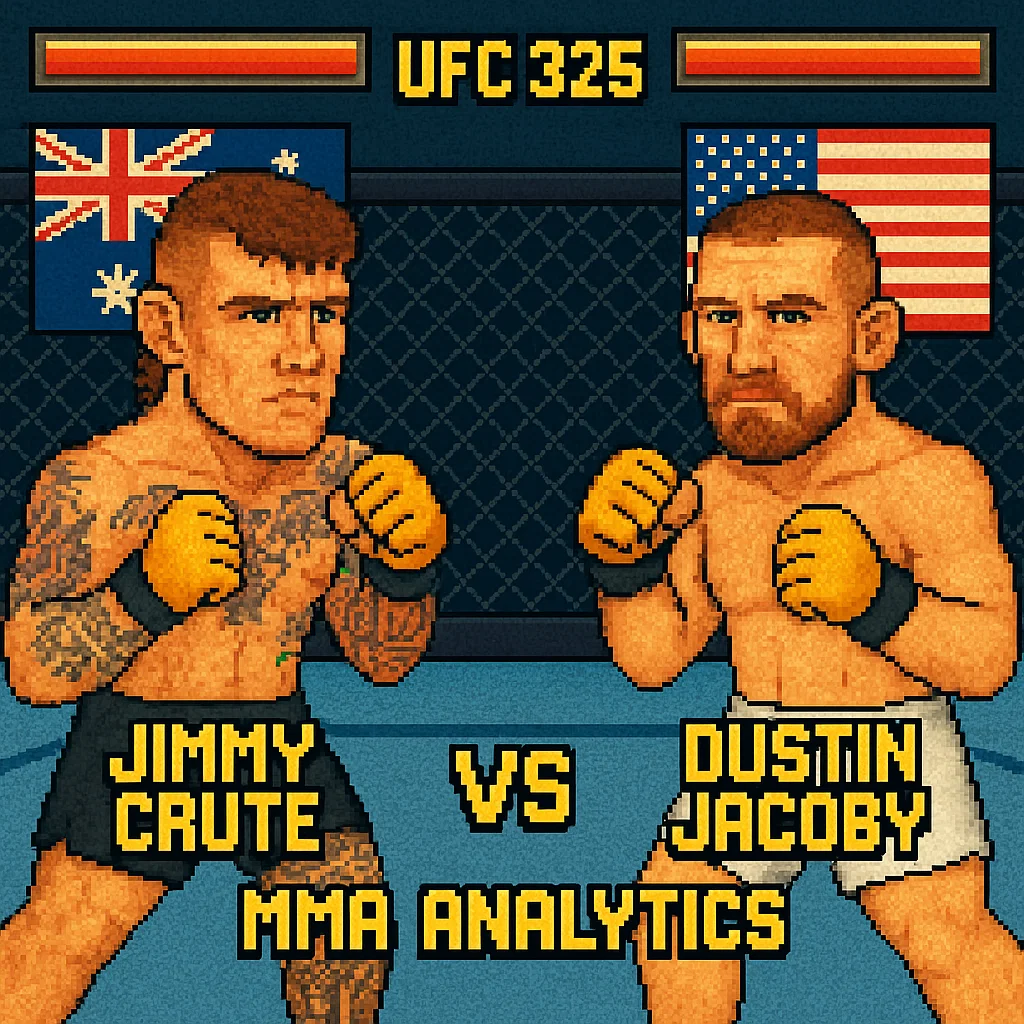
Jimmy Crute vs Dustin Jacoby
Men's Light Heavyweight Bout • UFC 325: Volkanovski vs Lopes 2
Saturday, January 31, 2026 • 30ft Octagon (Large Cage) • Qudos Bank Arena, Sydney, Australia
Explore Detailed Fighter Profiles
Click on either the fighter's name or profile image for each fighter to access comprehensive UFC statistics including striking metrics, grappling data, clinch performance, complete fight history, offensive & defensive analytics, and round-by-round breakdowns.
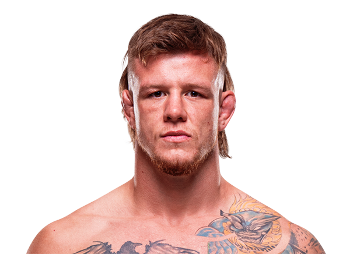
Jimmy Crute
Fighter Metrics
Victory Methods
Win Round Distribution
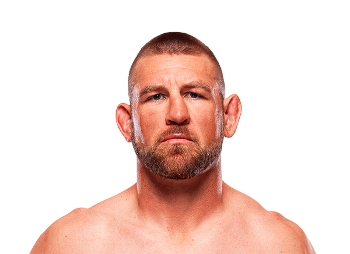
Dustin Jacoby
Fighter Metrics
Victory Methods
Win Round Distribution
📋 Last 5 Fights - Jimmy Crute
| Date | Opponent | Result | Method |
|---|---|---|---|
| 2025-09-27 | Ivan Erslan | W | Submission - Rear Naked Choke (R1, 3:19) |
| 2025-07-19 | Marcin Prachnio | W | Submission - Armbar (R1, 4:32) |
| 2025-02-08 | Rodolfo Bellato | D | Decision (R3, 5:00) |
| 2023-07-08 | Alonzo Menifield | L | Submission - Arm Triangle (R1, 3:38) |
| 2023-02-11 | Alonzo Menifield | D | Decision (R3, 5:00) |
📋 Last 5 Fights - Dustin Jacoby
| Date | Opponent | Result | Method |
|---|---|---|---|
| 2025-05-31 | Bruno Lopes | W | TKO - Punches (R1, 1:50) |
| 2024-12-14 | Vitor Petrino | W | TKO - Right Cross (R3, 3:44) |
| 2024-06-08 | Dominick Reyes | L | TKO - Strikes (R1, 2:00) |
| 2023-12-16 | Alonzo Menifield | L | Decision - Unanimous (R3, 5:00) |
| 2023-08-05 | Kennedy Nzechukwu | W | TKO - Strikes (R1, 1:22) |
Technical Analysis
Technical Score
Cardio Score
Overall Rating
📊 Technical Score
Calculated as the average of Striking Composite (44.0 vs 55.0) and Grappling Composite (67.0 vs 19.0). Balances overall striking effectiveness with grappling ability to measure complete technical skills.
💪 Cardio Score
Based on average fight duration, striking rate per minute, takedown rate, and finish rate. Measures cardiovascular endurance and ability to maintain pace throughout fights.
🎯 Overall Rating
Simple average of Technical Score and Cardio Score. Provides a holistic view of fighter capabilities combining skill level with physical conditioning and fight performance.
Striking Composite
Grappling Composite
📊 Technical Radar Comparison
📊 Metrics Legend
📊 Detailed Statistical Comparison
🥊 Fight Analysis Breakdown
🧩 Jimmy Crute Key Advantages
Crute's 3.86 takedowns per 15min vs Jacoby's 0.33 represents an 11.7x differential that fundamentally controls fight location. Crute's chain-wrestling sequences—double-leg entries into half-guard rides, back-takes, and submission attempts—create minute-winning cycles that accumulate control time. His 53% takedown accuracy against Jacoby's 63% defense suggests first-layer resistance, but Crute's re-shot ability and persistent pressure typically breaks through. The Australian's ability to chain multiple attempts and maintain pressure while Jacoby defends creates fatigue differentials that compound over three rounds.
Crute's 1.62 submissions per 15 minutes creates a constant finishing threat that forces defensive reactions from Jacoby. His recent submission victories (RNC vs Erslan, armbar vs Prachnio, both in R1) demonstrate active grappling offense once top control is established. Jacoby's zero submission attempts in UFC means any ground exchanges heavily favor Crute's offensive capabilities. This threat forces Jacoby to expend additional energy defending positions and transitions rather than working to stand, creating a cumulative energy drain over three rounds.
At 28 years old, Crute represents the younger, ascending fighter against Jacoby's veteran experience at 37. This age differential becomes significant in wrestling-heavy exchanges where explosive power and recovery between rounds matters. Crute's recent momentum (2 straight R1 submission wins) suggests he's entering his athletic prime, while Jacoby's higher-mileage body (31 total MMA fights vs Crute's 20) may struggle with sustained grappling pressure over three rounds in the large cage environment.
⚠️ Unfavorable Scenarios
Jacoby's striking volume (5.37 SLpM) and defensive awareness (58% StrDef) create counter opportunities when Crute commits to takedown attempts. The American's 2" reach advantage allows him to maintain distance while threatening intercept strikes as Crute level changes. Crute's poor striking defense (42%) means any extended periods standing expose him to accumulating damage, especially from Jacoby's power punching that has produced 14 career KO/TKOs.
If Crute fails to establish early takedowns in the 30-foot cage, Jacoby's volume striking advantage becomes significant. The large octagon provides ample space for Jacoby to circle, reset, and maintain preferred striking distance. Jacoby's ability to string together combinations (5.37 SLpM) can overwhelm Crute's defensive shell, especially if the Australian becomes hesitant to shoot after early stuffed attempts. Crute's 6:43 average fight duration suggests vulnerability in extended striking exchanges when he can't impose grappling.
📋 Likely Gameplan
Crute should target early takedowns within the first 2 minutes, exploiting Jacoby's fresh legs before the veteran establishes striking rhythm. His 53% TD accuracy suggests he can breach Jacoby's 63% defense with persistent volume and chain-wrestling sequences. Once down, Crute's priority is establishing dominant positions—half-guard rides, back-takes, and submission threats—maximizing control time while minimizing stand-up exchanges where Jacoby holds advantages.
Once top control is secured, Crute should emphasize submission hunting over ground-and-pound. His 1.62 Sub/15 and 79% finish rate demonstrate finishing instincts that can end fights early. Targeting rear-naked chokes (as vs Erslan) and armbars (as vs Prachnio) when opportunities present themselves creates multiple winning paths while banking control time. This approach maximizes scoring while minimizing Jacoby's chances to reset to striking.
🚀 Dustin Jacoby Key Advantages
Jacoby's 5.37 SLpM output represents one of the higher striking rates in the light heavyweight division, creating significant volume advantages when fights remain upright. His kickboxing background emphasizes combinations, jabs, crosses, and low kicks that accumulate damage over time. The American's 58% striking defense (vs Crute's 42%) provides defensive security while maintaining offensive pressure. In the 30-foot cage, Jacoby can utilize space to maintain preferred range, forcing Crute to cover distance and expose himself to counter strikes.
Jacoby's 14 career KO/TKOs (67% of his victories) demonstrate legitimate one-shot power that creates constant threat. His recent finishes (TKO vs Lopes R1, TKO vs Petrino R3) show both early finishing ability and sustained power deep into fights. Against Crute's poor striking defense (42%), Jacoby's power punching becomes even more dangerous—every exchange carries knockout equity. This power forces Crute into defensive shells or premature takedown attempts that may be telegraphed and easier to defend.
Jacoby's 76" reach and 6'3" height advantages (vs Crute's 74"/6'2") create additional striking range that compounds his technical striking superiority. These physical edges allow Jacoby to land jabs and crosses while staying outside Crute's reactive punching range, controlling distance without overcommitting. In the large cage, this reach advantage becomes more pronounced—Jacoby can maintain safe striking range while forcing Crute to cover more ground for takedown entries, increasing exposure to counter strikes.
⚠️ Unfavorable Scenarios
Crute's chain-wrestling sequences create nightmare scenarios for Jacoby—once the Australian secures takedowns, his ability to maintain top position, hunt submissions, and execute mat returns prevents Jacoby from regaining his feet or establishing striking rhythm. Jacoby's 63% TD defense suggests he can stuff initial attempts, but Crute's volume and persistence typically breaks through. Once grounded, Jacoby's zero submission offense and limited grappling threatens while Crute accumulates control time and seeks finishes.
Crute's 1.62 submissions per 15 minutes and recent R1 finishes (RNC, armbar) create constant finishing threats that Jacoby must navigate. Any scrambles, positional transitions, or defensive lapses could result in submission attempts. Jacoby's zero career submission victories suggest limited offensive grappling acumen, making defensive grappling his only ground game option. This asymmetric threat landscape means ground exchanges heavily favor Crute's finishing capabilities while Jacoby merely seeks survival and standup opportunities.
📋 Likely Gameplan
Jacoby's optimal strategy involves maintaining perimeter control while exploiting his reach and height advantages. His jabs, crosses, and low kicks should target Crute's base and mobility, making takedown entries more difficult. The large 30-foot cage provides space to circle, reset, and maintain preferred striking range. When Crute does commit to shots, Jacoby should threaten sprawls and pivots, creating counter opportunities rather than static defense. The key is staying active enough to score points while preventing Crute from settling into rhythm or establishing clinch pressure.
Jacoby should maintain high striking output (5.37 SLpM) to accumulate damage against Crute's poor striking defense (42%). His 67% KO/TKO rate suggests finishing equity exists in extended striking exchanges. By keeping Crute on the defensive with volume combinations and power shots, Jacoby can force defensive reactions that create openings for finishing sequences. The veteran's experience (31 total fights) should help him recognize when Crute is hurt or fatigued, capitalizing on those moments to press for finishes rather than coasting on volume advantages.
🎯 Fight Prediction Analysis
Data-driven prediction model based on statistical analysis
📊Detailed Analysis Summary
🏟️Cage Dynamics
The 30-foot octagon creates favorable conditions for Jacoby's range-striking game while providing space for Crute to set up takedown entries. Jacoby's 2" reach advantage and superior volume (5.37 SLpM) become more pronounced in the large cage where he can maintain distance and reset positioning. However, Crute's persistent pressure and chain-wrestling ability can compress the cage over time, forcing Jacoby into uncomfortable clinch exchanges at the fence. The key dynamic centers on whether Jacoby can maintain perimeter control throughout three rounds or Crute's grappling pressure gradually eliminates striking space.
🎯Technical Breakdown
The statistical analysis reveals clear stylistic divergence: Jacoby dominates striking metrics (5.37 vs 4.37 SLpM, 58% vs 42% StrDef) while Crute monopolizes grappling (3.86 vs 0.33 TD15, 1.62 vs 0 Sub/15). This creates distinct winning paths—Jacoby succeeds through extended striking exchanges accumulating volume and damage, while Crute wins via grappling control and submission threats. The 11.7x takedown differential represents Crute's most significant advantage, but Jacoby's defensive striking and power (14 career KO/TKOs) create constant finishing threat when upright. The fighter who successfully imposes their game location (striking vs grappling) will likely dictate the outcome.
🧩Key Battle Areas
Three critical battlegrounds determine the outcome: initial takedown defense vs pressure wrestling, striking volume vs grappling control time, and finishing equity vs decision paths. Jacoby's 63% TD defense suggests he can stuff some attempts, but Crute's volume (3.86 TD/15) and chain-wrestling typically breaks through over time. In striking exchanges, Jacoby holds clear advantages in volume, defense, and power, but Crute's submission threat (1.62 Sub/15) creates finishing paths unavailable to Jacoby. The age differential (28 vs 37) favors Crute's explosive grappling over extended periods, while Jacoby's experience (31 total fights) provides strategic awareness for managing distance and timing opportunities.
🏁Final Prediction
The most likely outcome is Dustin Jacoby by KO/TKO (42% probability), achieved through volume striking and power punching exploiting Crute's poor defensive metrics (42% StrDef). Jacoby's decision path (17%) requires maintaining distance control across three rounds, a plausible scenario given the large cage and his reach advantages. Crute's most viable path is submission (18%), capitalizing on his grappling superiority and recent finishing momentum (2 straight R1 submissions). His decision path (12%) requires consistent takedown success and control time accumulation without finishing. The stylistic clash favors Jacoby's striking game in Sydney's home environment, but Crute's submission threat keeps the fight dangerous at all times.
💰 Betting Analysis: Model vs Market
Detailed value assessment in the betting market
📊Market Odds
🤖Analytical Model
💎Value Opportunities
MAXIMUM VALUE
Model: 42% | Fair: +138
GOOD VALUE
Model: 18% | Fair: +456
SLIGHT VALUE
Model: 29% | Fair: +245
⚠️Key Market Discrepancies
- • Undervalues striking equity – Jacoby's volume and power create consistent finishing paths.
- • Overweights grappling threat – Crute's submission rate is high but requires successful takedowns first.
- • Age factor bias – Market may underestimate veteran experience in large cage environment.
🎯 Comprehensive Probabilistic Analysis
100 hypothetical fight simulation based on statistical data
🏆Outcome Distribution - Jimmy Crute
Primary path via grappling control and finishing sequences
Via consistent takedowns and control time
Ground-and-pound or striking in transitions
💥Outcome Distribution - Dustin Jacoby
Best lane via volume striking and power punching
Requires sustained distance control in large cage
Zero career submission profile
⏰Fight Timeline Analysis
⚡Window of Opportunity - Jimmy Crute
- • First 5 minutes: Highest submission threat window.
- • Chain wrestling: Volume TD attempts break through defense.
- • Ground control: Accumulate minutes and hunt finishes.
🎯Progressive Dominance - Dustin Jacoby
- • Distance management: Maintain range and circle.
- • Volume accumulation: Build damage with combinations.
- • Finish hunting: Capitalize on defensive lapses.
🎯 Final Confidence Assessment
Confidence level and uncertainty factors
Confidence Level
Clear stylistic divergence with multiple viable winning paths for both fighters
✅Supporting Factors
- • Significant striking advantages (volume, defense, power)
- • Large cage favors distance striking game
- • Physical reach and height advantages
- • Recent finishing momentum (2 straight TKOs)
⚠️Risk Factors
- • Crute's massive grappling volume advantage (11.7x)
- • Submission threat creates finishing paths
- • Youth and explosiveness factors
🏁Executive Summary
Dustin Jacoby's striking superiority should control fight location in the 30-foot octagon, banking safe striking minutes through volume combinations and defensive awareness, while Jimmy Crute's best equity centers on persistent takedown pressure and submission hunting before Jacoby's power accumulation takes hold. The statistical differentials favor Jacoby: his 5.37 vs 4.37 SLpM and 58% vs 42% StrDef create significant striking advantages, while his 14 career KO/TKOs demonstrate legitimate finishing power. Crute's 3.86 TD15 vs Jacoby's 0.33 represents an 11.7x takedown volume advantage, and his 1.62 Sub/15 creates constant finishing threats when grappling exchanges occur.
Prediction: Jacoby by KO/TKO most likely (42% probability) through volume striking and power punching exploiting Crute's defensive vulnerabilities; Crute's upset lane is submission (18%) via grappling control and finishing sequences. The fight's outcome hinges on whether Crute can establish consistent takedowns before Jacoby's striking accumulation and finishing power become decisive factors.