

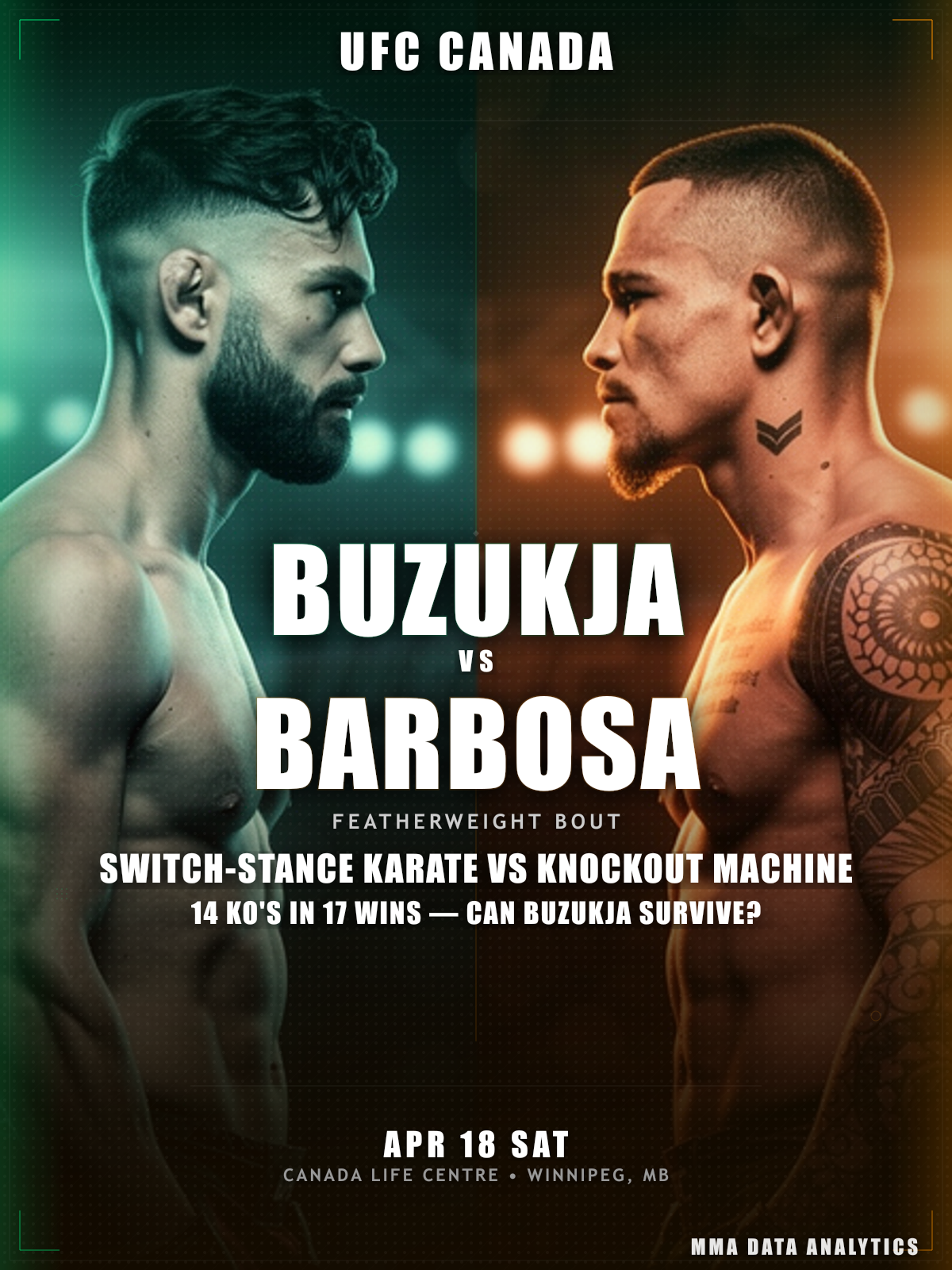
Dennis Buzukja vs Márcio Barbosa
Men's Featherweight Bout • UFC Fight Night: Burns vs. Malott
Saturday, April 18, 2026 • 30ft Octagon (Large Cage) • Canada Life Centre, Winnipeg
Explore Detailed Fighter Profiles
Click on either the fighter's name or profile image for each fighter to access comprehensive UFC statistics including striking metrics, grappling data, clinch performance, complete fight history, offensive & defensive analytics, and round-by-round breakdowns.
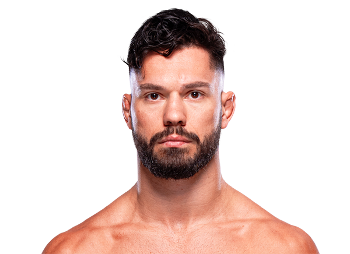
Dennis Buzukja
Fighter Metrics
Victory Methods
Win Round Distribution
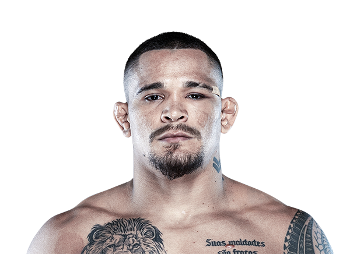
Márcio Barbosa
Fighter Metrics
Victory Methods
Win Round Distribution
📋 Last 5 Fights - Dennis Buzukja
| Date | Opponent | Result | Method |
|---|---|---|---|
| Aug 24, 2024 | Francis Marshall | L | Decision (Split) (R3, 5:00) |
| Mar 30, 2024 | Connor Matthews | W | KO/TKO (R3, 0:22) |
| Nov 11, 2023 | Jamall Emmers | L | KO/TKO (R1, 0:49) |
| Aug 5, 2023 | Sean Woodson | L | Decision (Unanimous) (R3, 5:00) |
| Jun 16, 2023 | Soslan Abanokov | W | Submission (Rear-Naked Choke) (R2, 1:29) |
📋 Last 5 Fights - Márcio Barbosa
| Date | Opponent | Result | Method |
|---|---|---|---|
| Aug 26, 2025 | Damon Wilson | W | KO/TKO (Punches) (R1, 4:14) |
| Nov 22, 2024 | Felipe Oliveira | W | KO/TKO (Punches) (R1, 2:54) |
| Nov 3, 2023 | Gian Sarturi | W | KO/TKO (Punches) (R1, 3:08) |
| Jul 7, 2023 | Wellington Prado | W | KO/TKO (Punches) (R1, 2:40) |
| Nov 4, 2022 | Gabriel Santos | L | KO/TKO (Head Kick) (R2, 0:09) |
Technical Analysis
Technical Score
Cardio Score
Overall Rating
📊 Technical Score
Calculated as the average of Striking Composite (62.0 vs 58.0) and Grappling Composite (68.0 vs 35.0). Balances overall striking effectiveness with grappling ability to measure complete technical skills.
💪 Cardio Score
Based on average fight duration, striking rate per minute, takedown rate, and finish rate. Measures cardiovascular endurance and ability to maintain pace throughout fights.
🎯 Overall Rating
Simple average of Technical Score and Cardio Score. Provides a holistic view of fighter capabilities combining skill level with physical conditioning and fight performance.
Striking Composite
Grappling Composite
Technical Radar Comparison
Visual comparison of key performance metrics between both fighters
📊 Detailed Statistical Comparison
🥊 Fight Analysis Breakdown
🧩 Dennis Buzukja Key Advantages
Buzukja fights comfortably from both orthodox and southpaw stances, constantly switching to create unpredictable angles. His karate base gives him a unique movement profile—lateral footwork, in-and-out distance management, and explosive entries from unorthodox positions. Against a forward-pressure fighter like Barbosa who walks opponents down, Buzukja's ability to switch stances mid-combination forces Barbosa to constantly readjust his range and timing. This is particularly effective against aggressive fighters who rely on walking down their opponents in a straight line. Buzukja's stance switching creates different lead-hand angles (jab from orthodox, left straight from southpaw) that can disrupt Barbosa's forward march and create counter-striking opportunities off Barbosa's aggressive entries.
At 5'9" vs Barbosa's 5'6", Buzukja holds a 3-inch height advantage while sharing identical 70-inch reach. This means Buzukja can use his height to jab downward, make Barbosa reach up for power shots, and create difficult angles for the shorter fighter to land cleanly. More critically, Buzukja has 4 UFC fights and 6 total fights on the UFC/DWCS platform, while Barbosa is making his official UFC debut. Octagon experience—ring awareness, crowd management, pacing under UFC lights—provides an intangible but real edge. Buzukja has faced UFC-caliber opposition (Sean Woodson, Jamall Emmers, Francis Marshall) and understands the speed and intensity of UFC competition. Barbosa's regional and LFA experience, while impressive, hasn't tested him against this level consistently.
Buzukja's 75% takedown defense is a strong metric that ensures the fight stays on the feet where both fighters want it. While Barbosa has zero recorded takedown attempts in his DWCS data, the judo/BJJ black belt background suggests he could clinch and try to change levels if striking goes poorly. Buzukja's Serra-Longo wrestling fundamentals make him hard to get down. Additionally, Buzukja has proven he can go 15 minutes—his average fight duration (10:18) and multiple 3-round decision wins show he maintains output deep into fights. Barbosa's average fight duration of just 2:41 (almost all R1 finishes) means his cardio in later rounds is completely untested. If this fight goes past R1, Buzukja's conditioning advantage could become decisive.
⚠️ Unfavorable Scenarios
Barbosa's 14 KO/TKO wins (82% of his victories) and his habit of finishing fights within the first round make the opening minutes extremely dangerous for Buzukja. With 15 of 17 wins coming in R1, Barbosa brings terrifying early pressure and devastating power. Buzukja absorbs 4.82 significant strikes per minute with only 48% striking defense—meaning he gets hit often. Against a power puncher of Barbosa's caliber, one clean connection could end the fight. Buzukja's 49-second KO loss to Jamall Emmers at UFC 295 shows he can be caught early when facing explosive opponents.
Buzukja's 1-3 UFC record is concerning. Three losses in four UFC appearances—including a flash KO and two decision losses—raises questions about whether he can perform at UFC level consistently. His 9-month suspension following a fan altercation at UFC 310 adds further instability. Meanwhile, Barbosa arrives on a 4-fight win streak with all finishes, riding peak momentum and confidence into his debut. The psychological dynamic favors the Brazilian's fearless aggression over Buzukja's cautious approach coming off losses.
📋 Likely Gameplan
Buzukja's best path to victory is using his 3-inch height advantage and switch-stance movement to fight at range, avoiding Barbosa's power zone. The jab and teep from distance, combined with lateral movement, can frustrate Barbosa's forward pressure and force him to overextend. Buzukja should look to counter off Barbosa's aggressive entries—stepping back and firing straight shots when Barbosa lunges forward. The goal is to make Barbosa miss and pay for his aggression. Serra-Longo's emphasis on technical striking and footwork should shine here. If Buzukja can survive the early storm and start landing counters, he can take over in R2 and R3 as Barbosa's output naturally decreases.
The single most important tactical objective for Buzukja is surviving the first round. Barbosa's 15 R1 finishes in 17 wins demonstrate his power is concentrated early. If Buzukja weathers the initial storm—using clinch work, circling off the fence, and tying up when pressured—he enters uncharted territory for Barbosa. Only 1 of Barbosa's wins went past R1, and his cardio is a complete unknown in later rounds. Buzukja should prioritize defensive responsibility in R1 (even if he loses the round), then increase output in R2-R3 when Barbosa's aggression fades and fatigue sets in. This patient approach mirrors his decision wins where he outworks opponents over the full distance.
🚀 Márcio Barbosa Key Advantages
Barbosa is one of the most explosive finishers entering the UFC, with 14 of his 17 wins coming by KO/TKO—an extraordinary 82% knockout rate. His forward pressure and heavy hands have ended fights rapidly: his last 4 wins averaged just 3:14 in the first round. In his DWCS debut, he posted 8.27 SLpM with 47% accuracy—blistering volume combined with legitimate power. Against Buzukja, who absorbs 4.82 strikes per minute with only 48% striking defense, Barbosa's power advantage is the defining threat. His judo background and BJJ black belt give him additional tools if the striking stalls, but his bread and butter is walking opponents down with devastating punching combinations that end fights emphatically.
Barbosa enters his UFC debut on a 4-fight winning streak, all by KO/TKO in round 1 (Wellington Prado, Gian Sarturi, Felipe Oliveira, Damon Wilson). This isn't just volume momentum—each finish demonstrates his ability to identify and capitalize on hurt opponents immediately. His 94% career finish rate (only 1 decision in 17 wins) shows elite finishing instinct—when he hurts opponents, he doesn't let them recover. His pro debut at age 17 and current 27-year-old prime suggest he's entering the UFC at peak physical maturity. Against a fighter like Buzukja who has shown vulnerability to early finishes (49-second KO loss to Emmers), Barbosa's aggressive style creates constant fight-ending danger from the opening bell.
⚠️ Unfavorable Scenarios
Barbosa's average fight duration of 2:41 is a double-edged sword—it reflects devastating finishing ability but also means his cardio beyond the first round is completely untested at the professional level. Only 1 of his 19 pro fights went to a decision (a split decision in 2021), and he's never fought past the second round. If Buzukja can weather the early storm and push this fight into R2 and R3, Barbosa enters unknown territory where his conditioning, fight IQ, and ability to adjust mid-fight have never been challenged. Both of Barbosa's losses came by KO/TKO in round 2, suggesting he may become hittable when he fails to finish early.
Making your UFC debut is one of the most significant transitions in MMA. The bright lights, packed arena, higher-level competition, and increased intensity catch many prospects off guard. Barbosa's experience is primarily on the Brazilian regional circuit (NEC, Shooto Brasil, Jungle Fight, Favela Kombat) and LFA—a significant step below UFC competition. While his DWCS performance was impressive, that was one fight. Buzukja's UFC-caliber opponents (Woodson, Emmers, Marshall) have tested him at a level Barbosa hasn't experienced. The speed, timing, and defensive sophistication of UFC fighters can neutralize regional-level power.
📋 Likely Gameplan
Barbosa's optimal strategy is simple and direct: march forward, cut off the cage, and land heavy punching combinations. His 8.27 SLpM output demonstrates he throws at relentless volume, and his power generates fight-ending damage on every connection. Against Buzukja, the game plan is to close distance quickly, negate the height advantage by fighting on the inside, and unleash hooks and uppercuts in the pocket. Barbosa should target the body early to slow Buzukja's lateral movement, then attack the head as Buzukja drops his hands to protect the body. Walking Buzukja into the fence and unloading combinations in close quarters plays directly to Barbosa's strengths as a compact power striker.
Barbosa must recognize that every minute the fight continues past the first round, the odds shift toward Buzukja. His game plan should prioritize maximum output and aggression in R1—accepting damage to land damage. If Buzukja tries to clinch and slow the pace, Barbosa should use his judo background to create separation and return to punching range. The key is to maintain the relentless pace that overwhelmed 15 opponents in R1 without becoming reckless. If Barbosa can corner Buzukja early and land 2-3 clean power shots, his finishing instinct will take over. The worst-case scenario is a tactical point-fighting contest—Barbosa must make this a violent fight from the opening bell.
🎯 Fight Prediction Analysis
Data-driven prediction model based on statistical analysis
📊Detailed Analysis Summary
🏟️Cage Dynamics
The larger octagon creates an interesting dynamic for this striker vs striker matchup. The extra space benefits Buzukja's switch-stance movement and lateral footwork—he can circle, change angles, and avoid being cornered by Barbosa's forward pressure. Buzukja's karate-style in-and-out movement is maximized in a larger cage where he has room to bounce in, land, and retreat before Barbosa can close distance.
Conversely, the larger cage forces Barbosa to cover more distance to trap Buzukja on the fence—his preferred fighting zone. However, once Barbosa closes distance, the cage becomes his ally: he can pin Buzukja against the fence and unload power shots in close quarters. The 3-round format slightly favors Buzukja's patient approach, as Barbosa must invest energy cutting off the ring while maintaining the relentless pace that defines his style. Buzukja should use the full octagon to make Barbosa work for every exchange.
🎯Technical Breakdown
This fight presents a classic technical striker vs power puncher dynamic. Buzukja's 4.21 SLpM and 43% accuracy suggest measured, selective striking from range, while Barbosa's 8.27 SLpM at 47% accuracy (from limited DWCS data) reflects overwhelming forward volume. The statistical caveat is significant: Barbosa's UFCStats numbers come from a single DWCS fight, making them unreliable for projecting UFC performance. His true output will likely normalize against UFC-caliber defense.
Both fighters share identical 70-inch reach, neutralizing what could have been an advantage for either. Buzukja's 3-inch height advantage (5'9" vs 5'6") is the key physical differentiator—he can jab downward and use range to make Barbosa bridge the gap. Defensively, Buzukja's 48% striking defense vs Barbosa's 50% are comparable, but Barbosa's numbers come from a single fight while Buzukja's reflect 6 fights on the platform.
The fight will be decided by pace and timing. If Barbosa can close distance and land heavy shots early, his power advantage should be decisive. If Buzukja can maintain range, use his switch-stance to create angles, and survive R1, the fight increasingly favors his conditioning and experience. Neither fighter offers significant grappling threat—this is a striking chess match with a ticking clock that favors Buzukja the longer it runs.
🧩Key Battle Areas
1) First 5 Minutes Survival: This is THE critical variable. Barbosa finishes 15 of 17 wins in R1— the opening round is his domain. Buzukja must prioritize defensive responsibility, using movement and clinch work to survive the early onslaught. If Buzukja is still standing and competitive after R1, the complexion of the fight changes dramatically. Every minute past the 5:00 mark shifts probability toward Buzukja.
2) Range Control: Buzukja's height advantage (5'9" vs 5'6") creates a natural range advantage even with identical reach. Using the jab, teep, and lateral movement to fight at distance negates Barbosa's power advantage in the pocket. If Buzukja gets drawn into pocket exchanges where Barbosa's compact power is most effective, the fight favors the Brazilian. The 30-foot cage gives Buzukja room to circle—he must use it.
3) Cardio & Late-Round Ability: Barbosa has virtually no experience in late rounds. His 2:41 average fight duration means he's never been tested for conditioning beyond 5 minutes. If the fight reaches R2 competitive, Buzukja's proven ability to go 15 minutes and multiple decision wins create a substantial advantage. The question is whether Barbosa can maintain his blistering pace or fades like many power punchers do in later rounds.
Verdict: This is a timing fight. Barbosa must finish early or risk fading against a more experienced opponent who can go the distance. Buzukja must survive the early storm to capitalize on his conditioning and octagon IQ. The fight is genuinely close—a coin flip where each fighter has a clear path to victory.
🏁Final Prediction
Most Likely Outcome: Barbosa by KO/TKO (30%)— Barbosa closes distance in R1, traps Buzukja on the fence, and lands a fight-ending combination. His 82% KO rate and R1 finishing ability make this the single most probable outcome. Barbosa's power is the kind that ends fights immediately once he connects clean.
Buzukja by Decision (22%) — Buzukja survives the early storm, uses his switch-stance and movement to outpoint Barbosa over three rounds, and wins a decision as Barbosa fades. This is Buzukja's most natural path—6 of his 12 wins came by decision, and his ability to go the distance is proven.
Buzukja by KO/TKO (18%) — Buzukja catches Barbosa with a counter as the Brazilian overcommits on a power shot, or accumulates enough damage in R2-R3 to force a stoppage. Both of Barbosa's career losses came by KO/TKO in R2, suggesting he becomes vulnerable when his early aggression doesn't yield results.
Barbosa by Submission (5%) — Barbosa's BJJ black belt and guillotine ability (2 career sub wins) give him a secondary path if the striking stalls or transitions to clinch work.
Assessment: This is a genuine pick'em fight where the outcome hinges on timing and pacing. Barbosa is the more dangerous fighter in the opening minutes, but Buzukja is the more proven fighter over 15 minutes. The critical question: can Buzukja survive Barbosa's R1 onslaught? If yes, he likely wins. If no, Barbosa adds another highlight-reel finish to his resume.
💰 Betting Analysis: Model vs Market
Detailed value assessment in the betting market
📊Market Odds
🤖Analytical Model
💎Value Opportunities
MAXIMUM VALUE
Model: 25% | Fair: +300
GOOD VALUE
Model: 22% | Fair: +355
SLIGHT VALUE
Model: 58% | Fair: -138
⚠️Key Market Discrepancies
- • Barbosa's KO power is real – 14 KO/TKO wins in 17 fights with 15 R1 finishes creates massive early danger.
- • Buzukja's UFC record is concerning – 1-3 in the UFC with a flash KO loss raises questions about performance at this level.
- • Barbosa's cardio is untested – Average fight duration of 2:41 means late-round conditioning is a complete unknown.
🎯 Comprehensive Probabilistic Analysis
100 hypothetical fight simulation based on statistical data
🏆Outcome Distribution - Dennis Buzukja
Primary path via outpointing Barbosa over 3 rounds
Counter-striking as Barbosa fades in later rounds
Unlikely but has 1 career submission win
💥Outcome Distribution - Márcio Barbosa
Primary threat via devastating R1 power punching
BJJ black belt with 2 career guillotine finishes
Extremely unlikely—only 1 career decision win in 17 fights
⏰Fight Timeline Analysis
R1: The Danger Zone
This is Barbosa's round. He comes forward immediately with heavy hands, looking to establish pressure and trap Buzukja on the fence. With 15 of 17 wins coming in R1, Barbosa's opening-round aggression is his defining weapon. Buzukja must survive this onslaught using his switch-stance movement to circle away from power, clinch work to smother Barbosa's offense, and defensive awareness from his Serra-Longo training. Buzukja's height advantage (5'9" vs 5'6") helps him jab from distance and avoid the pocket where Barbosa is most dangerous. If Barbosa lands clean power shots early, this fight could end fast. If Buzukja weathers the storm and lands some counters, Barbosa's confidence may waver as the round progresses. This round likely decides the fight.
R2: The Crossover Point
If the fight reaches R2, the dynamic shifts significantly toward Buzukja. Barbosa has virtually no experience fighting past the first round—both of his career losses came in R2 when opponents survived his early onslaught and caught him as his pace dropped. Buzukja should increase his output here, using combinations and switching stances to keep Barbosa guessing. Buzukja's 4.21 SLpM with 43% accuracy becomes more effective against a tiring opponent whose defense deteriorates with fatigue. If Barbosa's power hasn't earned an early finish, he enters survival mode— unknown territory for a fighter who almost never sees R2. This is where Buzukja's experience pays dividends, as he understands mid-fight adjustments that Barbosa has never needed to make.
R3: Buzukja's Territory
If this fight reaches R3 competitive, Buzukja should be in complete control of the pace. Barbosa has never been in a competitive third round in his career—his only decision went the distance as a split decision where he nearly lost. Buzukja's multiple 3-round decision victories demonstrate he maintains output and fight IQ in the championship rounds. With 5 minutes remaining, Buzukja can push the pace against a fading Barbosa, using combinations and movement to outpoint him decisively. Conversely, if Barbosa is behind on the scorecards, he may become reckless—swinging for the KO with diminished power and poor technique, which creates counter-striking opportunities for Buzukja. A competitive R3 overwhelmingly favors Buzukja.
⚡Window of Opportunity - Márcio Barbosa
- • First 3 minutes: Peak power window before any fatigue sets in—maximum aggression.
- • Cut off the cage: Walk Buzukja down and trap him on the fence for close-range power shots.
- • Body attacks: Heavy body shots to slow Buzukja's lateral movement and set up head strikes.
🎯Progressive Dominance - Dennis Buzukja
- • Survive R1: Defensive movement and clinch work to weather Barbosa's early storm.
- • Counter-strike: Use switch-stance angles to catch Barbosa on entries.
- • Push pace R2-R3: Increase output as Barbosa fades in uncharted later rounds.
🎯 Final Confidence Assessment
Confidence level and uncertainty factors
Confidence Level
Near coin-flip — Buzukja's experience vs Barbosa's devastating power
✅Supporting Factors
- • Switch-stance versatility creates unpredictable angles
- • 3-inch height advantage (5'9" vs 5'6") for range striking
- • Proven 3-round cardio vs Barbosa's untested stamina
- • 4 UFC fights of experience vs Barbosa's debut
⚠️Risk Factors
- • Barbosa's 82% KO rate — 14 of 17 wins by knockout
- • Buzukja 1-3 in UFC with flash KO loss to Emmers
- • Barbosa's 4-fight win streak, all R1 KO/TKOs, peak momentum
- • Barbosa's stats from only 1 DWCS fight — small sample size
🏁Executive Summary
This featherweight clash pits Dennis Buzukja's technical versatility and octagon experience against Márcio Barbosa's devastating knockout power in Barbosa's UFC debut. Buzukja's switch-stance karate style and 3-inch height advantage (5'9" vs 5'6") give him tools to fight at range and frustrate Barbosa's forward pressure. His 75% takedown defense and proven 3-round cardio create a path to victory if he can survive the early storm. However, Buzukja's 1-3 UFC record—including a 49-second KO loss—raises legitimate questions about his durability at this level. Barbosa arrives with devastating momentum: a 4-fight KO streak, an 82% career knockout rate, and 15 of 17 wins finishing in R1. His power is legitimate, but his cardio beyond R1 is completely untested, and both career losses came via KO/TKO in R2.
Prediction: Barbosa by KO/TKO is the single most likely outcome (30%) through early pressure and power punching; Buzukja by Decision (22%) is the primary counter-path if he survives R1 and outworks Barbosa over three rounds. This fight hinges on timing— Barbosa must finish early or risk fading, while Buzukja must weather the storm to capitalize on his conditioning edge. A genuine pick'em fight at 52-48.