

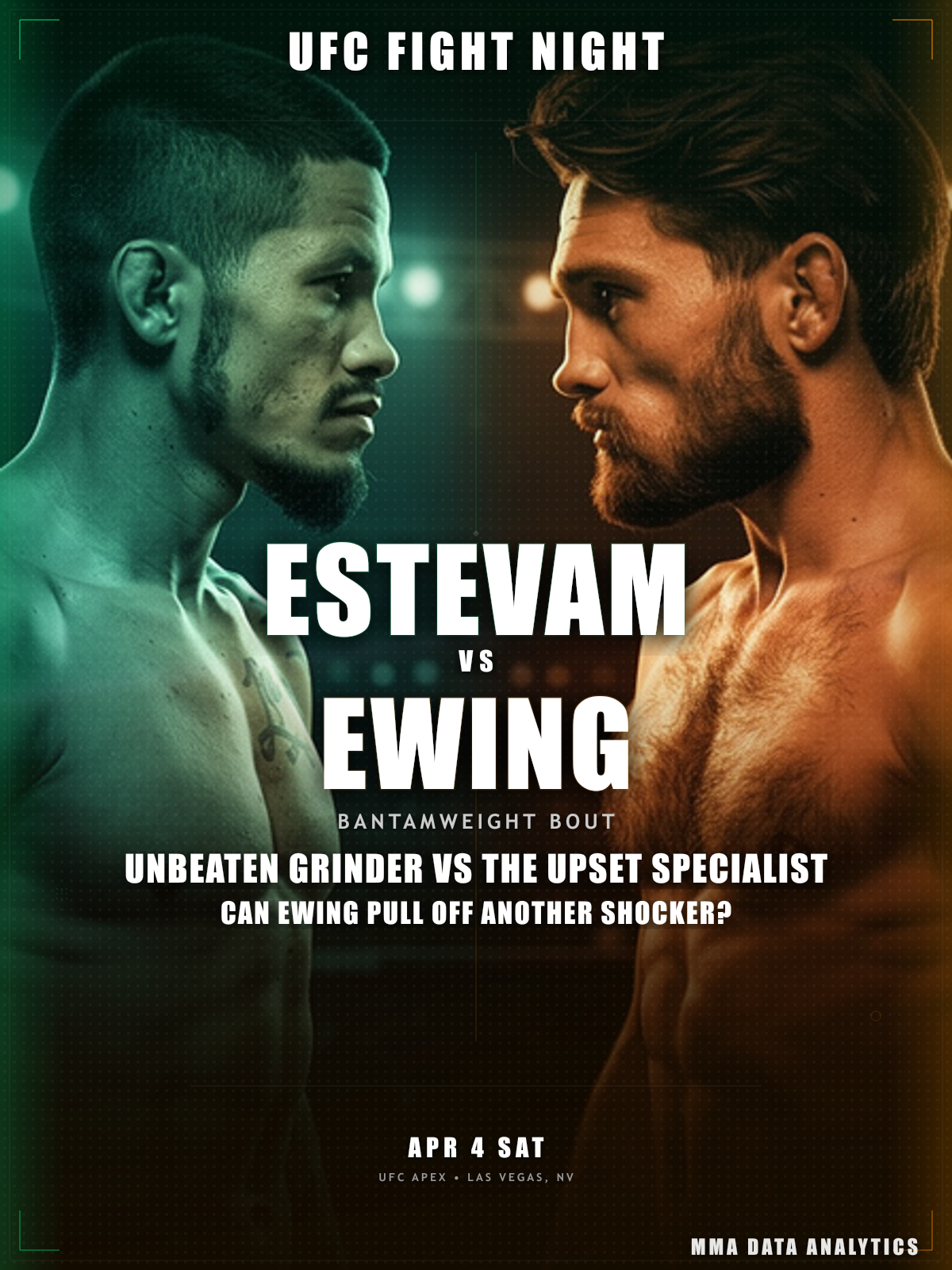
Rafael Estevam vs Ethyn Ewing
Men's Bantamweight Bout • UFC Fight Night: Moicano vs Duncan
Saturday, April 4, 2026 • 25ft Octagon (Small Cage)
Explore Detailed Fighter Profiles
Click on either the fighter's name or profile image for each fighter to access comprehensive UFC statistics including striking metrics, grappling data, clinch performance, complete fight history, offensive & defensive analytics, and round-by-round breakdowns.

Rafael Estevam
Fighter Metrics
Victory Methods
Win Round Distribution

Ethyn Ewing
Fighter Metrics
Victory Methods
Win Round Distribution
📋 Last 5 Fights - Rafael Estevam
| Date | Opponent | Result | Method |
|---|---|---|---|
| 2025-08-02 | Felipe Bunes | W | Decision - Unanimous (R3, 5:00) |
| 2025-02-15 | Jesus Aguilar | W | Decision - Unanimous (R3, 5:00) |
| 2023-11-18 | Charles Johnson | W | Decision - Unanimous (R3, 5:00) |
| 2022-09-27 | João Elias | W | TKO - Ground & Pound (R2, 2:25) |
| 2021-07-18 | Filipe Esteves | W | TKO - Ground & Pound (R2, 2:19) |
📋 Last 5 Fights - Ethyn Ewing
| Date | Opponent | Result | Method |
|---|---|---|---|
| 2025-11-15 | Malcolm Wellmaker | W | Decision - Unanimous (R3, 5:00) |
| 2025-11-07 | Billy Brand | W | TKO - Punch (R1, 4:13) |
| 2025-01-25 | Santos Verdinez | W | TKO - Head Kick (R1, 1:47) |
| 2024-10-26 | Brandon Carrillo | W | TKO - KO/TKO (R3, 2:14) |
| 2024-07-27 | Brandon Gonzalez | W | Decision - Unanimous (R3, 5:00) |
Technical Analysis
Technical Score
Cardio Score
Overall Rating
📊 Technical Score
Calculated as the average of Striking Composite (52.0 vs 60.0) and Grappling Composite (68.0 vs 45.0). Balances overall striking effectiveness with grappling ability to measure complete technical skills.
💪 Cardio Score
Based on average fight duration, striking rate per minute, takedown rate, and finish rate. Measures cardiovascular endurance and ability to maintain pace throughout fights.
🎯 Overall Rating
Simple average of Technical Score and Cardio Score. Provides a holistic view of fighter capabilities combining skill level with physical conditioning and fight performance.
Striking Composite
Grappling Composite
📊 Technical Radar Comparison
📊 Metrics Legend
📊 Detailed Statistical Comparison
🥊 Fight Analysis Breakdown
🧩 Rafael Estevam Key Advantages
6.21 takedowns per 15min vs 3.0 represents a 2x differential that fundamentally shifts fight control in the 25-foot cage. Estevam's chain-wrestling sequences from Nova Uniao—single legs into body locks, mat returns, and ride control—create minute-winning cycles that accumulate control time. His 37% takedown accuracy against Ewing's 100% defense (1-fight sample) suggests early resistance is possible, but Estevam's relentless re-shot ability and fence pressure in the small cage typically break through. The Brazilian's ability to chain multiple attempts and maintain pressure while Ewing defends creates fatigue differentials that compound over three rounds.
Estevam's perfect 14-0 record with a 5-0 UFC record demonstrates remarkable consistency across competition levels. He has never been finished, showing durability and fight IQ that prevents opponents from finding openings. His improvement trajectory—from regional scene finishes to UFC decision victories against increasingly tough competition—suggests a fighter who adapts and evolves. The mental edge of an unblemished record creates confidence in high-pressure moments and forces opponents to respect all aspects of his game.
The 25-foot APEX octagon eliminates the space that strikers like Ewing need to maintain range and circle. Estevam's pressure wrestling becomes significantly more effective in the small cage—fence encounters happen faster, angles are harder to create, and there's less room to reset after defending takedowns. The compressed space means Estevam can cut off the cage in fewer steps, forcing Ewing into uncomfortable exchanges along the fence where wrestling entries are most dangerous. This environmental factor alone shifts the fight dynamics 5-8% toward Estevam compared to a full-size octagon.
⚠️ Unfavorable Scenarios
Ewing's 5.67 SLpM output and proven KO power (6 of 9 wins by knockout) represent his most dangerous weapons in the opening minutes. If Estevam engages in extended striking exchanges before establishing his wrestling rhythm, Ewing's power advantage could produce a fight-ending sequence. Estevam's 46% striking defense leaves him vulnerable to clean shots, and the small cage means less room to retreat if hurt. The Brazilian must be disciplined about closing distance for takedowns rather than getting drawn into firefights.
Ewing's 100% takedown defense in his UFC debut, while based on a single fight, could indicate genuine defensive wrestling talent from his CSW Training Center background. If Ewing can consistently stuff Estevam's first-layer takedown attempts and make him pay with counters, the fight dynamic shifts dramatically. Estevam's 37% takedown accuracy means he misses more than he lands, and each failed attempt creates counter opportunities for Ewing's power shots.
📋 Likely Gameplan
Estevam should utilize jab feints and low kicks to force Ewing into a high guard, creating openings for level changes. His 56% striking accuracy suggests he can land these setup strikes while maintaining defensive positioning. The small cage means shorter distances to close, making his takedown entries more explosive. By mixing striking feints with takedown attempts, Estevam can keep Ewing guessing and prevent him from setting his feet for power shots.
Once Estevam secures takedowns, his priority should be establishing dominant positions and accumulating control time. His wrestling background emphasizes mat returns, wrist control, and short ground-and-pound rather than high-risk submission attempts. This approach maximizes scoring while minimizing risk—Estevam can bank minutes through rides and positional control without exposing himself to scrambles or sweeps. His 60% takedown defense suggests he can maintain top position once established.
🚀 Ethyn Ewing Key Advantages
Ewing's 6 knockouts in 9 wins demonstrate legitimate fight-ending power that demands respect. His ability to finish opponents across multiple promotions with clean punches shows this isn't just regional-level power—it translates against quality opposition. The Californian's KO victories have come in both Round 1 and Round 2, showing he can time his power shots early or set them up later. Against Estevam's 46% striking defense, Ewing has genuine opportunities to land clean power shots that could change the fight instantly.
Ewing's 5.67 SLpM output versus Estevam's 2.08 represents a nearly 3x striking volume differential—one of the largest in any bantamweight matchup. When fights remain standing, this volume creates significant scoring advantages and increases the probability of landing fight-ending shots. Ewing's 52% accuracy means he's landing clean shots consistently, and his ability to string together combinations can overwhelm opponents who struggle to match his pace. If Ewing can keep the fight upright for even 60% of the total time, his volume creates a compelling scoring narrative for judges.
⚠️ Unfavorable Scenarios
Estevam's 6.21 TD/15min with chain-wrestling sequences creates the nightmare scenario for Ewing—once the Brazilian secures takedowns, his ability to chain shots, establish rides, and execute mat returns prevents Ewing from regaining his feet or establishing striking rhythm. The 25-foot cage amplifies this problem as there's less space to circle away from the fence where Estevam is most dangerous. Once on the ground, Ewing's striking output drops to near zero while Estevam accumulates control time and scoring opportunities.
The 25-foot APEX octagon significantly reduces Ewing's ability to maintain his preferred striking distance and circle away from pressure. With less space to reset after defending takedowns, Ewing faces repeated grappling exchanges that drain his energy. His 5.13 strikes absorbed per minute suggests he trades heavily in exchanges, and in the small cage, these exchanges happen closer to the fence where Estevam can transition to takedowns. The compressed space eliminates the movement-heavy strategy that would give Ewing his best chance of keeping the fight standing.
📋 Likely Gameplan
Ewing's optimal strategy involves maintaining distance while threatening counter strikes. His power shots should target Estevam's entries—uppercuts and hooks as the Brazilian changes levels for takedowns. The Californian needs to stay off the fence at all costs, using lateral movement and angles to create space. When Estevam commits to takedown attempts, Ewing should threaten knees and uppercuts to deter entries and create counter opportunities. The key is making Estevam pay for every shot attempt while staying mobile.
Ewing's best chance for victory lies in front-loading damage during the first round when he's freshest and Estevam hasn't yet established his wrestling rhythm. The Californian should look to capitalize on his early energy advantage by maintaining high output and landing clean power shots. His 5.67 SLpM output becomes most dangerous when he can sustain it without grappling exchanges or takedown defense draining his energy. By establishing early momentum and potentially scoring knockdowns or significant damage, Ewing can force Estevam to fight from behind and potentially alter the Brazilian's gameplan.
🎯 Fight Prediction Analysis
Data-driven prediction model based on statistical analysis
📊Detailed Analysis Summary
🏟️Cage Dynamics
The 25-foot APEX octagon creates a significant advantage for Estevam's pressure wrestling style. Unlike the full-size 30-foot cage where strikers can maintain distance and circle, the small cage compresses the available space and accelerates fence encounters. Ewing's 5.67 SLpM volume becomes less impactful when he can't maintain range, and Estevam's 6.21 TD/15min becomes more dangerous when the distance to the fence is shorter. The environmental factor alone shifts this matchup approximately 5-8% toward Estevam compared to a large cage scenario, making his already strong wrestling game even more dominant.
🎯Technical Breakdown
The statistical analysis reveals two primary battlefields where this fight will be decided: wrestling control and striking exchanges. Estevam's 6.21 TD15 vs Ewing's 3.0 represents a 2x differential that creates consistent scoring opportunities through control time. While Ewing's striking metrics (5.67 SLpM, 52% accuracy) create impressive volume when standing, Estevam's wrestling pressure reduces the time available for these exchanges. The damage economy also favors Estevam—his 2.77 SApM vs Ewing's 5.13 means significantly less damage absorbed, which becomes visually apparent to judges as the fight progresses.
🧩Key Battle Areas
Three critical battle areas will determine the outcome: first-layer takedown defense vs chain wrestling at the fence, early KO threat vs sustained pressure, and cardio durability over three rounds. Ewing's 100% takedown defense (1-fight sample) could indicate genuine ability, but it's untested against an elite grappler like Estevam. The Californian's knockout power represents his most dangerous tool, but the small cage limits his ability to set up power shots from range. As the fight progresses, Estevam's superior cardio (13:20 avg duration vs 8:45) becomes increasingly decisive, especially when combined with wrestling pressure that forces Ewing to expend energy defending takedowns.
🏁Final Prediction
The most likely outcome is Rafael Estevam by Decision (38% probability), achieved through consistent takedown pressure, control time accumulation, and superior damage economy over three rounds. Estevam's Submission path (20%) becomes viable through back-takes and ride transitions in later rounds when Ewing fatigues. Ewing's upset lane centers on early KO/TKO (22%) via power punches before Estevam establishes wrestling rhythm—the most dangerous period is the first 5 minutes when Ewing is fresh and explosive. Ewing's decision path (5%) requires maintaining range control throughout three rounds—a scenario made unlikely by the small cage dimensions.
💰 Betting Analysis: Model vs Market
Detailed value assessment in the betting market
📊Market Odds
🤖Analytical Model
💎Value Opportunities
MAXIMUM VALUE
Model: 38% | Fair: +163
GOOD VALUE
Model: 22% | Fair: +355
SLIGHT VALUE
Model: 52% | Fair: -108
⚠️Key Market Discrepancies
- • Overweights Ewing's striking volume – Underprices wrestling control in 25ft small cage.
- • 100% TDDef inflated – Based on 1-fight sample only; likely regression against elite grappler.
- • Small cage factor not priced – APEX cage heavily favors pressure wrestlers like Estevam.
🎯 Comprehensive Probabilistic Analysis
100 hypothetical fight simulation based on statistical data
🏆Outcome Distribution - Rafael Estevam
Primary path via wrestling control and rides
Back-takes off rides create RNC chances
Attritional GNP and accumulative pressure
💥Outcome Distribution - Ethyn Ewing
Best lane via power punches and counters
Requires range control in small cage
Low historical submission profile
⏰Fight Timeline Analysis
⚡Window of Opportunity - Ethyn Ewing
- • First 5 minutes: Highest KO equity when fresh and explosive.
- • Counter strikes: Uppercuts + hooks vs level changes.
- • Stay off fence: Lateral movement to avoid wrestling traps.
🎯Progressive Dominance - Rafael Estevam
- • Chain shots: Re-mats and rides bank control and sap pace.
- • Damage economy: Keep exchanges short; minimize risk.
- • Late minutes: Safer control edges decision likelihood.
🎯 Final Confidence Assessment
Confidence level and uncertainty factors
Confidence Level
Strong wrestling edge in small cage with limited Ewing UFC data
✅Supporting Factors
- • Significant takedown volume edge (6.21 vs 3.0 TD15)
- • Small cage heavily favors pressure wrestler
- • Undefeated record shows consistency (14-0)
- • Superior cardio for 3 rounds (13:20 vs 8:45 avg)
⚠️Risk Factors
- • Ewing's genuine KO power (6 KOs in 9 wins)
- • Limited UFC sample on both fighters
- • 100% TDDef could reflect real talent
- • Small cage may lead to wild clinch exchanges
🏁Executive Summary
Rafael Estevam's relentless wrestling should systematically compress the 25-foot APEX octagon and accumulate control time through chain-wrestling sequences, while Ethyn Ewing's best equity centers on early knockout power before the Brazilian's pressure takes hold. The statistical differentials favor Estevam: his 6.21 TD15 vs Ewing's 3.0 creates a 2x takedown volume advantage, compounded by the small cage that eliminates Ewing's preferred striking distance. Estevam's undefeated 14-0 record with 5 UFC wins demonstrates consistency, while Ewing's 9-fight win streak with 6 KOs shows genuine power but only 1 UFC fight limits sample size. Estevam's 13:20 average fight duration with decision-heavy approach demonstrates exceptional cardio management, while Ewing's 8:45 duration reflects a fighter who either finishes early or faces challenges in later rounds.
Prediction: Estevam by Decision most likely (38% probability) through consistent takedown pressure and control time accumulation; Ewing's upset lane is early KO/TKO (22%) via power punches before Estevam establishes rhythm. The fight's outcome hinges on whether Ewing can capitalize on his early striking advantages before Estevam's wrestling pressure and superior cardio become decisive factors in the small cage.