

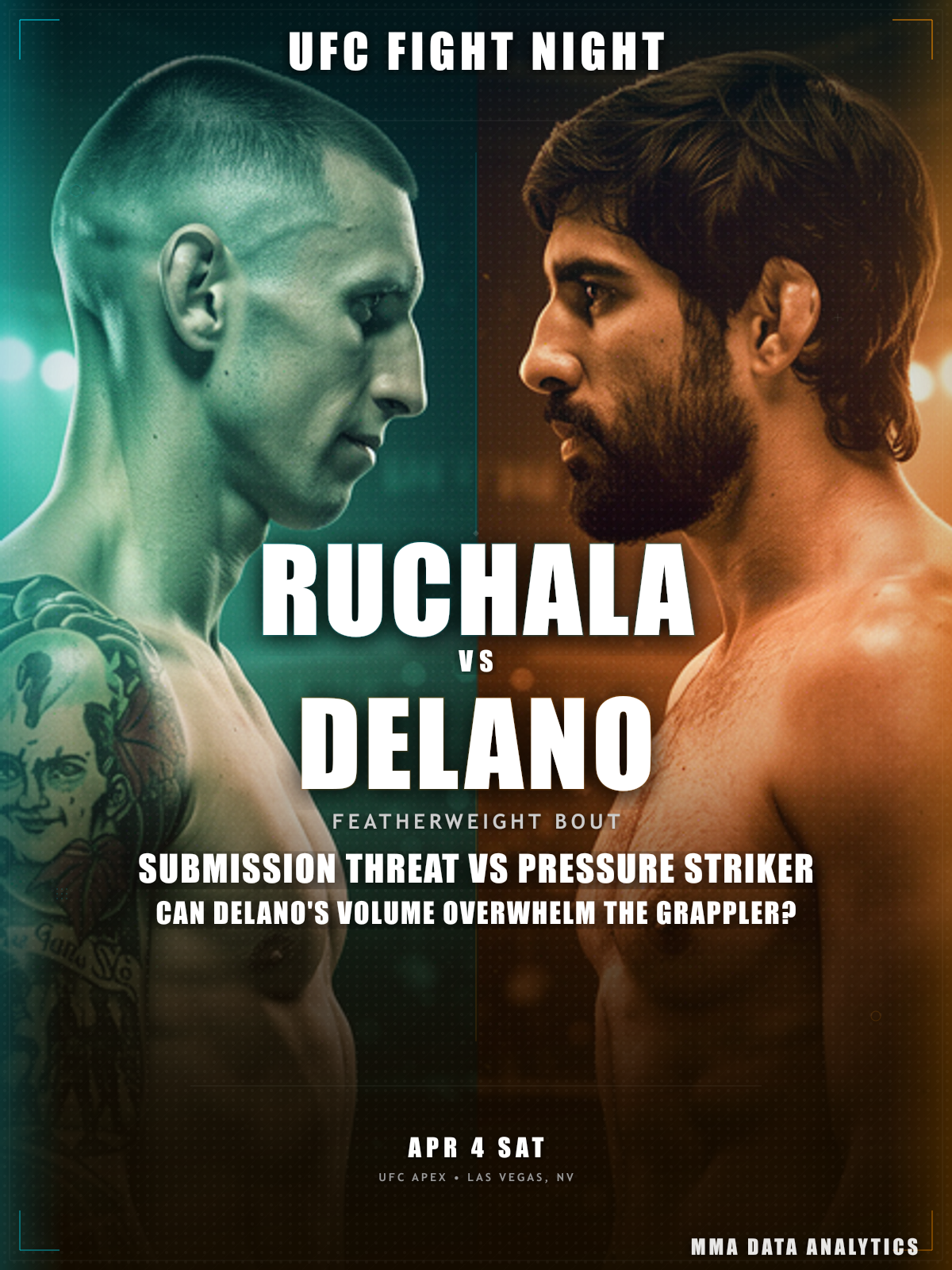
Robert Ruchala vs Jose Delano
Men's Featherweight Bout • UFC Fight Night: Moicano vs Duncan
Saturday, April 4, 2026 • 25ft Octagon (Small Cage) • UFC Apex, Las Vegas
Explore Detailed Fighter Profiles
Click on either the fighter's name or profile image for each fighter to access comprehensive UFC statistics including striking metrics, grappling data, clinch performance, complete fight history, offensive & defensive analytics, and round-by-round breakdowns.

Robert Ruchala
Fighter Metrics
Victory Methods
Win Round Distribution

Jose Delano
Fighter Metrics
Victory Methods
Win Round Distribution
📋 Last 5 Fights - Robert Ruchala
| Date | Opponent | Result | Method |
|---|---|---|---|
| 2025-09-06 | William Gomis | L | Decision - Unanimous (R3, 5:00) |
| 2024-11-16 | Kacper Formela | W | TKO - Elbows & Punches (R3, 2:44) |
| 2024-05-11 | Patryk Kaczmarczyk | W | TKO - Body Kick (R1, 0:59) |
| 2023-08-19 | Salahdine Parnasse | L | TKO - Soccer Body Kick (R4, 4:42) |
| 2023-03-17 | Lom-Ali Eskiev | W | TKO - Elbows (R5, 4:35) |
📋 Last 5 Fights - Jose Delano
| Date | Opponent | Result | Method |
|---|---|---|---|
| 2025-08-19 | Manuel Exposito | W | Decision - Unanimous (R3, 5:00) |
| 2025-02-07 | Abu Muslim Alikhanov | W | TKO - Punch (R1, 3:46) |
| 2024-03-23 | Alan Villalba | W | Submission - Rear Naked Choke (R1, 4:55) |
| 2023-09-02 | Fabrício Soares | W | Decision - Unanimous (R3, 5:00) |
| 2023-01-28 | Gabriel Santos | L | TKO - Liver Punch to Ground Strikes (R3, 0:51) |
Technical Analysis
Technical Score
Cardio Score
Overall Rating
📊 Technical Score
Calculated as the average of Striking Composite (42.0 vs 72.0) and Grappling Composite (35.0 vs 30.0). Balances overall striking effectiveness with grappling ability to measure complete technical skills.
💪 Cardio Score
Based on average fight duration, striking rate per minute, takedown rate, and finish rate. Measures cardiovascular endurance and ability to maintain pace throughout fights.
🎯 Overall Rating
Simple average of Technical Score and Cardio Score. Provides a holistic view of fighter capabilities combining skill level with physical conditioning and fight performance.
Striking Composite
Grappling Composite
Technical Radar Comparison
Visual comparison of key performance metrics between both fighters
📊 Detailed Statistical Comparison
🥊 Fight Analysis Breakdown
🧩 Robert Ruchala Key Advantages
Ruchala's 2.00 takedowns per 15 minutes vs Delano's 0.00 represents a complete grappling monopoly. The Polish fighter's KSW background emphasizes chain-wrestling sequences and switch-stance entries that create unpredictable angles for takedown attempts. In the small 25-foot cage at UFC Apex, Ruchala's ability to close distance quickly and force clinch exchanges becomes amplified. Delano's 60% takedown defense will be tested repeatedly, and each successful takedown fundamentally shifts the round's scoring dynamic in Ruchala's favor. The switch stance creates confusion in timing defensive reactions.
At 72 inches vs Delano's 70 inches, Ruchala holds a 2-inch reach advantage that is unusual for a wrestler-first fighter. This extra length allows him to set up takedowns with jabs and long hooks while maintaining a safe distance from Delano's counter strikes. The reach edge also helps in the clinch, where Ruchala can establish underhooks and collar ties more easily. In a 25-foot cage, this advantage becomes more meaningful as Delano has less room to circle out of range and must engage at distances where Ruchala's longer arms give him control options both standing and in transition.
With 3 submission victories in his career including rear-naked chokes, Ruchala adds a significant finishing threat once fights go to the ground. This submission game complements his wrestling pressure — opponents defending takedowns must also worry about being choked, creating a dual threat that is difficult to manage simultaneously. Delano has been submitted once in his career, showing vulnerability in bottom positions. If Ruchala can chain takedowns into back-takes in the small cage, his submission arsenal becomes a viable finishing mechanism that keeps Delano on the defensive throughout grappling exchanges.
⚠️ Unfavorable Scenarios
Delano's 9.73 SLpM is an elite-level output that could overwhelm Ruchala's 57% striking defense. If Ruchala cannot close the distance and initiate grappling exchanges, he faces a sustained barrage of accurate strikes from a fighter landing at 65% accuracy. Ruchala's own 2.27 SLpM and 35% accuracy mean he cannot compete in a pure striking exchange. The volume differential of over 7 strikes per minute creates a scenario where Ruchala absorbs significant damage while failing to score meaningfully on the feet. Every minute spent standing favors Delano's path to victory.
Ruchala's 33% takedown accuracy means two out of every three attempts fail, leaving him exposed to Delano's counters during recovery. Each failed shot costs energy and allows Delano to reset at range where his 9.73 SLpM output dominates. With Ruchala absorbing 3.27 strikes per minute when standing, failed takedown attempts create a compounding problem — he expends energy shooting, gets stuffed, and then eats volume while trying to reset. If Delano can sprawl effectively and punish failed entries, Ruchala's entire gameplan collapses and the fight becomes a one-sided striking affair.
📋 Likely Gameplan
Ruchala should leverage his switch stance to create unpredictable angles for takedown entries. By switching between orthodox and southpaw, he forces Delano to constantly readjust his defensive positioning, creating windows for level changes. The stance switching also disguises whether a jab or a shot is coming, making it harder for Delano to time his sprawls. In the small 25-foot cage, Ruchala can use feinted stance switches to back Delano toward the fence, then commit to takedowns when Delano's back touches the cage wall where his escape options are limited.
The 25-foot UFC Apex cage is Ruchala's greatest environmental ally. He should use constant forward pressure to corner Delano against the fence, where clinch exchanges and takedown attempts become significantly easier to execute. Delano's high-volume striking style requires space to operate effectively, and the small cage limits his ability to circle, reset, and maintain range. Ruchala should focus on cutting off the cage systematically, forcing clinch positions where his wrestling advantage is maximized and Delano's striking volume is neutralized.
🚀 Jose Delano Key Advantages
Delano's 9.73 significant strikes landed per minute is an elite-tier output that dwarfs Ruchala's 2.27 SLpM by a factor of 4.3x. Combined with 65% striking accuracy, Delano does not just throw volume — he lands clean, scoring strikes at a rate that overwhelms most opponents. This output creates a massive scoring advantage in any round that remains standing. Even in a small cage, Delano's ability to fire rapid combinations from range and in the pocket means Ruchala faces constant pressure to initiate grappling or risk losing every minute of standing time on the scorecards decisively.
Hooker's 5.03 SLpM output represents one of the highest striking rates in the lightweight division, creating significant volume advantages when fights remain upright. His ability to maintain this pace while switching stances and varying attack angles makes him difficult to counter effectively. The Kiwi's volume becomes particularly dangerous in early rounds when he's fresh and can sustain high output without fatigue. His 49% accuracy means he's landing clean shots consistently, and his ability to string together combinations can overwhelm opponents who struggle to match his pace or establish their own rhythm.
⚠️ Unfavorable Scenarios
Tsarukyan's chain-wrestling sequences create a nightmare scenario for Hooker—once the Georgian secures takedowns, his ability to chain shots, establish rides, and execute mat returns prevents Hooker from regaining his feet or establishing striking rhythm. The Kiwi's 78% takedown defense suggests he can stuff initial attempts, but Tsarukyan's re-shot ability and persistence typically break through. Once on the ground, Hooker's striking output drops to near zero while Tsarukyan accumulates control time and scoring opportunities. This scenario becomes increasingly likely as the fight progresses and Hooker's cardio begins to fade.
Hooker's 10:13 average fight duration suggests he struggles to maintain his high-volume striking approach over extended periods. His 5.03 SLpM output becomes increasingly difficult to sustain as fights progress, especially when combined with takedown defense and grappling exchanges. The Kiwi's cardio limitations become particularly apparent in championship rounds where Tsarukyan's wrestling pressure escalates. Hooker's tendency to fade in later rounds, combined with his high absorption rate (4.72 SApM), creates a dangerous combination where he becomes increasingly vulnerable to both striking counters and takedowns as his energy reserves deplete.
📋 Likely Gameplan
Hooker's optimal strategy involves maintaining perimeter control while threatening intercept strikes. His calf kicks and teeps should target Tsarukyan's base and mobility, making takedown entries more difficult. The Kiwi's ability to switch stances allows him to vary his attack angles and keep Tsarukyan guessing. When Tsarukyan does commit to shots, Hooker should threaten knees and uppercuts to deter entries and create counter opportunities. The key is maintaining distance while staying active enough to score points and prevent Tsarukyan from settling into rhythm or establishing consistent pressure.
Hooker's best chance for victory lies in front-loading damage during the first two rounds when he's fresh and Tsarukyan hasn't yet established his wrestling rhythm. The Kiwi should look to capitalize on his early energy advantage by maintaining high output and landing clean shots before Tsarukyan's pressure begins to take effect. His 5.03 SLpM output becomes most dangerous when he can sustain it without grappling exchanges or takedown defense draining his energy. By establishing early momentum and potentially scoring knockdowns or significant damage, Hooker can force Tsarukyan to fight from behind and potentially alter the Georgian's gameplan.
🎯 Fight Prediction Analysis
Data-driven prediction model based on statistical analysis
📊Detailed Analysis Summary
🏟️Cage Dynamics
The 30-foot octagon creates a fascinating dynamic in this matchup—initially favoring Hooker's range weapons and movement, but gradually shifting toward Tsarukyan's pressure as the fight progresses. Hooker's 75-inch reach and 6'0" height give him significant advantages in the early rounds when he can maintain distance and utilize his teeps, calf kicks, and intercept knees effectively. However, Tsarukyan's relentless pressure and chain-wrestling sequences gradually compress the available space, forcing Hooker into increasingly uncomfortable positions. The Georgian's ability to cut off angles and force exchanges at the fence transforms the cage from Hooker's ally into Tsarukyan's weapon, creating a progressive advantage that compounds over five rounds.
🎯Technical Breakdown
The statistical analysis reveals two primary battlefields where this fight will be decided: wrestling activity and damage economy. Tsarukyan's 3.25 TD15 vs Hooker's 0.73 represents a 4.4x differential that fundamentally alters fight control and scoring dynamics. While Hooker's striking moments (5.03 SLpM, 49% accuracy) create impressive volume, Tsarukyan's damage economy (1.84 SApM vs 4.72) means he absorbs significantly less damage while maintaining offensive output. The Georgian's 53% striking defense combined with his wrestling threat forces Hooker into uncomfortable exchanges where his high-volume approach becomes less effective. These differentials create a scoring framework where Tsarukyan's control time and damage efficiency consistently outweigh Hooker's striking output in judges' eyes.
🧩Key Battle Areas
Three critical battle areas will determine the outcome: first-layer takedown defense vs chain wrestling at the fence, intercept knees vs level changes, and late-round pace durability. Hooker's 78% takedown defense suggests he can stuff initial attempts, but Tsarukyan's persistence and re-shot ability typically break through over time. The Kiwi's intercept weapons (teeps, knees, uppercuts) represent his most dangerous tools against Tsarukyan's entries, but the Georgian's ability to vary his approach and mix striking with takedowns makes these counters less predictable. As the fight progresses, Tsarukyan's superior cardio (12:36 avg duration vs 10:13) becomes increasingly decisive, especially when combined with his wrestling pressure that forces Hooker to expend energy defending takedowns and fighting off his back.
🏁Final Prediction
The most likely outcome is Arman Tsarukyan by Decision (40% probability), achieved through consistent takedown pressure, control time accumulation, and superior damage economy over five rounds. Tsarukyan's KO/TKO path (22%) becomes viable if his ground-and-pound accumulates damage through rides and mat returns, particularly in later rounds when Hooker's cardio begins to fade. Hooker's upset lane centers on early KO/TKO (18%) via intercept knees or uppercuts as Tsarukyan commits to takedown attempts. The Kiwi's decision path (7%) requires maintaining extended range control throughout five rounds—a scenario that becomes increasingly unlikely as Tsarukyan's pressure escalates and the cage space compresses.
💰 Betting Analysis: Model vs Market
Detailed value assessment in the betting market
📊Market Odds
🤖Analytical Model
💎Value Opportunities
MAXIMUM VALUE
GOOD VALUE
SLIGHT VALUE
⚠️Key Market Discrepancies
- • Overweights early KO volatility – Underprices five-round wrestling cycles.
- • Undervalues damage economy – Low SApM differential drives optics on cards.
- • Big-cage bias – Space helps early, but fence/rides erode it late.
🎯 Comprehensive Probabilistic Analysis
100 hypothetical fight simulation based on statistical data
🏆Outcome Distribution - Robert Ruchala
Wrestling control and cage pressure over 3 rounds
Ground-and-pound stoppage after takedowns
Chain wrestling into back-takes for RNC
💥Outcome Distribution - Jose Delano
Primary path via high-volume striking advantage
Accumulative damage from volume striking
5 career subs show legitimate finishing ability
⏰Fight Timeline Analysis
⚡Window of Opportunity - Jose Delano
- • Rounds 1-2: Highest striking volume equity before fatigue.
- • Anti-wrestling: Sprawl aggressively and punish reset attempts.
- • Volume bursts: Combination flurries to overwhelm Ruchala's 57% defense.
🎯Progressive Dominance - Robert Ruchala
- • Early takedowns: Establish wrestling threat to slow Delano's output.
- • Cage control: Use small cage to cut off angles and force clinch.
- • Submission chaining: Convert control time into back-take opportunities.
🎯 Final Confidence Assessment
Confidence level and uncertainty factors
Confidence Level
Strong edge via wrestling cycles and safer damage profile
✅Supporting Factors
- • Significant takedown volume edge (3.25 vs 0.73 TD15)
- • Lower SApM and better damage economy
- • Ride control creates safe scoring minutes
- • Proven cardio over three rounds; scalable to five
⚠️Risk Factors
- • Intercept knees/uppercuts vs level changes
- • Big cage extends early range time
- • Hooker's high-volume surges in pockets
🏁Executive Summary
Arman Tsarukyan's systematic approach to fight control should steadily compress the 30-foot octagon space and bank safe minutes through chain-wrestling sequences, while Dan Hooker's best equity centers on early intercept strikes and range weapons before the Georgian's pressure takes hold. The statistical differentials heavily favor Tsarukyan: his 3.25 TD15 vs Hooker's 0.73 creates a 4.4x takedown volume advantage, while his 1.84 SApM vs Hooker's 4.72 represents superior damage economy that compounds over five rounds. Tsarukyan's 12:36 average fight duration with 70% of wins in Round 3 demonstrates exceptional cardio management, while Hooker's 10:13 duration suggests struggles maintaining his high-volume approach over extended periods. The Georgian's ability to minimize damage while maximizing control time creates a scoring framework that judges consistently reward, especially in championship rounds where damage accumulation becomes visually apparent.
Prediction: Tsarukyan by Decision most likely (40% probability) through consistent takedown pressure and control time accumulation; Hooker's upset lane is early KO/TKO (18%) via intercept knees or uppercuts as Tsarukyan commits to shots. The fight's outcome hinges on whether Hooker can capitalize on his early range advantages before Tsarukyan's wrestling pressure and superior cardio become decisive factors.