

Azamat Bekoev vs Tresean Gore
Men's Middleweight Bout • UFC Fight Night: Moicano vs Duncan
Saturday, April 4, 2026 • 25ft Octagon (Small Cage)
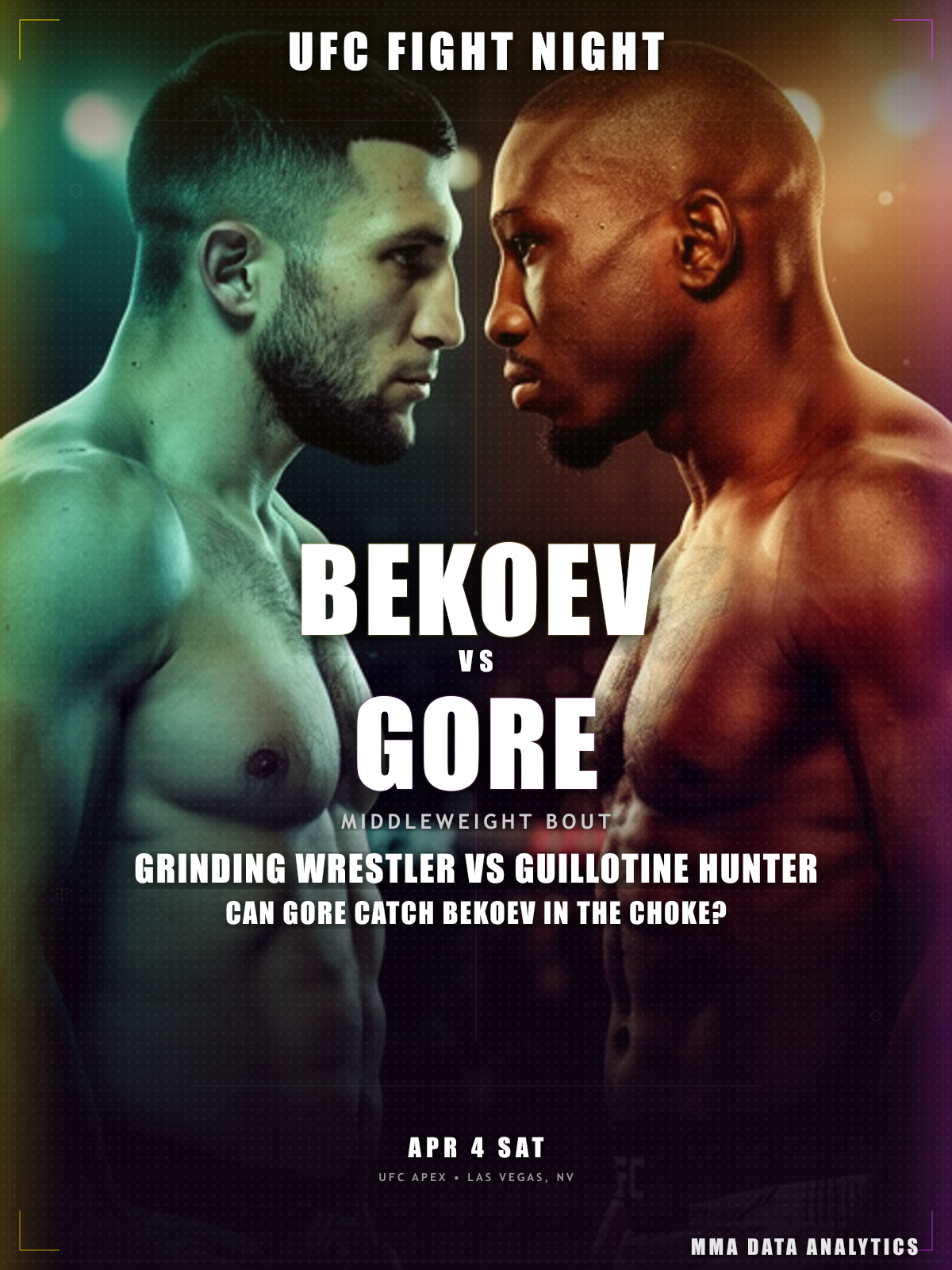
Explore Detailed Fighter Profiles
Click on either the fighter's name or profile image for each fighter to access comprehensive UFC statistics including striking metrics, grappling data, clinch performance, complete fight history, offensive & defensive analytics, and round-by-round breakdowns.
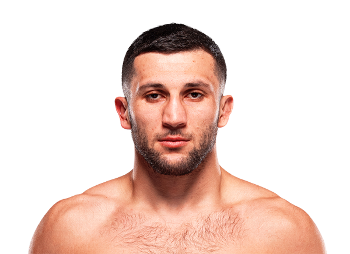
Azamat Bekoev
Fighter Metrics
Victory Methods
Win Round Distribution
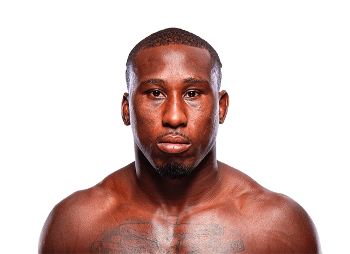
Tresean Gore
Fighter Metrics
Victory Methods
Win Round Distribution
Last 5 Fights - Azamat Bekoev
| Date | Opponent | Result | Method |
|---|---|---|---|
| 2025-10-18 | Yousri Belgaroui | L | KO/TKO - Strikes (R3, 0:55) |
| 2025-05-03 | Ryan Loder | W | TKO - Strikes (R1, 2:44) |
| 2025-01-18 | Zachary Reese | W | KO/TKO - Punches (R1, 3:04) |
| 2024-06-22 | Chauncey Foxworth | W | TKO - Punches (R2, 3:15) |
| 2023-12-15 | Lucas Fernando | W | Decision - Unanimous (R5, 5:00) |
Last 5 Fights - Tresean Gore
| Date | Opponent | Result | Method |
|---|---|---|---|
| 2025-08-02 | Rodolfo Vieira | L | Decision - Unanimous (R3, 5:00) |
| 2025-04-12 | Marco Tulio | L | KO/TKO - Strikes (R2, 3:16) |
| 2024-11-09 | Antonio Trocoli | W | Submission - Guillotine Choke (R1, 1:23) |
| 2022-10-29 | Josh Fremd | W | Submission - Rear Naked Choke (R2, 0:49) |
| 2022-07-09 | Cody Brundage | L | KO/TKO - Punches (R1, 3:50) |
Technical Analysis
Technical Score
Cardio Score
Overall Rating
Technical Score
Calculated as the average of Striking Composite (58.0 vs 45.0) and Grappling Composite (68.0 vs 58.0). Balances overall striking effectiveness with grappling ability to measure complete technical skills.
Cardio Score
Based on average fight duration, striking rate per minute, takedown rate, and finish rate. Measures cardiovascular endurance and ability to maintain pace throughout fights.
Overall Rating
Simple average of Technical Score and Cardio Score. Provides a holistic view of fighter capabilities combining skill level with physical conditioning and fight performance.
Striking Composite
Grappling Composite
Technical Radar Comparison
Metrics Legend
Detailed Statistical Comparison
🥊 Fight Analysis Breakdown
🧩 Azamat Bekoev Key Advantages
2.80 takedowns per 15min vs Gore's 0.80 represents a 3.5x differential that fundamentally shifts fight control in the 25ft small cage. Bekoev's chain-wrestling sequences and submission threat (8 career subs) create compounding pressure cycles. His ability to mix KO power with submissions makes him unpredictable on the ground, forcing Gore to defend multiple threats simultaneously. The confined octagon space amplifies these grappling advantages by limiting Gore's ability to create distance after defending initial shots, allowing Bekoev to chain attempts and maintain pressure against the fence.
The 4.08 strikes absorbed per minute differential (3.40 vs Gore's catastrophic 7.48 SApM) creates a damage economy that heavily favors Bekoev in both scoring optics and durability. Bekoev lands 3.50 SLpM while absorbing far less than he dishes out, while Gore's 41% striking defense means clean shots land regularly. This defensive efficiency compounds over three rounds—Bekoev maintains his pace without accumulating damage, while Gore's high absorption rate leaves him increasingly vulnerable to both striking counters and takedowns as the fight progresses. The 52% vs 41% striking defense gap is the fight's defining statistical advantage.
24 professional fights vs Gore's 10 provides a substantial experience edge across multiple promotions. Bekoev's 80% finish rate (8 KO + 8 Sub) demonstrates killer instinct and dual-threat finishing ability that keeps opponents guessing. His ability to find the finish through both striking and submissions means opponents cannot simply defend one dimension. This versatility becomes particularly dangerous in the small cage where escape routes are limited and Bekoev's pressure can escalate rapidly once he establishes control position.
⚠️ Unfavorable Scenarios
Gore's ability to switch stances creates timing disruptions for Bekoev's entries. Angle changes can nullify predictable level changes, and the stance switching generates power from unexpected angles that could catch Bekoev coming in. If Gore can consistently disrupt Bekoev's rhythm with stance switches, the pressure game becomes significantly harder to implement.
Gore's 88% TDDef is elite-level. If Bekoev cannot penetrate this wall, the fight stays at range where Gore's 3" reach advantage (75" vs 72") becomes meaningful. An upright fight with Gore maintaining distance through jabs and kicks would shift the dynamic significantly in Gore's favor and negate Bekoev's primary path to victory.
📋 Likely Gameplan
Use the 25ft small cage to close distance quickly, feint strikes to set up level changes, and chain wrestling sequences against the fence. Bekoev's feint-to-level-change approach should exploit the confined space, forcing Gore into the fence where his reach advantage is neutralized and Bekoev's grappling becomes most dangerous.
Once down, Bekoev should hunt submissions (8 career sub wins) while accumulating control time and ground-and-pound. His dual-threat finishing ability on the ground forces opponents to defend both strikes and submissions simultaneously, creating openings for either path. Accumulating control time also banks safe scoring minutes that compound his advantage on the scorecards.
🚀 Tresean Gore Key Advantages
Gore's 75" reach vs Bekoev's 72" gives him significant range tools. His switch stance creates angles and timing disruptions that can generate fight-ending power from unexpected positions. Athletic explosiveness combined with the reach advantage allows Gore to maintain distance while threatening with jabs, calf kicks, and power shots that deter Bekoev's entries. When fresh, Gore's ability to switch stances and vary attack angles makes him difficult to time for level changes.
Gore's 88% takedown defense is elite-level, representing his most critical asset against Bekoev's grappling-heavy approach. This defensive prowess keeps fights standing where Gore's reach and athleticism are most effective. His 75% TDAcc when he does shoot shows offensive wrestling capability as well. If Gore can consistently stuff Bekoev's initial takedown attempts and force a standup fight, the dynamic shifts significantly in his favor.
Gore's 3 career submission wins (guillotine, RNC) show he is dangerous off his back and in scrambles. This submission threat means Bekoev cannot simply take Gore down and expect a free ride—there is inherent risk in grappling exchanges. Gore's ability to threaten submissions from bottom position adds a layer of danger to Bekoev's takedown game that could deter aggressive ground pursuit.
⚠️ Unfavorable Scenarios
If Bekoev establishes consistent cage pressure and chain wrestling, Gore's poor damage economy (7.48 SApM) compounds rapidly. His 41% StrDef means he takes heavy shots even when the fight stays standing. The combination of grappling pressure and striking damage creates a deteriorating situation that becomes increasingly difficult to escape as rounds progress.
Gore's 6:45 average fight duration suggests cardio concerns. His explosive style front-loads energy expenditure, and if Bekoev survives the early burst, Gore tends to fade significantly. This cardio limitation becomes particularly dangerous when combined with takedown defense energy expenditure and his high absorption rate, creating a compounding vulnerability in later rounds.
📋 Likely Gameplan
Use reach advantage and switch stance to keep Bekoev at distance. Calf kicks and jabs to deter entries and force Bekoev to cover more ground before committing to shots. Gore's ability to switch stances allows him to vary attack angles and keep Bekoev guessing, making level changes harder to time. The key is maintaining distance while staying active enough to score and prevent Bekoev from settling into pressure rhythm.
Front-load damage in R1 when fresh and explosive. Look for fight-ending moments before Bekoev's pressure takes hold. Gore's best chance for victory lies in capitalizing on his early energy advantage with high output and clean power shots. By establishing early momentum and potentially scoring knockdowns, Gore can force Bekoev to fight from behind and potentially alter the pressure gameplan.
🎯 Fight Prediction Analysis
Data-driven prediction model based on statistical analysis
📊Detailed Analysis Summary
🏟️Cage Dynamics
The 25ft small cage at the UFC APEX initially appears neutral but quickly favors Bekoev's pressure-heavy style. Unlike the standard 30ft octagon, the reduced space severely limits Gore's ability to circle away and reset at range. Bekoev's fence control and cage-cutting become amplified in this environment, compressing Gore's 3" reach advantage by forcing exchanges in the pocket and clinch where length matters less. The confined space transforms what would be a moderate pressure advantage in a larger cage into a significant structural advantage that compounds with each passing minute.
🎯Technical Breakdown
The statistical analysis reveals two primary battlefields: takedown volume differential and damage economy. Bekoev's 2.80 TD15 vs Gore's 0.80 represents a 3.5x differential that fundamentally alters fight control dynamics. The damage economy gap is even more telling—Bekoev's 3.40 SApM vs Gore's catastrophic 7.48 SApM means Gore absorbs more than twice the damage. Bekoev's 48% StrAcc and 52% StrDef vs Gore's 43% and 41% create a consistent technical edge in striking exchanges. These differentials create a scoring framework where Bekoev's control and efficiency consistently outweigh Gore's output.
🧩Key Battle Areas
Three critical battle areas will determine the outcome: Gore's 88% TDDef vs Bekoev's chain wrestling at the fence, switch stance counters vs level changes, and cardio sustainability over three rounds. Gore's elite takedown defense suggests he can stuff initial attempts, but Bekoev's persistence and re-shot ability in the small cage typically break through over time. The switch stance vs level change battle creates timing uncertainty on both sides. As the fight progresses, Bekoev's superior cardio becomes increasingly decisive against Gore's 6:45 average fight duration.
🏁Final Prediction
The most likely outcome is Bekoev by KO/TKO (30% probability) through accumulated pressure and Gore's poor defensive metrics. Bekoev's submission path (22%) becomes viable through chain wrestling and his 8 career sub wins. Gore's upset lane centers on early KO/TKO (18%) via switch-stance power shots and his explosive athleticism during the first round when his energy is highest. Gore's decision path (6%) requires maintaining extended range control throughout three rounds—a scenario that becomes increasingly unlikely as Bekoev's pressure escalates and the small cage space compresses.
💰 Betting Analysis: Model vs Market
Detailed value assessment in the betting market
📊Market Odds
🤖Analytical Model
💎Value Opportunities
MAXIMUM VALUE
Model: 30% | Gore's 41% StrDef makes this very viable
GOOD VALUE
Model: 22% | 8 career subs, small cage amplifies grappling
SLIGHT VALUE
Model: 58% | Both fighters finish frequently
⚠️Key Market Discrepancies
- • Undervalues grappling in small cage – Bekoev's chain wrestling amplified by 25ft octagon.
- • Overestimates Gore's durability – 7.48 SApM is catastrophic for sustained fights.
- • Small cage dynamics – Compress range advantages and amplify pressure fighters.
🎯 Comprehensive Probabilistic Analysis
100 hypothetical fight simulation based on statistical data
🏆Outcome Distribution - Azamat Bekoev
Primary path via accumulated pressure and Gore's poor defense
8 career sub wins, small cage chain wrestling creates openings
Control time and damage economy scoring over 3 rounds
💥Outcome Distribution - Tresean Gore
Best lane via early switch-stance power shots
Guillotine and RNC threats in scrambles
Requires sustained range control over all 3 rounds
⏰Fight Timeline Analysis
⚡Window of Opportunity - Tresean Gore
- • First 5 minutes: Highest KO equity when fresh and explosive.
- • Switch stance power: Angle changes create fight-ending opportunities.
- • Burst then reset: Front-load damage, avoid sustained clinch exchanges.
🎯Progressive Dominance - Azamat Bekoev
- • Chain wrestling: Fence pressure and re-shots sap Gore's energy.
- • Damage economy: 3.40 vs 7.48 SApM compounds each round.
- • Late round finishing: Gore's cardio fade opens KO and sub windows.
🎯 Final Confidence Assessment
Confidence level and uncertainty factors
Confidence Level
Moderate confidence — Bekoev's finishing ability vs Gore's elite TDDef creates uncertainty
✅Supporting Factors
- • Bekoev's 80% finish rate across 24 fights
- • Massive SApM differential (3.40 vs 7.48)
- • Small cage amplifies grappling pressure
- • Dual-threat finishing (8 KO, 8 Sub)
⚠️Risk Factors
- • Coming off a loss (KO'd by Belgaroui)
- • Gore's 88% TDDef is elite-level
- • Switch stance creates timing disruptions
- • Limited UFC sample (3 fights)
🏁Executive Summary
Bekoev's systematic pressure and finishing ability should gradually overwhelm Gore's athleticism in the confined 25ft cage. The damage economy differential (3.40 vs 7.48 SApM) is the fight's defining statistical gap. Gore's best equity is an early explosive finish, but his defensive limitations and Bekoev's well-rounded attack profile make this increasingly unlikely as the fight progresses.
Prediction: Bekoev by KO/TKO most likely (30% probability) through accumulated pressure and Gore's poor defense; Gore's upset lane is early KO (18%) via switch-stance power shots. The fight's outcome hinges on whether Gore can capitalize on his early explosive advantages before Bekoev's grappling pressure and superior cardio become decisive factors.