

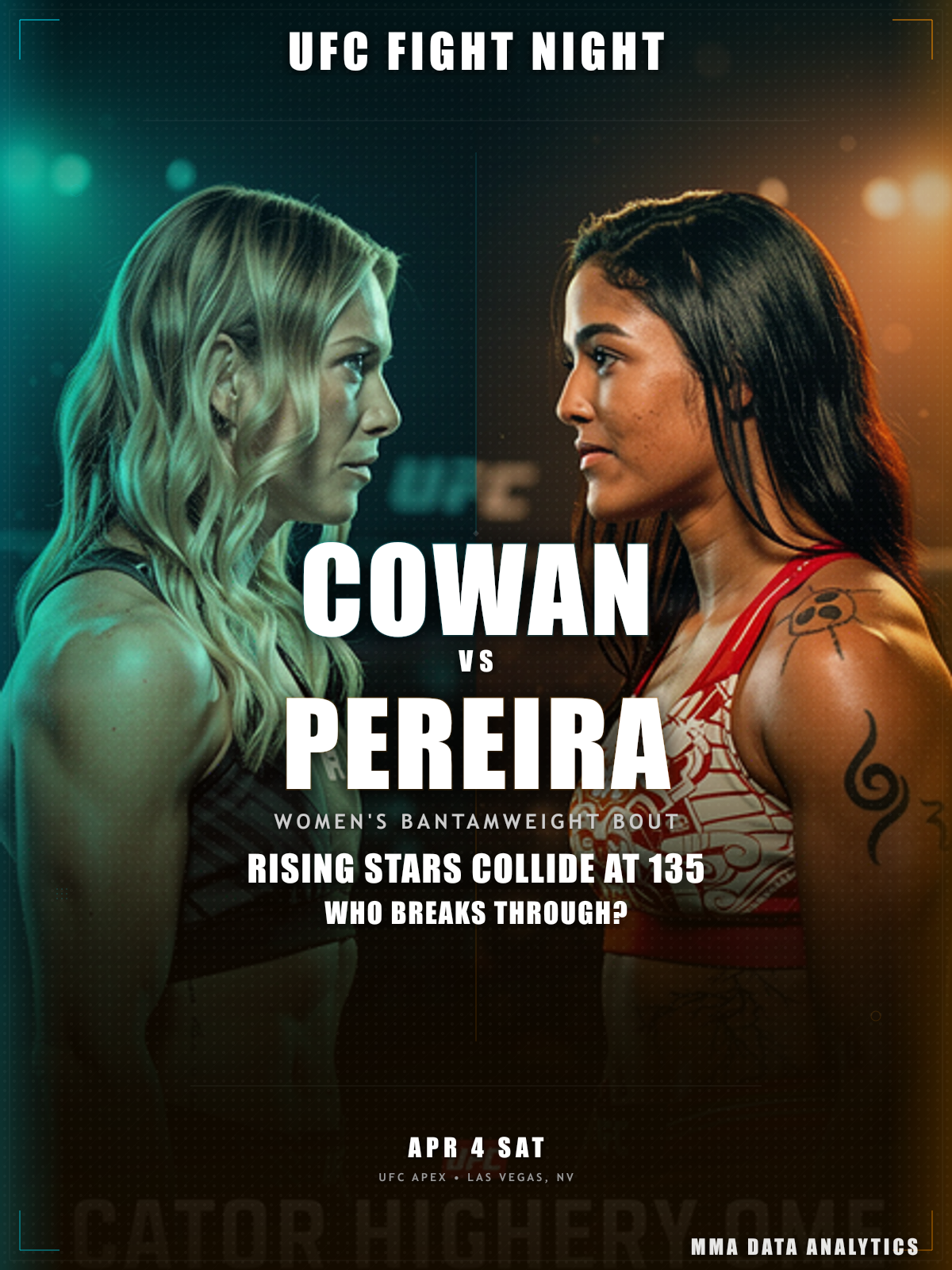
Hailey Cowan vs Alice Pereira
Women's Bantamweight Bout • UFC Fight Night: Moicano vs Duncan
Saturday, April 4, 2026 • 25ft Octagon (Small Cage) • UFC Apex, Las Vegas
Explore Detailed Fighter Profiles
Click on either the fighter's name or profile image for each fighter to access comprehensive UFC statistics including striking metrics, grappling data, clinch performance, complete fight history, offensive & defensive analytics, and round-by-round breakdowns.

Hailey Cowan
7-4-0
Hailey Cowan
Fighter Metrics
Victory Methods
Win Round Distribution

Alice Pereira
5-1-0
Alice Pereira
Fighter Metrics
Victory Methods
Win Round Distribution
📋 Last 5 Fights - Hailey Cowan
| Date | Opponent | Result | Method |
|---|---|---|---|
| April 12, 2025 | Nora Cornolle | L | Submission (RNC) (2, 1:52) |
| April 29, 2023 | Jamey-Lyn Horth | L | Decision (Unanimous) (3, 5:00) |
| August 16, 2022 | Cláudia Leite | W | Decision (Split) (3, 5:00) |
| January 12, 2022 | Monica Franco | W | Submission (RNC) (2, 3:17) |
| September 11, 2020 | Kelly Clayton | L | Submission (Guillotine) (2, 0:46) |
📋 Last 5 Fights - Alice Pereira
| Date | Opponent | Result | Method |
|---|---|---|---|
| September 13, 2025 | Montserrat Rendon | L | Decision (Split) (3, 5:00) |
| December 14, 2024 | Samara Santos | W | Decision (Unanimous) (3, 5:00) |
| August 31, 2024 | Karla Lacerda | W | KO/TKO (2, 1:13) |
| July 27, 2024 | Hosana Enny | W | KO/TKO (Ground & Pound) (1, 0:11) |
| April 28, 2024 | Kristiane Silva | W | KO/TKO (1, 0:15) |
Technical Analysis
Technical Score
Cardio Score
Overall Rating
📊 Technical Score
Calculated as the average of Striking Composite (66.0 vs 66.0) and Grappling Composite (78.0 vs 55.0). Balances overall striking effectiveness with grappling ability to measure complete technical skills.
💪 Cardio Score
Based on average fight duration, striking rate per minute, takedown rate, and finish rate. Measures cardiovascular endurance and ability to maintain pace throughout fights.
🎯 Overall Rating
Simple average of Technical Score and Cardio Score. Provides a holistic view of fighter capabilities combining skill level with physical conditioning and fight performance.
Striking Composite
Grappling Composite
Technical Radar Comparison
Visual comparison of key performance metrics between both fighters
📊 Detailed Statistical Comparison
🥊 Fight Analysis Breakdown
🧩 Hailey Cowan Key Advantages
Cowan averages 2.06 takedowns per 15 minutes vs Pereira's 0.00, representing infinite offensive grappling advantage. Cowan is 3/10 on takedowns while Pereira failed all 3 of her attempts. Most critically, Cowan averages 4:32 of control time per fight vs Pereira's 0:19 total in her UFC career. Pereira's perfect 5/5 takedown defense came against Rendon, but Cowan's clinch pressure and commitment to control creates sustained grappling exchanges. The ability to change levels, clinch, and maintain position gives Cowan multiple paths to winning rounds through octagon control and ground time.
Cowan throws 3.02 significant strikes per minute vs Pereira's 2.47, representing a meaningful 22% volume advantage. Combined with her 41.8% accuracy vs Pereira's 31.6% (a 32% edge), Cowan projects to land significantly more total strikes. In a 15-minute fight, Cowan should land ~19 significant strikes vs Pereira's ~12. This volume differential forces Pereira into reactive mode and creates opportunities for Cowan to dictate pace and pressure. The aggression factor alone can sway judges in close rounds where neither fighter dominates.
Cowan landed 16/20 clinch strikes (80%) vs Horth and used the clinch to set up takedowns with 2:13 of clinch control in R2. Pereira attempted only 2 clinch strikes total in her UFC career (2/2 but tiny sample). Cowan can trap Pereira on the cage, land body shots to drain cardio, and threaten takedowns from collar-tie and body lock positions. The 25-foot Apex cage makes it easier to cut off angles and pressure Pereira into the fence where Cowan's grappling threat becomes overwhelming.
⚠️ Unfavorable Scenarios
If Pereira controls distance with footwork and lateral movement, Cowan cannot land takedowns. Cowan's catastrophic 27.6% striking defense means she'll absorb heavy volume if forced to strike. Cowan landed only 34% of distance strikes vs Horth (43/126). If Pereira circles, lands counters, and makes Cowan chase, the pressure fighter eats shots and loses on volume. The 25-foot Apex cage helps Cowan cut angles, but Pereira's youth and footwork could neutralize this advantage.
Pereira stuffed 5/5 takedowns vs Rendon. If she stuffs Cowan's first 2-3 attempts, Cowan has no backup plan—her striking is too low-output and inaccurate to win a pure striking battle. Cowan's TD accuracy dropped to 20% in Round 3 vs Horth (1/5), suggesting late-round vulnerability. If Pereira's takedown defense holds up, Cowan is forced into a striking match she cannot win.
Cowan got submitted at 6:52 in her first fight (cardio red flag). She's only fought 15 minutes once. Her TD accuracy dropped to 20% in R3. If Cowan gasses out, she can't finish takedowns and gets picked apart late by a fresher, younger Pereira who went the full distance in her debut.
📋 Likely Gameplan
Cowan should walk Pereira down, cut off the cage, and establish collar-tie or body lock positions. Use jabs and body kicks to close distance, then clinch on the fence. Land body punches (62% accuracy proven) to drain Pereira's cardio and create openings for takedowns. The 25-foot Apex cage makes it easier to trap Pereira—use it to pin her and prevent circling out. Chain-wrestle if first shot fails: single-leg to double-leg to trip sequences.
Once takedowns land, pass to half-guard or side control. Work toward mount or back. Land short punches and elbows to accumulate damage. Control time wins rounds—ride out positions if passing is difficult. Cowan had 4:24 of control in R1 vs Cornolle; replicate this to bank minutes. Pereira has 0:19 of control time total in UFC—she has no offensive grappling game to threaten sweeps or submissions.
If takedowns fail, out-work Pereira with volume (3.02 vs 2.47 SLpM). Throw combinations, maintain forward pressure, and score on aggression. Use dirty boxing in the clinch. Push pace in R2-R3 to exploit cardio edge (Cowan went 15min 50% of fights; Pereira 100%, but Pereira absorbed less damage in debut). Win via judges favoring aggression over defense.
🚀 Alice Pereira Key Advantages
Pereira's 72.9% striking defense is exceptional—25% above division average and a staggering 164% better than Cowan's catastrophic 27.6%. This is the single most decisive statistical edge in the fight. Pereira makes opponents miss 7 out of 10 strikes; Cowan gets hit by 7 out of 10. In her debut, Pereira forced Rendon to miss 121 of 166 strikes. If Pereira maintains this defensive excellence and keeps the fight at distance, Cowan's poor defense becomes a liability—she'll absorb damage while Pereira slips and counters.
At 20 years old, Pereira is 14 years younger than the 34-year-old Cowan. Pereira went full 15 minutes in her debut (100% of fights) while Cowan only went the distance once (50%) and got submitted at 6:52 in her first fight. Pereira's youth provides speed, reflexes, and recovery advantages. Her cardio score (68.2) is significantly higher than Cowan's (38.5). If this fight goes into Round 3, Pereira's conditioning edge could be decisive—she can maintain defensive movements and counter-striking pace while Cowan tires from failed takedown attempts.
Pereira's perfect 5/5 takedown defense vs Rendon is genuinely impressive and represents her most proven skill. While both fighters have 100% TD defense on paper, Pereira defended 5 attempts vs Cowan's 1, making hers more battle-tested. If Pereira can sprawl on Cowan's shots and immediately disengage from clinches, she neutralizes Cowan's primary path to victory. Pereira gave up only 0:19 of control time total—if she can keep this fight standing, she wins.
⚠️ Unfavorable Scenarios
Pereira has never fought off her back in the UFC. Cowan averages 2.06 takedowns per 15 minutes and had 4:24 of control in R1 vs Cornolle. If Cowan drags Pereira down repeatedly and grinds out rounds with control time, Pereira's striking defense becomes irrelevant. She has no offensive grappling game to threaten sweeps or submissions from bottom position.
Pereira's 2.47 SLpM is 39% below division average and her 31.6% accuracy is 35% below average. In 15 minutes, she projects to land only ~12 significant strikes. Even with elite defense, judges may favor Cowan's aggression and grappling over Pereira's defensive style. MMA judging historically favors octagon control and forward pressure—Pereira's counter-striking approach may not score well in close rounds.
📋 Likely Gameplan
Pereira should establish range with jabs and front kicks to keep Cowan at distance. Use lateral movement to circle away from Cowan's power side. Land straight right hands when Cowan overextends. Make her miss with head movement and footwork (72.9% defense proven). Reset to center when pushed to the cage. The key is avoiding prolonged clinch exchanges where Cowan can trap and control.
Stuff takedowns immediately—sprawl on every shot and deny all attempts (5/5 defense needs to hold). Counter with punches when Cowan's head is down. Frame and push off if Cowan grabs collar-tie. If taken down, wall-walk immediately (0:19 control against is the goal). Never accept bottom position. Maintain perfect TD defense and this fight stays in Pereira's world.
Push pace in Round 3 to exploit cardio advantage (68.2 vs 38.5 score). Maintain defensive movements as Cowan tires from failed takedowns. Land clean counters off Cowan's missed strikes. Coast to decision by winning distance exchanges and stuffing tired shots. Youth and conditioning become decisive factors late.
🎯 Fight Prediction Analysis
Data-driven prediction model based on statistical analysis
📊Detailed Analysis Summary
🏟️Cage Dynamics
The 25-foot UFC Apex cage heavily favors Cowan's pressure grappling style over Pereira's distance counter-striking. The smaller cage makes it easier for Cowan to cut off angles and trap Pereira against the fence where clinch control and takedown opportunities emerge. Pereira's defensive game relies on lateral movement and resetting to center—both become more difficult in the confined space. While Pereira's 72.9% striking defense is exceptional, it was proven in a 30-foot cage with more room to circle. The Apex cage compresses her escape routes and creates sustained pressure sequences where Cowan can chain takedown attempts and drain Pereira's cardio through grappling exchanges.
🎯Technical Breakdown
This fight represents a classic grappler vs striker matchup with decisive statistical edges on both sides. Cowan's grappling advantage is overwhelming: 2.06 TD15 vs 0.00, 4:32 avg control time vs 0:19 total, and 3/10 TD attempts vs 0/3. However, Pereira's defensive striking (72.9% vs 27.6%) creates a 164% differential—the single largest statistical gap in the fight. Pereira makes opponents miss 7 of 10 strikes while Cowan gets hit by 7 of 10. The key question: can Pereira's elite takedown defense (5/5 stuffed) hold up against Cowan's clinch pressure and cage control? If Pereira keeps this standing, her defense wins. If Cowan gets takedowns, her control time wins rounds. Judges favor aggression and octagon control—Cowan's forward pressure should sway close rounds.
🧩Key Battle Areas
Three critical battle areas will determine the outcome: Pereira's takedown defense vs Cowan's clinch pressure, defensive striking vs forward aggression, and late-round cardio. Pereira's perfect 5/5 TD defense is impressive but untested against volume wrestlers—Cowan's clinch-heavy approach creates sustained grappling exchanges rather than explosive shots. The defensive striking differential (72.9% vs 27.6%) favors Pereira, but judges historically reward aggression over defense in close rounds. The 14-year age gap (20 vs 34) and cardio scores (68.2 vs 38.5) favor Pereira in championship rounds, but only if she can avoid being controlled on the ground. Cowan got submitted at 6:52 in her first fight—if she survives early and establishes control patterns, her path to victory opens.
🏁Final Prediction
The most likely outcome is Hailey Cowan by Unanimous Decision (48% probability), achieved through 2+ takedowns, 5+ minutes of control time, and consistent octagon pressure across three rounds. Cowan's submission path (10%) becomes viable via rear-naked choke or armbar from top control in R2-R3. Her KO/TKO path (6%) centers on ground-and-pound TKO from mount or back control. Pereira's upset lane relies almost entirely on decision (32%) by stuffing takedowns and winning distance striking exchanges—her KO path (4%) requires counter right hands as Cowan tires. Pereira has zero submission threat (0%). The fight hinges on one question: can Pereira's takedown defense hold up? If yes, she wins via decision. If no, Cowan grinds out rounds with control.
💰 Betting Analysis: Model vs Market
Detailed value assessment in the betting market
📊Market Odds
🤖Analytical Model
💎Value Opportunities
MAXIMUM VALUE
Model: 48% | Fair Odds: +108
GOOD VALUE
Model: 80% | Fair Odds: -400
SLIGHT VALUE
Model: 94% | Fair Odds: -1567
⚠️Key Market Discrepancies
- • Undervalues grappling dominance – Cowan's 2.06 TD15 vs Pereira's 0.00 is insurmountable edge.
- • Overrates defensive metrics – Pereira's 72.9% StrDef impressive but low offensive output limits scoring.
- • Apex cage advantage – 25-foot cage heavily favors pressure grapplers over distance counter-strikers.
🎯 Comprehensive Probabilistic Analysis
100 hypothetical fight simulation based on statistical data
🏆Outcome Distribution - Hailey Cowan
Primary path via takedowns, control time, and cage pressure
RNC, armbar, or arm-triangle from top control in R2-R3
Ground-and-pound TKO from mount or back control in R3
💥Outcome Distribution - Alice Pereira
Stuffing takedowns and winning distance striking exchanges
Counter right hand in R2-R3 as Cowan tires
Zero submission attempts in UFC career
⏰Fight Timeline Analysis
⚡Window of Opportunity - Alice Pereira
- • First 7–10 minutes: Highest intercept KO equity.
- • Perimeter control: Teeps + calf kicks to stall entries.
- • Short pockets: Burst then reset; avoid extended clinch.
🎯Progressive Dominance - Hailey Cowan
- • Chain shots: Re-mats and rides bank control and sap pace.
- • Damage economy: Keep exchanges short; minimize risk.
- • Late minutes: Safer control edges decision likelihood.
🎯 Final Confidence Assessment
Confidence level and uncertainty factors
Confidence Level
Strong edge via wrestling cycles and safer damage profile
✅Supporting Factors
- • Significant takedown volume edge (3.25 vs 0.73 TD15)
- • Lower SApM and better damage economy
- • Ride control creates safe scoring minutes
- • Proven cardio over three rounds; scalable to five
⚠️Risk Factors
- • Intercept knees/uppercuts vs level changes
- • Big cage extends early range time
- • Hooker's high-volume surges in pockets
🏁Executive Summary
Arman Tsarukyan's systematic approach to fight control should steadily compress the 30-foot octagon space and bank safe minutes through chain-wrestling sequences, while Dan Hooker's best equity centers on early intercept strikes and range weapons before the Georgian's pressure takes hold. The statistical differentials heavily favor Tsarukyan: his 3.25 TD15 vs Hooker's 0.73 creates a 4.4x takedown volume advantage, while his 1.84 SApM vs Hooker's 4.72 represents superior damage economy that compounds over five rounds. Tsarukyan's 12:36 average fight duration with 70% of wins in Round 3 demonstrates exceptional cardio management, while Hooker's 10:13 duration suggests struggles maintaining his high-volume approach over extended periods. The Georgian's ability to minimize damage while maximizing control time creates a scoring framework that judges consistently reward, especially in championship rounds where damage accumulation becomes visually apparent.
Prediction: Tsarukyan by Decision most likely (40% probability) through consistent takedown pressure and control time accumulation; Hooker's upset lane is early KO/TKO (18%) via intercept knees or uppercuts as Tsarukyan commits to shots. The fight's outcome hinges on whether Hooker can capitalize on his early range advantages before Tsarukyan's wrestling pressure and superior cardio become decisive factors.