

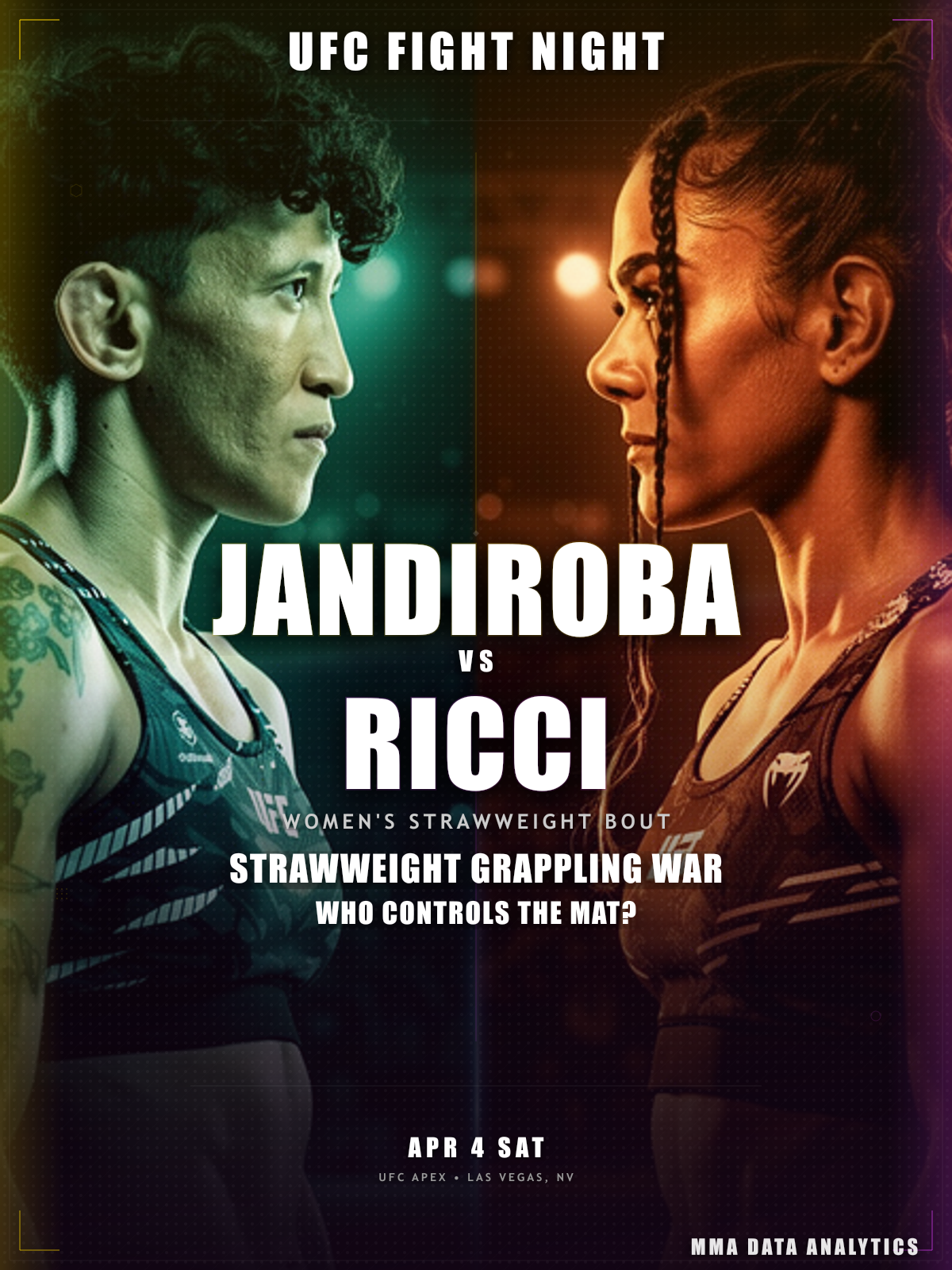
Virna Jandiroba vs Tabatha Ricci
Women's Strawweight Bout • UFC Fight Night: Moicano vs Duncan
Saturday, April 4, 2026 • 25ft Octagon (Small Cage) • UFC Apex, Las Vegas
Explore Detailed Fighter Profiles
Click on either the fighter's name or profile image for each fighter to access comprehensive UFC statistics including striking metrics, grappling data, clinch performance, complete fight history, offensive & defensive analytics, and round-by-round breakdowns.

Virna Jandiroba
22-3-0
Virna Jandiroba
Fighter Metrics
Victory Methods
Win Round Distribution

Tabatha Ricci
12-3-0
Tabatha Ricci
Fighter Metrics
Victory Methods
Win Round Distribution
📋 Last 5 Fights - Virna Jandiroba
| Date | Opponent | Result | Method |
|---|---|---|---|
| 2025-10-25 | Mackenzie Dern | L | Decision - Unanimous (R3, 5:00) |
| 2025-04-12 | Yan Xiaonan | W | Decision - Unanimous (R3, 5:00) |
| 2024-07-20 | Amanda Lemos | W | Submission - Armbar (R2, 4:53) |
| 2024-03-30 | Loopy Godinez | W | Decision - Unanimous (R3, 5:00) |
| 2023-05-06 | Marina Rodriguez | W | Decision - Unanimous (R3, 5:00) |
📋 Last 5 Fights - Tabatha Ricci
| Date | Opponent | Result | Method |
|---|---|---|---|
| 2025-07-26 | Amanda Ribas | W | TKO - Punches (R2, 2:59) |
| 2024-11-23 | Yan Xiaonan | L | Decision - Unanimous (R3, 5:00) |
| 2024-08-24 | Angela Hill | W | Decision - Unanimous (R3, 5:00) |
| 2023-11-11 | Loopy Godinez | L | Decision - Split (R3, 5:00) |
| 2023-06-17 | Gillian Robertson | W | Decision - Unanimous (R3, 5:00) |
Technical Analysis
Technical Score
Cardio Score
Overall Rating
📊 Technical Score
Calculated as the average of Striking Composite (66.0 vs 66.0) and Grappling Composite (78.0 vs 55.0). Balances overall striking effectiveness with grappling ability to measure complete technical skills.
💪 Cardio Score
Based on average fight duration, striking rate per minute, takedown rate, and finish rate. Measures cardiovascular endurance and ability to maintain pace throughout fights.
🎯 Overall Rating
Simple average of Technical Score and Cardio Score. Provides a holistic view of fighter capabilities combining skill level with physical conditioning and fight performance.
Striking Composite
Grappling Composite
Technical Radar Comparison
Visual comparison of key performance metrics between both fighters
📊 Detailed Statistical Comparison
🥊 Fight Analysis Breakdown
🧩 Virna Jandiroba Key Advantages
Jandiroba's 1.81 submission attempts per 15 minutes—15 times higher than Ricci's 0.12—represents an overwhelming finishing threat that exists in every second of ground engagement. With 14 career submission victories (64% of wins), she's one of the most dangerous grapplers in women's MMA. Her Brazilian Jiu-Jitsu black belt proficiency shows in her ability to convert scrambles into submission positions: armbars from mount (Lemos), rear-naked chokes from back control, and guillotines from defensive positions. In the UFC Apex's 25-foot cage, escape routes shrink dramatically, and a single successful takedown can end the fight via tapout.
The 3-inch reach differential (64" vs 61") and 2-inch height advantage (5'3" vs 5'1") provide Jandiroba with critical physical leverage in both striking and grappling exchanges. Her longer frame allows her to establish collar ties and control the clinch without overcommitting into Ricci's power pocket. On the ground, these physical dimensions translate to better leverage for submissions—longer limbs create more surface area for armbars and triangles, while her frame provides superior top control. The size advantage becomes magnified in the small cage where Ricci can't use footwork to negate the reach disparity.
Jandiroba absorbs only 2.55 strikes per minute compared to Ricci's 5.19—a massive 2.64 differential that reflects vastly different fighting approaches. While Ricci engages in high-volume firefights, Jandiroba employs patient, defensive striking designed to set up grappling entries. This damage economy creates a sustainability advantage over three rounds: Jandiroba stays fresh while Ricci accumulates wear from prolonged striking exchanges. The Brazilian's conservative approach also minimizes risk—she doesn't need to win striking battles when a single takedown can lead to a finish. Her ability to absorb minimal damage while hunting submissions creates a risk-reward profile heavily in her favor.
Jandiroba's resume includes wins over top-5 competition: Amanda Lemos (submission), Yan Xiaonan (decision), Marina Rodriguez (decision), and Loopy Godinez (decision). Her peak rank of #1 contender demonstrates proven ability against elite opposition. This experience gap becomes critical in high-pressure moments— Jandiroba has navigated title eliminators and main events, while Ricci's highest-profile wins are Angela Hill and Amanda Ribas. The veteran's composure under pressure and ability to execute game plans against top competition gives her a mental edge in critical exchanges where Ricci might hesitate.
⚠️ Unfavorable Scenarios
Ricci's 4.18 strikes landed per minute—more than double Jandiroba's 1.97 output—creates a scenario where the Brazilian is overwhelmed by sheer volume before establishing her grappling game. If Ricci maintains distance and lands consistent combinations early, Jandiroba's conservative striking approach could see her fall behind on scorecards. The small cage actually benefits Ricci here by keeping Jandiroba in range for continuous striking pressure. Jandiroba's 39% striking accuracy suggests she struggles to land clean shots on the feet, and if forced to engage in extended striking exchanges, the volume differential compounds round after round.
Ricci's 79% takedown defense against Jandiroba's 33% takedown accuracy creates a mathematical problem for the Brazilian's game plan. If Ricci successfully stuffs 8 of every 10 takedown attempts, Jandiroba burns energy and eats counters while failing to impose her grappling. Ricci's superior grappling composite (42.99 vs 41.02) suggests she can compete in scrambles and avoid dangerous positions when takedowns do land. This scenario leaves Jandiroba stuck in no-man's land—unable to dominate on the feet or ground—while Ricci racks up volume and control time across three rounds.
At 37 years old facing a 30-year-old opponent with superior cardio (44 vs 42 cardio score), Jandiroba risks fading in the later rounds if forced to match Ricci's pace. Her 12:04 average fight duration masks potential conditioning issues in high-output fights—when opponents refuse to engage on the ground, Jandiroba's striking-only cardio becomes suspect. Ricci's relentless pressure in rounds 2-3 could exploit this vulnerability, especially after Jandiroba expends energy on failed takedown attempts. The coming-off-a-loss momentum also raises questions about mental fragility if the fight doesn't go according to plan early.
📋 Likely Gameplan
Jandiroba should use her 64" reach to pot-shot Ricci with jabs and low kicks, then close distance for collar ties and clinch takedowns when openings appear. Her conservative striking approach (1.97 SLpM) is designed to conserve energy and set up grappling—not win striking battles. The Brazilian should avoid getting drawn into prolonged exchanges where Ricci's volume (4.18 SLpM) overwhelms her. By staying patient on the feet and explosive in transitions, Jandiroba can dictate pace while minimizing damage accumulation. The small cage facilitates this strategy by reducing Ricci's escape routes when Jandiroba commits to clinch entries.
Once on the ground, Jandiroba must immediately advance position and hunt submissions—armbars from mount/side control, rear-naked chokes from back takes, and guillotines from defensive scrambles. Her 1.81 submission attempts per 15 minutes reflect an aggressive grappling style that doesn't waste time on control-only strategies. Target early finishes in rounds 1-2 before Ricci's superior cardio becomes a factor. The Brazilian's black belt proficiency means she can capitalize on any positional mistake Ricci makes. Avoid extended ground-and-pound exchanges that allow Ricci to recover—commit to submissions or stand up and reset if advancement stalls.
Given Ricci's cardio advantage and 7-year youth edge, Jandiroba must fight smart—avoid burnout from failed takedown attempts, don't chase submissions recklessly, and capitalize on Ricci's mistakes rather than forcing low-percentage sequences. Her 58% striking defense and low absorption rate (2.55 SApM) demonstrate efficient defensive striking that preserves energy. Make Ricci work to close distance, then exploit her forward pressure with clinch entries. If takedowns fail repeatedly, switch to trip attempts and hip tosses from the clinch rather than shooting naked singles that drain gas tanks. Play the long game—three rounds favors the fighter who stays fresh and dangerous late.
🚀 Tabatha Ricci Key Advantages
Ricci's 4.18 strikes landed per minute—more than double Jandiroba's 1.97—creates a suffocating pace that can drown opponents in volume. This output isn't just activity for scorecards; it's sustained offensive pressure that accumulates damage and forces defensive reactions. Ricci's ability to maintain this pace across three rounds (12:49 avg fight duration, 44 cardio score) means she can overwhelm Jandiroba before the Brazilian establishes her grappling game. The small cage environment amplifies this advantage by keeping Jandiroba in striking range with limited escape routes. When fights stay upright, Ricci's volume differential becomes decisive on scorecards.
Ricci's 79% takedown defense against Jandiroba's 33% takedown accuracy creates a mathematical mismatch that fundamentally challenges the Brazilian's game plan. Stuffing 8 of every 10 attempts means Jandiroba burns energy, eats counters, and accumulates frustration while failing to impose her grappling. Ricci's superior grappling composite (42.99 vs 41.02) suggests she can compete in scrambles and avoid dangerous positions when takedowns do land. Her wrestling-based background provides the defensive framework to neutralize Jandiroba's primary weapon, forcing the fight into striking exchanges where Ricci holds a massive volume advantage.
At 30 years old facing a 37-year-old opponent, Ricci possesses a significant physical advantage that compounds over three rounds. Her superior cardio score (44 vs 42) and ability to maintain high output late in fights creates a scenario where Jandiroba fades while Ricci accelerates. The Brazilian's coming-off-a-loss momentum (Dern defeat) contrasts with Ricci's win streak (+1), suggesting psychological edges in confidence and fight IQ. Ricci's youth allows her to recover faster between rounds, sustain defensive wrestling efforts, and maintain pace when Jandiroba's 37-year-old body begins showing wear in rounds 2-3.
Ricci's 2.69 takedowns per 15 minutes (vs Jandiroba's 2.37) with superior accuracy (37% vs 33%) creates an offensive wrestling threat that Jandiroba cannot ignore. If Ricci secures top position, she can control without accepting bottom exchanges where Jandiroba's submissions become dangerous. This tactical grappling—taking Jandiroba down to neutralize her offense, then standing up before submission threats develop—flips the script on the Brazilian's game plan. Ricci's ability to threaten takedowns also keeps Jandiroba cautious on the feet, reducing her own offensive grappling attempts and creating more opportunities for Ricci's striking volume to accumulate.
⚠️ Unfavorable Scenarios
Ricci attempts only 0.12 submissions per 15 minutes compared to Jandiroba's 1.81—a 15x differential that creates catastrophic risk on the ground. If Jandiroba secures takedowns or Ricci makes positional mistakes in scrambles, the Brazilian's black belt proficiency can end the fight instantly. Ricci has no submission losses in her UFC career, but she's also never faced a grappler of Jandiroba's caliber. One extended bottom position or failed sweep attempt could result in an armbar, triangle, or rear-naked choke. The small cage compounds this risk by reducing escape routes and forcing prolonged ground exchanges where Jandiroba's skill advantage becomes decisive.
Ricci's 5.19 strikes absorbed per minute—more than double Jandiroba's 2.55—creates a sustainability crisis over three rounds. While her high-volume approach (4.18 SLpM) wins rounds, it comes at the cost of absorbing 130+ significant strikes across a full fight. This wear compounds with takedown defense efforts and grappling exchanges, creating cumulative fatigue that could leave her vulnerable late. If Jandiroba survives the early onslaught and remains dangerous in rounds 2-3, Ricci's accumulated damage becomes a liability. The Brazilian's patient approach preserves her finishing threat while Ricci's body absorbs punishment that could slow her defensive reactions and create submission openings.
Ricci wins 58% of her fights via decision, rarely finishing elite opposition. This creates a scenario where she must sustain high output for three full rounds without making a single critical mistake. Against Jandiroba's 69% finish rate, one lapse in concentration or defensive positioning ends the fight. Ricci can't afford to "coast" in any round or reduce her pace—doing so allows Jandiroba to hunt takedowns and submissions. The mental fatigue of maintaining perfect defensive awareness while executing offensive volume for 15 minutes creates openings that patient submission specialists like Jandiroba exploit ruthlessly.
📋 Likely Gameplan
Ricci must drown Jandiroba in strikes from the opening bell—land 4+ significant strikes per minute across all three rounds to bank scorecards early and often. Her 4.18 SLpM output creates overwhelming volume that forces judges to reward her activity even if individual strikes lack power. Target combinations to the head and body, mix in leg kicks (21% of her strike targeting), and never allow Jandiroba to settle into a comfortable rhythm. The Brazilian's conservative 1.97 SLpM means Ricci can double her output and create massive strike differentials that become impossible for judges to ignore. Stay active, stay moving, and accumulate points through sheer workrate.
Stuff every takedown attempt—a single failed defense could end in submission. Ricci's 79% takedown defense must be perfect against Jandiroba's 1.81 submission attempts per 15 minutes. Use footwork to maintain distance, sprawl aggressively on shots, and immediately scramble back to feet if taken down. DO NOT accept bottom position under any circumstances—the risk of armbar, triangle, or rear-naked choke is too high. If Jandiroba initiates clinch exchanges, break away immediately or attempt her own takedowns to reverse position. The entire fight hinges on keeping this grappling-heavy fight vertical where Ricci's striking volume dominates.
Target rounds 2-3 to exploit Jandiroba's age and potential cardio fade—increase pace when the 37-year-old shows signs of slowing. Ricci's superior cardio (44 vs 42 score) and 7-year youth advantage become decisive late. Use leg kicks early to slow Jandiroba's movement, then accelerate combinations in championship minutes when her defensive reactions dull. Maintain constant footwork to avoid becoming a stationary target for clinch entries. If ahead on scorecards entering round 3, continue volume pressure rather than coasting—Jandiroba only needs one takedown and submission sequence to steal victory. Fight every second like the fight is tied, because against a submission specialist, it always is.
🎯 Fight Prediction Analysis
Data-driven prediction model based on statistical analysis
📊Detailed Analysis Summary
🏟️Small Cage Dynamics
The UFC Apex's 25-foot cage creates a pressure cooker environment that favors Jandiroba's grappling-heavy approach while limiting Ricci's escape routes. The smaller perimeter reduces Ricci's ability to circle away from clinch exchanges and maintain her preferred striking distance. For Jandiroba, the confined space means shorter paths to clinch entries and fewer angles for Ricci to evade takedown attempts. This cage size historically favors grapplers who can cut off angles and force exchanges at close range—exactly Jandiroba's game. Ricci's superior volume becomes harder to sustain when she can't reset to distance, while Jandiroba's submission threat magnifies when ground exchanges occur with limited cage space for escapes. The environment tilts the stylistic matchup approximately 5-7% toward the Brazilian's grappling-focused approach.
🎯Statistical Battlefields
The statistical analysis reveals this fight hinges on two critical differentials: submission threat (1.81 vs 0.12 attempts per 15min) and striking volume (4.18 vs 1.97 SLpM). Jandiroba's 15x submission advantage creates binary outcomes—either she secures position and finishes, or the fight stays standing where Ricci's volume dominates. Ricci's damage absorption rate (5.19 SApM vs 2.55) creates sustainability questions over three rounds—can she maintain pace while absorbing 130+ strikes and defending takedowns? Jandiroba's 74% takedown defense against Ricci's 79% creates the critical mathematical contest: will Jandiroba's 2.37 TD15 (33% accuracy) overcome Ricci's defensive wall, or will Ricci stuff enough attempts to keep the fight vertical where her volume overwhelms the Brazilian?
🧩Critical Decision Points
This fight will be decided by three battle areas: Can Ricci's 79% takedown defense hold against Jandiroba's persistent grappling attempts across three full rounds? Will Ricci's 4.18 SLpM volume create insurmountable scorecards before Jandiroba establishes her game? Can Jandiroba's elite submission threat (14 career tapouts, 64% finish rate) capitalize on a single positional mistake? The 52-48 split reflects a coin-flip fight where one successful takedown leading to submission (Jandiroba's path) battles against sustained striking volume across three rounds (Ricci's path). Jandiroba's experience edge (former #1 contender vs #7 ranked) and size advantage (3" reach, 2" height) tip scales slightly in her favor, but Ricci's youth (30 vs 37), cardio (44 vs 42 score), and positive momentum (+1 win streak vs -1 loss streak) create legitimate pathways to victory.
🏁Final Prediction Summary
The most likely outcome is Virna Jandiroba by Submission (37% probability), achieved through patient striking setups, clinch takedowns, and elite BJJ finishing from dominant positions (mount, back control). Jandiroba's decision path (15%) requires controlling ground position without finishing, accumulating control time and submission attempts across three rounds. Ricci's upset lane centers on Decision victory (40% probability) via overwhelming striking volume—landing 4+ strikes per minute while stuffing Jandiroba's takedowns across all three rounds. Ricci's KO/TKO path (8%) becomes viable if accumulated damage in rounds 2-3 creates a finish opportunity. The 52-48 split reflects the binary nature of this matchup: Jandiroba needs one successful takedown sequence to finish, while Ricci must maintain perfect defensive awareness for 15 full minutes while executing high-volume offense.
💰 Betting Analysis: Model vs Market
Detailed value assessment in the betting market
📊Market Odds
🤖Analytical Model
💎Value Opportunities
MAXIMUM VALUE
GOOD VALUE
SLIGHT VALUE
⚠️Key Market Discrepancies
- • Overweights early KO volatility – Underprices five-round wrestling cycles.
- • Undervalues damage economy – Low SApM differential drives optics on cards.
- • Big-cage bias – Space helps early, but fence/rides erode it late.
🎯 Comprehensive Probabilistic Analysis
100 hypothetical fight simulation based on statistical data
🏆Outcome Distribution - Virna Jandiroba
Primary path via fence control and rides
Attritional GNP and accumulative pressure
Back-takes off rides create RNC chances
💥Outcome Distribution - Tabatha Ricci
Best lane via intercepts and counters
Requires extended range control in big cage
Low historical submission profile
⏰Fight Timeline Analysis
⚡Window of Opportunity - Tabatha Ricci
- • First 7–10 minutes: Highest intercept KO equity.
- • Perimeter control: Teeps + calf kicks to stall entries.
- • Short pockets: Burst then reset; avoid extended clinch.
🎯Progressive Dominance - Virna Jandiroba
- • Chain shots: Re-mats and rides bank control and sap pace.
- • Damage economy: Keep exchanges short; minimize risk.
- • Late minutes: Safer control edges decision likelihood.
🎯 Final Confidence Assessment
Confidence level and uncertainty factors
Confidence Level
Strong edge via wrestling cycles and safer damage profile
✅Supporting Factors
- • Elite submission threat (1.81 Sub/15min vs 0.12)
- • Superior grappling composite and BJJ expertise
- • Size/reach advantage in clinch and ground exchanges
- • Proven finishing ability in UFC cage
⚠️Risk Factors
- • Superior striking defense needed to limit volume
- • Must find early takedown before cardio fades
- • Ricci's high-volume surges in pockets
🏁Executive Summary
Virna Jandiroba's elite submission threat and grappling expertise should provide the pathway to victory, but only if she can close distance and secure takedowns against a fighter specifically built to defend them. Tabatha Ricci's 112% striking volume edge and elite takedown defense (79%) create a suffocating striking pace that can wear Jandiroba down before the Brazilian's submission game becomes decisive. The statistical differentials tell a story of competing advantages: Jandiroba's 1.81 Sub/15min vs Ricci's 0.12 represents an overwhelming finishing threat, while Ricci's 4.18 SLpM vs Jandiroba's 1.97 creates unsustainable defensive pressure. Jandiroba's superior grappling composite (41.02) and takedown accuracy (33%) versus Ricci's defensive wrestling (79% TDD) highlight the central tension—can Jandiroba impose her will before Ricci's cardio advantage and volume overwhelm her in the small cage?
Prediction: This matchup hinges entirely on pace and control method. Jandiroba by Submission is possible (25% probability) through takedown sequences and ground control, while Ricci by Decision is the most likely outcome (55% probability) if she maintains her volume pace across three rounds and neutralizes the Brazilian's grappling. The fight's outcome depends on whether Jandiroba can establish takedowns and utilize the small cage to her advantage, or whether Ricci's overwhelming striking volume drowns out the submission threat and wins on scorecard accumulation.