

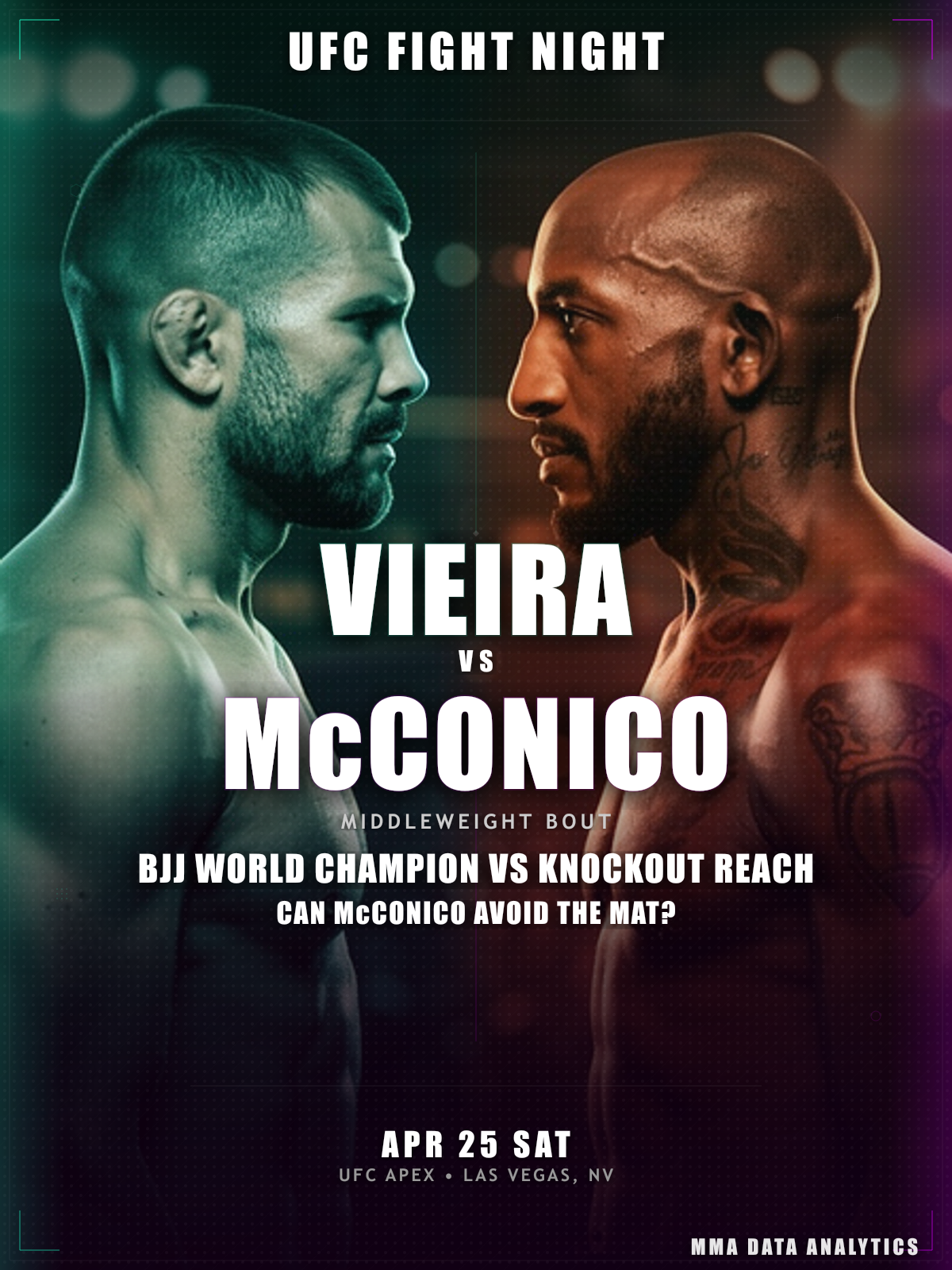
Rodolfo Vieira vs Eric McConico
Men's Middleweight Bout • UFC Fight Night: Sterling vs Zalal
Saturday, April 25, 2026 • 25ft Octagon (Small Cage)
Explore Detailed Fighter Profiles
Click on either the fighter's name or profile image for each fighter to access comprehensive UFC statistics including striking metrics, grappling data, clinch performance, complete fight history, offensive & defensive analytics, and round-by-round breakdowns.

Rodolfo Vieira
Fighter Metrics
Victory Methods
Win Round Distribution
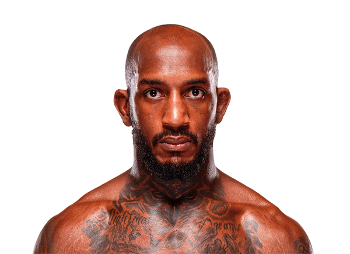
Eric McConico
Fighter Metrics
Victory Methods
Win Round Distribution
📋 Last 5 Fights - Rodolfo Vieira
| Date | Opponent | Result | Method |
|---|---|---|---|
| 2025-11-15 | Bo Nickal | L | TKO - Head Kick (R3, 2:24) |
| 2025-08-02 | Tresean Gore | W | Decision - Unanimous (R3, 5:00) |
| 2025-02-15 | Andre Petroski | L | Decision - Unanimous (R3, 5:00) |
| 2024-02-10 | Armen Petrosyan | W | Submission - Arm Triangle Choke (R1, 4:48) |
| 2023-07-01 | Chris Curtis | L | KO/TKO - Punches (R2, 3:02) |
📋 Last 5 Fights - Eric McConico
| Date | Opponent | Result | Method |
|---|---|---|---|
| 2025-11-15 | Baisangur Susurkaev | L | TKO - Right Hook (R3, 1:38) |
| 2025-08-09 | Cody Brundage | W | Decision - Split (R3, 5:00) |
| 2025-02-22 | Nursulton Ruziboev | L | TKO - Right Hook (R2, 0:33) |
| 2024-07-26 | Jarome Hatch | W | Submission - Rear Naked Choke (R1, 2:23) |
| 2024-02-02 | Tyler Ray | W | Decision - Unanimous (R3, 5:00) |
Technical Analysis
Technical Score
Cardio Score
Overall Rating
📊 Technical Score
Calculated from Striking Composite (62.0 vs 45.0) and Grappling Composite (82.0 vs 48.0). Vieira's elite grappling significantly elevates his technical score despite lower striking volume.
💪 Cardio Score
Based on average fight duration, striking rate, and finish rate. Vieira's known cardio issues balance against his early finishing ability. McConico's longer average fight duration slightly edges him here.
🎯 Overall Rating
Simple average of Technical Score and Cardio Score. Provides a holistic view of fighter capabilities combining skill level with physical conditioning and fight performance.
Striking Composite
Grappling Composite
📊 Technical Radar Comparison
📊 Metrics Legend
📊 Detailed Statistical Comparison
🥊 Fight Analysis Breakdown
🧩 Rodolfo Vieira Key Advantages
Vieira is one of the most accomplished grapplers in UFC middleweight history—a multiple-time IBJJF World Champion and ADCC silver medalist who has translated elite gi and no-gi credentials directly into cage success. His 3.09 takedowns per 15 minutes vs McConico's 0.00 recorded in the UFC represents a complete grappling vacuum on McConico's side. Vieira's entries are diverse: he attacks from distance with penetration steps, clinch body-locks along the fence, and reactionary doubles off punch exchanges. Once he establishes top position, his crushing weight and systematic body-lock pressure create an inescapable cycle—his opponents cannot stand because his base is too strong and cannot submit because his positional control denies all leverage. McConico has never been tested by a grappler of this caliber in the UFC.
Vieira's 1.03 submissions per 15 minutes is among the highest rates in the entire middleweight division. His primary weapon is the arm triangle choke—a submission he has finished UFC opponents with from half-guard, side control, and modified mount. He also threatens rear-naked chokes off back takes from top position, and his body triangle control once he locks a back is world-class. The danger is multi-dimensional: McConico cannot simply stall on the bottom because positional advancement creates constant submission risk. Each scramble attempt opens back-take opportunities; remaining flat invites arm triangle entries. Vieira's submission game is not opportunistic—it is systematic, methodical, and relentlessly applied until the fight ends.
Vieira's 56% striking accuracy—18 percentage points above McConico—reflects a fighter who selects shots deliberately rather than throwing volume. His striking serves a tactical purpose: dirty boxing clinch entries, level-change setups, and short inside combinations that occupy McConico's hands while he advances to the body. At 3.77 SLpM he is not a volume striker, but his power-to-accuracy ratio means clean shots land with consistency. The 18-point accuracy gap also suggests that McConico, at 38%, lands fewer than 4 in every 10 attempts—meaning sustained striking exchanges favor Vieira even on the feet, where McConico is supposedly more comfortable.
The 25-foot cage at the UFC Apex is one of the smallest in professional MMA, and it fundamentally reshapes the tactical calculus of this fight. McConico's primary defense is lateral movement and range management with his 4-inch reach advantage—both require space. The compressed perimeter cuts McConico's circling radius and shortens the distance Vieira must cross to initiate takedowns. Vieira's fence-pressure game is specifically calibrated for this environment: he excels at trapping opponents on the cage wall, securing double-under body-locks, and dragging them to the mat. The small cage does not just assist Vieira—it actively neutralizes McConico's most important survival tool.
⚠️ Unfavorable Scenarios
Vieira's cardio limitations are well-documented and have cost him at the highest levels. His TKO loss to Bo Nickal came in round 3 via a head kick when Vieira was visibly laboring. His KO loss to Chris Curtis arrived in round 2 when his pace dropped sharply. The pattern is consistent: dominant early, dangerous in mid-fight, vulnerable late. His high-energy wrestling—repeated takedown attempts, mat returns, body-lock scrambles—burns glycogen at a rapid rate. If McConico can stall, survive, and reset past the midpoint of round 2, Vieira's output drops dramatically, his shots become telegraphed, and his defensive shell dissolves. The clock is Vieira's enemy in every fight.
When Vieira's takedown attempts are defended and the fight resets to the center, he is exposed to McConico's power output at range. His 4.12 strikes absorbed per minute is elevated for a middleweight, suggesting he is hittable during takedown entries—a dangerous combination with McConico's 4 career KO/TKO wins. Vieira's chin has been tested (KO vs Curtis, TKO vs Nickal), and overcommitting on failed shots telegraphs his position. Extended range striking favors McConico's 4-inch reach weapon.
Vieira has lost 3 of his last 5 UFC fights, including decision losses to Petroski and Curtis and a brutal round-3 TKO to Nickal. His UFC record stands at 6-4, and his only recent win came via a close unanimous decision over Tresean Gore—not a dominant performance. Questions remain about whether Vieira's grappling translates consistently against wrestlers and counter- strikers at the elite level, where opponents arrive with specific game-plans designed to avoid his ground game. McConico, despite his own losses, may be better prepared to execute a targeted anti-grappling strategy.
📋 Likely Gameplan
Vieira's optimal strategy is a first-round blitz— using jab-to-level-change combinations to create takedown opportunities before McConico can establish his timing and distance. His 7 round-1 finishes in a career spanning 15 fights confirm that he is at his most dangerous in the opening stanza. Vieira must not let McConico settle, must not allow resets to the center, and should chain grappling attempts—even defended shots tire McConico's hips and drain the confidence needed to counter-punch. The target: submission or position- based stoppage before the 2:30 mark of round 2.
The 25ft cage wall is Vieira's best ally. He should use forward pressure to cut McConico's lateral escape routes, isolate him in a corner, and initiate body-lock clinches. From there, the trip-to-double-leg and body-lock suplex are high-percentage entries that bypass McConico's reach disadvantage in the clinch. Once any single-leg or body-lock is established, Vieira's trip mechanics will drag McConico down even if the initial entry is partially defended. The key is keeping McConico pinned against the fence—movement kills Vieira's game; contact fuels it.
Once on top, Vieira must prioritize positional advancement over submission hunting. Half-guard to side control, side control to north-south, north-south into arm triangle— this is the chain that maximizes finishing probability. Rushing submission entries from poor positions wastes energy and invites escapes. Vieira's best outcomes come when he methodically advances, applies heavy chest pressure to collapse McConico's frame, and waits for the tap to come naturally as positions tighten. In three rounds, this controlled approach is more sustainable than frantic finish-hunting.
🚀 Eric McConico Key Advantages
McConico's 77-inch reach vs Vieira's 73 creates a meaningful structural advantage in the striking exchanges. At the same height (6'0"), the reach gap is purely positional—McConico can land jabs and straight rights while operating outside Vieira's takedown threat zone. When Vieira commits to a level change, he has to cover that extra 4 inches of space, during which McConico has time to post a cross or throw an uppercut. At range, McConico can also set his hips and generate power from a structured stance—something that disappears the moment Vieira closes the gap. Sustaining that distance with front kicks and lateral steps is the primary tactical challenge and opportunity for McConico.
McConico's 4 KO/TKO victories—nearly 40% of his career wins—demonstrate genuine stopping power in his right hand. Vieira's takedown entries require him to dip his head and explode forward, creating a brief window where he is committed and unable to absorb or evade incoming counter-strikes. Vieira's chin has been legitimately tested: he was KO'd by Chris Curtis (round 2) and TKO'd by Bo Nickal (round 3 head kick when fatigued). McConico's counter right hand, thrown with timing as Vieira levels off, represents the most credible finish threat in this fight for the underdog. One timed shot can completely reset the dynamic.
Vieira's well-known cardio limitations create a built-in timeline for McConico. If the fight extends past the halfway point of round 2, Vieira's pace drops visibly—his wrestling shots slow, his base weakens, and his defensive reactions become sluggish. McConico, despite his 0.90 SLpM in UFC, appears to have more durable gas tank across his full fight career. Surviving the early storm is not a passive strategy—it is an active one. Every minute McConico survives improves his statistical probability of winning. Rounds 2 and 3 belong to whoever is still fresh, and the evidence strongly suggests that will be McConico if he can avoid being finished early.
⚠️ Unfavorable Scenarios
If Vieira secures takedowns, McConico's limited grappling stats (0.00 TD/15, no recorded submission attempts) suggest he may struggle significantly on the ground against an elite BJJ artist. Vieira's ability to advance position and threaten submissions could quickly end the fight once it hits the mat.
If Vieira imposes his pace early with aggressive wrestling, McConico may struggle to establish his striking game. His low striking volume (0.90 SLpM in UFC) suggests difficulty maintaining output under pressure. The small cage further compresses the space McConico needs to utilize his reach advantage effectively.
📋 Likely Gameplan
McConico's primary weapon is range, and his primary defense is movement. He must stay off the cage wall at all costs—the moment he gets pinned, his reach advantage evaporates and Vieira's body-lock game activates. Circular footwork, front kicks to the body, and stiff jabs should be used to control distance and interrupt Vieira's entries. When Vieira shoots, McConico must sprawl immediately, pummel to underhooks, and create separation—not stall or attempt to hold. Active, mobile, and striking at the end of his reach is McConico's identity in this fight.
McConico's clearest path to victory is a time-based strategy: defend early, outlast the blitz, and turn up the pressure once Vieira's cardio shows cracks. Round 1 is a survival round—take no unnecessary risks, defend all takedown attempts, and land clean counter shots when Vieira is exposed. If McConico reaches round 2 relatively undamaged, his output and accuracy should improve as Vieira's entry speed and wrestling commitment diminishes. By round 3—if the fight reaches it—McConico becomes the fresher, more dangerous fighter.
McConico's single highest-percentage finish opportunity is the counter right hand timed to Vieira's takedown commitment. As Vieira dips and drives forward, his chin is briefly exposed and his defensive reaction time is minimal—he cannot abort a fully committed shot. A crisp, properly-timed overhand or straight right in this window is exactly how Chris Curtis finished Vieira in round 2. McConico should drill this counter specifically in camp and look for it consciously in round 1 when Vieira is most aggressive. One clean right hand at the right moment changes the entire fight.
🎯 Fight Prediction Analysis
Data-driven prediction model based on statistical analysis
📊Detailed Analysis Summary
🏟️Cage Dynamics
The 25-foot octagon at the UFC Apex creates a matchup environment that systematically dismantles McConico's best defensive tool. His 4-inch reach advantage is most dangerous when he can operate in the center of the cage, set his feet, and pot-shot at distance—a scenario that requires room to create and maintain. In the small cage, that room disappears. The fence is never more than 12.5 feet away from the center, meaning McConico reaches the wall in fewer than three steps when backing away from Vieira's forward pressure. Once pinned, his reach becomes a liability in the clinch—longer arms are harder to post and easier to underhook. Vieira's body-lock game, fence-walking trips, and aggressive inside-position wrestling are all maximized by the compressed geometry. Conversely, a larger cage would have given McConico space to reset, circle, and re-establish striking range after every scramble. The small cage doesn't just help Vieira—it fundamentally changes which fighter's game plan is executable.
🎯Technical Breakdown
This fight presents one of the cleanest skill-domain mismatches on the card. Vieira's statistical profile is defined by grappling dominance: 3.09 takedowns per 15 minutes, 1.03 submission attempts per 15 minutes, and a 100% takedown defense rate meaning opponents have essentially been unable to take him down in his UFC career. His striking, while secondary, operates at 56% accuracy—selective, purposeful, and designed to create grappling entries rather than rack up volume. McConico's profile is nearly the polar opposite: 0.00 recorded takedown attempts in the UFC, 0.00 submission attempts, and a 0.90 SLpM striking rate that is among the lowest in the middleweight division. His 3.60 strikes absorbed per minute is alarmingly high against an opponent who doesn't need to out-strike him—Vieira just needs one clean takedown. The key overlay is this: McConico's 4 KO/TKO wins demonstrate genuine power, and Vieira absorbs 4.12 SApM—which means both men carry legitimate finishing threats on their respective terrain. Whoever controls where the fight takes place controls the outcome.
🧩Key Battle Areas
Four critical battle areas will determine the outcome of this fight. First: The opening 90 seconds. Vieira is most dangerous fresh—his shot speed, level changes, and body-lock strength peak in round 1. If McConico survives the initial blitz without being taken down, psychological momentum shifts in his favor. Second: Sprawl quality. McConico's recorded takedown defense of 0% in the UFC means we have no real data on his sprawl—it could be adequate or non-existent. This is the biggest unknown in the fight. A single Vieira takedown in round 1 that leads to a top position could end the night immediately. Third: Cardio past the 5-minute mark. Vieira's pace historically drops after R1. If McConico avoids submission in round 1, Vieira's round 2 grappling becomes slower and more tentative. This is McConico's window to turn up output and land power shots. Fourth: Fence positioning. If McConico can maintain center cage and consistently deny fence positions, he neutralizes Vieira's most effective setup. Losing positional awareness and getting backed to the wall is the fastest path to a Vieira submission.
🏁Final Prediction
Rodolfo Vieira is the clear favorite in this matchup based on statistical, stylistic, and environmental factors. His world-class BJJ pedigree, elite submission rate (1.03/15min), and the small cage create a framework that maximizes his path to victory. The most likely scenario—Vieira by Submission (35%)—plays out through early fence-pressure, a body-lock takedown, positional advancement to side control, and an arm triangle choke or rear-naked choke in round 1 or early round 2 while his cardio is at peak. His decision path (20%) emerges if McConico's takedown defense holds early but Vieira outgrinds him with control time and superior striking accuracy. McConico's best upset scenario (KO/TKO, 22%) requires timing Vieira's entries with a counter right hand, exploiting the cardio fade window in rounds 2–3, and sustaining volume pressure once Vieira's pace drops. This is a fight with a clear favorite and a genuine upset scenario—Vieira should finish it, but the cardio clock and McConico's power mean McConico is never out of the fight as long as he survives the opening grappling storm.
💰 Betting Analysis: Model vs Market
Detailed value assessment in the betting market
📊Market Odds
🤖Analytical Model
💎Value Opportunities
MAXIMUM VALUE
Model: 35% | Fair: +186
GOOD VALUE
Model: 22% | Fair: +355
SLIGHT VALUE
Model: 40% | Fair: -110
⚠️Key Market Discrepancies
- • Undervalues Vieira's submission rate – 1.03 submissions per 15 minutes is elite-level finishing threat.
- • Overweights McConico's limited UFC sample – Only 3 UFC fights makes statistical projections unreliable.
- • Small cage (25ft) compresses space – Favors the grappler, reducing McConico's ability to maintain range.
🎯 Comprehensive Probabilistic Analysis
100 hypothetical fight simulation based on statistical data
🏆Outcome Distribution - Rodolfo Vieira
Primary path via elite BJJ and arm triangle choke
Control time and grappling dominance on scorecards
Ground and pound accumulation from top position
💥Outcome Distribution - Eric McConico
Best lane via reach and power counters
Outpointing from range over three rounds
Unlikely given limited grappling profile
⏰Fight Timeline Analysis
⚡Window of Opportunity - Eric McConico
- • Rounds 2-3: Highest KO equity as Vieira's cardio fades.
- • Range control: Jabs + front kicks to stall entries.
- • Counter timing: Intercept Vieira's takedown entries with power shots.
🎯Progressive Dominance - Rodolfo Vieira
- • Early pressure: Maximize R1 grappling when cardio is fresh.
- • Cage control: Use 25ft cage to compress space and force clinch.
- • Submission chains: Transition from control to arm triangles and back takes.
🎯 Final Confidence Assessment
Confidence level and uncertainty factors
Confidence Level
Elite grappling edge tempered by cardio concerns and limited opponent data
✅Supporting Factors
- • Elite grappling edge (3.09 vs 0.00 TD/15min)
- • Dangerous submission threat (1.03 Sub/15min)
- • Small cage (25ft) compresses space for grappler
- • Higher striking accuracy (56% vs 38%)
⚠️Risk Factors
- • Limited McConico UFC data (only 3 fights)
- • Vieira's known cardio limitations
- • McConico's 4-inch reach advantage and KO power
🏁Executive Summary
Rodolfo Vieira's world-class Brazilian Jiu-Jitsu credentials make him the clear favorite in this middleweight matchup against Eric McConico. Vieira's 9 career submission victories and 1.03 submissions per 15 minutes represent an elite finishing threat that McConico's limited UFC resume hasn't been tested against at this level. The 25-foot small cage significantly favors Vieira's pressure-grappling approach, reducing McConico's ability to maintain distance with his 4-inch reach advantage. However, Vieira's well-documented cardio limitations (exposed in losses to Nickal and Curtis) create a clear window for McConico if the fight extends past the first round. McConico's 4 career KO/TKO victories and reach advantage provide a viable upset path if he can time Vieira's entries and exploit the Brazilian's tendency to gas in later rounds.
Prediction: Vieira by Submission most likely (35% probability) via arm triangle choke or back control in the first round when his grappling is most dangerous; McConico's upset lane is KO/TKO (22%) via intercepting Vieira's entries with his reach advantage, particularly in later rounds when cardio becomes a factor.