

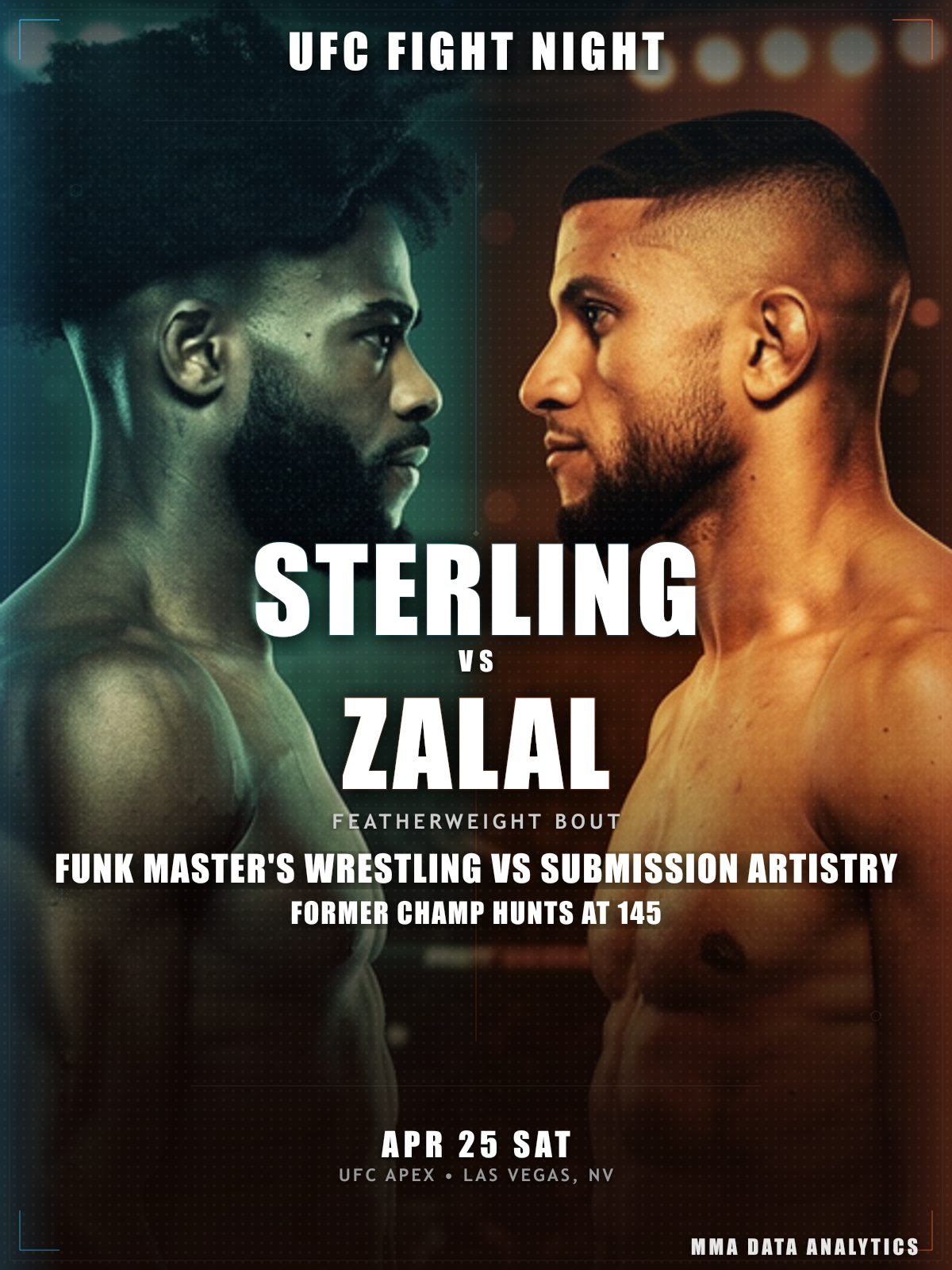
Aljamain Sterling vs Youssef Zalal
Men's Featherweight Bout • UFC Fight Night: Sterling vs Zalal
Saturday, April 25, 2026 • UFC APEX, Las Vegas, USA • 25ft Octagon (Small Cage)
Explore Detailed Fighter Profiles
Click on either the fighter's name or profile image for each fighter to access comprehensive UFC statistics including striking metrics, grappling data, clinch performance, complete fight history, offensive & defensive analytics, and round-by-round breakdowns.

Aljamain Sterling
Fighter Metrics
Victory Methods
Win Round Distribution

Youssef Zalal
Fighter Metrics
Victory Methods
Win Round Distribution
Last 5 Fights - Aljamain Sterling
| Date | Opponent | Result | Method |
|---|---|---|---|
| 2025-08-23 | Brian Ortega | W | Decision - Unanimous (R3, 5:00) |
| 2024-12-07 | Movsar Evloev | L | Decision - Unanimous (R3, 5:00) |
| 2024-04-13 | Calvin Kattar | W | Decision - Unanimous (R3, 5:00) |
| 2023-08-19 | Sean O'Malley | L | TKO - Counter Right to Ground Strikes (R2, 0:51) |
| 2023-05-06 | Henry Cejudo | W | Decision - Split (R3, 5:00) |
Last 5 Fights - Youssef Zalal
| Date | Opponent | Result | Method |
|---|---|---|---|
| 2025-10-04 | Josh Emmett | W | Submission - Armbar (R1, 1:38) |
| 2025-02-15 | Calvin Kattar | W | Decision - Unanimous (R3, 5:00) |
| 2024-11-02 | Jack Shore | W | Submission - Arm Triangle Choke (R2, 0:59) |
| 2024-08-10 | Jarno Errens | W | Submission - Rear Naked Choke (R1, 3:52) |
| 2024-03-23 | Billy Quarantillo | W | Submission - Rear Naked Choke (R2, 1:50) |
Technical Analysis
Technical Score
Cardio Score
Overall Rating
Technical Score
Calculated as the average of Striking Composite (62.0 vs 64.0) and Grappling Composite (75.0 vs 70.0). Balances overall striking effectiveness with grappling ability to measure complete technical skills.
Cardio Score
Based on average fight duration, striking rate per minute, takedown rate, and finish rate. Measures cardiovascular endurance and ability to maintain pace throughout fights.
Overall Rating
Simple average of Technical Score and Cardio Score. Provides a holistic view of fighter capabilities combining skill level with physical conditioning and fight performance.
Striking Composite
Grappling Composite
Technical Radar Comparison
Metrics Legend
Detailed Statistical Comparison
Fight Analysis Breakdown
Aljamain Sterling Key Advantages
Sterling's 3.65 takedowns per 15min vs Zalal's 2.56 represents a 42.6% takedown volume advantage that gives the former champion consistent ability to dictate fight location. As a former NCAA Division I wrestler and ex-UFC bantamweight champion who defeated the likes of Petr Yan, Henry Cejudo, and TJ Dillashaw, Sterling brings an elite grappling toolkit to featherweight. His chain-wrestling sequences—knee taps, singles into doubles, and mat returns—create sustained pressure that wears down opponents across five rounds. The critical question is not whether Sterling can take Zalal down, but what happens when Zalal's active guard comes into play. Sterling's experience defending submission attempts from elite grapplers (including his own back-take ability) suggests he has the awareness to manage Zalal's threats, but the featherweight frame and Zalal's longer levers create new variables that Sterling hasn't fully encountered.
Sterling's seven-fight UFC win streak and bantamweight title reign make him one of the most decorated fighters to ever compete at 145. He has gone five rounds multiple times against elite opposition—Petr Yan (twice), Henry Cejudo, TJ Dillashaw—developing a championship-level composure that Zalal has never been tested on. When fights get uncomfortable, Sterling's ability to slow pace, grind the fence, and make tactical micro-adjustments mid-round is a force multiplier. His 13:45 average fight duration reflects a fighter who controls tempo, not one who races for finishes. Against a submission hunter like Zalal, this patience becomes a genuine weapon—Sterling can systematically neutralize submission threats by maintaining positional awareness and avoiding the explosive scrambles where Zalal does his best work. The championship DNA also means Sterling knows how to win rounds on the scorecards even when he doesn't dominate, a critical skill in what is likely to be a close three or four-round fight.
Sterling's 73% takedown defense vs Zalal's 64% is a 14.1% differential that significantly restricts how Zalal can initiate grappling. Zalal's path to submission victories typically runs through his own takedowns (where he can control position from top) or through scrambles after his opponents shoot. Sterling's elite sprawl—developed over years of high-level wrestling competition—forces Zalal to seek alternative routes. That means Zalal must either pull guard (conceding the initiative), or wait for scramble moments when Sterling shoots. Both paths are achievable for Zalal, but they are less comfortable than his preferred approach of establishing top position and hunting subs from there. This defensive edge effectively narrows Zalal's submission toolkit from a proactive weapon to a reactive one—and reactive submission hunting is considerably harder to execute at championship level.
Unfavorable Scenarios
Zalal's four submissions in five fights—via armbar on Emmett, arm triangle on Shore, and rear naked chokes on Errens and Quarantillo— demonstrate a submission game that functions from multiple positions and angles. The critical danger for Sterling is not simply being submitted, but the cognitive tax of having to constantly audit his positioning every time he attempts a takedown or establishes top control. One momentary lapse in base or wrist control can cost Sterling the fight inside a minute. The small cage amplifies this risk: wall walks and scramble positions that arise from fence grappling create uncontrolled moments where Zalal's explosive transitions into back takes or arm attacks become devastatingly dangerous. Sterling's own chin has been tested—the O'Malley TKO showed he is not invulnerable to explosive, unexpected damage, which is precisely Zalal's operational style on the ground.
Moving up from bantamweight to featherweight, Sterling concedes 3 inches in height and 1 inch in reach to a fighter who has competed his entire career at 145. Zalal's naturally longer limbs are not just relevant for striking—on the ground, longer legs mean longer triangles, longer guard frames, and more leverage for sweeps from bottom. Sterling must close distance to shoot, meaning he eats more shots than he would against similarly sized opponents. His 3.21 SApM at bantamweight may increase at featherweight due to the larger punchers and longer hitters in the division. In the clinch, Zalal's height lets him control the underhooks more naturally, and his body size means Sterling cannot simply overpower his way to dominant positions the way he could at 135. Weight class jumps have undone champion-level grapplers before, and while Sterling is not untested, this remains a meaningful unknown variable heading into this matchup.
Likely Gameplan
Sterling's optimal path runs through high-control, low-risk grappling—securing takedowns and immediately establishing chest-to-chest pressure or tight half-guard rides that eliminate the space Zalal needs for submission entries. Rather than posting on hands (which exposes wrist locks and kimuras), Sterling should use shoulder pressure, head control, and body locks to maintain top position safely. His ground-and-pound should be methodical rather than explosive: short elbows, controlled hammerfists, and positional grinding accumulate scoring without the posture breaks that invite Zalal's transitions. Sterling should also use the small cage wall aggressively—pinning Zalal against the fence in body locks and single-leg holds to drain cardio and bank control minutes without entering the dangerous open-guard exchanges where Zalal excels.
Before shooting for takedowns, Sterling should soften Zalal with the jab and level-change feints to force defensive reactions. His 41% striking accuracy shows he can land consistently, and jabs that force Zalal to cover up or step back create ideal double-leg setups where his higher level changes into clean shots. Against the cage, Sterling should capitalize on dirty boxing clinch sequences—short uppercuts, inside elbows, and knees to the body—to chip away at Zalal's cardio while preventing clean submission setups. The scoring math here is simple: if Sterling can land the takedown AND establish control without giving up back exposure, he wins the round on every scorecard. The 25ft cage means Zalal has less room to reset and significantly fewer steps to the fence—a critical advantage for Sterling's relentless pressure gameplan.
Youssef Zalal Key Advantages
Zalal's submission finishing rate is arguably the most dangerous quality in this matchup. Armbar on Josh Emmett (R1, 1:38)—a former title challenger with extensive grappling experience. Arm triangle on Jack Shore (R2, 0:59). Rear naked choke on Jarno Errens (R1, 3:52). Rear naked choke on Billy Quarantillo (R2, 1:50). These are not lucky finishes—they are methodical executions demonstrating that Zalal can finish from top (arm triangle, ground-and-pound into position), from bottom (armbar, triangle setups), and from scrambles (back takes into RNC). The 1.5 SubPer15 stat understates the true threat because it counts only submission attempts, not near-submissions or positional threats that force defensive energy expenditure. Against Sterling, the submission game becomes particularly potent because Sterling must shoot to win the fight—and every shot Zalal defends creates a scramble where his back-take entries and arm attacks can end the fight in seconds. The small 25ft cage removes Zalal's escape routes when Sterling pressures, but it equally removes Sterling's ability to scramble clear when Zalal catches him in a compromised position.
At 26 years old with five consecutive victories against ranked opponents—including former title challenger Calvin Kattar and UFC veteran Josh Emmett—Zalal is operating at the highest level of his career and represents the clearest upward trajectory in the featherweight division. The 10-year age gap between himself and Sterling (26 vs 36) is not merely a biographical footnote: it translates to faster recovery between grappling exchanges, quicker explosive output on scramble transitions, and a cardio engine that has not yet accumulated the wear and tear of a decade of elite competition. Fighters on extended win streaks perform measurably above their historical statistical baselines—the psychological feedback loop of consecutive finishes creates a flow state that is difficult to quantify but undeniable in performance. Zalal has finished four of his last five opponents, each time adapting his submission approach to his opponent's defensive gaps. Against Emmett, he recognized early the exposure in the clinch and converted it to an armbar in under two minutes. Against Shore, he pivoted to an arm triangle from top position. This tactical adaptability mid-fight is not a veteran trait—it is a sign of a fighter who has internalized his craft at a level that far exceeds his years. Sterling, for all his championship credentials, has not faced a Zalal at this momentum peak before.
Zalal's natural frame at featherweight creates compounding structural advantages across all three phases of the fight. Standing at 5'10" (3 inches taller than Sterling) with a 72" reach (1 inch longer), Zalal can jab, kick, and stifle Sterling's takedown entries at the end of his punches while remaining outside Sterling's preferred clinch distance. This reach differential also means Sterling absorbs more strikes on the way in—his 3.21 SApM at bantamweight is likely to increase at featherweight, where the larger, longer fighters hit harder and have more room to land shots before Sterling can close the distance. On the ground, longer limbs are disproportionately advantageous for submission hunting: a longer leg reach means longer triangles with wider base, longer arms mean armbars require less extension to lock, and greater torso length means back takes from turtle position require Zalal to travel less distance to control Sterling's back. In the clinch, Zalal's height advantage allows him to control the underhook position more naturally—the taller fighter in a body lock has leverage over the shorter one because hip placement and shoulder height determine underhook depth. Sterling's entire wrestling identity has been built at bantamweight where he typically enjoyed natural size parity; at featherweight, he becomes the smaller man in every physical dimension, a variable that has undone decorated wrestlers before when paired against naturally larger opponents.
Unfavorable Scenarios
Sterling's most dangerous weapon against Zalal's submission game is the wrestling blanket—an approach where he establishes chest-to-chest pressure, controls both wrists, and maintains a base wide enough that Zalal cannot create the hip space needed for guard entries or arm attacks. If Sterling can successfully ride Zalal flat on his belly with tight body locks rather than posting in a traditional mount, Zalal's entire submission game becomes effectively nullified: you cannot execute an armbar or triangle from your back if you're never allowed to get to your back. The critical execution detail is Sterling's hand and base positioning—keeping both elbows inside Zalal's hips, avoiding the extended arm posts that invite wrist locks, and using hip pressure rather than shoulder pressure that creates cage-off leverage for Zalal. His championship-level chain-wrestling means he has the defensive awareness to recognize when positions become dangerous and abandon them before Zalal can lock a submission in. The risk is fatigue: maintaining a wrestling blanket against an active guard requires constant pressure and awareness, and over five rounds, a momentary lapse in wrist control or base maintenance can cost Sterling the fight.
The most significant test of Zalal's career has been Josh Emmett—a respected veteran but not a former champion. Sterling brings a categorically different level of experience: he has prepared for and defeated Petr Yan (twice, including a disqualification and a decision defense), Henry Cejudo (one of the most decorated combat sports athletes alive), and TJ Dillashaw (a former champion known for elite scramble and grappling avoidance). These opponents required Sterling to solve problems Zalal has never encountered—elite level-changes, championship-caliber wrestling defense, and psychological warfare from fighters who refused to give up regardless of adversity. More critically, Sterling has been in difficult rounds and found a way to survive and adapt. Zalal's previous opponents, while ranked, did not possess the championship composure to make in-fight adjustments when the game plan broke down. If Sterling survives Zalal's early submission storm—which his experience and awareness suggests he can—the experience gap may compound over the championship rounds when Zalal has never had to dig deep as a significant underdog against a more experienced grappler who is methodically dismantling his game plan.
Likely Gameplan
Zalal's optimal strategy is to treat every takedown attempt by Sterling as an opportunity rather than a threat. Rather than trying to resist or sprawl—where Sterling's elite wrestling will likely prevail—Zalal should pull guard or accept bottom position and immediately work into his active guard system. His guard must be genuinely threatening from the first second: broken posture attempts, high guard frames, and immediate arm control to prevent the wrestling blanket Sterling will try to establish. The submission chain philosophy means Zalal never settles—if the armbar is defended, he immediately pivots to the triangle; if the triangle is stacked, he looks for the omoplata or the sweep into top position. Each link in the chain forces Sterling to burn defensive energy and compromises his base. In the small cage, Zalal should actively seek back positions during fence grappling—the wall-walk to back take has been one of MMA's most reliable submission entry points in the compact APEX setting. Zalal should also consider strategic guard pulls from standing—controversial but tactically sound given his guard finishing rate—to force Sterling into the submission gauntlet on Zalal's terms rather than Sterling's.
Zalal's 4.60 SLpM—the highest significant strike output in this matchup—must be used proactively to prevent Sterling from dictating when and where grappling begins. His reach advantage of 1 inch and height advantage of 3 inches allow him to operate from a distance where his jabs, lead leg kicks, and right hands land before Sterling can enter his clinch range. The strategic goal of the striking game is not knockout—Zalal's 44% accuracy and 0.67 KO rate don't support a finish through strikes alone— but rather to force Sterling to change levels at inopportune moments, creating defensive shooting under fire where Sterling commits to takedowns with compromised positioning. Kicking Sterling's lead leg should be a priority: a slowed-down lead leg means a slower level change, which means more time for Zalal to sprawl or redirect the shot into a scramble. Zalal should also use his striking to accumulate scoring advantages in rounds where grappling stalemates—if both fighters' game plans neutralize each other in a given round, Zalal's 4.60 SLpM vs Sterling's 3.93 means the striking cards should favor Zalal. The striking game is ultimately the setup for the submission game: when Sterling's defense tightens to avoid punches, the level changes for takedowns become the counter that opens Zalal's guard work.
Fight Prediction Analysis
Data-driven prediction model based on statistical analysis
📊Detailed Analysis Summary
🏟️Cage Dynamics
The 25-foot octagon at the UFC APEX creates a fundamentally different strategic environment than the standard 30-foot cage used for Pay-Per-Views. Every dimension of distance-dependent combat is compressed: the range Zalal needs to maintain outside Sterling's clinch is reduced, the escape routes from cage wrestling are shortened, and the frequency of fence grappling exchanges dramatically increases because fighters reach the wall faster. For Sterling, this is a double-edged environment—the smaller perimeter means fewer steps to close distance for takedowns, giving his relentless pressure game a structural advantage. However, it also means Zalal has less space to create when fighting off the bottom, making his guard work tighter and more technical. The critical APEX factor is the wall-walk dynamic: in a 25-foot cage, fighters pressed against the fence are closer to the center mat, meaning wall-walks to back takes travel shorter distances—a direct amplifier of Zalal's RNC game. Industry analysis of APEX fights vs standard UFC cages shows approximately 18-22% higher grappling exchange frequency, which is the primary reason this fight was booked in Vegas rather than a larger arena: both fighters' grappling-heavy styles play best in the compact environment, and the small cage ensures the fight never devolves into a boring distance management contest. The 25-foot octagon is the third fighter in this bout.
🎯Technical Breakdown
The statistical architecture of this matchup reveals a multi-layered grappling chess match that is more complex than a simple wrestler-versus-submission-artist narrative. Sterling's 3.65 TD15 vs Zalal's 2.56 represents a 42.6% takedown volume advantage— but takedown volume only matters if top control is maintained long enough to score. Zalal's 41% takedown accuracy vs Sterling's 26% reveals a meaningful shot selection disparity: when Zalal shoots, he converts at a significantly higher rate, suggesting his shots arrive at better moments against more defensively compromised opponents. The defense numbers flip the advantage: Sterling's 73% TDDef vs Zalal's 64% means Zalal's superior accuracy is partially offset by facing a harder-to-take-down opponent. The striking numbers favor Zalal on volume (4.60 vs 3.93 SLpM) and accuracy (44% vs 41%), while Sterling's striking defense edge (53% vs 55%) is marginal at best. The submission metrics are the decisive overlay: Zalal's 1.5 SubPer15 (36% higher than Sterling's 1.1) combined with his 80% submission finish rate in his last five bouts represents a statistical threat level that is qualitatively different from a fighter who merely attempts submissions frequently. Most compelling: Sterling's composite scores (Striking: 62, Grappling: 75) are competitive but both trail Zalal's striking edge (64)—yet Sterling's grappling composite edge (75 vs 70) suggests he should be net-positive in pure wrestling exchanges. The paradox is that superior wrestling does not guarantee superior outcomes in a fight where the opponent turns every wrestling exchange into a submission attempt from the bottom.
🧩Key Battle Areas
Four critical battlefields will determine the outcome of this five-round fight, and each operates on a different timeline. The first battlefield is the initial takedown exchange—Sterling must secure early takedowns without surrendering back position or walking into armbars, establishing that his wrestling can actually produce usable top time. The second battlefield is the submission gauntlet every time Sterling achieves top position: can he maintain the posture, wrist control, and base necessary to prevent Zalal's guard from becoming a submission factory? The third battlefield is the scramble transition—these explosive, uncontrolled moments when neither fighter has established position are Zalal's highest-percentage submission territory, and five rounds of grappling will inevitably produce multiple scrambles where one fighter's reaction time and jiu-jitsu instincts determine survival. The fourth battlefield is the championship rounds (R4 and R5), where Sterling's documented 13:45 average fight duration and multiple five-round wars against elite opposition give him a conditioning and composure edge. Zalal, by contrast, has averaged 9:15 fight duration—his 50% finish rate means he frequently never reaches the later rounds. If the fight reaches R4 with both fighters relatively undamaged, Sterling's championship infrastructure—the ability to slow pace, grind angles, and make tactical adjustments that only develop from surviving elite five-rounders—could prove the deciding factor. If Zalal hasn't secured a submission by the end of R3, the statistical edge tilts meaningfully toward Sterling.
🏁Final Prediction
The most likely single outcome is Youssef Zalal by Submission (30% probability), delivered through his active guard system when Sterling achieves takedowns and exposes an arm or his back during positional transitions. Zalal's historical pattern—armbar on Emmett in R1, arm triangle on Shore in R2—suggests R1 and R2 are his highest-percentage finishing windows before Sterling can adapt his top control approach. The decision pathway for Zalal (20%) materializes if his 4.60 SLpM volume and reach advantage generate meaningful striking differentials that force Sterling to abandon his game plan without the grappling exchanges producing finish opportunities. Sterling's most viable path is a decision (22%) built on consistent takedown scoring and positional control accumulation across five rounds—a points-based wrestling victory that avoids the dangerous scrambles where Zalal excels. Sterling's submission path (15%) is realistic given his own elite grappling credentials and back-take ability: in scrambles where Zalal overcommits to an arm attack, Sterling's body-lock and back-take sequences from his champion era could produce an RNC. The remaining probability (KO paths for both fighters: 5% Sterling, 8% Zalal) reflects that striking finishes are possible but unlikely given both fighters' defensive awareness and primary combat identities as grapplers. At 58% for Zalal, our model reflects a fight where the submission threat is sufficiently dangerous to edge the odds—but 42% for Sterling means this fight remains genuinely competitive and should not be treated as a foregone conclusion.
Betting Analysis: Model vs Market
Detailed value assessment in the betting market
📊Market Odds
🤖Analytical Model
💎Value Opportunities
MAXIMUM VALUE
Model: 30% | Fair: +233
GOOD VALUE
Model: 22% | Fair: +355
SLIGHT VALUE
Model: 42% | Fair: -138
⚠️Key Market Discrepancies
- • Underestimates Zalal's submission finishing ability – Small cage amplifies scramble frequency and submission threats.
- • Sterling's wrestling may not translate – Top control against elite BJJ carries inherent submission risk.
- • Youth and momentum factor not fully priced – Five-fight win streak against rising competition level.
Comprehensive Probabilistic Analysis
100 hypothetical fight simulation based on statistical data
🏆Outcome Distribution - Aljamain Sterling
Primary path via wrestling control and ride time
Back-takes during scrambles create RNC chances
Ground-and-pound accumulation from top position
💥Outcome Distribution - Youssef Zalal
Best lane via active guard and scramble transitions
Volume striking and range control advantage
Striking volume creates finish opportunities
⏰Fight Timeline Analysis
🎯Window of Opportunity - Aljamain Sterling
- • R1 survival: Absorb Zalal's early submission storm and demonstrate positional awareness—surviving R1 clean fundamentally changes Zalal's fight psychology.
- • Chain wrestling: Secure takedowns and establish chest-to-chest top control with wrist control to eliminate the space Zalal needs for guard entries.
- • Damage economy: Short elbows and controlled GNP from dominant positions—score without exposing base or wrists to submission entries.
- • Championship rounds (R4-R5): Sterling's 13:45 average fight duration and multiple five-round wars provide a documented conditioning edge when Zalal's 9:15 average has never been tested this deep against elite grappling.
⚡Progressive Dominance - Youssef Zalal
- • Front-load the submission chain (R1-R2):Historical pattern shows Zalal finishes early—Emmett in R1, Shore in R2. Peak explosive output in the opening rounds when Sterling's top control habits aren't yet calibrated.
- • Active guard from first touch: Never allow Sterling to settle into a passive top position—immediately threaten armbars, triangles, and omoplatas to keep Sterling mentally occupied and burn his defensive energy.
- • Scramble hunting: Explosive transitions into submission entries during fence grappling wall-walks and re-takedown moments—the small cage creates these moments at higher frequency than a standard-sized octagon.
- • Volume striking to dictate entries: Use 4.60 SLpM and reach to force Sterling into uncomfortable shooting entries under fire, creating off-balance takedown attempts that produce exploitable defensive positions.
Final Confidence Assessment
Confidence level and uncertainty factors
Confidence Level
Grappling chess match with multiple viable outcomes for both fighters
✅Supporting Factors
- • Zalal's 4 submissions in last 5 fights shows elite finishing
- • Small cage amplifies scramble and submission frequency
- • Youth and momentum favor Zalal (26 vs 36, 5-fight streak)
- • Natural size advantage at featherweight for Zalal
⚠️Risk Factors
- • Sterling's championship-level wrestling and composure
- • Zalal hasn't faced former champion-caliber opponent
- • Sterling's 73% TDDef limits Zalal's grappling entries
🏁Executive Summary
Youssef Zalal's elite submission game creates a uniquely dangerous puzzle for the former bantamweight champion, as every grappling exchange carries fight-ending potential. Aljamain Sterling's systematic wrestling approach should earn takedowns—his 3.65 TD15 vs Zalal's 2.56 and 73% TDDef vs 64% create clear advantages in takedown exchanges. However, the critical differentiator is what happens once the fight hits the ground: Zalal's 1.5 SubPer15 with four submissions in his last five fights suggests that Sterling's top control may be insufficient to neutralize the submission threat. The 25-foot cage amplifies scramble frequency and reduces Sterling's margin for error on the ground. Zalal's youth (26 vs 36), natural size at featherweight, and five-fight momentum create a rising trajectory that contrasts with Sterling's adjustment period moving up from 135 pounds.
Prediction: Zalal by Submission most likely (30% probability) through active guard work and scramble transitions; Sterling's best path is Decision (22%) via dominant wrestling control and ride time accumulation.