

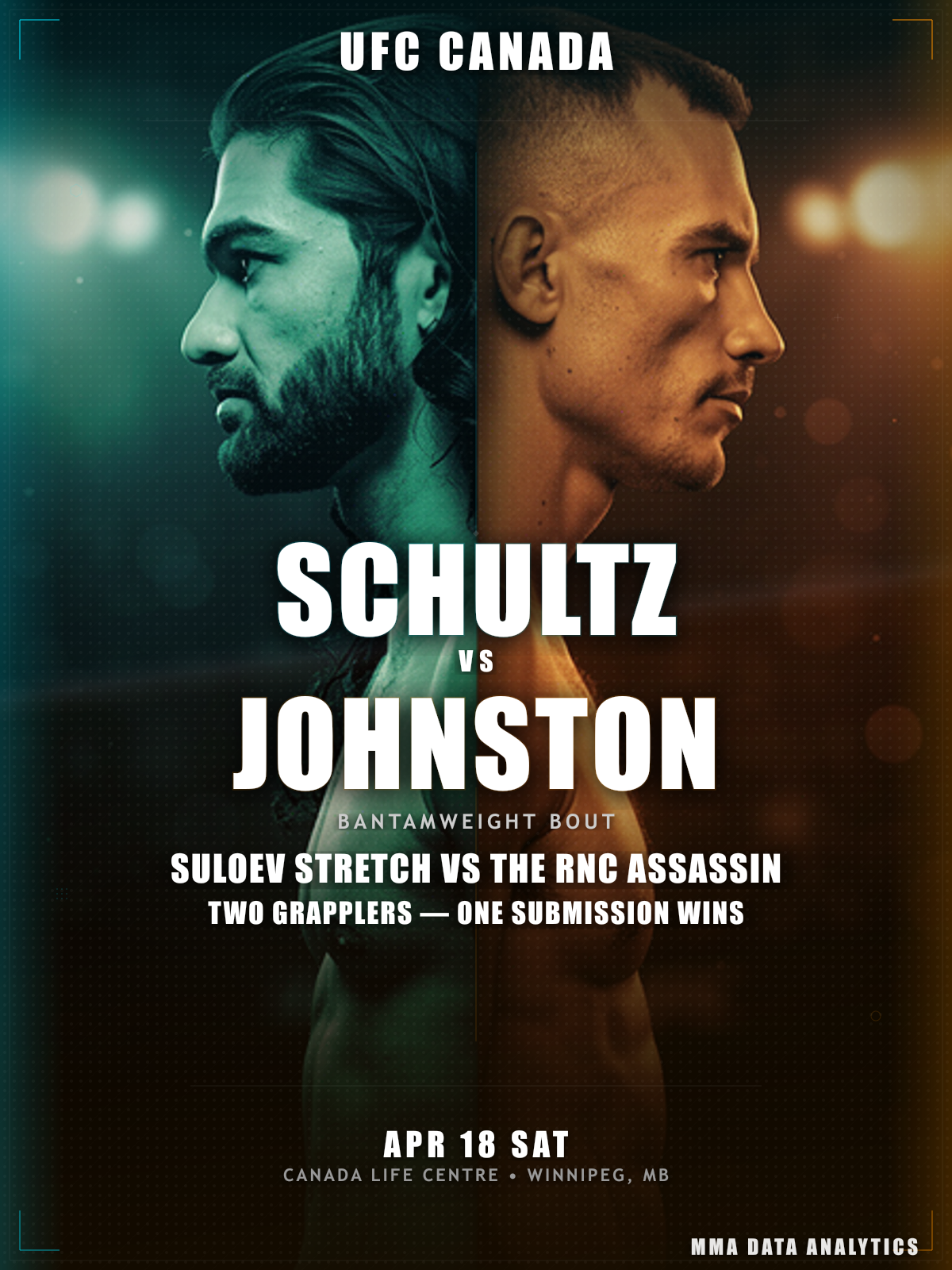
Wes Schultz vs Ben Johnston
Men's Bantamweight Bout • UFC Fight Night: Burns vs. Malott
Saturday, April 18, 2026 • 30ft Octagon (Large Cage) • Canada Life Centre, Winnipeg
Explore Detailed Fighter Profiles
Click on either the fighter's name or profile image for each fighter to access comprehensive UFC statistics including striking metrics, grappling data, clinch performance, complete fight history, offensive & defensive analytics, and round-by-round breakdowns.
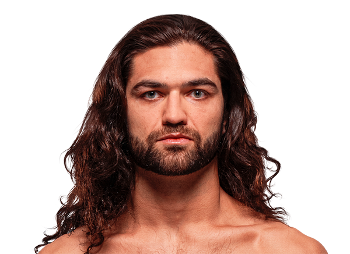
Wes Schultz
Fighter Metrics
Victory Methods
Win Round Distribution

Ben Johnston
Fighter Metrics
Victory Methods
Win Round Distribution
📋 Last 5 Fights - Wes Schultz
| Date | Opponent | Result | Method |
|---|---|---|---|
| Feb 28, 2026 | Damian Pinas | L | TKO (Jab-Cross) (R1, 2:30) |
| Oct 14, 2025 | Mario Mingaj | W | Submission (Suloev Stretch) (R1, 1:51) |
| Apr 12, 2025 | Dustin Pape | W | Submission (Guillotine Choke) (R1, 0:55) |
| Aug 13, 2024 | Mansur Abdul-Malik | L | TKO (Ground & Pound) (R2, 3:55) |
| Apr 5, 2024 | Adland Benson | W | TKO (Ground & Pound) (R1, 3:39) |
📋 Last 5 Fights - Ben Johnston
| Date | Opponent | Result | Method |
|---|---|---|---|
| Mar 16, 2024 | John Martin Fraser | W | Submission (Rear Naked Choke) (R2, 1:15) |
| Sep 23, 2023 | Yoon Seo Shin | W | TKO (Knee & Punches) (R1, 3:42) |
| Jul 1, 2023 | Emil Jeries | W | Submission (Rear Naked Choke) (R1, 1:44) |
| Jul 16, 2022 | Kahn Sandy | W | Submission (Rear Naked Choke) (R2, 3:04) |
| Mar 19, 2022 | Kaleb Rideout | L | TKO (Strikes) (R1, 1:10) |
Technical Analysis
Technical Score
Cardio Score
Overall Rating
📊 Technical Score
Calculated as the average of Striking Composite (50.0 vs 45.0) and Grappling Composite (72.0 vs 70.0). Balances overall striking effectiveness with grappling ability to measure complete technical skills.
💪 Cardio Score
Based on average fight duration, striking rate per minute, takedown rate, and finish rate. Measures cardiovascular endurance and ability to maintain pace throughout fights.
🎯 Overall Rating
Simple average of Technical Score and Cardio Score. Provides a holistic view of fighter capabilities combining skill level with physical conditioning and fight performance.
Striking Composite
Grappling Composite
Technical Radar Comparison
Visual comparison of key performance metrics between both fighters
📊 Detailed Statistical Comparison
🥊 Fight Analysis Breakdown
🧩 Wes Schultz Key Advantages
Schultz owns a more diverse finishing toolkit than Johnston, having won by Suloev Stretch, Guillotine Choke, and TKO ground-and-pound. The Suloev Stretch in particular—a shoulder-compression lock from the back—is a rare and technically demanding submission that requires elite positional control to execute. Johnston's four wins have all been by Rear Naked Choke, making him a one-trick specialist, whereas Schultz can pivot between multiple finishing paths depending on the positional battle. This versatility means Schultz doesn't need to force one specific position—he can submit opponents from guard, back control, or top position. His 88% finish rate across 11 fights confirms this is not selective memory but a consistent pattern of decisive victories across varied scenarios.
Schultz has been battle-tested at significantly higher competition levels than Johnston, who has fought exclusively in Eternal MMA (Australian regional circuit). Schultz earned a UFC contract via the Dana White Contender Series, defeating Mario Mingaj in 1:51 of R1—and his two losses came against Damian Pinas (UFC, 8-2 at time of fight) and Mansur Abdul-Malik (DWCS, 5-0 unbeaten prospect). These are losses to legitimate quality opponents, not skills deficiencies. Johnston's opposition—Fraser (7-3), Shin (0-2), Jeries (1-0)—represents far softer competition. Schultz's ability to compete in UFC-caliber environments, even in a losing effort, suggests a durability advantage when stepping up to this level.
Unlike Johnston whose only TKO win came from a somewhat one-sided early stoppage, Schultz has won twice by ground-and-pound TKO—demonstrating the ability to secure dominant top position and force stoppages with strikes. This dual threat (submissions AND TKO) makes Schultz significantly harder to game-plan against. Johnston must fear both choke attempts and strikes from top position, which creates the hesitation that leads to defensive errors. Schultz's aggressive ground-and-pound game also means he doesn't need to overextend for a clean submission finish— he can accumulate damage from top position until the referee steps in.
⚠️ Unfavorable Scenarios
Johnston's four RNC wins all came from back control, meaning he is elite at taking the back and finishing from there. If Schultz gets scrambled to his belly or turtles up on the mat, Johnston's finishing weapon is activated. Schultz has shown some vulnerability to being stopped on the ground (TKO loss to Abdul-Malik via ground-and-pound), suggesting that sustained bottom position is a danger zone. Schultz must avoid giving his back at all costs.
Both of Schultz's losses came by TKO, suggesting he can be stopped by strikes. Johnston's single TKO win (Knee & Punches vs Shin) and active striking game could create a path to an early stoppage if Johnston mixes his striking to set up transitions. Schultz's 52% striking defense is lower than ideal—if Johnston lands cleanly early, he can change the fight dynamic before Schultz's submission game can be deployed.
📋 Likely Gameplan
Schultz should use his higher estimated takedown volume (3.2 TD15) to pressure early and often, getting Johnston to the mat where the submission battle begins. From top position, Schultz can mix ground-and-pound with submission attempts—guilotine from guard attempts, back-take attempts, and Suloev Stretch setups. The goal is not to force one specific submission but to keep Johnston guessing. Schultz must secure dominant positions (side control, mount, or back control) before going for submissions to avoid giving up a reversal that puts him in Johnston's RNC finishing position.
With similar grappling ability, Schultz should use striking as a setup tool rather than a primary weapon. Jabs and overhands can force Johnston to react defensively, creating the distraction needed for clean takedown entries. Schultz's 2 TKO wins by ground-and-pound suggest he's comfortable striking from top position once the fight hits the mat. This two-phase approach—strike to distract, shoot to takedown, submit or TKO from top—is his proven template for winning.
🚀 Ben Johnston Key Advantages
Johnston has finished four of his five career wins by Rear Naked Choke — an extraordinary level of submission consistency that defines him as one of the most lethal back- control specialists in regional MMA. All four RNC finishes came in R1 or R2, suggesting Johnston works quickly once he obtains the back — he doesn't stall or grind. His estimated 2.8 Sub/15 reflects this aggression. If Johnston can secure back control on Schultz at any point in the fight, he has demonstrated the technique and finishing instinct to end it rapidly. Schultz's two TKO losses show he can be finished on the ground, meaning bottom position for Schultz against a RNC specialist is genuinely dangerous.
Johnston is 5-1-0 with a 100% finish rate — he has never been to a judges' decision in a win. Every time Johnston prevails, he finishes. This indicates either elite finishing instinct or the ability to control dominant positions long enough to force stoppages. His 83% overall win rate (5/6) and 3-fight winning streak heading into this bout suggest he's improving with each outing. The clean record (only one loss, in his debut) indicates Johnston has resolved early weaknesses. By contrast, Schultz owns a 73% win rate with 3 losses, including his UFC debut loss — Johnston enters this fight with superior momentum and a cleaner trajectory.
⚠️ Unfavorable Scenarios
Johnston's entire career has been in Australian regional MMA (Eternal MMA), fighting opponents with combined records of Fraser (7-3), Shin (0-2), Jeries (1-0), Sandy (3-2), and Rideout (5-2). Even his best win, Fraser, was a domestic regional fighter. Schultz has operated at DWCS and UFC level, absorbing losses to quality unbeaten prospects. The jump to UFC-caliber competition is massive, and Johnston has zero experience at this level. Physical attributes, pace, and technique all increase significantly at UFC events.
All four submission wins are Rear Naked Chokes — Johnston has not won by any other submission technique. This predictability is exploitable: Schultz, as an experienced submission grappler himself, will know to protect his neck and back. An opponent who is aware of Johnston's RNC obsession can defend back-takes specifically and limit the primary finishing path. Schultz's diverse arsenal (Suloev Stretch, Guillotine, TKO) means Johnston cannot predict what submission to defend, giving Schultz a strategic asymmetry.
📋 Likely Gameplan
Johnston's entire offensive system is built around back control. His gameplan should focus on clinch wrestling and positional grappling designed to create back-take opportunities — trips, body-lock scrambles, and transition chains that put him behind Schultz. Once back control is established, Johnston's RNC is elite and fast. He should press the action early and not allow the fight to stall standing, where Schultz's UFC experience may give him an edge. In R1, Johnston must force the grappling exchange and demonstrate his back-take is a problem.
Johnston's TKO win over Yoon Seo Shin (Knee & Punches) shows he can mix striking into his offense. Against Schultz, targeted striking combinations designed to force reaction can create the stumble or defensive shell position that leads to back-take opportunities. Johnston should press forward behind combinations, then seek body locks or clinch transitions when Schultz covers up. The goal is to create chaos in the clinch where his back-take instincts take over. Early damage via striking also disrupts Schultz's confidence, potentially forcing him into defensive grappling positions rather than offensive submission hunting.
🎯 Fight Prediction Analysis
Data-driven prediction model based on statistical analysis
📊Detailed Analysis Summary
🏟️Cage Dynamics
The 30-foot octagon in Winnipeg creates an interesting dynamic for this submission-vs-submission matchup. Both fighters want to grapple, which means the fight is likely to hit the mat frequently. Schultz's slightly higher estimated takedown volume (3.2 TD15) and UFC/DWCS experience give him an edge in dictating where the fight goes. The larger cage gives both fighters room to circle and set up grappling entries, but it also provides more escape angle when grappling against the fence.
Against the fence, Schultz can lean on his clinch wrestling to pin Johnston and work trips and body locks—this is where his UFC-level preparation likely exceeds Johnston's regional experience. Johnston needs to avoid getting pinned in the fence game and must create scrambles where his back-take instinct activates. The larger perimeter means Johnston has more space to create those scrambles rather than being driven directly into the cage.
🎯Technical Breakdown
This is a rare regional grappler vs regional grappler matchup where both men want the same thing — submission finishes. The key differentiator is finishing style: Schultz is versatile (Suloev Stretch, Guillotine, TKO), while Johnston is a RNC specialist. Schultz's diversity creates uncertainty; Johnston's specialization creates elite execution in one specific scenario.
The experience gap is significant. Schultz has competed at DWCS where he defeated Mario Mingaj in 1:51, and his UFC debut loss to Damian Pinas (8-1) demonstrates familiarity with elite-level pace. Johnston has never left Australian regional MMA, fighting opponents with a combined pro record that does not approach UFC-caliber competition. This gap typically shows up in conditioning, pace, and the ability to execute technique under elevated pressure.
The fight hinges on whose grappling translates first. Schultz needs to take top position and avoid giving his back. Johnston must create scrambles that generate back-take opportunities and capitalize before Schultz's experience settles the fight.
🧩Key Battle Areas
1) Who Gets Top Position: Both fighters want to grapple, making the takedown exchange critical. Schultz's higher estimated TD volume (3.2 vs 2.5 per 15min) and superior accuracy (52% vs 60%) suggest a closely contested grappling battle, but Schultz's DWCS/UFC experience likely gives him an edge in shot setups and scramble awareness.
2) Back Protection: Johnston's entire submission game depends on getting the back. Schultz, as an experienced submission grappler, must prioritize back awareness in every scramble — never turning away from Johnston during transitions. If Schultz surrenders the back even once, Johnston has demonstrated the ability to finish quickly.
3) Submission Variety: Schultz's ability to threaten from multiple positions (Suloev Stretch from top half guard, Guillotine from front headlock, TKO from mount) gives Johnston a complex defensive problem. Johnston has historically only needed to defend one primary finishing position (his own guard passing to back takes).
Verdict: If Schultz takes top position and avoids scrambles, his submission diversity should eventually find a finish. If Johnston creates chaos and gets the back in even one scramble, his RNC is elite enough to end the fight quickly.
🏁Final Prediction
Most Likely Outcome: Schultz by Submission (28%)— Schultz uses his experience edge to establish top position and works his diverse submission game, eventually forcing a Suloev Stretch or guillotine from a dominant position. His DWCS/UFC exposure provides the technical edge needed to control the grappling scrambles against a regional opponent.
Johnston by RNC Submission (25%) — Johnston forces a scramble, takes the back, and executes his signature Rear Naked Choke within R1 or R2. His 100% finish rate and four straight RNCs make this outcome very real — if he gets the back, he finishes. Schultz must never make the mistake of turning away from Johnston.
Schultz by TKO (15%) — Schultz secures top position and transitions to ground-and-pound when submissions are defended, accumulating enough damage for the referee stoppage. His 2 TKO wins by GnP make this a real path.
Schultz by Decision (10%) — The fight is competitive but Schultz outworks Johnston over 3 rounds via takedowns and top control without securing a finish. Unlikely given both fighters' finish rates.
Assessment: This is a closely contested matchup between two submission grapplers at different levels of competition. Schultz's experience at DWCS and UFC level gives him the edge, but Johnston's perfect finish rate and elite RNC specialization make him dangerous in every scramble. The fight likely ends in a submission — the question is whose.
💰 Betting Analysis: Model vs Market
Detailed value assessment in the betting market
📊Market Odds
🤖Analytical Model
💎Value Opportunities
MAXIMUM VALUE
Model: 25% | Fair: +300
GOOD VALUE
Model: 28% | Fair: +257
SLIGHT VALUE
Model: 68% | Fair: +47
⚠️Key Market Discrepancies
- • Johnston's RNC is elite – Four straight RNC finishes is a pattern of mastery, not coincidence.
- • Schultz's UFC experience matters – His DWCS win and UFC debut provide a significant competition-level edge over a regional fighter.
- • Both fighters likely finish – With 88% and 100% finish rates, the fight going to the scorecards is the real upset scenario.
🎯 Comprehensive Probabilistic Analysis
100 hypothetical fight simulation based on statistical data
🏆Outcome Distribution - Wes Schultz
Suloev Stretch or Guillotine from top control
Ground-and-pound accumulation from top position
Neither finisher finds the finish — rare outcome
💥Outcome Distribution - Ben Johnston
Primary threat via back control and RNC
Striking to set up grappling, surprise finish
Unlikely given both fighters' 100% finish intent
⏰Fight Timeline Analysis
R1: Most Dangerous Round
This fight is most likely to end in R1. Both fighters have demonstrated the ability to finish quickly — Johnston finishes in R1 twice (vs Jeries and Shin) and Schultz submits Pape in just 55 seconds. The early grappling exchange is the defining moment: if Schultz establishes top position and begins working his submission game, Johnston's primary path to victory (back control) closes quickly. Conversely, if Johnston creates a scramble that exposes Schultz's back in the first minute, his fast RNC finish is a real possibility. Both fighters will be fresh and aggressive — this is the highest-variance round.
R2: Experience Matters
If the fight survives R1, Schultz's DWCS and UFC experience begins to assert itself. Johnston has never competed past regional Australian MMA — the increased pace, intensity, and technical precision of a UFC card changes the game. Schultz, who has been on the Contender Series and survived his UFC debut (even in a loss to a quality opponent), understands this environment. In R2, Schultz should be settling into his submission game while Johnston may find the pace harder than any previous fight. If Johnston failed to land his signature back-take in R1, this round is increasingly Schultz's to control.
R3: Schultz's Conditioned Edge
If the fight reaches R3, the competition-level gap in conditioning becomes decisive. Johnston's longest winning streak was 4 fights in Australian regional competition — he has never been tested over three hard rounds at UFC-caliber pace. Schultz, who has competed at DWCS and UFC with opponents who have elite fitness, is conditioned for this environment. In a competitive R3, Schultz should be able to out-work Johnston from top position, accumulating submission attempts and ground-and-pound while Johnston's gas tank limits his scramble attempts. The longer this fight goes, the more Schultz's experience edge separates the fighters.
⚡Window of Opportunity - Ben Johnston
- • First 5 minutes: Highest RNC equity before Schultz's experience settles the grappling.
- • Force scrambles: Create chaotic transitions that generate back-take opportunities.
- • Early strikes: Mix striking to disrupt Schultz's composure and set up clinch wrestling.
🎯Progressive Dominance - Wes Schultz
- • Take top position early: First takedown sets the grappling control narrative for the fight.
- • Protect the back: Never give Johnston back control — that's his one elite weapon.
- • Submission variety: Keep Johnston guessing between Guillotine, Suloev Stretch, and GnP.
🎯 Final Confidence Assessment
Confidence level and uncertainty factors
Confidence Level
Moderate edge via experience, tempered by Johnston's elite RNC and perfect finish rate
✅Supporting Factors
- • DWCS/UFC experience vs Australian regional competition
- • More diverse submission arsenal (Suloev, Guillotine, TKO)
- • Higher volume of finishes (88%) across tougher opposition
- • TKO wins show ability to finish from top position
⚠️Risk Factors
- • Johnston's RNC mastery — 4 straight finishes, 100% finish rate
- • Schultz's UFC debut loss may carry mental pressure
- • Back control for even one scramble could end it immediately
- • Johnston's cleaner record (5-1 vs 8-3) shows better career trajectory
🏁Executive Summary
Wes Schultz' experience advantage — DWCS win and UFC debut appearance — gives him the edge over Ben Johnston, who has competed exclusively in Australian regional MMA (Eternal MMA). Schultz's diverse submission arsenal (Suloev Stretch, Guillotine, TKO ground-and-pound) creates multiple finishing paths, while Johnston is a specialist whose entire game revolves around securing back control for the Rear Naked Choke. Johnston's four consecutive RNC wins demonstrate elite technique in that specific position, but Schultz's experience with higher-level grapplers means he understands back protection better than Johnston's previous opponents.
Prediction: Schultz by Submission most likely (28% probability) via his diverse grappling game from top position; Johnston's primary upset lane is RNC Submission (25%) if he can force a scramble and take the back. Both fighters finish — this fight almost certainly ends inside the distance, with the winner determined by who controls the grappling scrambles.