

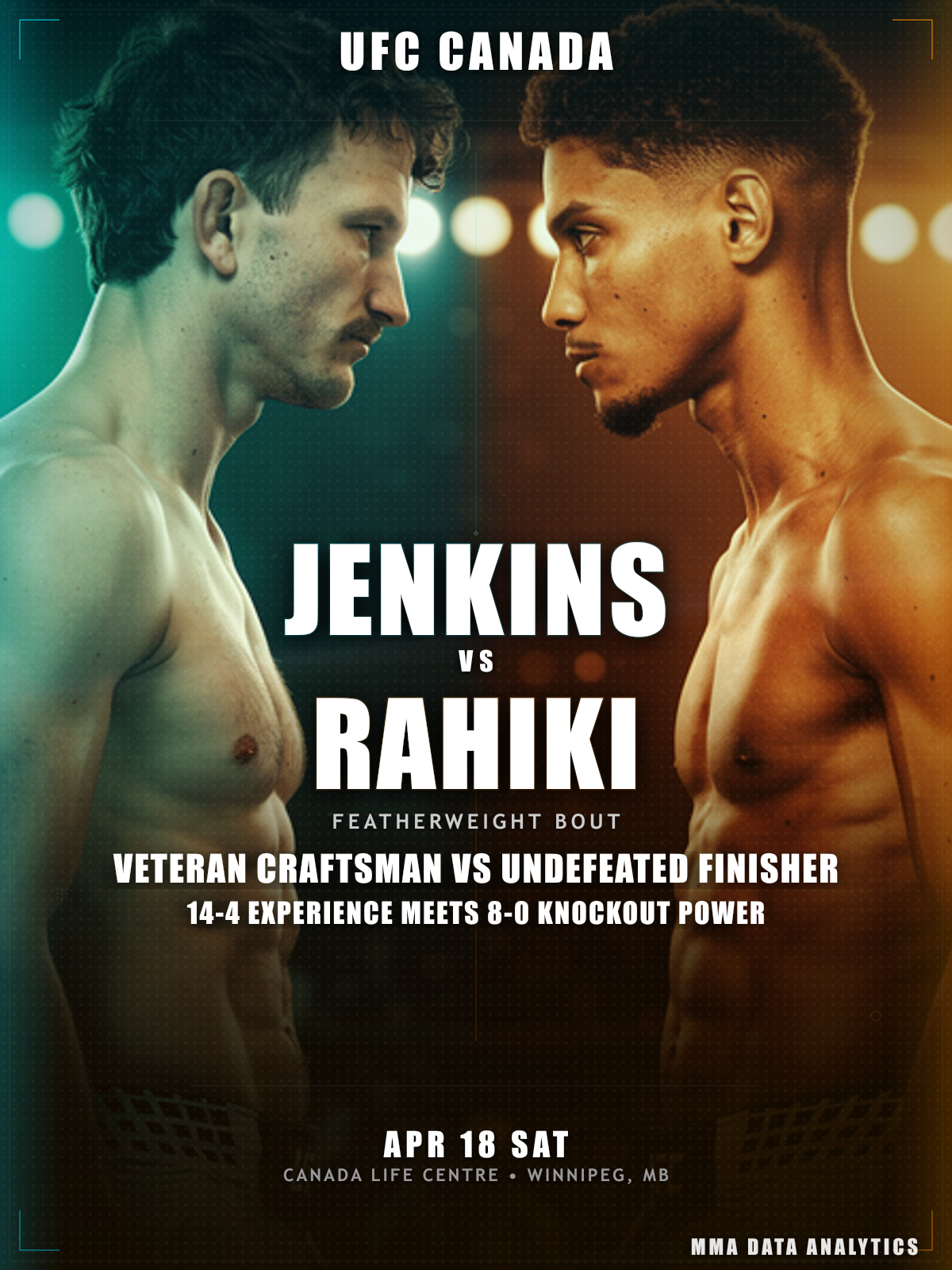
Jack Jenkins vs Marwan Rahiki
Men's Featherweight Bout • UFC Fight Night: Burns vs. Malott
Saturday, April 18, 2026 • 30ft Octagon (Large Cage) • Canada Life Centre, Winnipeg
Explore Detailed Fighter Profiles
Click on either the fighter's name or profile image for each fighter to access comprehensive UFC statistics including striking metrics, grappling data, clinch performance, complete fight history, offensive & defensive analytics, and round-by-round breakdowns.
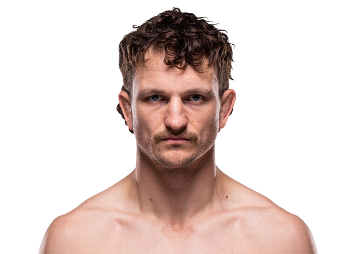
Jack Jenkins
Fighter Metrics
Victory Methods
Win Round Distribution
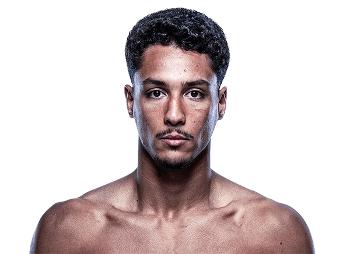
Marwan Rahiki
Fighter Metrics
Victory Methods
Win Round Distribution
📋 Last 5 Fights - Jack Jenkins
| Date | Opponent | Result | Method |
|---|---|---|---|
| Sep 27, 2025 | Ramon Taveras | W | Decision (Unanimous) (R3, 5:00) |
| Feb 8, 2025 | Gabriel Santos | L | Submission (Rear Naked Choke) (R3, 2:06) |
| Aug 17, 2024 | Herbert Burns | W | TKO (Right Hook to Ground Strikes) (R3, 0:48) |
| Sep 9, 2023 | Chepe Mariscal | L | TKO (Verbal Tapout - Arm Injury) (R2, 3:19) |
| Jun 24, 2023 | Jamall Emmers | W | Decision (Split) (R3, 5:00) |
📋 Last 5 Fights - Marwan Rahiki
| Date | Opponent | Result | Method |
|---|---|---|---|
| Mar 14, 2026 | Harry Hardwick | W | TKO (Corner Stoppage) (R2, 5:00) |
| Oct 14, 2025 | Ananias Mulumba | W | TKO (Knee, Elbows & Uppercut) (R2, 2:13) |
| Jul 5, 2025 | Gabriel Schlupp | W | TKO (Ground & Pound) (R2, 5:00) |
| May 31, 2025 | Semakadde Kakembo | W | Submission (Guillotine Choke) (R4, N/A) |
| Mar 1, 2025 | Michael Barber | W | TKO (Punches) (R1, 3:02) |
Technical Analysis
Technical Score
Cardio Score
Overall Rating
📊 Technical Score
Calculated as the average of Striking Composite (62.0 vs 72.0) and Grappling Composite (68.0 vs 18.0). Balances overall striking effectiveness with grappling ability to measure complete technical skills.
💪 Cardio Score
Based on average fight duration, striking rate per minute, takedown rate, and finish rate. Measures cardiovascular endurance and ability to maintain pace throughout fights.
🎯 Overall Rating
Simple average of Technical Score and Cardio Score. Provides a holistic view of fighter capabilities combining skill level with physical conditioning and fight performance.
Striking Composite
Grappling Composite
Technical Radar Comparison
Visual comparison of key performance metrics between both fighters
📊 Detailed Statistical Comparison
🥊 Fight Analysis Breakdown
🧩 Jack Jenkins Key Advantages
Jenkins carries a massive octagon experience advantage: six UFC fights (4-2) against ranked and vetted featherweights, while Rahiki has just one UFC appearance (TKO of Harry Hardwick, corner stoppage in R2). Jenkins has faced opponents who could pressure him, hurt him, take him down, and submit him—and has recovered. His two UFC losses came to Gabriel Santos (RNC, R3) and Chepe Mariscal (arm injury TKO), both competitive contests that tested his composure under adversity. That experience shapes how he manages pressure, reads opponents, and adjusts mid-fight. Rahiki, despite his perfect 8-0 record, has never felt the chaos of a high-level UFC fight where an opponent adapts round by round and forces him into unfamiliar territory. The ability to navigate adversity—to be hurt and continue executing—is irreplaceable, and Jenkins has it; Rahiki's record doesn't tell us yet.
Jenkins' 2.31 takedowns per 15 minutes and 45% takedown accuracy give him a clear grappling pathway against an opponent with zero recorded takedown attempts in his career. Rahiki's 65% takedown defense is built on minimal sample size—his opponents have rarely if ever threatened the takedown. Against a wrestler who attempts 2-3 per round, Rahiki will face repeated level changes, clinch battles, and cage-wrestling sequences he has virtually no experience defending at this level. Jenkins' 76% takedown defense also means that even if Rahiki scrambles to offense, Jenkins can neutralize it. Jenkins has submission wins on his record (3 career), so once he gets top position, he offers legitimate submission threats from dominant control, not just ground-and-pound. Grappling is Jenkins' clearest advantage and Rahiki's biggest unknown.
Rahiki's average fight duration is under 6 minutes—he has never been tested beyond the second round of any meaningful fight. Jenkins' average duration of nearly 12 minutes means he's built for a three-round war; his last three fights have all gone to a R3 decision. If Jenkins can survive the early blitz that defines Rahiki's game—the explosive R1 and R2 finishing blitz—he enters territory where Rahiki is completely unproven. A Rahiki who cannot finish by the midpoint of R2 is a Rahiki who has never faced this situation before. Jenkins' wrestling gameplan naturally eats into the clock and forces Rahiki into a grinding environment that erodes his explosive striking base. The longer this fight goes, the more Jenkins' proven conditioning and fight IQ come to the fore.
⚠️ Unfavorable Scenarios
Rahiki's 7 KO/TKO wins reflect genuine power that has stopped every single opponent. Jenkins' losses have come by submission (RNC vs Santos) and arm injury TKO (vs Mariscal), suggesting his chin and stand-up durability remain partially unknown at the highest KO threat level. If Jenkins stands flat-footed or gets drawn into brawling range in R1 or R2, Rahiki's finishing instinct is his most dangerous weapon. The corner stoppage of Hardwick at the R2 bell shows Rahiki dominates rounds convincingly enough that opponents' corners stop the fight—that's a statement about damage accumulation, not just single shots.
Rahiki's only submission win (guillotine choke vs Kakembo in R4) demonstrates he has the submission awareness to catch wrestlers who shoot carelessly. Jenkins' wrestling approach requires repeated level changes—each one is a potential guillotine opportunity if head position is poor. Although Rahiki is primarily a striker, a single well-timed front headlock during a sloppy Jenkins entry could end the fight unexpectedly. Jenkins must prioritize clean shot mechanics over high-volume takedown attempts.
📋 Likely Gameplan
Jenkins knows Rahiki's danger window is R1 and R2. The smart play is to use his 72-inch reach to maintain distance, stay disciplined on the outside, and avoid reckless exchanges in those early minutes. Once the urgency of an early KO fades, Jenkins can begin integrating his wrestling—clinch-to-takedown sequences, body-lock attacks, and cage wrestling that eats time. His 2.31 TD/15min means he can attempt multiple takedowns per round without gassing, slowly shifting the fight toward his comfort zone. By R2 mid and R3, Rahiki is in unknown territory and Jenkins' conditioning advantage compounds.
Once Jenkins gets Rahiki against the cage or on the mat, the priority is sustained control—not frantic offense. Heavy hips, positional grinding, and short damage from top position accumulate scorecard points and drain Rahiki's gas tank simultaneously. Jenkins' 76% takedown defense ensures that even if Rahiki scrambles back to his feet, Jenkins can re-establish control. Three successful takedowns across the fight, each held for 60-90 seconds, could be enough to win two rounds on the judges' scorecards while keeping Jenkins far away from Rahiki's KO power zone.
🚀 Marwan Rahiki Key Advantages
Rahiki has finished every single professional opponent he has faced—8 for 8—and the manner of those wins speaks to genuine finishing power rather than luck. Seven of his eight wins have come by KO/TKO, including corner stoppages, ground and pound sequences, and brutal knockout combinations. His one submission win (guillotine choke vs Kakembo, R4) shows he can adapt if needed. Against Jenkins, who owns two KO/TKO losses in his career (Mariscal arm injury TKO, plus submission losses), Rahiki's ability to create damage quickly gives him a legitimate early-round upset path. A single clean exchange—as Rahiki has demonstrated repeatedly—can end the fight before Jenkins' experience advantage becomes a factor.
Rahiki's estimated striking rate of 7.2 significant strikes per minute is among the highest in the featherweight division's rising prospects—he overwhelms opponents with relentless volume combined with power. His fights average under 6 minutes precisely because he creates damage so quickly that opponents either get finished or their corners intervene. Against Jenkins, who absorbs 3.83 strikes per minute, Rahiki's 7.2 output creates a significant striking differential in the stand-up. Jenkins' 60% striking defense helps, but absorbing Rahiki's pace over even 2-3 rounds of action is a different test than any previous Jenkins opponent has presented. Rahiki's combination striking—knees, elbows, and uppercuts (as seen vs Mulumba)— diversifies his attack and limits Jenkins' defensive reads.
An undefeated fighter with a 100% finish rate carries a psychological edge that is difficult to quantify but real. Rahiki has never had to deal with adversity, never faced a scorecard deficit, never been hurt and needed to survive a round. That untested confidence can translate into an aggressive, fearless attack that disrupts the game planning of experienced opponents like Jenkins. His DWCS performance earned him a UFC contract by stopping Ananias Mulumba with a brutal combination in R2, and his UFC debut immediately produced a corner stoppage of Hardwick. Momentum, confidence, and a willingness to always press forward are real advantages that statistics cannot fully capture.
⚠️ Unfavorable Scenarios
Rahiki has zero recorded takedown attempts in his career, meaning his opponents have never pressured him with wrestling. Jenkins' 2.31 TD/15min and 45% takedown accuracy against a completely untested grappling defense is a massive unknown. If Jenkins can cage him, take him down, and grind for even 90 seconds per round, Rahiki enters territory where his striking can't be expressed and his finishing instinct becomes irrelevant. Rahiki has never been in a dogfight, never clawed back from a bad position—a scenario where Jenkins repeatedly takes him down and controls him is Rahiki's clearest path to his first loss.
Rahiki's career average fight duration is under 6 minutes. He has never gone past R2 in any fight. If Jenkins survives the early finishing attempts and forces the fight past the 8-minute mark, Rahiki enters genuinely uncharted territory. His gas tank in a 3-round featherweight bout with a physically strong, wrestling-heavy opponent is completely unknown. An undefeated prospect hitting the wall for the first time on the biggest stage of his career is a real risk, and Jenkins' measured gameplan is built to create exactly that scenario.
📋 Likely Gameplan
Rahiki's clearest path to victory is finishing the fight before Jenkins' experience and conditioning advantages take hold. He must come out aggressively in R1—high-volume combinations, working the body to sap Jenkins' wrestling power, and looking for a clean landing that creates a finish opportunity. His TKO of Hardwick came via corner stoppage at R2's end, meaning he dominated an entire round convincingly—applying that same overwhelming pressure to Jenkins early is the blueprint.
Rahiki must avoid cage-wrestling sequences where Jenkins' body lock, trips, and clinch takedowns can neutralize his striking. Maintaining center-octagon positioning— cutting angles, moving laterally, and not allowing Jenkins to crowd him against the fence—keeps the fight in the open where Rahiki's striking volume is most dangerous. When Jenkins shoots, Rahiki should look to sprawl cleanly and stay standing rather than committing to scrambles where Jenkins' grappling experience could take over. His R2 and R3 risk is real if he cannot finish early—keeping the fight in brief, explosive exchanges minimizes time in Jenkins' wheelhouse.
🎯 Fight Prediction Analysis
Data-driven prediction model based on statistical analysis
📊Detailed Analysis Summary
🏟️Cage Dynamics
The 30-foot octagon at Canada Life Centre provides Jenkins with room to use his reach and manage distance before committing to takedown entries—important when facing a striker with Rahiki's early-round KO power. Rahiki benefits from the larger space too, as it gives him more area to stay off the cage and avoid the fence-wrestling clinch sequences where Jenkins is most dangerous. The larger cage slightly favors Jenkins' methodical wrestling approach, since it provides more room for level changes and approach angles without being immediately cornered.
Against the cage, Jenkins can use his body lock and clinch wrestling to drag Rahiki into takedown scenarios without having to shoot across the octagon. If Jenkins can press Rahiki to the fence early, he limits Rahiki's lateral movement and makes his explosive combination striking harder to generate. Rahiki must stay moving and avoid giving Jenkins the cage—his best work happens in open space with full range of motion.
🎯Technical Breakdown
This fight is a classic experienced veteran vs undefeated finisher matchup. Jenkins has the deeper UFC résumé (4-2 vs 1-0), battle-tested composure, and a wrestling game that gives him a legitimate path to winning every round on the judges' scorecards. His 2.31 TD/15min against an opponent with no recorded takedown defense experience at this level is the fight's defining statistical advantage.
Rahiki's counter-argument is impossible to ignore: an 8-0 record with 100% finish rate, where 7 of 8 wins came by KO/TKO, represents finishing power and aggression that transcends sample size concerns. His estimated 7.2 SLpM (extrapolated from available data) vs Jenkins' 5.04 creates a striking volume gap, and his shorter average fight duration (5:48 vs Jenkins' ~12 min) shows he makes fights short by design—not by accident.
Jenkins' wrestling advantage is real and statistically significant, but Rahiki's power means that every exchange carries finish potential. This fight will be decided in the first 8 minutes: if Jenkins neutralizes the early danger and forces the fight toward a grappling war, he wins. If Rahiki lands something clean and forces Jenkins into a firefight, anything can happen.
🧩Key Battle Areas
1) R1 Early-Round Survival (Jenkins): Rahiki has finished 2 of his last 5 fights in R1 and the rest in R2. Jenkins must be disciplined in R1—no reckless exchanges, measured jab to maintain distance, and avoid eating clean combinations while feeling out Rahiki's power level. Surviving the most dangerous window opens Jenkins' gameplan up considerably.
2) First Takedown Success (Jenkins): If Jenkins can get even one successful takedown in R1, he plants the seed of doubt and forces Rahiki to defend the threat throughout the rest of the fight. Rahiki has never been against the mat with a skilled grappler on top—that first experience is a major psychological and tactical shift in the fight narrative.
3) Round 3 Scenario (Jenkins): If the fight reaches R3, Jenkins should be comfortably ahead or at worst even, with Rahiki having exhausted his most dangerous tools. Jenkins must close the fight professionally—no last-minute recklessness that gives Rahiki a miracle KO opportunity.
Verdict: Jenkins by decision is the model's primary outcome path if his wrestling and conditioning plan executes. Rahiki's KO power keeps him live until the final horn. The fight hinges on execution: can Jenkins get past Rahiki's explosive early-round threat and force a prolonged grappling contest?
🏁Final Prediction
Most Likely Outcome: Jenkins by Decision (25%)— Jenkins survives Rahiki's early blitz, uses his wrestling to dictate location and pace, and accumulates control time that wins rounds on the judges' scorecards. His conditioning edge becomes decisive in R2 and R3. Requires Jenkins to be disciplined and not over-commit on striking exchanges.
Rahiki by KO/TKO (38%) — Rahiki's most likely path. Seven career KO wins, 100% finish rate, and the aggressive combination striking he's demonstrated throughout his career give him real early-round KO equity. Jenkins has two stoppages on his record, and if Rahiki lands cleanly in R1 or R2, the fight could be over quickly.
Jenkins by KO/TKO (18%) — Jenkins secures dominant top position and grinds down Rahiki with sustained ground-and-pound. If Rahiki's gas tank runs short in R2 or R3, Jenkins can pour on damage from top position and force a stoppage.
Jenkins by Submission (12%) — Jenkins takes Rahiki down and works a submission from top position. Three career sub wins show he has the technique. Rahiki's limited grappling experience makes him a viable submission target once Jenkins establishes dominant control.
Assessment: Jenkins enters as the more proven and experienced fighter with a clear tactical gameplan, but Rahiki's 100% finish rate and undefeated record remind us that statistics don't measure punch power. The veteran has the blueprint to win; the prospect has the tools to shock everyone in the building.
💰 Betting Analysis: Model vs Market
Detailed value assessment in the betting market
📊Market Odds
🤖Analytical Model
💎Value Opportunities
MAXIMUM VALUE
Model: 25% | Primary path via wrestling control
GOOD VALUE
Model: 38% | Rahiki's primary and most likely path
SLIGHT VALUE
Model: 75% | Rahiki 100% finish rate drives this high
⚠️Key Market Discrepancies
- • Rahiki's KO power is real – Seven KO/TKO wins in 8 fights with an average fight time under 6 minutes. Even odds probably undervalue his early-round finishing threat.
- • Jenkins' grappling vs an untested Rahiki – No opponent has successfully taken Rahiki down. Jenkins' 2.31 TD/15min against unproven grappling defense could be a decisive edge.
- • Late-round collapse risk (Rahiki) – Rahiki has never been in a fight past R2. If Jenkins drags him into R3, Rahiki's cardio and composure are the biggest unknowns on the board.
🎯 Comprehensive Probabilistic Analysis
100 hypothetical fight simulation based on statistical data
🏆Outcome Distribution - Jack Jenkins
Primary path via wrestling control and grinding pace
Ground-and-pound from dominant top position
Choke or armlock from dominant control position
💥Outcome Distribution - Marwan Rahiki
Primary path — explosive combinations in R1/R2
Guillotine on a careless Jenkins takedown entry
Extremely unlikely — Rahiki has 0 career decision wins
⏰Fight Timeline Analysis
R1: Danger Zone
Round 1 is Rahiki's most dangerous window—he has finished two of his last five fights in R1 alone. Rahiki comes out aggressively with high volume (est. 7.2 SLpM), looking to land the kind of clean combination that has ended seven careers before. Jenkins must stay disciplined: use his 72-inch reach to control distance, avoid extended striking sequences, and survive the early blitz without eating anything fight-changing. If Jenkins can get even one takedown in R1 to break Rahiki's rhythm and show him the grappling threat, it changes Rahiki's mental calculus for the rest of the fight. Jenkins' R1 goal is not to win the round outright—it's to survive it and establish his wrestling reality.
R2: The Pivot
If Jenkins survives R1, Round 2 is where the fight's narrative shifts. Rahiki has finished four of his last five fights in R2 via TKO—this is still his most dangerous territory. Jenkins, now familiar with Rahiki's timing, can begin chaining his wrestling attempts with more conviction. His 2.31 TD/15min means two or more takedown attempts this round. If any succeed and Jenkins controls for even 90 seconds, he banks the round. This is also the first round where Rahiki enters uncharted territory in terms of sustained pressure against a skilled wrestler—his gas tank and composure are being tested in ways his career hasn't prepared him for. R2 is the fight's decisive round.
R3: The Deep End
If the fight reaches R3, Jenkins holds an enormous structural advantage: Rahiki has literally never been in a third round. Jenkins' career avg fight duration of ~12 minutes means R3 is his natural habitat. With Rahiki's gas tank an open question and his finishing urgency elevated by the scorecard situation, Jenkins can increase wrestling pressure with maximum commitment. Every takedown attempt carries less risk because Rahiki's energy and timing are diminished. Jenkins' conditioning allows him to sustain pace while Rahiki battles fatigue and the psychological weight of being in uncharted waters. A competitive R3 almost certainly goes to Jenkins, and a dominant one could produce a late TKO finish.
⚡Window of Opportunity - Marwan Rahiki
- • R1 and R2 blitz: Highest KO equity before Jenkins' wrestling control and conditioning take over.
- • Stay mobile: Avoid cage-wrestling sequences where Jenkins' clinch takedowns are most effective.
- • Early combination volume: Relentless combinations to accumulate damage and force Jenkins into reactive, defensive mode.
🎯Progressive Dominance - Jack Jenkins
- • Survive early: Disciplined footwork and jab management in R1 to neutralize Rahiki's finish window.
- • Cage control: Press Rahiki to fence, limit lateral movement and striking angles.
- • Grind and bank rounds: Takedowns plus top control accumulate scorecard points in R2 and R3.
🎯 Final Confidence Assessment
Confidence level and uncertainty factors
Confidence Level
Moderate edge via wrestling and experience, tempered by Rahiki's elite finishing power
✅Supporting Factors
- • Significant takedown volume edge (2.31 TD/15min vs Rahiki's 0)
- • Superior UFC experience (6 fights vs 1)
- • Proven cardio in 3-round fights; Rahiki has never gone past R2
- • Strong TD defense (76%) limits scramble reversal risk
⚠️Risk Factors
- • Rahiki's 100% finish rate — every opponent has been stopped
- • Rahiki's KO power is real (7 TKO wins); Jenkins has been stopped before
- • Rahiki's higher estimated striking volume (7.2 SLpM) overwhelms in firefights
- • Rahiki undefeated, fresh, and driven by momentum; Jenkins 4-2 in UFC
🏁Executive Summary
Jack Jenkins brings the tools of a seasoned UFC veteran into this featherweight contest: 2.31 TD/15min wrestling, 76% takedown defense, proven three-round cardio, and a battle-tested 4-2 UFC record. Marwan Rahiki counters with the most dangerous unknown in combat sports—8-0 with a 100% finish rate and 7 KO/TKO wins, whose fights average under 6 minutes because every opponent has been stopped. Jenkins' experience edge and wrestling depth give him a clear long-game advantage, but Rahiki's power makes every exchange a potential finish opportunity. Jenkins' path is disciplined survival followed by grinding wrestling; Rahiki's path is an early-round blitz before Jenkins' conditioning and grappling can neutralize the threat.
Prediction: Jenkins by Decision most likely (25% probability) through wrestling control and late-round dominance; Rahiki's primary path is KO/TKO (38%) in R1 or R2 via explosive combinations. This fight hinges on one question: can Jenkins survive Rahiki's early finishing window long enough to make this a 15-minute grappling contest?