

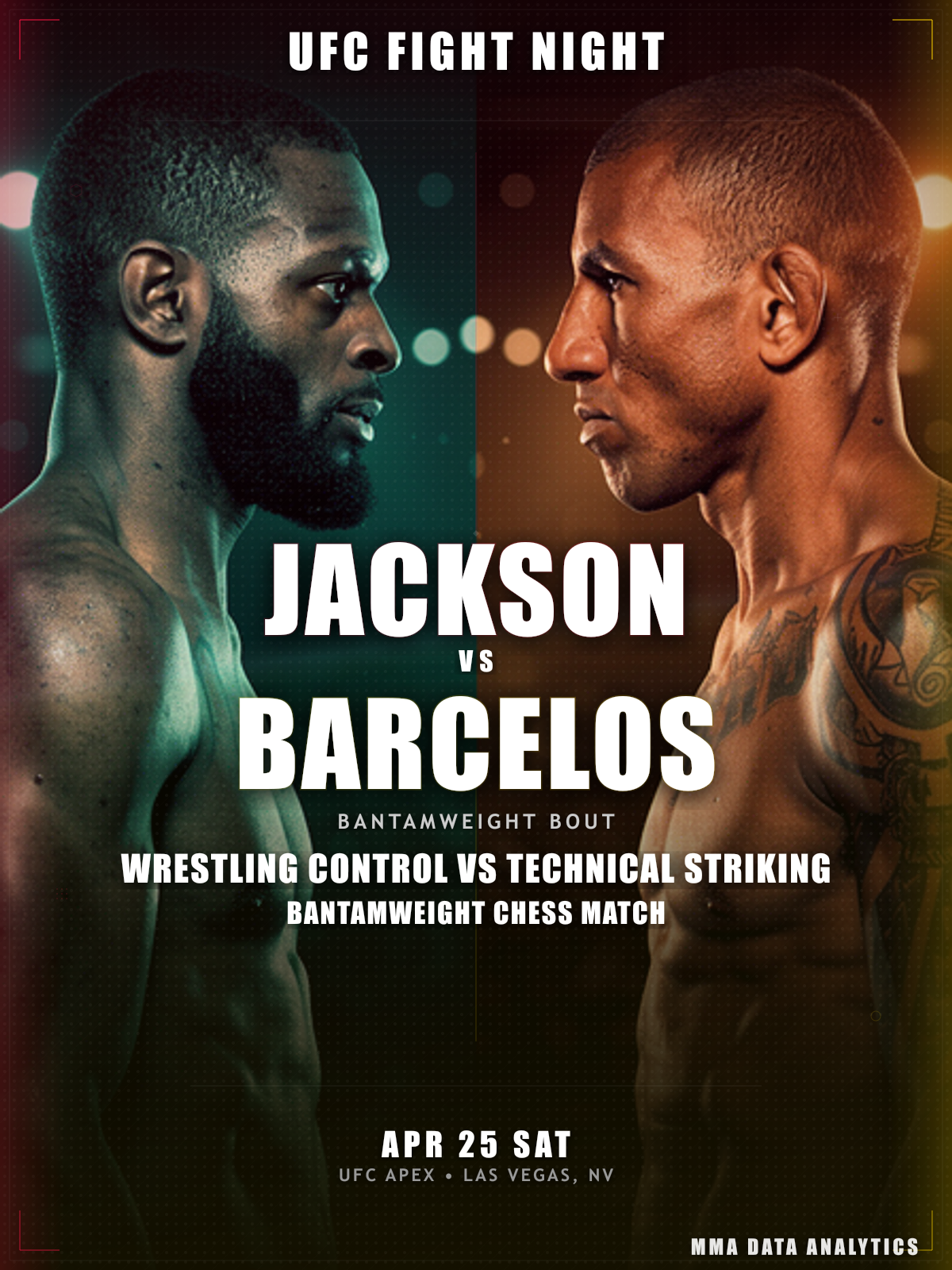
Montel Jackson vs Raoni Barcelos
Men's Bantamweight Bout • UFC Fight Night: Sterling vs Zalal
Saturday, April 25, 2026 • 25ft Octagon (Small Cage)
Explore Detailed Fighter Profiles
Click on either the fighter's name or profile image for each fighter to access comprehensive UFC statistics including striking metrics, grappling data, clinch performance, complete fight history, offensive & defensive analytics, and round-by-round breakdowns.

Montel Jackson
Fighter Metrics
Victory Methods
Win Round Distribution
Raoni Barcelos
Fighter Metrics
Victory Methods
Win Round Distribution
📋 Last 5 Fights - Montel Jackson
| Date | Opponent | Result | Method |
|---|---|---|---|
| 2025-10-11 | Deiveson Figueiredo | L | Decision - Split (R3, 5:00) |
| 2025-05-03 | Daniel Marcos | W | Decision - Unanimous (R3, 5:00) |
| 2024-07-13 | Da'Mon Blackshear | W | TKO - Straight Left (R1, 0:18) |
| 2023-04-22 | Rani Yahya | W | TKO - Counter Left to GNP (R1, 3:42) |
| 2022-11-12 | Julio Arce | W | Decision - Unanimous (R3, 5:00) |
📋 Last 5 Fights - Raoni Barcelos
| Date | Opponent | Result | Method |
|---|---|---|---|
| 2025-11-08 | Ricky Simón | W | Decision - Unanimous (R3, 5:00) |
| 2025-06-14 | Cody Garbrandt | W | Decision - Unanimous (R3, 5:00) |
| 2025-01-18 | Payton Talbott | W | Decision - Unanimous (R3, 5:00) |
| 2024-02-24 | Cristian Quiñonez | W | Submission - Rear Naked Choke (R3, 2:04) |
| 2023-08-05 | Kyler Phillips | L | Decision - Unanimous (R3, 5:00) |
Technical Analysis
Technical Score
Cardio Score
Overall Rating
📊 Technical Score
Calculated as the average of Striking Composite (65.0 vs 67.0) and Grappling Composite (72.0 vs 65.0). Balances overall striking effectiveness with grappling ability to measure complete technical skills.
💪 Cardio Score
Based on average fight duration, striking rate per minute, takedown rate, and finish rate. Measures cardiovascular endurance and ability to maintain pace throughout fights.
🎯 Overall Rating
Simple average of Technical Score and Cardio Score. Provides a holistic view of fighter capabilities combining skill level with physical conditioning and fight performance.
Striking Composite
Grappling Composite
📊 Technical Radar Comparison
📊 Metrics Legend
📊 Detailed Statistical Comparison
🥊 Fight Analysis Breakdown
🧩 Montel Jackson Key Advantages
Jackson's 3.24 takedowns per 15min vs Barcelos' 2.33 provides a meaningful volume advantage that becomes critical in the small 25ft cage. More importantly, Jackson's 63% takedown accuracy dwarfs Barcelos' 33%, meaning Jackson converts nearly double his attempts when he commits to the shot. This wrestling threat gives Jackson the ability to dictate where the fight takes place, especially in the compressed Apex octagon where there is far less space for Barcelos to circle and maintain distance. Jackson's chain-wrestling sequences—single-leg entries to body locks, knee taps off clinch breaks, and mat returns from half-guard positions—create minute-winning cycles that accumulate control time on the scorecards. His ability to mix takedown threats with strikes keeps Barcelos guessing and prevents him from settling into a pure striking rhythm. Against Daniel Marcos, Jackson demonstrated the patience to work methodical wrestling over three rounds; against Blackshear, he showed the explosive power to finish immediately. This dual threat makes his wrestling entries particularly dangerous because Barcelos must respect both the sustained pressure and the sudden burst.
The 3.01 strikes absorbed per minute differential (1.39 vs 4.40) creates an enormous damage economy advantage for Jackson. His 63% striking defense—elite among UFC bantamweights—allows him to fight conservatively while building advantages through wrestling and selective striking. While Barcelos outputs more volume at 4.87 SLpM, he also absorbs significantly more punishment per minute, creating a compounding damage imbalance over three rounds. This differential means Jackson accumulates far less visible damage while maintaining his pace, making him fresher and more effective as the fight progresses. In scoring optics, Jackson's cleaner face and composed demeanor create a psychological advantage with judges who factor in effective defense. The damage economy also reduces Jackson's knockout risk—his 0 KO losses in 18 career fights (15-3) demonstrates remarkable durability, while Barcelos has been stopped by KO/TKO once and absorbs 4.40 SApM, leaving him vulnerable to accumulative damage in the later rounds. Jackson's defensive shell combined with his wrestling threat creates a frustrating puzzle: Barcelos must overcommit to land clean shots, which opens takedown windows.
The 25ft small cage at the UFC Apex heavily favors Jackson's wrestling-centric approach. With 30% less floor space than a standard 30ft octagon, Barcelos has significantly fewer escape routes and less room to circle and reset after exchanges. Jackson can cut off the cage in 2-3 lateral steps instead of 4-5, compressing the time window Barcelos has to establish striking rhythm before facing cage pressure. The compressed space creates more frequent fence engagements and clinch situations, which directly favor Jackson's 75.5-inch reach advantage in dirty boxing and underhook battles. Historically, pressure wrestlers show a measurable win-rate improvement in the small Apex cage—the reduced perimeter forces strikers into reactive positions rather than proactive ones. For Barcelos, the small cage neutralizes one of his key assets: the ability to use angular footwork and lateral movement to create space after exchanges. Every time he circles, he encounters the fence sooner, giving Jackson another opportunity to close distance and initiate his wrestling sequences.
⚠️ Unfavorable Scenarios
If Barcelos maintains distance and builds volume with his 4.87 SLpM output, he can outpace Jackson's 3.22 on the feet by a staggering 51% differential. In extended striking exchanges—particularly in the first round before Jackson establishes his wrestling rhythm—Barcelos can build significant volume advantages that sway judges. His recent victories over Ricky Simón, Cody Garbrandt, and Payton Talbott all came via unanimous decision fueled by volume striking dominance. Jackson needs to avoid prolonged striking sequences and mix in takedown threats to prevent Barcelos from finding rhythm and building momentum on the scorecards. If Barcelos strings together 30+ significant strikes in a round while Jackson lands only 15-18, even control time may not overcome that volume gap in judges' eyes under the current scoring criteria.
Barcelos boasts an elite 86% takedown defense rate—one of the highest in the bantamweight division—which could neutralize Jackson's primary weapon entirely. If Barcelos consistently stuffs Jackson's shots, Jackson will be forced to compete in a striking fight where he is at a massive 51% volume disadvantage. The high TDDef rate suggests Barcelos has excellent hip movement, underhooks, and cage awareness that can frustrate even accomplished wrestlers. His ability to defend Payton Talbott's explosive entries and Ricky Simón's persistent pressure wrestling demonstrates that this 86% holds against diverse wrestling styles. If Jackson burns energy on failed takedown attempts, his own striking output drops further below Barcelos' pace, creating a compounding disadvantage that worsens each round.
📋 Likely Gameplan
Jackson should utilize relentless forward pressure to cut off the cage and create takedown opportunities along the fence. The 25ft cage amplifies this strategy enormously, allowing Jackson to close distance in fewer steps and establish clinch positions before Barcelos can reset. His 63% takedown accuracy means he converts at a high rate once he gets to his shots, and the cage wall provides additional leverage for completing takedowns even against Barcelos' strong 86% defense. The key is persistence— Jackson should not be discouraged by stuffed initial attempts but should immediately re-engage with follow-up shots, body locks from the clinch, and short trips along the fence. His 75.5-inch reach allows him to control wrist positioning in the clinch while threatening takedowns, forcing Barcelos into a constant defensive posture that drains cardio and prevents offensive output.
Jackson needs to keep Barcelos perpetually guessing with level changes and feints. By threatening the takedown, Jackson can open up striking opportunities as Barcelos drops his hands to defend the shot—his 18-second TKO of Da'Mon Blackshear with a straight left demonstrated the devastating power in his hands when opponents overreact to wrestling threats. His 53% striking accuracy shows he can capitalize when openings appear. The key is creating constant uncertainty—when Barcelos expects the shot, Jackson fires straight punches over the top; when Barcelos expects strikes, Jackson level-changes into singles and doubles. This unpredictability prevents Barcelos from settling into his preferred high-output striking rhythm and forces him to fight reactively rather than proactively. The jab feint to level-change entry is particularly effective against high-volume strikers who stay extended in their stance to generate output.
🚀 Raoni Barcelos Key Advantages
Barcelos' 4.87 SLpM output vs Jackson's 3.22 gives him a massive 51% volume advantage on the feet—one of the largest differentials in any bantamweight matchup on this card. This output gap means Barcelos can overwhelm Jackson in standing exchanges, building significant round-winning volume when the fight stays upright. His 53% accuracy matches Jackson's exactly, meaning the higher volume translates directly to roughly 50% more significant strikes landed per minute. Barcelos' ability to maintain this blistering pace while switching stances and varying attack angles makes him exceptionally difficult to counter. His recent stretch of unanimous decisions over Ricky Simón (a pressure wrestler), Cody Garbrandt (explosive power striker), and Payton Talbott (undefeated prospect) demonstrates his volume works against all styles. The Brazilian's combination punching—particularly his lead hook to cross sequences—creates cascading damage that compounds over three rounds and can visibly mark opponents in ways that influence judging.
Barcelos' elite 86% takedown defense is arguably the single most important metric in this fight and the primary reason this matchup is closer than the stylistic breakdown might suggest. If he can consistently stuff Jackson's wrestling entries, he forces a pure striking fight where his 51% volume advantage becomes the deciding factor. His hip movement, underhook fighting, and defensive wrestling fundamentals have been battle-tested against quality grapplers throughout his 14-fight UFC career. The 86% rate suggests he doesn't just defend initial shots but can also resist chain-wrestling sequences and recover from compromised positions along the fence—which is Jackson's primary method of breaking through takedown defense. Notably, Barcelos maintained this elite defense rate even during his 4-fight win streak against wrestlers and grapplers, suggesting it's a reliable, ingrained skill rather than a statistical anomaly. Each stuffed takedown demoralizes the wrestler and wastes energy, shifting momentum toward Barcelos' preferred striking exchanges.
Barcelos' 12:52 average fight duration demonstrates excellent cardiovascular conditioning, significantly higher than Jackson's 10:24—a 2:28 differential that signals Barcelos sustains output deeper into fights. His current 4-fight win streak against quality opposition (Simón, Garbrandt, Talbott, Quiñonez) shows he is peaking at 37 years old with the maturity and fight IQ that comes from 26 professional bouts. His ability to maintain 4.87 SLpM output over three rounds while defending takedowns shows exceptional conditioning that belies his age. The longer the fight stays on the feet, the more Barcelos' cardio advantage compounds—his third-round output historically remains close to his first-round pace, while opponents who wrestle and absorb damage tend to fade. The submission of Quiñonez via rear naked choke in Round 3 also proves Barcelos retains finishing instincts even in the championship rounds, adding a late-fight submission threat that Jackson must respect if he takes the fight to the ground when fatigued.
⚠️ Unfavorable Scenarios
If Jackson gets Barcelos down despite the 86% TDDef, Barcelos absorbs damage and loses valuable minutes on the scorecards. Jackson's 63% TDAcc combined with relentless cage pressure in the 25ft octagon could overcome Barcelos' defensive wrestling through sheer persistence— even an 86% rate means roughly 1 in 7 attempts succeeds, and Jackson averages 3.24 per 15 minutes. Once on the mat, Jackson's ability to maintain top position through rides, half-guard control, and short ground-and-pound negates Barcelos' striking volume completely. Each successful takedown costs Barcelos 60-90 seconds of scoring opportunities and drains significant energy from defending and attempting to stand. The psychological impact compounds too—once taken down successfully, Barcelos may become tentative about committing to offensive combinations, knowing Jackson is loading level-change entries behind his punching exchanges.
Against the fence in the small cage, Barcelos' striking approach is severely compromised while Jackson's 8.5-inch reach advantage (75.5" vs 67") transforms from a striking metric into a clinch-control weapon. Jackson's longer arms allow him to control wrists, pummel for underhooks, and land short elbows and uppercuts from clinch positions that Barcelos struggles to replicate. The 25ft cage dramatically increases the likelihood of clinch engagements—Barcelos encounters the fence faster after every lateral step, giving Jackson repeated opportunities to initiate his chain-wrestling from dominant clinch positions. In this range, Barcelos cannot generate the space needed for his preferred high-volume combinations, effectively silencing his 4.87 SLpM output and reducing the fight to a grappling contest where Jackson holds every physical and technical advantage.
📋 Likely Gameplan
Despite the significant 8.5-inch reach disadvantage, Barcelos' optimal strategy centers on disciplined footwork and angular movement to maintain distance from Jackson's pressure. His lateral movement and ability to circle away from the cage are absolutely critical—every second spent on the fence is a second Jackson can initiate his wrestling sequences. Barcelos must prioritize staying in the center of the octagon, even in the compressed 25ft space, using pivot steps and angle-off counters to avoid being backed up. By making Jackson cover ground to engage, Barcelos can time counter combinations as Jackson closes distance, punishing overcommitted entries with hooks and uppercuts. The key is proactive movement—circling before Jackson establishes cage position rather than reacting after he's already cut off the ring. His wins over Garbrandt and Talbott demonstrated this ability to control range against aggressive opponents.
Barcelos' best strategy is to push relentlessly high output and drown Jackson's measured approach in volume. By maintaining his 4.87 SLpM pace from the opening bell, Barcelos can build striking differentials that sway judges even if Jackson secures some control time through intermittent clinch work. The key is keeping Jackson at range where Barcelos' volume is most effective—punishing level-change entries with intercept knees and uppercuts, immediately circling off the fence after any cage engagement, and resetting to center before Jackson can establish his chain-wrestling. Barcelos should target Jackson's body to slow his forward movement and sap the energy needed for explosive takedown entries. Front kicks to the midsection and calf kicks to compromise Jackson's base are particularly effective at discouraging the level-change shooting motion. If Barcelos can establish early volume dominance in Round 1, it forces Jackson into increasingly desperate wrestling attempts that become more telegraphed and easier to defend.
🎯 Fight Prediction Analysis
Data-driven prediction model based on statistical analysis
📊Detailed Analysis Summary
🏟️Cage Dynamics
The 25-foot octagon at the UFC Apex creates a dynamic that structurally favors Jackson's pressure wrestling style, though Barcelos' adaptability keeps this from being a foregone conclusion. The compressed space—30% less floor area than a standard 30-foot octagon—limits Barcelos' ability to circle and maintain his preferred striking range, creating more frequent cage engagements and clinch situations that play directly to Jackson's strengths. Jackson's 75.5-inch reach advantage (vs Barcelos' 67") becomes particularly valuable in the clinch, where he can control wrists, land short elbows, and create takedown opportunities that would be harder to manufacture in open space. However, Barcelos has fought at the Apex before and understands the spatial constraints—his ability to maintain center position and use angular footwork can mitigate the cage disadvantage. The critical dynamic is that every exchange resets closer to the fence in the small cage, meaning Barcelos must consciously reset to center after every combination or risk being pinned against the wall for extended grappling sequences. The cage size creates a ticking clock for Barcelos: the longer any single exchange lasts, the more likely it drifts toward the fence and Jackson's preferred wrestling range.
🎯Technical Breakdown
The statistical analysis reveals a classic wrestler vs striker dynamic with deeply nuanced edges on both sides. Jackson's 3.24 TD15 vs Barcelos' 2.33 represents a +39% takedown volume advantage, amplified dramatically by his 63% TDAcc vs Barcelos' 33%—meaning Jackson converts nearly twice as many attempts proportionally. However, Barcelos' 86% TDDef is elite-level and represents the primary obstacle that keeps this fight competitive. On the feet, Barcelos' 4.87 SLpM dwarfs Jackson's 3.22, creating a 51% output differential that becomes decisive if the fight stays standing for extended sequences. The damage economy heavily favors Jackson (1.39 SApM vs 4.40), meaning he fights significantly smarter and cleaner—absorbing roughly 3x less damage per minute. Both fighters share identical 53% striking accuracy, making the volume differential the key striking metric rather than precision. The grappling composites tell an interesting story: Jackson's 72.0 vs Barcelos' 65.0 reflects Jackson's wrestling dominance, while the striking composites (65.0 vs 67.0) show Barcelos holds a slight technical edge on the feet. The fight ultimately hinges on which fighter can impose their preferred range—Jackson needs clinch and ground time to leverage his grappling advantage, while Barcelos needs open space and sustained exchanges to exploit his volume superiority.
🧩Key Battle Areas
Four critical battle areas will determine the outcome of this evenly-matched bantamweight contest. First, takedown completion rate vs elite TDDef: Jackson's 63% TDAcc crashing against Barcelos' 86% TDDef is the fight's central equation—if Jackson can complete even 2-3 takedowns across three rounds, his control time and damage economy take over. Second, cage positioning in the 25ft octagon: whoever controls center position dictates the fight's character—Jackson needs fence proximity to initiate wrestling, Barcelos needs open space for volume combinations. Third, striking volume management: Barcelos' 4.87 SLpM vs Jackson's 3.22 creates a 51% output gap that builds insurmountable striking advantages in any round that stays predominantly standing. Fourth, energy expenditure and third-round cardio: Barcelos' 12:52 avg duration vs Jackson's 10:24 suggests the Brazilian paces himself better over three rounds, but defending persistent takedown attempts against the cage wall could drain his reserves faster than in previous fights. The cage size tilts toward Jackson, but Barcelos' 4-fight win streak against quality opponents (Simón, Garbrandt, Talbott, Quiñonez) shows he can adapt to different challenges and tactical puzzles.
🏁Final Prediction
The most likely outcome is Jackson by Decision (30% probability), achieved through consistent wrestling pressure, cage control, and control time accumulation in the small 25ft octagon. Jackson's ability to mix takedowns with selective striking, combined with his elite damage economy (1.39 SApM), creates a scoring framework that judges consistently reward—particularly when one fighter controls pace and position while the other fights reactively. Barcelos by Decision (25%) is the second most likely outcome if his 86% TDDef holds firm and his 4.87 SLpM volume carries rounds convincingly enough to override any control time Jackson accumulates in clinch positions. Jackson by KO/TKO (15%) is viable via ground-and-pound accumulation after secured takedowns or early explosive power shots—his 18-second TKO of Da'Mon Blackshear via straight left demonstrates he carries genuine one-punch stopping power when opponents overcommit defensively. Barcelos by KO/TKO (12%) comes through volume accumulation creating cumulative damage and sharp counters off telegraphed takedown attempts, particularly if Jackson becomes frustrated by defensive wrestling success. Submission finishes carry lower probability for both fighters (Jackson 10%, Barcelos 8%), though Barcelos' RNC of Quiñonez shows he has legitimate finishing instincts on the ground when opportunities present themselves.
💰 Betting Analysis: Model vs Market
Detailed value assessment in the betting market
📊Market Odds
🤖Analytical Model
💎Value Opportunities
MAXIMUM VALUE
Model: 30% | Fair: +233
GOOD VALUE
Model: 25% | Fair: +300
SLIGHT VALUE
Model: 60% | Fair: -150
⚠️Key Market Discrepancies
- • Small cage impact underpriced – Market may not fully account for 25ft cage favoring Jackson's wrestling.
- • Barcelos streak premium – 4-fight win streak may be inflating Barcelos' line beyond statistical value.
- • TDDef vs TDAcc tension – 86% TDDef vs 63% TDAcc creates genuine uncertainty in fight location.
🎯 Comprehensive Probabilistic Analysis
100 hypothetical fight simulation based on statistical data
🏆Outcome Distribution - Montel Jackson
Primary path via wrestling control and cage pressure
Power shots and GNP after takedowns
Opportunistic submissions from top control
💥Outcome Distribution - Raoni Barcelos
Volume striking and TDDef stuffs keep fight standing
Counters off takedown attempts and volume accumulation
Rear naked choke speciality from scrambles
⏰Fight Timeline Analysis
⚡Window of Opportunity - Raoni Barcelos
- • First 5-7 minutes: Highest volume striking advantage window before wrestling pressure drains energy—Barcelos must bank rounds early.
- • Footwork & angles: Stay off the fence and maintain center control at all costs; the 25ft cage punishes lazy positioning severely.
- • Counter opportunities: Punish level changes with knees, uppercuts, and collar ties that create scoring moments and discourage further entries.
- • Body attacks: Target Jackson's midsection with front kicks and hooks to sap his forward-pressure energy and compromise takedown entries.
- • Reset discipline: Immediately circle to center after any fence contact; never let exchanges drag into prolonged clinch battles.
🎯Progressive Dominance - Montel Jackson
- • Cage pressure: Use 25ft cage to cut off movement in 2-3 steps and force clinch engagements along the fence for wrestling entries.
- • Damage economy: Keep absorption low at 1.39 SApM; fight smart, selective, and avoid prolonged striking exchanges where Barcelos builds volume.
- • Chain wrestling: Don't abandon takedown attempts after initial defense; re-shoot, body lock, and work mat returns to exhaust Barcelos' TDDef.
- • Late round control: Wrestling becomes significantly more effective as Barcelos' legs tire from defending—R3 is Jackson's highest win probability round.
- • Level-change mixing: Feint takedowns to open straight punches; feint punches to create clean entry lines for singles and doubles.
🎯 Final Confidence Assessment
Confidence level and uncertainty factors
Confidence Level
Close competitive fight with genuine uncertainty
✅Supporting Factors
- • Wrestling volume edge (3.24 vs 2.33 TD15)
- • Lower absorption rate and better damage economy
- • Small cage favors pressure wrestling approach
- • Significant reach advantage (75.5" vs 67")
⚠️Risk Factors
- • Barcelos on 4-fight win streak, peaking form
- • 86% TDDef could neutralize wrestling
- • Barcelos' volume can sway judges in standing rounds
🏁Executive Summary
Montel Jackson's wrestling-centric approach should benefit significantly from the 25ft small cage at the UFC Apex, where reduced space limits Raoni Barcelos' ability to utilize footwork and maintain striking range. Jackson's 3.24 TD15 with 63% TDAcc represents a clear wrestling volume and efficiency advantage, while his exceptional damage economy (1.39 SApM vs 4.40) means he fights cleaner and more efficiently. However, Barcelos' 86% TDDef is elite-level and creates genuine uncertainty about whether Jackson can execute his wrestling gameplan. Barcelos' 4.87 SLpM volume gives him a significant advantage when the fight stays standing, and his current 4-fight win streak against quality opposition (Simón, Garbrandt, Talbott) demonstrates he is performing at his peak despite being 37 years old.
Prediction: Jackson by Decision most likely (30% probability) through consistent wrestling pressure and cage control in the small octagon; Barcelos by Decision (25%) is the primary counter- scenario if his TDDef holds and volume carries rounds. This is a genuinely competitive fight where the outcome hinges on whether Jackson can break through Barcelos' elite takedown defense—if he can, his control time and damage economy should carry the scorecards; if he cannot, Barcelos' striking volume becomes decisive.