

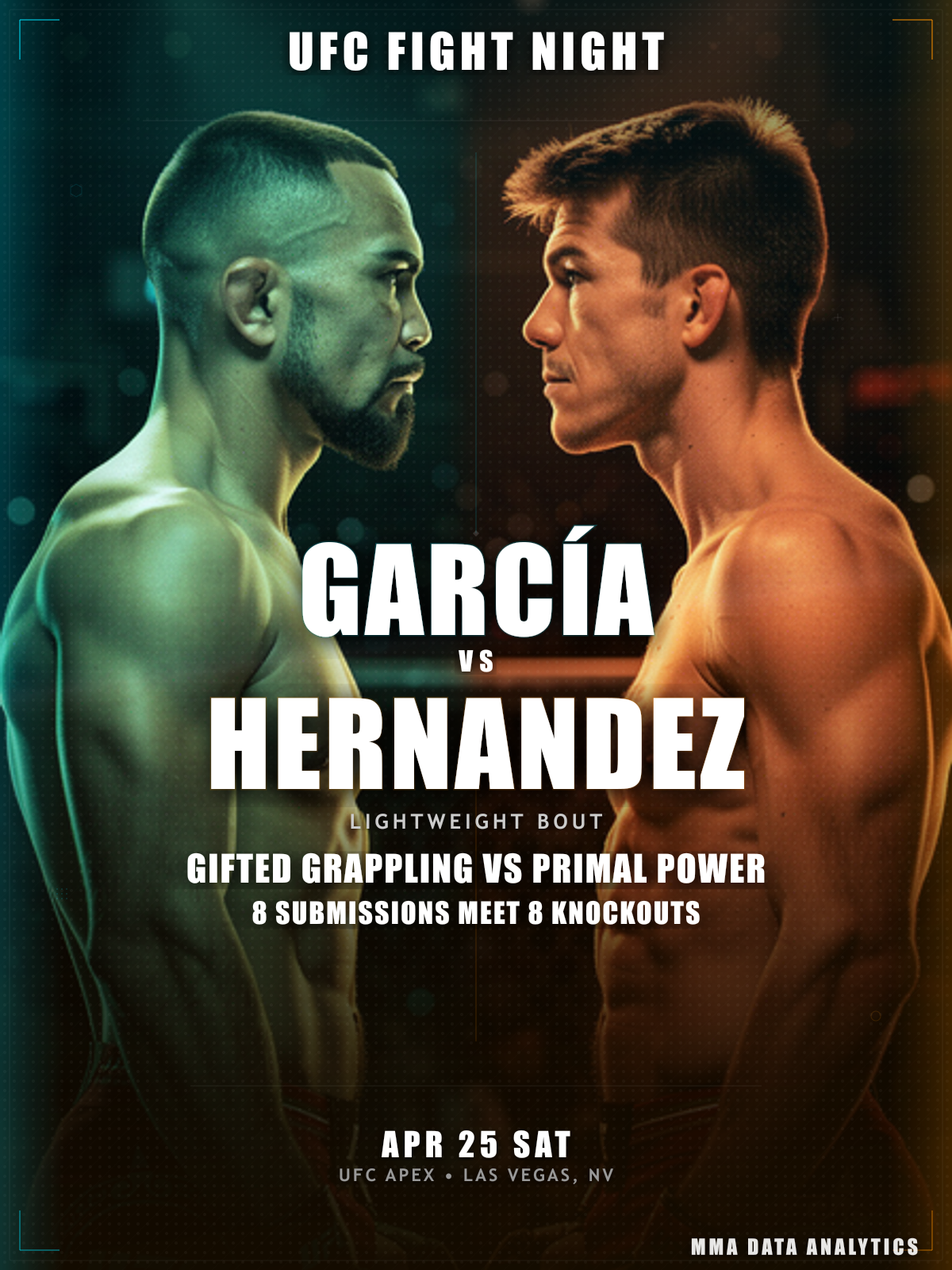
Rafa García vs Alexander Hernandez
Men's Lightweight Bout • UFC Fight Night: Sterling vs. Zalal
Saturday, April 25, 2026 • 25ft Octagon (Small Cage) • Meta APEX, Las Vegas
Explore Detailed Fighter Profiles
Click on either the fighter's name or profile image for each fighter to access comprehensive UFC statistics including striking metrics, grappling data, clinch performance, complete fight history, offensive & defensive analytics, and round-by-round breakdowns.

Rafa García
Fighter Metrics
Victory Methods
Win Round Distribution
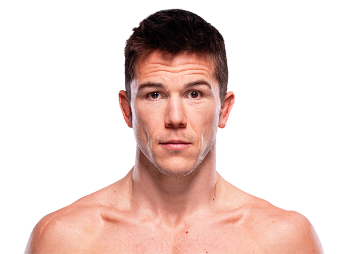
Alexander Hernandez
Fighter Metrics
Victory Methods
Win Round Distribution
📋 Last 5 Fights - Rafa García
| Date | Opponent | Result | Method |
|---|---|---|---|
| Sep 13, 2025 | Jared Gordon | W | TKO (Elbows From Top) (R3, 2:27) |
| Mar 29, 2025 | Vinc Pichel | W | Decision (Unanimous) (R3, 5:00) |
| Oct 12, 2024 | Grant Dawson | L | TKO (Ground & Pound) (R2, 1:42) |
| Apr 15, 2023 | Clay Guida | W | Decision (Unanimous) (R3, 5:00) |
| Dec 17, 2022 | Maheshate | W | Decision (Unanimous) (R3, 5:00) |
📋 Last 5 Fights - Alexander Hernandez
| Date | Opponent | Result | Method |
|---|---|---|---|
| Sep 13, 2025 | Diego Ferreira | W | TKO (Right Cross to GnP) (R2, 3:46) |
| Aug 16, 2025 | Chase Hooper | W | TKO (Right Cross to GnP) (R1, 4:58) |
| Mar 15, 2025 | Kurt Holobaugh | W | Decision (Unanimous) (R3, 5:00) |
| Oct 5, 2024 | Austin Hubbard | W | Decision (Split) (R3, 5:00) |
| Apr 6, 2024 | Damon Jackson | L | Decision (Split) (R3, 5:00) |
Technical Analysis
Technical Score
Cardio Score
Overall Rating
📊 Technical Score
Calculated as the average of Striking Composite (52.0 vs 58.0) and Grappling Composite (72.0 vs 45.0). Balances overall striking effectiveness with grappling ability to measure complete technical skills.
💪 Cardio Score
Based on average fight duration, striking rate per minute, takedown rate, and finish rate. Measures cardiovascular endurance and ability to maintain pace throughout fights.
🎯 Overall Rating
Simple average of Technical Score and Cardio Score. Provides a holistic view of fighter capabilities combining skill level with physical conditioning and fight performance.
Striking Composite
Grappling Composite
Technical Radar Comparison
Visual comparison of key performance metrics between both fighters
📊 Detailed Statistical Comparison
🥊 Fight Analysis Breakdown
🧩 Rafa García Key Advantages
García averages 3.42 takedowns per 15 minutes compared to Hernandez's 1.52—a 2.25x differential that gives García a clear path to dictating where this fight takes place. García's 47% takedown accuracy against Hernandez's 62% takedown defense creates a competitive exchange, but García's volume ensures he'll get multiple opportunities per round. With 8 career submission wins (including armbar, rear-naked choke, and heel hook), García is a constant threat once the fight hits the mat. His former Combate Americas Lightweight Championship demonstrates proven ability to control fights through grappling. Against Hernandez, who has been submitted once in his career, García's relentless pressure wrestling and submission attempts create a multi-layered ground threat that Hernandez must constantly defend.
García's 1.2 submission attempts per 15 minutes dwarfs Hernandez's 0.28, creating a 4.3x differential in submission activity. With 8 career submission wins (47% of total victories), García is one of the most active submission hunters in the lightweight division. His diverse finishing arsenal—armbar, rear-naked choke, heel hook—means Hernandez must defend multiple threats simultaneously. The small 25-foot APEX cage amplifies this advantage, limiting Hernandez's ability to create distance after scrambles and keeping the fight in grappling range. García's recent TKO win over Jared Gordon via elbows from top position shows he's dangerous both with submissions and ground-and-pound, forcing opponents to choose which threat to defend.
García's 55% striking defense vs Hernandez's 52% is a modest edge, but his lower strikes absorbed rate (3.54 SApM vs 4.38) shows he takes significantly less damage per minute—a 19% reduction in damage absorption. Over 15 minutes, this translates to roughly 12-15 fewer significant strikes absorbed, which compounds into less fatigue and better late-round performance. García's 13:05 average fight duration vs Hernandez's 10:41 demonstrates superior cardio endurance. His 68% takedown defense is also solid, meaning if Hernandez attempts to turn the tables with his own wrestling (he has a BJJ black belt), García can defend and return to his feet. This durability allows García to weather early storms and implement his grappling gameplan as the fight progresses.
⚠️ Unfavorable Scenarios
Hernandez's 4.21 SLpM with 46% accuracy outpaces García's 3.16 SLpM at 42%—a clear striking output advantage. Hernandez has 8 career KO/TKO wins and demonstrated devastating power in back-to-back TKO finishes over Ferreira and Hooper. If García gets drawn into extended striking exchanges at range, Hernandez's 2-inch reach advantage (72" vs 70") and superior volume create a dangerous equation. García's 42% striking accuracy is below average for the division, and prolonged standing engagements heavily favor Hernandez.
García gives up 2 inches in both height (5'7" vs 5'9") and reach (70" vs 72"), creating distance management challenges. In the 25-foot cage, Hernandez can use his longer frame to keep García at the end of his punches while García struggles to close distance for clinch entries and takedowns. This size differential means García must work harder to get inside Hernandez's striking range, potentially absorbing damage on entries.
📋 Likely Gameplan
García must close the distance early and often, using feints and level changes to set up takedown entries. The small APEX cage works in his favor—less room for Hernandez to circle away. García should look to push Hernandez to the fence, where his 3.42 TD/15 rate can generate consistent takedown opportunities. Once against the cage, García can work body-lock takedowns and trips that minimize the reach disadvantage. His 47% takedown accuracy means he needs volume, not precision—multiple attempts per round will eventually break through Hernandez's 62% TD defense.
Once García secures top position, he should mix ground-and-pound with submission attempts. His 1.2 Sub/15 rate means he'll be actively hunting for armbars, chokes, and leg locks from dominant positions. His recent TKO of Jared Gordon via elbows from top demonstrates he can finish with strikes too, forcing Hernandez into a lose-lose defensive position. Hernandez's BJJ black belt makes him more technically sound on the ground than most lightweights, so García must be careful about guard passes and back exposure. However, García's relentless submission activity (8 career sub wins) should create enough opportunities over three rounds to either finish or accumulate dominant control time for a decision victory.
🚀 Alexander Hernandez Key Advantages
Hernandez carries legitimate fight-ending power in both hands, with 8 career KO/TKO wins (44% of total victories). His recent back-to-back TKO finishes—dropping Ferreira with a right cross and finishing Hooper in R1—demonstrate he's in peak form. His 4.21 SLpM output with 46% accuracy outpaces García's 3.16 SLpM at 42%, giving him a significant volume and precision advantage on the feet. Against a fighter who must close distance to implement his grappling, Hernandez can time counters on García's entries and punish level changes with uppercuts and knees. His current 4-fight win streak is the best of his career, suggesting he's fighting with peak confidence and timing.
Hernandez stands 2 inches taller (5'9" vs 5'7") with a 2-inch reach advantage (72" vs 70"). This physical edge allows him to fight behind his jab, keep García at the end of his punches, and make García pay for every step forward. In the 25-foot APEX cage, Hernandez can use lateral movement and his longer frame to circle away from García's pressure wrestling. His Orthodox stance with longer limbs creates effective defensive framing that can stuff takedown entries and create distance after clinch breaks. Combined with his 62% takedown defense, Hernandez has the tools to keep this fight standing where he has a clear advantage.
⚠️ Unfavorable Scenarios
Hernandez's 62% takedown defense is decent but not elite, and against García's persistent 3.42 TD/15 volume, he'll face constant grappling pressure. Once on the mat, García's 1.2 Sub/15 submission rate and 8 career submission wins create a multi-layered ground threat. Despite Hernandez's BJJ black belt, he has only 2 career submission wins and doesn't actively hunt for submissions—his grappling is primarily defensive. If García can chain takedowns and maintain top control, the fight becomes a grappling contest where García has a clear experience and activity advantage.
Hernandez's 10:41 average fight duration vs García's 13:05 suggests he may struggle in extended grinding contests. His style relies on explosive power and early finishes—5 of his 8 KO/TKO wins came in R1 or R2. If García can survive the early power and drag the fight into deep waters, Hernandez's output historically drops. The cardio differential becomes significant if García implements his wrestling gameplan, as defending takedowns and working off the back is extremely fatiguing.
📋 Likely Gameplan
Hernandez should utilize his 2-inch reach advantage to fight behind his jab and keep García at distance. When García shoots for takedowns, Hernandez can time uppercuts and knees on entries, punishing level changes. His 62% takedown defense gives him a reasonable base to stuff shots and return to the feet quickly. Hernandez should focus on lateral movement in the cage, avoiding the fence where García's pressure wrestling is most effective. His power right cross—which finished both Ferreira and Hooper—is the key weapon to set behind feints and counters.
Hernandez's best chance comes in the first two rounds when his power and explosiveness are at their peak. His R1 and R2 finish rate is among the highest in the lightweight division, and García must close distance to implement his grappling—creating counter-striking opportunities. If Hernandez can wobble García early, the floodgates open for his ground-and-pound finishes (his last two TKOs came via right cross to ground strikes). Hernandez should look to make this an ugly, violent fight in the opening minutes before García can establish rhythm.
🎯 Fight Prediction Analysis
Data-driven prediction model based on statistical analysis
📊Detailed Analysis Summary
🏟️Cage Dynamics
The 25-foot APEX cage creates a favorable dynamic for García's grappling-heavy approach. The smaller cage limits Hernandez's ability to use his 2-inch reach advantage (72" vs 70") and lateral movement to keep García at distance. With less space to circle, Hernandez will find himself against the fence more frequently—exactly where García's pressure wrestling is most effective. García can cut the cage efficiently and initiate clinch sequences that lead to takedown attempts.
However, the compact cage also creates danger for García. Less distance to close means Hernandez's power strikes arrive faster, and his 4.21 SLpM volume can overwhelm in close quarters. The APEX cage amplifies the explosive early exchanges where Hernandez thrives (5 of 8 KOs in R1-R2). García must survive the initial flurry and use the cage walls to his advantage—pressing forward, establishing underhooks, and converting standing clinch battles into ground positions where his submission game takes over.
🎯Technical Breakdown
This fight presents a classic grappler vs power striker dynamic. García's 3.42 TD/15 vs Hernandez's 1.52 represents a 2.25x wrestling volume differential, while García's 1.2 Sub/15 rate creates a constant submission threat that Hernandez must respect on the ground. Hernandez's 62% takedown defense is solid but may crack under García's persistent volume. However, Hernandez's BJJ black belt means he won't panic on the mat—he has the technical knowledge to defend submissions, even if his offensive grappling is limited (0.28 Sub/15).
The striking comparison clearly favors Hernandez (4.21 SLpM at 46% vs García's 3.16 at 42%), with a significant power differential (8 KO/TKO wins vs 2). García's lower damage absorption (3.54 SApM vs 4.38) suggests he can weather early storms, and his superior cardio (13:05 avg duration vs 10:41) indicates he gets stronger as the fight progresses while Hernandez potentially fades.
The fight will be decided by whether García can close the distance and implement his grappling before Hernandez's power creates a fight-ending moment. García needs to survive the dangerous early exchanges and drag the fight to the mat, while Hernandez must use his size and striking advantage to keep the fight standing and finish within the first two rounds before cardio becomes a factor.
🧩Key Battle Areas
1) Distance Closing: This is THE critical variable. García must bridge the 2-inch reach gap to establish clinch and takedown positions. His best entries will come behind feints and level changes—using the jab to create reactions, then shooting underneath Hernandez's counter strikes. García must avoid lunging in from distance, as Hernandez's power right cross is most effective against fighters moving forward. The APEX cage helps García here—less space for Hernandez to retreat.
2) Takedown Defense vs Volume: Hernandez's 62% takedown defense is respectable, but García's 3.42 TD/15 rate means multiple attempts per round. If García can land 1-2 takedowns per round, the accumulated mat control time dominates scorecards. Hernandez needs to stuff the first few shots to discourage García from shooting, then capitalize on standing exchanges where he holds the advantage.
3) Ground Position Battle: If the fight goes to the mat, García's 1.2 Sub/15 rate vs Hernandez's BJJ black belt creates an interesting dynamic. García is the more active submission hunter, but Hernandez has technical ground knowledge to survive. The question is whether García can create enough submission threats to keep Hernandez defensive, or whether Hernandez can neutralize the ground game and scramble back to his feet.
Verdict: If García can consistently take the fight to the mat and maintain top position, his submission threat and ground control should be decisive over three rounds. If Hernandez keeps the fight standing and uses his power early, his KO potential creates genuine finish equity—especially in R1 and R2 where his output is highest.
🏁Final Prediction
Most Likely Outcome: García by Decision (23%)— García closes distance, establishes wrestling control, and accumulates takedowns and mat time across three rounds. His superior cardio (13:05 avg) allows him to increase grappling pressure in later rounds while Hernandez fatigues from defending. Judges reward consistent control time and submission attempts over Hernandez's sporadic striking bursts. This assumes García survives the early power shots.
Hernandez by KO/TKO (22%) — Hernandez times García's entries with counter strikes, landing a clean right cross as García ducks into a level change. His 8 career KO/TKO wins and back-to-back TKO finishes show this is his most reliable path. The smaller APEX cage means García must close distance quickly, creating counter-striking windows Hernandez excels at exploiting. Most likely in R1-R2.
García by Submission (19%) — García secures a takedown and transitions to a dominant position where his 1.2 Sub/15 rate kicks in. With 8 career submission wins across multiple techniques (armbar, RNC, heel hook), García has the arsenal to finish from any top position. This path becomes more likely in R2-R3 as Hernandez fatigues from defending takedowns.
Hernandez by Decision (15%) — Hernandez stuffs enough takedowns (62% TD Def) to keep the fight predominantly standing, and his 4.21 SLpM volume at 46% accuracy outpoints García over three rounds. This requires consistent takedown defense and effective cage movement.
Assessment: This is a competitive style clash where the fight location (ground vs standing) determines the winner. García has the grappling tools to dominate if he can implement his gameplan, but Hernandez's power and momentum (4-fight win streak with 2 TKOs) make him dangerous every second the fight stays on the feet. The outcome hinges on whether García can survive the early exchanges and drag the fight to his world.
💰 Betting Analysis: Model vs Market
Detailed value assessment in the betting market
📊Market Odds
🤖Analytical Model
💎Value Opportunities
MAXIMUM VALUE
Model: 19% | Fair: +426
GOOD VALUE
Model: 23% | Fair: +335
SLIGHT VALUE
Model: 49% | Fair: +104
⚠️Key Market Discrepancies
- • Hernandez's power is real – Back-to-back TKO finishes via right cross demonstrate fight-ending power on entries.
- • García's submission volume – 1.2 Sub/15 rate with 8 career subs creates constant ground threat.
- • Hernandez's momentum – Career-best 4-fight win streak with 2 TKOs suggests peak form at lightweight.
🎯 Comprehensive Probabilistic Analysis
100 hypothetical fight simulation based on statistical data
🏆Outcome Distribution - Rafa García
Primary path via grappling control and mat time
Ground-and-pound or elbows from top position
Armbar, RNC, or heel hook from dominant position
💥Outcome Distribution - Alexander Hernandez
Primary threat via power right cross and ground-and-pound
Outpointing García on the feet with volume and accuracy
BJJ black belt allows rare but possible submission finish
⏰Fight Timeline Analysis
R1: Feeling Out Round
Hernandez looks to establish his range advantage early, using his jab and 72-inch reach to keep García at distance. García must close the gap quickly—feinting to draw Hernandez's reactions and shooting on the counter. Hernandez is most dangerous in R1 (5 of 8 KOs came early), so García must survive the initial power shots. If García can land an early takedown, it changes the complexion entirely—Hernandez becomes more cautious about his stance and power, creating more wrestling opportunities. This round sets the tone: if Hernandez lands clean power, he builds confidence for a finish. If García gets the first takedown, the grappling narrative takes over.
R2: Pressure & Accumulation
García increases wrestling pressure if R1 went according to plan. His 3.42 TD/15 rate means multiple takedown attempts, and by R2, Hernandez is beginning to feel the energy drain from defending takedowns. García's submission hunting becomes more active— looking for armbars from mount and RNCs from back control. If Hernandez successfully defended early wrestling, R2 becomes his window—his power is still fresh enough to land significant strikes, and García may be forced into riskier entries. However, if García secured mat time in R1, R2 is where accumulated fatigue begins favoring him. Hernandez's 10:41 avg fight duration suggests he starts fading by late R2, while García's 13:05 avg shows he's comfortable at this pace.
R3: Championship Cardio
If the fight reaches R3 competitive, García's cardio advantage becomes decisive. He can increase grappling pressure knowing there's only 5 minutes left—Hernandez's power has diminished from defending takedowns for 10 minutes. García's 13:05 average duration suggests he peaks in late rounds, while Hernandez's 10:41 avg means he's in unfamiliar territory. A competitive R3 favors García heavily. Conversely, if Hernandez has been dominant on the feet and is ahead on scorecards, García must take greater risks with takedown entries—potentially walking into counter strikes. If either fighter secured dominant position in earlier rounds, R3 becomes about sustaining that advantage. García's conditioning allows him to maintain high-volume grappling, while Hernandez must fight through fatigue to keep the fight standing.
⚡Window of Opportunity - Alexander Hernandez
- • First 5 minutes: Highest KO equity before García establishes grappling rhythm.
- • Counter on entries: Punish level changes with uppercuts and knees as García shoots.
- • Power right cross: Set up his signature weapon behind feints and distance management.
🎯Progressive Dominance - Rafa García
- • Pressure wrestling: Close distance behind feints, chain takedowns against the cage.
- • Cage cutting: Push Hernandez to fence, limit his lateral movement and reach advantage.
- • Submission hunting: Mix ground-and-pound with armbar, RNC, and heel hook attempts.
🎯 Final Confidence Assessment
Confidence level and uncertainty factors
Confidence Level
Moderate edge via grappling, tempered by Hernandez's power and momentum
✅Supporting Factors
- • Strong takedown volume edge (3.42 vs 1.52 TD/15)
- • Elite submission rate (1.2 Sub/15 with 8 career subs)
- • Better cardio profile (13:05 avg duration, 70 cardio score)
- • Lower damage absorption (3.54 vs 4.38 SApM)
⚠️Risk Factors
- • Hernandez's knockout power (8 KO/TKO wins, 2 recent TKOs)
- • Hernandez on career-best 4-fight win streak with peak momentum
- • Hernandez's higher striking volume (4.21 vs 3.16 SLpM) and reach (+2")
- • García's size disadvantage (-2" height, -2" reach)
🏁Executive Summary
Rafa García's submission-heavy grappling game should create a clear tactical advantage against Alexander Hernandez in this lightweight contest. García's 3.42 TD/15 vs Hernandez's 1.52 creates a 2.25x takedown volume differential, and his elite 1.2 Sub/15 rate with 8 career submission wins makes him a constant threat on the mat. However, Hernandez's explosive power — 8 KO/TKO wins with back-to-back TKO finishes over Ferreira and Hooper — creates genuine knockout equity on every exchange. The small APEX cage limits Hernandez's ability to use his 2-inch reach advantage, but it also means García must close distance quickly through Hernandez's power range. Hernandez's career-best 4-fight win streak suggests peak form, while García's 2-fight win streak (including a TKO of Gordon) shows he's back on track after a loss to Dawson.
Prediction: García by Decision most likely (23% probability) through consistent grappling pressure and mat control; Hernandez's primary upset lane is KO/TKO (22%) via power strikes on García's entries. This fight hinges on whether García can survive the dangerous early exchanges and drag the fight to the mat, or whether Hernandez's power and reach create a fight-ending moment before García's grappling takes over.