

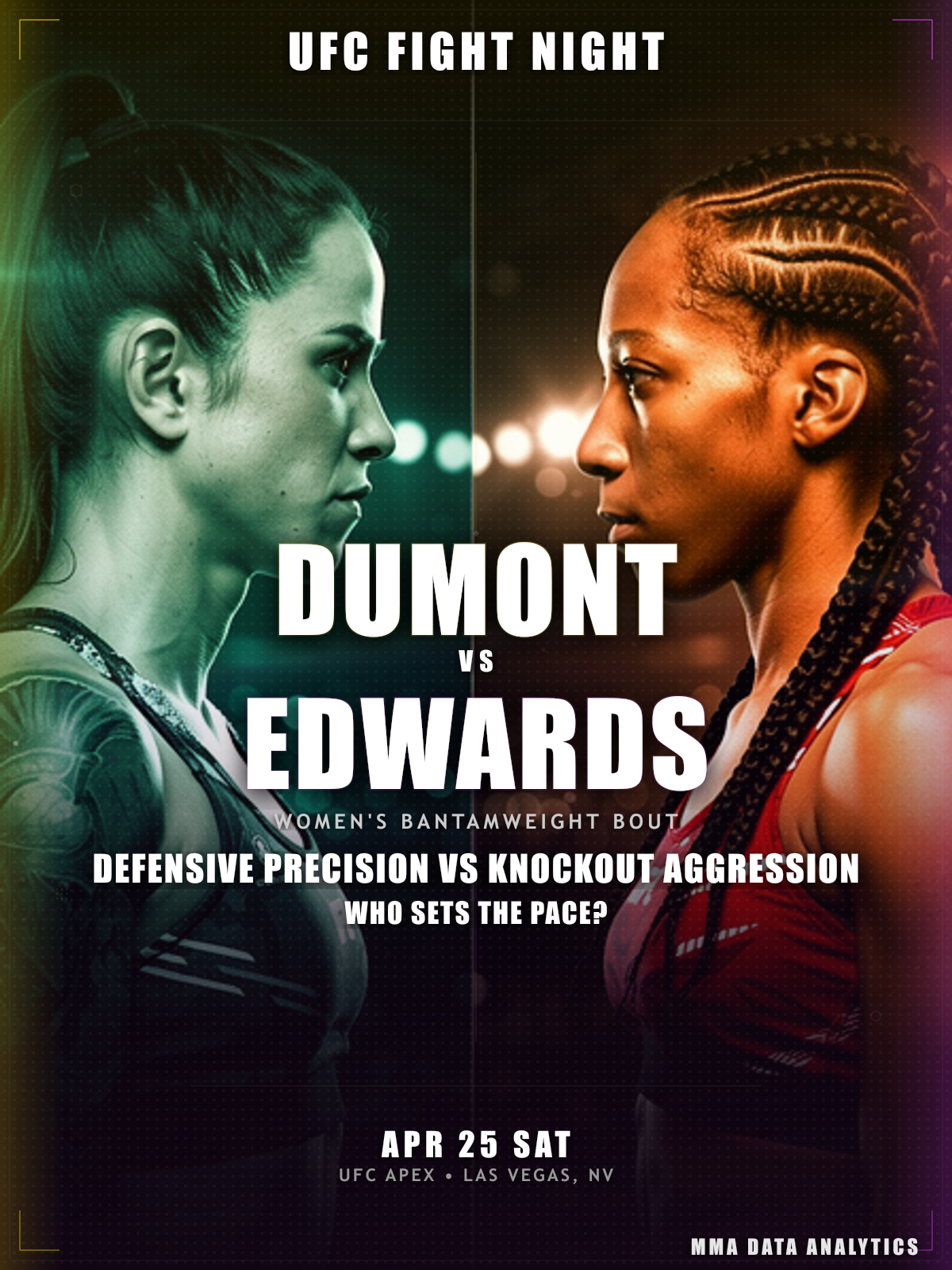
Norma Dumont vs Joselyne Edwards
Women's Bantamweight Bout • UFC Fight Night: Sterling vs Zalal
Saturday, April 25, 2026 • 25ft Octagon (Small Cage)
Explore Detailed Fighter Profiles
Click on either the fighter's name or profile image for each fighter to access comprehensive UFC statistics including striking metrics, grappling data, clinch performance, complete fight history, offensive & defensive analytics, and round-by-round breakdowns.

Norma Dumont
Fighter Metrics
Victory Methods
Win Round Distribution
Joselyne Edwards
Fighter Metrics
Victory Methods
Win Round Distribution
📋 Last 5 Fights - Norma Dumont
| Date | Opponent | Result | Method |
|---|---|---|---|
| 2025-11-01 | Ketlen Vieira | W | Decision - Split (R3, 5:00) |
| 2024-09-14 | Irene Aldana | W | Decision - Unanimous (R3, 5:00) |
| 2024-04-06 | Germaine de Randamie | W | Decision - Unanimous (R3, 5:00) |
| 2023-07-15 | Chelsea Chandler | W | Decision - Unanimous (R3, 5:00) |
| 2023-04-22 | Karol Rosa | W | Decision - Unanimous (R3, 5:00) |
📋 Last 5 Fights - Joselyne Edwards
| Date | Opponent | Result | Method |
|---|---|---|---|
| 2026-02-21 | Nora Cornolle | W | Submission - Rear Naked Choke (R2, 2:44) |
| 2025-08-09 | Priscila Cachoeira | W | TKO - Right Hook & Ground Punch (R1, 2:24) |
| 2025-04-26 | Chelsea Chandler | W | TKO - Hooks (R1, 2:31) |
| 2024-10-19 | Tamires Vidal | W | Submission - Rear Naked Choke (R3, 4:33) |
| 2024-06-01 | Ailin Perez | L | Decision - Unanimous (R3, 5:00) |
Technical Analysis
Technical Score
Cardio Score
Overall Rating
📊 Technical Score
Calculated as the average of Striking Composite (60.0 vs 58.0) and Grappling Composite (52.0 vs 50.0). Balances overall striking effectiveness with grappling ability to measure complete technical skills.
💪 Cardio Score
Based on average fight duration, striking rate per minute, takedown rate, and finish rate. Measures cardiovascular endurance and ability to maintain pace throughout fights.
🎯 Overall Rating
Simple average of Technical Score and Cardio Score. Provides a holistic view of fighter capabilities combining skill level with physical conditioning and fight performance.
Striking Composite
Grappling Composite
Technical Radar Comparison
Visual comparison of key performance metrics between both fighters
📊 Detailed Statistical Comparison
🥊 Fight Analysis Breakdown
🧩 Norma Dumont Key Advantages
Dumont's 66% striking defense vs Edwards' 50% creates a significant damage differential over 3 rounds. She absorbs only 2.16 strikes per minute vs Edwards' 3.28, meaning she takes 34% less damage while maintaining consistent output. This defensive advantage becomes critical as the fight progresses—Dumont can weather Edwards' early storm while preserving energy for later rounds. Her ability to slip, parry, and counter keeps her clean in exchanges where Edwards tends to absorb punishment in return.
Dumont's average fight duration of 14:51 demonstrates elite cardiovascular conditioning that perfectly suits the 3-round format. Her 6-fight win streak—all by decision against ranked opponents including Vieira, Aldana, and de Randamie—shows she can maintain output and sharpness from bell to bell. While Edwards has improved her conditioning with recent finishes, her 12:41 average suggests she pushes harder for early finishes because she knows the championship rounds favor more methodical fighters like Dumont.
Dumont's 70-inch reach vs Edwards' 68 creates a subtle but important advantage in the 25-foot APEX cage. In the smaller octagon, Dumont can establish her jab and front kicks to manage distance effectively, keeping Edwards at the end of her punches where she's less dangerous. Her 50% striking accuracy with longer tools means she can pick Edwards apart from range while avoiding the power exchanges where Edwards thrives. The reach edge also helps stuff entries and create angles when Edwards pressures forward.
Dumont's 6-fight win streak reads like a who's who of women's bantamweight: former title challenger Ketlen Vieira (#4 at the time), ex-champion Irene Aldana (#4), veteran Germaine de Randamie, and solid contenders Chelsea Chandler and Karol Rosa. Edwards' recent finishes—Cornolle (#16), Cachoeira (#16), Chandler (unranked)—came against opponents ranked significantly lower. When the stakes and caliber rise, Dumont has proven she performs; Edwards has yet to beat a top-10 opponent. This experience gap under pressure could be decisive in close exchanges and late-round moments where composure matters most.
⚠️ Unfavorable Scenarios
Edwards' recent form is frightening—4 consecutive finishes with 3 coming in the first 2 rounds. If Edwards can close distance quickly and land her power shots (hooks, uppercuts, ground-and-pound), Dumont's conservative approach becomes a liability. Dumont's 1 KO loss in her career shows she can be hurt, and Edwards' 50% KO/TKO win rate represents a genuine threat. The small APEX cage reduces the space Dumont needs to circle and reset, potentially allowing Edwards to trap her against the fence where finishing sequences begin.
Edwards has shown evolving grappling with 4 career submission wins, including 2 Rear Naked Chokes in her last 4 fights. If Edwards can secure takedowns (1.29 TD/15min vs Dumont's 72% TDDef) or scramble to back control, her submission game presents a real danger. Dumont's 0.0 Sub/15min shows she has no submission offense to threaten from bottom position, and her takedown defense, while solid at 72%, is not impenetrable—Edwards' physical explosiveness could create dangerous grappling exchanges.
In the small APEX octagon, Edwards can cut off angles far more efficiently than in a standard 30-foot cage. Dumont relies on lateral movement and resetting after exchanges, but the 25-foot canvas leaves barely two steps before hitting the fence. Edwards' 86% standing strike rate means most of her damage comes on the feet in close quarters—if she pins Dumont against the cage and chains hooks and uppercuts, the Brazilian's point-fighting approach could unravel. Dumont's only career stoppage loss (TKO) shows the template: sustained close-range pressure she couldn't escape.
📋 Likely Gameplan
Dumont's primary strategy should involve establishing her jab, front kicks, and long straight punches to keep Edwards at range. Her 50% striking accuracy with a 2-inch reach advantage means she can win exchanges at distance while avoiding Edwards' power zone. By maintaining a consistent 3.86 SLpM output over 15 minutes, Dumont can bank rounds through volume and accuracy without taking excessive risks. The key is staying disciplined and not engaging in wild exchanges where Edwards' power is most dangerous.
Dumont must prioritize keeping the fight standing and at distance. When Edwards closes distance, Dumont should utilize clinch defense and cage awareness to break free rather than engage in scrambles where Edwards' athleticism and finishing instincts take over. Maintaining strong posture if taken down and immediately working to stand back up negates Edwards' ground game. The small cage makes this harder, but Dumont's experience against high-level opponents gives her the composure to reset after dangerous exchanges.
Dumont's 20% body and 15% leg strike distribution provide a key tactical lever. Attacking the body saps Edwards' cardio earlier—critical given Edwards already fades in later rounds— while leg kicks punish Edwards' aggressive forward movement and reduce her explosiveness for power shots and takedown entries. By investing in these diversified targets early, Dumont can slow Edwards' output and create a more comfortable range for her jab-heavy game by the second half of the fight.
🚀 Joselyne Edwards Key Advantages
Edwards' ability to finish fights is her defining weapon—8 KO/TKOs and 4 submissions across 17 wins show a truly dangerous fighter. Her recent 4-fight finishing streak (TKO Chandler R1, TKO Cachoeira R1, Sub Vidal R3, Sub Cornolle R2) demonstrates evolving kill instinct and improved fight IQ. Against Dumont's conservative approach, Edwards' power hooks and uppercuts represent a constant threat that can end the fight in any round. Her 54% striking accuracy—higher than Dumont's 50%—means she's not just throwing wild shots but landing with precision.
Unlike pure strikers, Edwards threatens everywhere—standing with KO power, in the clinch with dirty boxing, and on the ground with submissions. Her 0.54 Sub/15min shows active submission hunting, and her recent Rear Naked Choke wins demonstrate improved positional control. This versatility creates a constant decision-making burden for Dumont, who must defend multiple threats simultaneously. The ability to switch from striking to grappling mid-exchange catches opponents off-guard and creates finishing opportunities that pure strikers can't generate.
Edwards enters on the hottest streak of her career with 4 consecutive wins—all finishes—against increasingly tough opposition. This momentum carries tangible benefits: improved confidence in exchanges, willingness to commit to finishing sequences, and a proven ability to perform under pressure. At 28, Edwards is in her physical prime, while 34-year-old Dumont faces questions about how much longer she can maintain her current level. The trajectory favors Edwards as the rising contender against the established veteran.
⚠️ Unfavorable Scenarios
If Edwards fails to finish within the first two rounds, Dumont's cardio advantage and defensive skills become increasingly decisive. Dumont has won 11 of 13 fights by decision, meaning she excels in exactly the scenario Edwards struggles in. Edwards' 31% decision win rate shows she's significantly less effective when she can't get the finish, and her 3.28 SApM (strikes absorbed per minute) means she's accumulating damage throughout the fight. By Round 3, Dumont's fresher legs and sharper output would likely dominate the scorecards.
If Dumont successfully manages the range with her 2-inch reach advantage and keeps Edwards at the end of her punches, Edwards' power becomes neutralized. Edwards' 50% striking defense means she gets hit often, and at distance, Dumont's jab and straight punches can accumulate damage without risking the close-range exchanges where Edwards is most lethal. The key for Dumont is not letting Edwards close the gap—if she succeeds, Edwards becomes a volume striker without the power context that makes her dangerous.
Edwards' 4-fight finishing streak came against opponents ranked #16 or below—a significant step down from Dumont's recent slate of top-5 opponents. Cornolle, Cachoeira, and Chandler are game fighters but lack the defensive sophistication Dumont brings. Edwards has never beaten a current top-10 bantamweight, and her 4 UFC losses all came by decision against ranked opponents (Holm, Chiasson, Aldana, Pérez). The jump from finishing lower-ranked fighters to outworking a defensively elite veteran is significant—Edwards may find her power shots meeting tighter guards and better footwork than anything she's faced in her recent run.
📋 Likely Gameplan
Edwards must close the distance early and often, negating Dumont's reach advantage. Her higher output (4.73 SLpM vs 3.86) becomes most effective in the pocket where her hooks and uppercuts generate maximum power. Feinting aggressively to draw Dumont's long weapons, then stepping inside to land power combinations is the blueprint. In the small APEX cage, Edwards has less ground to cover before establishing her preferred fighting range, making this strategy more viable than in a standard octagon.
If the striking battle stalls or Dumont establishes distance, Edwards should look to change levels and take the fight to the mat. Her 1.29 TD/15min rate with 39% accuracy isn't elite, but Dumont's 72% TDDef is beatable. Once on the ground or in scrambles, Edwards' submission game—particularly the Rear Naked Choke—becomes a fight-ending threat. Mixing takedown attempts with striking keeps Dumont guessing and creates the uncertainty that leads to finishing opportunities.
Edwards should capitalize on clinch exchanges when Dumont tries to reset off the fence. Dumont's 14% clinch strike distribution shows she's comfortable there, but Edwards' physicality and power at close range—short hooks, uppercuts, and knees—can turn Dumont's escape attempts into damage opportunities. The Panamanian should look to initiate the clinch after closing distance, land 2-3 meaningful strikes, then decide whether to continue striking or drag the fight to the mat for submission attempts. This middle-ground approach prevents Dumont from settling into her preferred long-range rhythm.
🎯 Fight Prediction Analysis
Data-driven prediction model based on statistical analysis
📊Detailed Analysis Summary
🏟️Cage Dynamics
The 25-foot APEX cage creates an interesting dynamic—it reduces the space Dumont needs for her range-based approach while giving Edwards less distance to cover when pressing forward. The smaller cage typically favors aggressive pressure fighters like Edwards, but Dumont's experience at the APEX (multiple fights there) means she's adapted to managing distance in the smaller octagon. The cage size is a slight edge for Edwards' pressure style but not enough to overcome Dumont's technical advantages.
🎯Technical Breakdown
The statistical analysis reveals a classic styles clash: Dumont's defensive efficiency (66% StrDef, 2.16 SApM) vs Edwards' offensive explosiveness (4.73 SLpM, 54% StrAcc, 70.6% finish rate). Dumont wins the damage economy battle decisively—she takes less damage while maintaining sufficient output to win rounds. However, Edwards' ability to end fights suddenly means every exchange carries risk. The grappling domain shows moderate activity from both fighters, with Edwards holding a slight edge in submission threat (0.54 Sub/15min vs 0.0) while Dumont's takedown defense (72% vs 61%) helps her avoid those situations.
🧩Key Battle Areas
Three critical areas will determine the outcome: (1) distance management—if Dumont maintains range, she wins; if Edwards closes distance consistently, she creates finishing opportunities; (2) early vs. late fight dynamics—Edwards needs to establish damage in R1-R2 before Dumont's cardio advantage kicks in; (3) defensive discipline—Dumont must avoid the type of exchanges where Edwards' power is most dangerous, particularly against the cage where the Panamanian's hooks and ground-and-pound are most effective.
📊Striking Volume vs Efficiency
A deeper look at the striking numbers reveals why this matchup is so compelling. Edwards lands 4.73 significant strikes per minute at 54% accuracy, meaning she throws roughly 8.8 strikes per minute. Dumont lands 3.86 at 50% accuracy, throwing about 7.7 per minute. The output gap is narrower than expected. Where Dumont separates herself is the defensive side: she absorbs only 2.16 SApM (allowing roughly 6.5 strikes per minute at 34% landing rate against her), while Edwards absorbs 3.28 SApM (allowing roughly 6.6 per minute at 50% landing rate against her). The net striking exchange rate—strikes landed minus absorbed— favours Dumont by +1.70 per minute vs Edwards' +1.45. Over 15 minutes this compounds into a meaningful scoring differential on the judges' scorecards.
🔄Grappling & Positional Battle
The grappling metrics add a wrinkle most casual observers will overlook. Dumont averages 1.72 takedowns per 15 minutes at 57% accuracy—surprisingly high for a perceived point-striker—while Edwards manages 1.29 at 39%. Dumont also defends 72% of takedowns vs Edwards' 61%. This suggests Dumont can dictate where the fight takes place: she can stuff Edwards' shots while occasionally putting her on her back to nullify momentum. However, Edwards' 0.54 Sub/15min threat transforms every scramble into a high-risk moment. If Edwards can reverse position or take the back during transitions, her Rear Naked Choke—the finish in 2 of her last 4 wins—becomes a live threat that Dumont has no equivalent counter for (0.0 Sub/15min).
🏁Final Prediction
The most likely outcome is Norma Dumont by Decision (44% probability), achieved through consistent volume, superior defense, and cardio advantages over 3 rounds. Edwards' KO/TKO path (22%) becomes viable if she can close distance and land clean power shots in the first two rounds before Dumont's pace becomes overwhelming. Edwards' submission path (13%) is a real secondary threat via back control and Rear Naked Choke transitions. The fight hinges on whether Edwards can find her finishing opportunities before Dumont's methodical approach takes control of the scorecards. The common opponent Chelsea Chandler—whom Dumont decisioned and Edwards TKO'd in R1—illustrates the style contrast perfectly: Dumont grinds, Edwards detonates.
💰 Betting Analysis: Model vs Market
Detailed value assessment in the betting market
📊Market Odds
🤖Analytical Model
💎Value Opportunities
MAXIMUM VALUE
Model: 35% | Finishing power in small cage
GOOD VALUE
Model: 44% | Fair: -127
SLIGHT VALUE
Model: 70% | Dumont's defensive style extends fights
⚠️Key Market Discrepancies
- • Overweights Edwards' recent finishes – Against lower-ranked opposition.
- • Undervalues Dumont's defensive sophistication – Against top-5 opponents.
- • Small cage bias – Favors pressure but Dumont has APEX experience.
🎯 Comprehensive Probabilistic Analysis
100 hypothetical fight simulation based on statistical data
🏆Outcome Distribution - Norma Dumont
Primary path via volume and defense
Accumulative damage in later rounds
Opportunistic from top position
💥Outcome Distribution - Joselyne Edwards
Best lane via power and aggression
Rear Naked Choke from back control
Requires outpacing Dumont's volume
⏰Fight Timeline Analysis
⚡Window of Opportunity - Joselyne Edwards
- • First 7-8 minutes: Highest KO/Sub equity—Edwards must make these count.
- • Close distance early: Hooks + uppercuts in the pocket; Dumont is least comfortable in the opening minutes.
- • Mix takedowns: Create scrambles for back control—2 of 4 recent wins via RNC.
- • Body work: Dumont's low absorption rate masks limited body-shot defense; attacking the midsection early can slow her output later.
- • Cage pressure: 25ft cage is her ally—cut angles, pin Dumont, and chain combinations.
🎯Progressive Dominance - Norma Dumont
- • Range discipline: Jab and front kicks to manage distance and slow Edwards' entries.
- • Volume banking: Steady 3.86 SLpM outpaces late-round Edwards as her output drops.
- • Defense first: 66% StrDef preserves clean appearance on scorecards through all 3 rounds.
- • Leg kicks investment: Target Edwards' lead leg to reduce forward pressure and explosiveness for power shots.
- • Takedown insurance: 1.72 TD/15min at 57% accuracy gives Dumont a Plan B to steal rounds via top control if striking gets uncomfortable.
🎯 Final Confidence Assessment
Confidence level and uncertainty factors
Confidence Level
Competitive matchup with contrasting styles
✅Supporting Factors
- • Superior defense and cardio (Dumont)
- • Proven at elite level vs ranked opponents
- • 6-fight win streak with consistency
- • +2" reach advantage in small cage
⚠️Risk Factors
- • Edwards' 4-fight finishing streak
- • Versatile attack: KO + submissions
- • Small cage pressure favors aggression
🏁Executive Summary
Norma Dumont's superior defensive skills and elite cardio should allow her to weather Joselyne Edwards' early aggression and bank rounds through consistent volume and accuracy, while Edwards' best path to victory centers on her finishing power in the first two rounds before Dumont's methodical approach takes hold. The statistical differentials reveal Dumont's edge in damage economy (2.16 SApM vs 3.28) and striking defense (66% vs 50%), while Edwards counters with higher output (4.73 SLpM vs 3.86) and a 70.6% career finish rate that keeps every exchange dangerous. Dumont's 6-fight win streak against elite opposition (Vieira, Aldana, de Randamie) demonstrates championship-caliber consistency, while Edwards' 4-fight finishing streak shows a fighter peaking at the right time. The 25-foot APEX cage slightly favors Edwards' pressure style, but Dumont's experience managing distance in the smaller octagon mitigates this advantage.
Prediction: Dumont by Decision most likely (44% probability) through consistent volume and superior defense; Edwards' upset lane is early KO/TKO (22%) or Submission (13%) if she can close distance and establish power in the first two rounds. The fight's outcome hinges on distance management—Dumont at range is a clear favorite, but Edwards in the pocket is a fight-ending threat.