

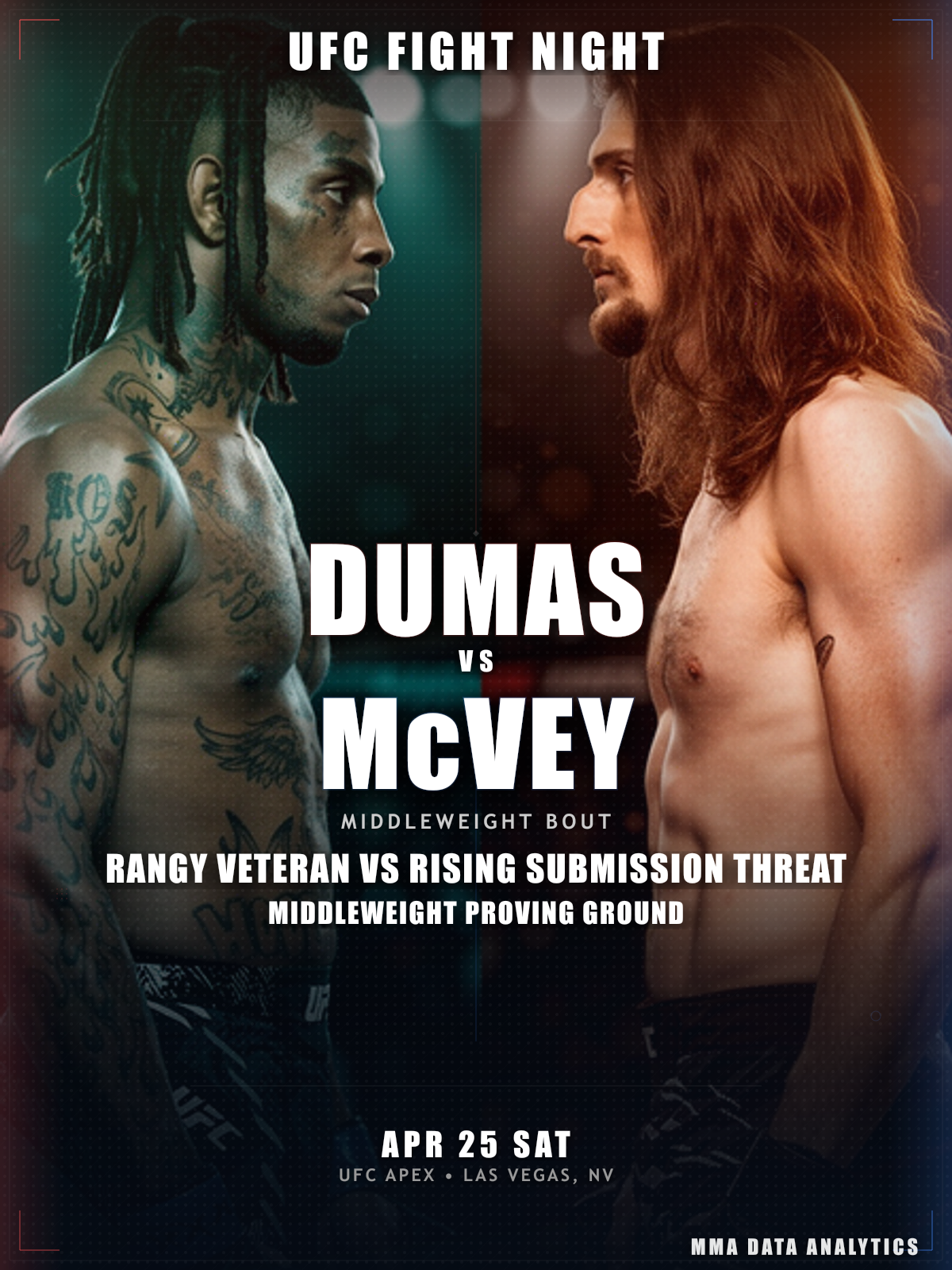
Sedriques Dumas vs Jackson McVey
Men's Middleweight Bout • UFC Fight Night: Sterling vs. Zalal
Saturday, April 25, 2026 • 25ft Octagon (Small Cage)
Explore Detailed Fighter Profiles
Click on either the fighter's name or profile image for each fighter to access comprehensive UFC statistics including striking metrics, grappling data, clinch performance, complete fight history, offensive & defensive analytics, and round-by-round breakdowns.
Sedriques Dumas
Fighter Metrics
Victory Methods
Win Round Distribution

Jackson McVey
Fighter Metrics
Victory Methods
Win Round Distribution
📋 Last 5 Fights - Sedriques Dumas
| Date | Opponent | Result | Method |
|---|---|---|---|
| 2025-11-01 | Donte Johnson | L | SUB - Guillotine Choke (R2, 1:25) |
| 2025-09-13 | Zach Reese | NC | No Contest (R1, 0:51) |
| 2025-04-12 | Michał Oleksiejczuk | L | TKO - Left Hook to Ground Strikes (R1, 2:49) |
| 2024-08-03 | Denis Tiuliulin | W | Decision - Unanimous (R3, 5:00) |
| 2024-03-30 | Nursulton Ruziboev | L | TKO - Uppercut & Ground Punches (R1, 3:18) |
📋 Last 5 Fights - Jackson McVey
| Date | Opponent | Result | Method |
|---|---|---|---|
| 2025-11-08 | Zach Reese | L | SUB - Rear Naked Choke (R2, 1:38) |
| 2025-07-19 | Brunno Ferreira | L | SUB - Armbar (R1, 3:35) |
| 2025-06-13 | Mataeo Garner | W | TKO - Knees & Punches (R1, 1:28) |
| 2024-09-20 | Ben Fowler | W | SUB - Brabo Choke (R1, 0:33) |
| 2024-07-13 | Jaquis Williams | W | SUB - Guillotine Choke (R1, 0:53) |
Technical Analysis
Technical Score
Cardio Score
Overall Rating
📊 Technical Score
Calculated as the average of Striking Composite (52.0 vs 40.0) and Grappling Composite (45.0 vs 48.0). Balances overall striking effectiveness with grappling ability to measure complete technical skills.
💪 Cardio Score
Based on average fight duration, striking rate per minute, takedown rate, and finish rate. Measures cardiovascular endurance and ability to maintain pace throughout fights.
🎯 Overall Rating
Simple average of Technical Score and Cardio Score. Provides a holistic view of fighter capabilities combining skill level with physical conditioning and fight performance.
Striking Composite
Grappling Composite
📊 Technical Radar Comparison
📊 Metrics Legend
📊 Detailed Statistical Comparison
🥊 Fight Analysis Breakdown
🧩 Sedriques Dumas Key Advantages
Dumas holds a significant +3" reach advantage (79" vs 76"), allowing him to use his jab and long-range weapons effectively. His SLpM of 2.12 is measured but with 79" reach he can keep McVey at distance and control the fight from the outside. His 56% striking defense is substantially better than McVey's estimated 38%, meaning he can stay defensively responsible while picking shots from range. In the small 25ft cage, this reach advantage becomes even more impactful as there's less room for McVey to reset and re-enter range after being pushed back by Dumas's longer strikes.
Dumas absorbs only 2.50 significant strikes per minute compared to McVey's 4.00 SApM — a 1.50 differential that creates a favorable damage economy. His 56% striking defense shows a significantly better ability to avoid incoming damage compared to McVey's 38%. Over the course of three rounds, this sustained defensive efficiency will accumulate a scoring advantage on the judges' cards while keeping Dumas fresher and less compromised. McVey's high absorption rate means he takes more punishment even when winning exchanges, creating a compounding problem as the fight progresses.
Dumas has competed in 8 UFC fights compared to McVey's mere 2, giving him a significant octagon experience edge. He has won 3 UFC bouts and understands the pacing, pressure, and judging criteria at the highest level. McVey's 0-2 UFC record shows he hasn't yet figured out how to translate his regional dominance into octagon success. This experience gap manifests in cage awareness, round management, and the ability to adjust mid-fight — all critical factors in a three-round contest where every minute counts on the scorecards.
⚠️ Unfavorable Scenarios
Dumas lost to Donte Johnson by guillotine choke, showing a clear vulnerability to submissions. McVey has 3 submission wins including a brabo choke and guillotine — the exact techniques that have troubled Dumas in the past. If the fight goes to the ground early, McVey's submission game becomes extremely dangerous. The small cage compresses available space and increases the likelihood of clinch exchanges that can lead to takedowns and submission opportunities for the more submission-savvy McVey.
Dumas's 40% takedown defense is very poor and represents his most glaring statistical weakness. McVey's grappling approach can exploit this vulnerability consistently. If McVey gets takedowns regularly, Dumas's striking and reach advantages become completely irrelevant. The combination of poor TDDef and proven submission vulnerability creates a scenario where a single successful takedown could end the fight for Dumas at any point in the bout.
📋 Likely Gameplan
Dumas should leverage his 79" reach advantage to outwork McVey from distance. Mixing jabs, teeps, and front kicks to maintain distance will be critical. His priority should be avoiding clinch and grappling exchanges at all costs, using lateral movement to stay off the cage and keep the fight in open space. By staying at range, Dumas can accumulate scoring strikes while minimizing McVey's opportunities to initiate his dangerous grappling game.
Dumas should use his UFC experience to dictate the pace and cut off the cage in the small 25ft octagon. By using combinations at range and maintaining consistent output, he can accumulate points on the scorecards while keeping McVey defensive. The key is keeping the fight standing at all costs — every exchange that stays on the feet favors Dumas's reach, accuracy, and defensive efficiency advantages.
🚀 Jackson McVey Key Advantages
McVey boasts 3 submission victories including a guillotine choke, brabo choke, and has shown RNC attempts — displaying a diverse submission arsenal. His 100% finish rate across 6 wins demonstrates extreme danger whenever he gets into advantageous positions. His Sub per 15 rate of 0.50 shows consistent submission hunting, and his strong finishing instinct means opponents can never feel safe on the ground. Against Dumas's poor 40% TDDef and proven submission vulnerability, McVey's grappling becomes his most potent weapon and primary path to victory.
All 6 of McVey's wins have come in Round 1 or early Round 2, showcasing explosive finishing ability across multiple disciplines. His mix of TKO victories (knees & punches) and submission finishes demonstrates well-rounded finishing capability that keeps opponents guessing about his attack vectors. McVey is at his most dangerous in the first five minutes when his energy and explosiveness are at peak levels. His ability to finish fights quickly means every exchange in the opening round carries fight-ending potential, creating constant pressure on Dumas to stay defensively perfect early.
⚠️ Unfavorable Scenarios
McVey is 0-2 in the UFC with both losses coming by submission — ironically his own best weapon being used against him. The step up in competition has exposed defensive grappling holes that weren't apparent in regional competition. His difficulty adjusting to UFC-level opponents suggests he may struggle with the speed, timing, and technical sophistication that Dumas brings from 8 UFC appearances. The pressure of needing a win to stay on the roster could also affect his decision-making in critical moments.
McVey's 38% striking defense and 28% takedown defense are both very poor numbers that create significant liabilities. He absorbs 4.00 significant strikes per minute, indicating he takes substantial damage in exchanges. If he can't secure an early finish, the accumulating damage becomes a major problem over three rounds. His defensive deficiencies mean that even when he's winning scrambles and hunting submissions, he's absorbing punishment that will affect his performance as the fight progresses.
📋 Likely Gameplan
McVey's optimal strategy involves closing distance quickly and seeking the clinch at every opportunity. His knees in the clinch and ability to work for takedowns from close range represent his best path to neutralizing Dumas's reach advantage. He should hunt for guillotine and brabo choke opportunities off scrambles and failed takedown attempts. The 25ft small cage naturally compresses available space, making it easier for McVey to force clinch engagements and prevent Dumas from maintaining his preferred fighting distance.
McVey must push the pace aggressively in Round 1 when his finishing power is at its highest. All of his wins have come in R1 — he should capitalize on this explosive early window before Dumas settles into rhythm and begins using his reach and experience advantages. By front-loading aggression and maintaining relentless pressure, McVey can force Dumas into uncomfortable exchanges and create the chaotic scrambles where his submission game thrives. The longer this fight goes, the more it favors Dumas, so McVey's urgency in the first round is paramount.
🎯 Fight Prediction Analysis
Data-driven prediction model based on statistical analysis
📊Detailed Analysis Summary
🏟️Cage Dynamics
The 25-foot small octagon creates a fascinating dynamic in this matchup — compressing available space and potentially benefiting McVey's clinch-heavy approach while also exposing his defensive liabilities to Dumas's striking. The smaller cage means less room for Dumas to maintain his preferred range, but it also means McVey has less space to retreat when Dumas cuts off the cage. Dumas's 79-inch reach gives him significant advantages when he can control distance, but the compressed space increases the likelihood of clinch exchanges that favor McVey's submission game. The fight's location dynamics will shift based on which fighter can impose their preferred range — Dumas at distance or McVey in the clinch.
🎯Technical Breakdown
The statistical analysis reveals two primary battlefields: striking range control and grappling exchanges. Dumas's 56% StrDef vs McVey's 38% represents a significant defensive gap that favors the more experienced fighter in prolonged exchanges. However, McVey's 1.50 TD15 vs Dumas's 1.23 and his 0.50 SubPer15 vs Dumas's 0.25 indicate a grappling activity advantage that could flip the fight's dynamic entirely. Dumas's alarming 40% takedown defense creates a vulnerability that McVey's aggressive grappling can exploit. The fight essentially becomes a battle of whether Dumas can keep the fight at range (where his reach, defense, and accuracy advantages dominate) or McVey can force it to the mat (where his submissions and finishing instinct take over).
🧩Key Battle Areas
Three critical battle areas will determine the outcome: distance management vs clinch entries, takedown defense vs submission hunting, and early explosiveness vs sustained pacing. Dumas's 40% TDDef is his biggest liability — if McVey can consistently close distance and implement takedowns, the fight shifts dramatically in his favor. However, Dumas's experience edge (8 vs 2 UFC fights) means he's more likely to make correct tactical adjustments as the fight progresses. McVey's 100% finish rate shows he doesn't need many opportunities to end fights, but his 0-2 UFC record suggests the highest level of competition has been able to neutralize his finishing ability so far.
🏁Final Prediction
The most likely outcome is Dumas by Decision (28% probability), achieved through sustained range striking and defensive discipline over three rounds. Dumas's KO/TKO path (20%) becomes viable if his reach advantage allows him to accumulate damage from the outside while McVey struggles to close distance. McVey's best lane is early Submission (22%) via guillotine or brabo choke in the first round when his explosiveness is at peak levels. McVey's KO/TKO path (12%) requires landing knees in the clinch or catching Dumas during exchanges. The fight's outcome hinges on whether McVey can close distance and implement his grappling game before Dumas settles into his preferred range.
💰 Betting Analysis: Model vs Market
Detailed value assessment in the betting market
📊Market Odds
🤖Analytical Model
💎Value Opportunities
MAXIMUM VALUE
Model: 22% | Fair: +355
GOOD VALUE
Model: 28% | Fair: +257
SLIGHT VALUE
Model: 48% | Fair: +108
⚠️Key Market Discrepancies
- • Overweights Dumas's UFC experience – Underprices McVey's finishing ability.
- • Undervalues submission threat – McVey's sub game very dangerous against poor TDDef.
- • Small-cage bias – 25ft cage compresses space, favoring aggressive grapplers.
🎯 Comprehensive Probabilistic Analysis
100 hypothetical fight simulation based on statistical data
🏆Outcome Distribution - Sedriques Dumas
Primary path via range striking and defensive discipline
Accumulative damage from reach advantage
Opportunistic submission from scrambles
💥Outcome Distribution - Jackson McVey
Best lane via guillotine or brabo choke
Knees in clinch or catching Dumas in exchanges
Unlikely given 0 career decision wins
⏰Fight Timeline Analysis
⚡Window of Opportunity - Jackson McVey
- • First 5 minutes: Highest submission finish equity.
- • Clinch entries: Guillotine and brabo choke traps.
- • Scrambles: Attack transitions aggressively.
🎯Progressive Advantage - Sedriques Dumas
- • Sustained range striking: Accumulate damage safely.
- • Defensive discipline: Avoid grappling exchanges.
- • Late rounds: Experience + pacing edge.
🎯 Final Confidence Assessment
Confidence level and uncertainty factors
Confidence Level
Low confidence — both fighters inconsistent at UFC level
✅Supporting Factors
- • Dumas's reach advantage (+3" at 79")
- • Better striking defense (56% vs 38%)
- • More UFC experience (8 vs 2 fights)
- • Lower absorption rate (2.50 vs 4.00 SApM)
⚠️Risk Factors
- • McVey's finishing ability (100% finish rate)
- • Dumas's poor TDDef (40%)
- • Small cage benefits grappler
- • Both fighters on losing streaks
🏁Executive Summary
This matchup features two fighters searching for answers at the UFC level. Sedriques Dumas brings the experience edge with 8 UFC appearances compared to McVey's 2, but his 3-4 record shows inconsistency at the highest level. His 79-inch reach and 56% striking defense provide tools to maintain distance and outwork McVey over three rounds. However, his alarming 40% takedown defense creates a significant vulnerability against McVey's aggressive grappling. Jackson McVey arrives with a perfect finishing record (6 wins, all by stoppage) but has been unable to translate his regional dominance to the UFC, losing both octagon appearances by submission. The 25-foot small cage compresses available space, potentially benefiting McVey's clinch-heavy approach but also exposing his defensive liabilities to Dumas's striking. The fight likely comes down to whether McVey can secure early grappling exchanges and hunt submissions before Dumas's experience and range tools take over in the later rounds.
Prediction: Dumas by Decision most likely (28% probability) through sustained range striking and defensive discipline; McVey's best path is early Submission (22%) via guillotine or brabo choke in the first round. The fight's outcome hinges on whether McVey can close distance and implement his grappling game before Dumas settles into his preferred range and begins accumulating scoring advantages.