

Cub Swanson vs Nate Landwehr
Men's Featherweight Bout • UFC 327
Saturday, April 11, 2026 • Kaseya Center, Miami, FL • 30ft Octagon (Large Cage)
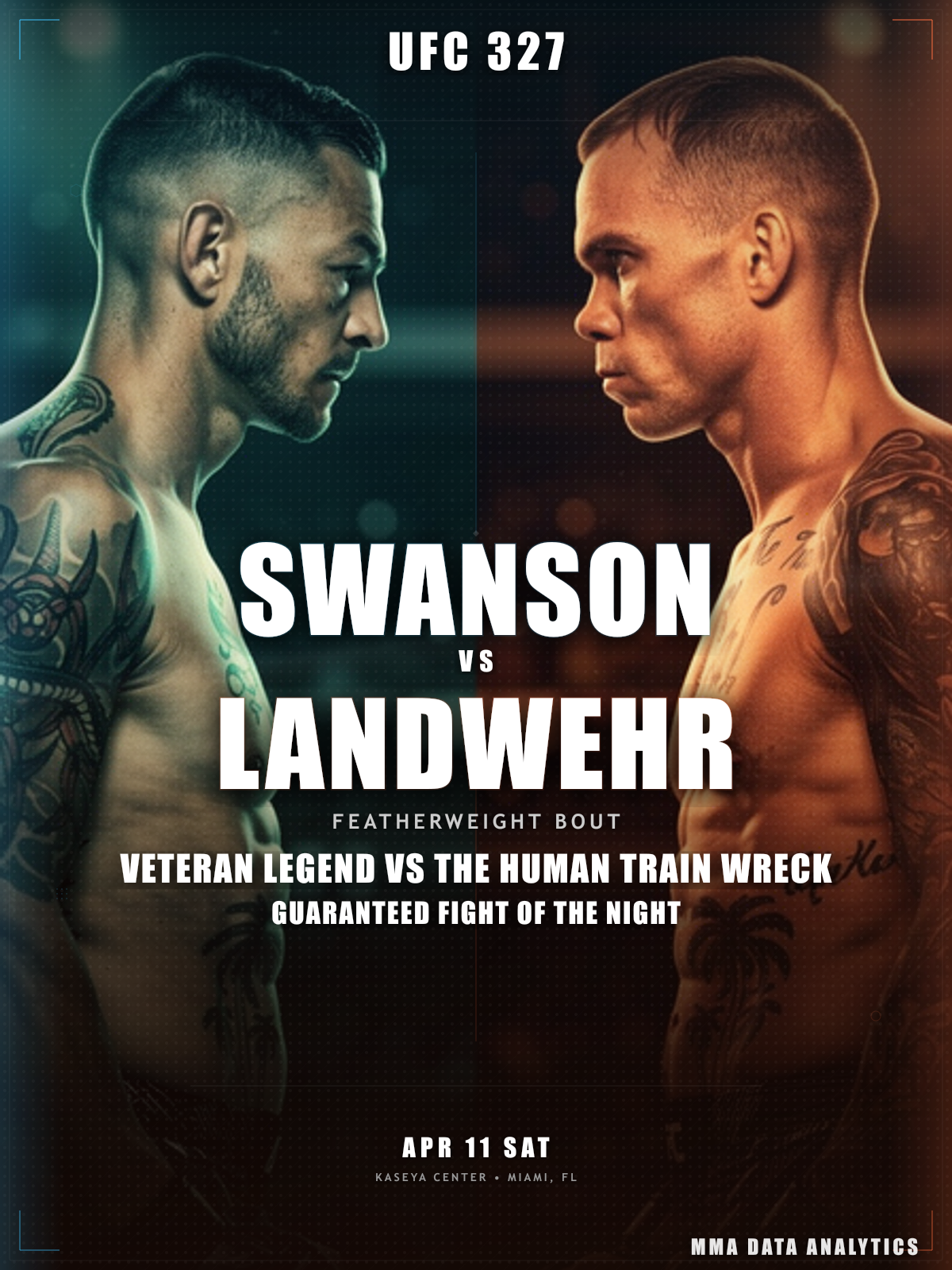
Explore Detailed Fighter Profiles
Click on either the fighter's name or profile image for each fighter to access comprehensive UFC statistics including striking metrics, grappling data, clinch performance, complete fight history, offensive & defensive analytics, and round-by-round breakdowns.
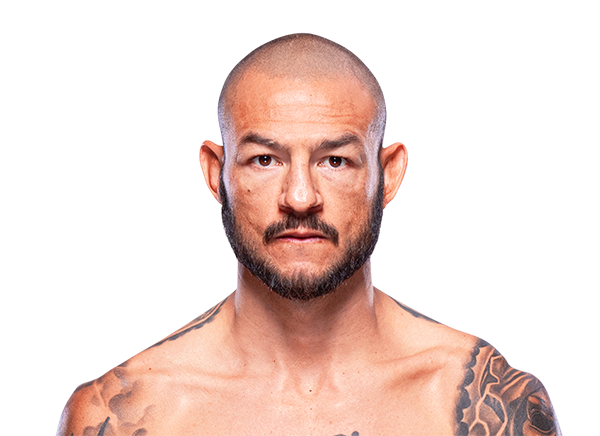
Cub Swanson
Fighter Metrics
Victory Methods
Win Round Distribution

Nate Landwehr
Fighter Metrics
Victory Methods
Win Round Distribution
Last 5 Fights - Cub Swanson
| Date | Opponent | Result | Method |
|---|---|---|---|
| Dec 14, 2024 UFC Fight Night | Billy Quarantillo (29-14, 18-6 UFC) Fight #39 in UFC | W | TKO - Right Cross R3 · 1:36 |
| Jun 29, 2024 UFC 303: Pereira vs. Procházka 2 | Andre Fili (29-13, 23-11 UFC) Fight #37 in UFC | L | Decision - Split R3 · 5:00 |
| Aug 12, 2023 UFC Fight Night | Hakeem Dawodu (28-13, 13-3-1 UFC) Fight #32 in UFC | W | Decision - Unanimous R3 · 5:00 |
| Oct 15, 2022 UFC Fight Night | Jonathan Martinez (28-12, 16-4 UFC) Fight #30 in UFC | L | TKO - Leg Kicks R2 · 4:19 |
| Dec 18, 2021 UFC Fight Night | Darren Elkins (27-12, 26-9 UFC) Fight #31 in UFC | W | TKO - Punches & Wheel Kick R1 · 2:12 |
Last 5 Fights - Nate Landwehr
| Date | Opponent | Result | Method |
|---|---|---|---|
| Jul 12, 2025 UFC Fight Night | Morgan Charrière (18-6, 20-11-1 UFC) Fight #47 in UFC | L | TKO - Punches R3 · 0:27 |
| Dec 7, 2024 UFC 310: Pantoja vs. Asakura | Doo Ho Choi (18-5, 15-4-1 UFC) Fight #31 in UFC | L | TKO - Elbows From Crucifix R3 · 3:21 |
| Mar 30, 2024 UFC Fight Night | Jamall Emmers (17-5, 20-7 UFC) Fight #47 in UFC | W | TKO - Uppercut, Right Hook, & Hammerfists R1 · 4:43 |
| Jun 10, 2023 UFC 289: Nunes vs. Aldana | Dan Ige (17-4, 16-6 UFC) Fight #12 in UFC | L | Decision - Unanimous R3 · 5:00 |
| Mar 25, 2023 UFC Fight Night | Austin Lingo (16-4, 9-1 UFC) Fight #65 in UFC | W | SUB - Rear Naked Choke R2 · 4:11 |
Technical Analysis
Technical Score
Cardio Score
Overall Rating
Technical Score
Calculated as the average of Striking Composite (65.0 vs 55.0) and Grappling Composite (48.0 vs 50.0). Balances overall striking effectiveness with grappling ability to measure complete technical skills.
Cardio Score
Based on average fight duration, striking rate per minute, takedown rate, and finish rate. Measures cardiovascular endurance and ability to maintain pace throughout fights.
Overall Rating
Simple average of Technical Score and Cardio Score. Provides a holistic view of fighter capabilities combining skill level with physical conditioning and fight performance.
Striking Composite
Grappling Composite
Technical Radar Comparison
Metrics Legend
Detailed Statistical Comparison
Fight Analysis Breakdown
Cub Swanson Key Advantages
Swanson's 51% striking accuracy vs Landwehr's 46% reflects his refined Muay Thai technique developed over 30 professional fights. His ability to pick shots rather than throw volume creates cleaner scoring sequences that judges reward. The 24 UFC bouts of experience allow Swanson to read opponents' patterns and time counter shots with precision that raw aggression cannot match. His diverse arsenal—elbows, spinning backfists, body kicks—keeps opponents guessing and creates openings that pure volume fighters struggle to find.
The 1.83 strikes absorbed per minute differential (4.00 vs 5.83) reveals a significant damage economy gap. Swanson's 59% striking defense vs Landwehr's 52% means he avoids more incoming fire while landing at a higher rate. In a three-round fight, this translates to Swanson taking roughly 27 fewer significant strikes over 15 minutes. His head movement and footwork, honed through years of elite competition, allow him to slip exchanges that Landwehr walks through. This defensive advantage becomes critical when both fighters are trading in the pocket.
With 44 professional fights and 24 UFC bouts, Swanson brings an unmatched wealth of experience to this matchup. He has faced and defeated elite featherweights throughout his career, developing the ability to adapt mid-fight and find solutions under pressure. His 68% career win rate with a 60% finish rate shows he can close fights when opportunities present themselves. Against a brawler like Landwehr, Swanson's veteran composure allows him to weather early storms and capitalize on openings as the fight progresses.
Swanson's finish portfolio—14 KO/TKOs, 12 decisions, and 4 submissions—demonstrates tactical versatility that keeps opponents guessing. His Muay Thai background provides elbows, knees, spinning attacks, and clinch control, while his submission threat (4 career subs including guillotines and rear-naked chokes) means Landwehr cannot simply shoot desperate takedowns when hurt. This finish diversity becomes crucial in close fights: Swanson can adapt to opportunities rather than forcing a singular path to victory. His recent Quarantillo TKO (right cross) showed he still possesses one-shot power when timing aligns.
Unfavorable Scenarios
Landwehr's 5.63 SLpM output could overwhelm Swanson if the fight becomes a sustained firefight. When Landwehr builds momentum with combinations and forward pressure, even experienced fighters struggle to maintain composure. At 41 years old, Swanson's reflexes may not recover as quickly from heavy exchanges, and Landwehr's relentless pace could expose age-related durability concerns.
Swanson has been stopped 5 times by KO/TKO in his career, and at 41, chin durability becomes a legitimate concern. Landwehr's willingness to trade and throw power shots from unorthodox angles could find openings that younger fighters might defend. Swanson's recent TKO loss to Jonathan Martinez shows he remains vulnerable to power strikers who can find clean shots.
Likely Gameplan
Swanson should look to time Landwehr's aggressive entries with counter elbows and check hooks. His Muay Thai background provides the tools to punish forward pressure—clinch knees, sweep kicks, and stepping elbows become highly effective against a fighter who charges in recklessly. By making Landwehr pay for every blitz, Swanson can gradually discourage the volume approach and force a more measured fight that favors his technical edge.
Investing in body shots early can drain Landwehr's cardio and slow his volume output as the fight progresses. Swanson's Muay Thai body kicks and liver shots are proven weapons that can sap an opponent's gas tank. By controlling the pace and forcing Landwehr to fight at a measured tempo rather than his preferred chaotic pace, Swanson can leverage his superior cardio score (68 vs 55) into a decisive late-fight advantage.
Nate Landwehr Key Advantages
Landwehr's 5.63 SLpM output creates relentless forward pressure that can overwhelm opponents who prefer measured exchanges. His "The Train" nickname reflects his fighting style—constant forward motion with combinations thrown from multiple angles. This volume approach is particularly effective against aging fighters whose defensive reactions may have slowed. Landwehr's ability to sustain high output in the early rounds creates scoring windows that can build insurmountable leads before his opponent can establish rhythm.
Landwehr's 72-inch reach advantage over Swanson's 70 inches, combined with his 5'9" height vs Swanson's 5'8", creates physical advantages that force Swanson to close distance before engaging effectively. His longer limbs allow him to initiate from range where Swanson's counters are less dangerous. Additionally, Landwehr's 72% takedown defense significantly exceeds Swanson's 64%, meaning he is better at keeping the fight in his preferred standing range where his volume advantage is maximized.
Landwehr's 61.1% career finish rate (11 of 18 wins) demonstrates genuine finishing ability when he finds his rhythm. His 9 KO/TKO victories include spectacular stoppages like the Emmers destruction (uppercut-hook-hammerfist combo at 4:43 R1) that show his ability to chain attacks when opponents are hurt. This finishing instinct becomes critical against a 41-year-old opponent whose recovery between exchanges may be diminished. When Landwehr smells blood, his relentless follow-up prevents opponents from surviving to the bell—a trait that can turn competitive rounds into decisive finishes. His submission threat (2 career subs including a rear-naked choke over Austin Lingo) adds another dimension if the fight hits the ground.
Unfavorable Scenarios
If Swanson establishes a counter-fighting rhythm, Landwehr's aggressive entries become liabilities rather than assets. Swanson's Muay Thai timing can turn every forward surge into a scoring opportunity for the veteran—elbows in the pocket, clinch knees on entries, and check hooks as Landwehr overcommits. The 51% vs 46% accuracy gap compounds when Landwehr is walking into clean shots while throwing volume that fails to land cleanly.
Landwehr's 5.83 SApM absorption rate is among the highest in the featherweight division. His willingness to eat shots while pressing forward means he accumulates damage rapidly, and his recent back-to-back TKO losses to Charriere and Choi suggest durability may be declining. Combined with an average fight duration of 8:45, Landwehr's pace appears unsustainable over three full rounds against a fighter who can weather the early storm and capitalize on fatigue.
Likely Gameplan
Landwehr's best strategy is to maintain relentless forward pressure from the opening bell, overwhelming Swanson with volume before the veteran can establish timing. By throwing combinations in bunches and varying levels, Landwehr can prevent Swanson from setting up counter shots. The key is maintaining constant output without pausing to let Swanson reset—every stoppage in action benefits the more technical fighter.
Landwehr's best chance for victory lies in securing an early stoppage, ideally in Round 1 when his energy and output are at their peak. His 7 first-round finishes from 18 wins show he is most dangerous when fresh and aggressive. Against a 41-year-old opponent with known durability concerns, early power shots and swarming combinations could force a stoppage before Swanson's experience and technical advantages can take effect.
Fight Prediction Analysis
Data-driven prediction model based on statistical analysis
📊Detailed Analysis Summary
🏟️Cage Dynamics
The 30-foot octagon at Kaseya Center creates a dynamic that could benefit both fighters in different ways. Landwehr's forward pressure and volume striking benefit from the space to build momentum on entries, while Swanson's counter- fighting style gains additional time to read and react to incoming attacks. The larger cage slightly favors the more technical fighter who can use footwork to maintain optimal range, though Landwehr's ability to cut off the cage with relentless pressure can negate this advantage if he maintains his pace.
🎯Technical Breakdown
This matchup pits precision against volume. Swanson's 51% accuracy and 59% defense create a cleaner damage profile, while Landwehr's 5.63 SLpM output generates raw volume that can overwhelm. The critical stat is absorption: Landwehr takes 5.83 strikes per minute vs Swanson's 4.00, meaning Landwehr absorbs 45.8% more damage per minute of fighting. In a three-round fight, this differential translates to roughly 27 additional significant strikes absorbed. The question is whether Landwehr's volume advantage (0.84 SLpM edge) can overcome Swanson's efficiency before the damage accumulation becomes decisive.
🧩Key Battle Areas
Three critical battle areas will determine the outcome: pace control in Round 1, damage accumulation through the middle rounds, and durability under fire. If Landwehr can establish his chaotic pace early and land power shots, his finish potential becomes the dominant factor. If Swanson can weather the initial storm and begin timing counters, the fight shifts toward a technical contest where his experience and accuracy become decisive. The takedown battle could be a wild card—Swanson's 1.01 TD15 and 50% accuracy give him an option to change levels, though Landwehr's 72% TDDef makes this a risky path.
🥊Stylistic Matchup Analysis
This classic striker vs brawler dynamic creates fascinating style contrasts. Swanson's Muay Thai background emphasizes clinch control, elbows, and counter timing—techniques that historically excel against aggressive forward pressure. Landwehr's "Train" persona reflects pure volume-based chaos, throwing combinations in bunches without regard for defensive positioning. The featherweight division history shows technical counterpunchers like Max Holloway and Alexander Volkanovski dominating volume strikers who lack defensive polish. Swanson's 24 UFC fights have exposed him to every variation of this matchup, while Landwehr's 12 UFC appearances suggest he's still learning to adjust mid-fight against crafty veterans. The age gap (41 vs 37) matters less than the experience gap—Swanson has seen 44 professional opponents compared to Landwehr's 25, a 76% increase in opponent variety.
⚔️Recent Form Trajectory
Analyzing recent performances reveals contrasting momentum patterns. Swanson enters on a 1-fight win streak after TKO'ing Billy Quarantillo in December 2024 with a perfectly timed right cross in Round 3—demonstrating his timing remains sharp at 41. His previous split decision loss to Andre Fili was competitive, showing Swanson can still hang with ranked competition. Landwehr, conversely, enters on a brutal 2-fight losing streak with back-to-back TKO losses: Charrière stopped him with punches at 0:27 of R3, then Doo Ho Choi finished him with elbows from crucifix at 3:21 of R3. Both finishes came late in Round 3, suggesting serious durability and cardio concerns. Landwehr's body may be showing accumulated damage from his high-absorption fighting style (5.83 SApM over 12 UFC fights = approximately 2,100 significant strikes absorbed in UFC alone).
🏁Final Prediction
This is a razor-thin matchup between a technical veteran and a volume brawler. The most likely outcome is Cub Swanson by KO/TKO (22% probability) via counter strikes that catch Landwehr pressing forward recklessly, or by Decision (20%) if Swanson can outpoint Landwehr with cleaner, more accurate striking. Landwehr's primary path is by KO/TKO (28%) through early volume overwhelming Swanson before the veteran can establish rhythm. His decision path (15%) requires maintaining output for three full rounds—a pace his 8:45 average fight duration suggests he struggles to sustain. The 52-48 split reflects genuine uncertainty: Swanson's technical edge and recent TKO victory suggest he's still dangerous, but Landwehr's aggressive style can create chaos that neutralizes skill advantages. The key variable is whether Landwehr's recent stoppage losses indicate permanent decline or were simply matchup-specific vulnerabilities.
Betting Analysis: Model vs Market
Detailed value assessment in the betting market
📊Market Odds
🤖Analytical Model
💎Value Opportunities
BEST VALUE
Model: 22% | Fair: +354
GOOD VALUE
Model: 65% | Fair: -186
SLIGHT VALUE
Model: 15% | Fair: +567
⚠️Key Market Discrepancies
- • Near coin-flip fight – Model sees this as 52/48, making large line movements exploitable.
- • Undervalues counter-striking – Swanson's Muay Thai timing vs reckless entries often produces finishes.
- • Losing streak discount – Landwehr's 2 TKO losses may be overweighted by market.
Comprehensive Probabilistic Analysis
100 hypothetical fight simulation based on statistical data
🏆Outcome Distribution - Cub Swanson
Counter elbows and check hooks vs forward pressure
Outpointing with accuracy and defense over 3 rounds
Guillotine or choke if Landwehr shoots recklessly
💥Outcome Distribution - Nate Landwehr
Best path via early volume and power combinations
Requires maintaining volume output for 15 minutes
Guillotine choke opportunistically
⏰Fight Timeline Analysis
⚡Window of Opportunity - Nate Landwehr
- • First 5-7 minutes: Highest KO equity when fresh and aggressive. Landwehr's round distribution shows 7 of his 18 wins came in Round 1, a 38.9% R1 finish rate that ranks among the division's most explosive starts. His TKO of Jamall Emmers (uppercut, right hook, hammerfists at 4:43 of R1) exemplifies this early blitz strategy.
- • Volume blitz: Sustained combos to overwhelm aging reflexes. At 5.63 SLpM, Landwehr throws approximately 28 significant strikes per round. Against a 41-year-old opponent, this pace aims to force defensive errors before Swanson can establish counter rhythm. The key is throwing combinations without pausing—every reset allows the veteran to recalibrate.
- • Power shots: Target chin durability with overhand rights. Swanson's 5 career KO/TKO losses show vulnerability to power strikers. Jonathan Martinez's leg-kick TKO at 4:19 of R2 in 2022 revealed accumulated wear. Landwehr must mix body-head combinations to set up his finishing shots, using the threat of body attacks to lower Swanson's guard before uncorking overhands.
🎯Progressive Dominance - Cub Swanson
- • Counter timing: Read patterns and punish entries with precision. Swanson's 30-fight career has exposed him to every aggressive style variant. His Quarantillo win (right cross TKO at 1:36 of R3) showed he can time finishes when opponents overcommit. Against Landwehr's predictable forward charges, Swanson should employ check hooks, stepping elbows, and clinch knees to make aggression costly.
- • Body investment: Drain cardio with liver kicks and knees. Muay Thai body attacks are particularly effective against high-volume fighters who prioritize output over defensive positioning. Each clean liver kick or body knee saps Landwehr's ability to sustain his pace. Swanson's 68 cardio score vs Landwehr's 55 suggests the veteran can maintain body attack frequency deeper into rounds.
- • Late rounds: Technical superiority shines as pace drops. Swanson's round distribution shows 16 of his 30 wins went to Round 3, a 53.3% rate that demonstrates championship cardio. His unanimous decision over Hakeem Dawodu showcased his ability to win close rounds with cleaner, more efficient striking. If Swanson survives the early storm, Round 3 becomes his ideal environment—tired opponent, accumulated reads, technical edge.
📈Momentum Shifts & Critical Moments
Round 1 (0:00-2:30): Landwehr establishes pace with volume, Swanson absorbs pressure and looks for timing. First 2.5 minutes critical—if Swanson survives without major damage, his counter game activates.
Round 2 (5:00-10:00): Pivotal round where Landwehr's cardio begins to wane while Swanson's reads improve. Body work from Round 1 compounds here. Landwehr must maintain aggression despite fatigue; Swanson must avoid desperation exchanges that favor chaos over technique.
Round 3 (10:00-15:00): Championship round favors cardio and durability. Both fighters have R3 vulnerabilities: Swanson (age-related recovery) vs Landwehr (recent R3 stoppages). First to impose their pace wins—Swanson's measured striking vs Landwehr's fading volume. Judges typically reward clean, controlled striking over desperate flurries, advantage Swanson if competitive.
Final Confidence Assessment
Confidence level and uncertainty factors
Confidence Level
Near coin-flip fight — slight edge to veteran experience
✅Supporting Factors
- • Superior striking accuracy (51% vs 46%)
- • Better striking defense (59% vs 52%)
- • Lower damage absorption (4.00 vs 5.83 SApM)
- • Vastly more experience (44 vs 25 pro fights)
⚠️Risk Factors
- • Age (41) and potential durability decline
- • Landwehr's overwhelming volume (5.63 SLpM)
- • Reach and height disadvantage for Swanson
- • Both fighters are unpredictable finishers
🏁Executive Summary
This featherweight clash between Cub Swanson and Nate Landwehr pits veteran precision against chaotic volume in what should be an explosive three-round affair. Swanson's 51% striking accuracy and 59% defense create a cleaner damage profile that favors technical exchanges, while Landwehr's 5.63 SLpM output generates overwhelming pressure that can break down even experienced fighters. The critical dynamic is Landwehr's 5.83 SApM absorption rate—among the highest in the division— which means he takes significant damage while pressing forward. Combined with his 8:45 average fight duration and back-to-back TKO losses, Landwehr's durability appears to be declining at a time when he faces one of the most experienced counter-strikers in featherweight history.
Prediction: Cub Swanson holds a slim 52-48 edge based on technical precision, defensive efficiency, and superior experience. Swanson's most likely path is by KO/TKO (22%) via counter strikes as Landwehr presses forward recklessly, or by Decision (20%) outpointing with accuracy. Landwehr's best path is early KO/TKO (28%) before Swanson can establish timing. This is a genuine coin-flip fight where the outcome likely hinges on whether Landwehr can overwhelm in the first round or Swanson can weather the storm and capitalize in the later rounds.