

Arnold Allen vs Jean Silva
Men's Featherweight Bout • UFC 324
Saturday, January 24, 2026 • T-Mobile Arena • 30ft Octagon (Large Cage)
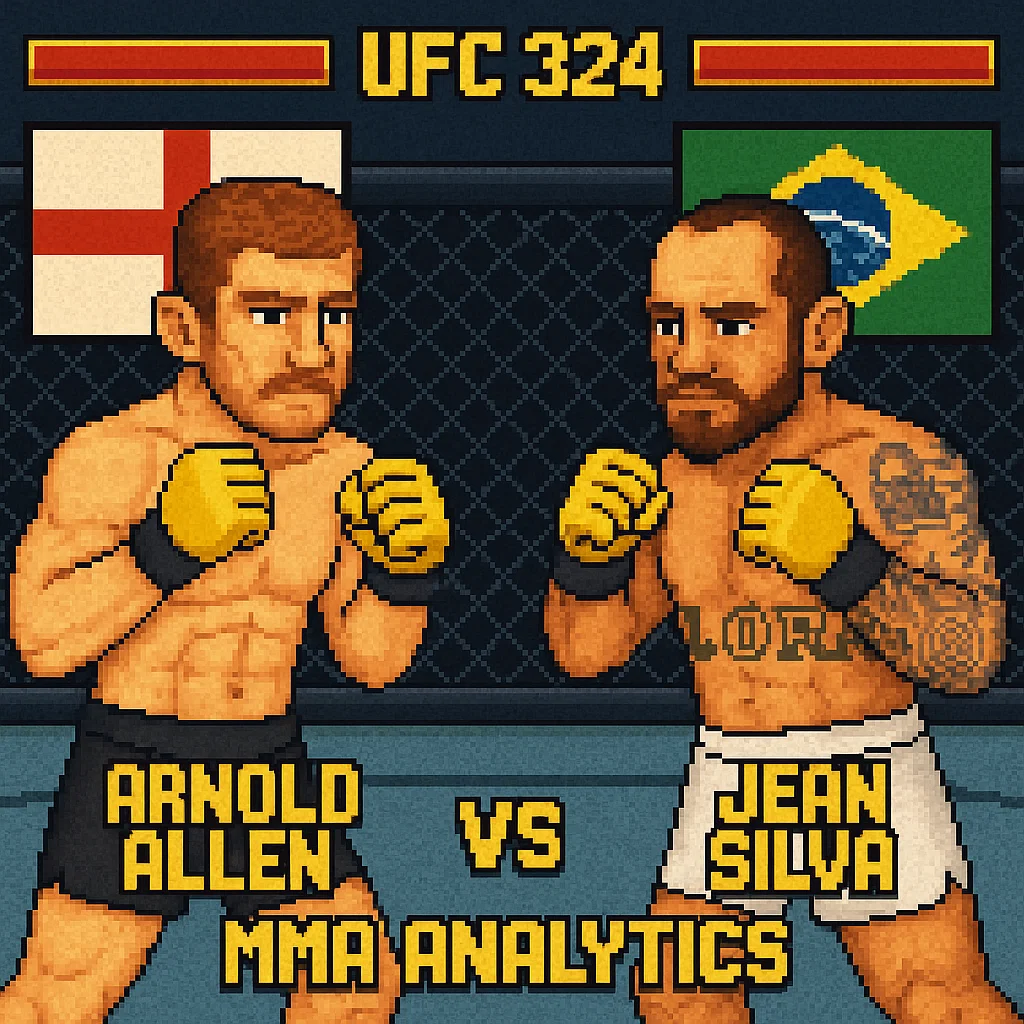
Explore Detailed Fighter Profiles
Click on either the fighter's name or profile image for each fighter to access comprehensive UFC statistics including striking metrics, grappling data, clinch performance, complete fight history, offensive & defensive analytics, and round-by-round breakdowns.

Arnold Allen
Fighter Metrics
Victory Methods
Win Round Distribution
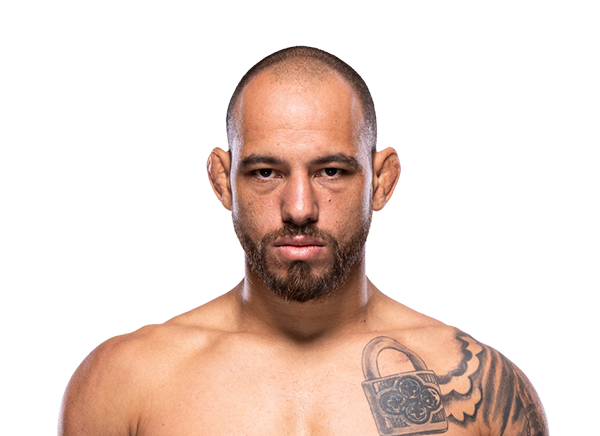
Jean Silva
Fighter Metrics
Victory Methods
Win Round Distribution
📋 Last 5 Fights - Arnold Allen
| Date | Opponent | Result | Method |
|---|---|---|---|
| 2024-09-14 | Giga Chikadze | W | Decision - Unanimous (R3, 5:00) |
| 2024-02-17 | Movsar Evloev | L | Decision - Unanimous (R3, 5:00) |
| 2023-04-22 | Max Holloway | L | Decision - Unanimous (R5, 5:00) |
| 2022-10-29 | Calvin Kattar | W | TKO - Knee Injury (R2, 3:14) |
| 2022-03-19 | Dan Hooker | W | TKO - Punches (R1, 2:33) |
📋 Last 5 Fights - Jean Silva
| Date | Opponent | Result | Method |
|---|---|---|---|
| 2024-09-14 | Diego Lopes | L | TKO - Punches (R3, 2:46) |
| 2024-05-04 | Bryce Mitchell | W | Submission - Ninja Choke (R2, 2:13) |
| 2024-02-10 | Melsik Baghdasaryan | W | TKO - Punches (R1, 3:58) |
| 2023-08-26 | Drew Dober | W | TKO - Doctor Stoppage (R3, 5:00) |
| 2023-05-06 | Charles Jourdain | W | TKO - Punches (R2, 3:22) |
Technical Analysis
Technical Score
Cardio Score
Overall Rating
📊 Technical Score
Calculated as the average of Striking Composite (48.0 vs 57.0) and Grappling Composite (49.0 vs 55.0). Balances overall striking effectiveness with grappling ability to measure complete technical skills.
💪 Cardio Score
Based on average fight duration, striking rate per minute, takedown rate, and finish rate. Measures cardiovascular endurance and ability to maintain pace throughout fights.
🎯 Overall Rating
Simple average of Technical Score and Cardio Score. Provides a holistic view of fighter capabilities combining skill level with physical conditioning and fight performance.
Striking Composite
Grappling Composite
📊 Technical Radar Comparison
📊 Metrics Legend
📊 Detailed Statistical Comparison
🥊 Fight Analysis Breakdown
🧩 Arnold Allen Key Advantages
Allen's 62% striking defense and 2.88 SApM represent elite damage avoidance at featherweight, creating a defensive framework that fundamentally shifts scoring dynamics in his favor. His tight guard, head movement, and footwork allow him to slip punches while countering effectively—this isn't just shelling up, but active defense that creates offensive opportunities. Against Silva's high-volume approach (4.87 SLpM), this defensive responsibility becomes crucial—Allen can make Silva miss repeatedly, forcing the Brazilian to overcommit and creating counter opportunities. The 1.25 strikes absorbed per minute differential (2.88 vs 4.13) compounds over three rounds, meaning Allen takes significantly less damage while maintaining offensive output. His experience surviving 5 rounds with Max Holloway—one of the highest-volume strikers in featherweight history—demonstrates championship-level durability and defensive composure. Against Silva's power, this proven ability to minimize damage accumulation while staying active provides a critical edge that judges consistently reward, especially as fights progress and damage differentials become visually apparent on scorecards.
The T-Mobile Arena's 30-foot octagon creates a fascinating dynamic that initially favors movement and gradually shifts control toward the better cage navigator. Allen's southpaw stance combined with excellent footwork and cage cutting ability allows him to control distance and dictate where exchanges happen—he can circle, reset, and avoid prolonged pocket brawls while forcing Silva to cover more ground. Against Holloway and Evloev—two elite pressure fighters with relentless forward movement—Allen demonstrated he can manage space for extended periods without breaking. The large cage makes Silva's preferred strategy of compressing range and trading in the pocket harder to execute, forcing him to work harder to close distance while Allen maintains his preferred striking range. Allen's ability to cut off angles and force exchanges at the perimeter rather than center-cage transforms the octagon into a weapon, making Silva expend more energy chasing while Allen conserves and counter-attacks. This spatial control becomes increasingly valuable as the fight progresses and Silva's early energy advantage begins to fade.
Allen's last 5 opponents (Holloway, Evloev, Chikadze, Kattar, Hooker) represent a murderer's row of top-10 featherweights that few fighters in the division can match. His composure against championship-caliber competition provides confidence that Silva's power won't mentally rattle him—Allen has been hit by bigger punchers and survived. He's been in deep waters against the division's best and emerged competitive even in losses, showing he can adapt mid-fight and make adjustments when things aren't going his way. The experience edge is significant both mentally and tactically—Silva's opposition (Jourdain, Mitchell, Baghdasaryan, Lopes) is impressive and includes solid wins, but it's one tier below Allen's gauntlet of elite contenders and former champions. This difference in level of competition means Allen has faced fighters with similar or greater finishing power than Silva and found ways to neutralize them, while Silva hasn't yet proven he can consistently solve elite defensive puzzles like the one Allen presents.
⚠️ Unfavorable Scenarios
If Allen gets drawn into prolonged pocket exchanges in center cage, Silva's power becomes maximally dangerous and Allen's primary advantages evaporate. Silva averages ~1.50 knockdowns per 15 minutes—a very high rate at featherweight that indicates genuine fight-ending threat, not padded regional statistics. Allen's 42% striking accuracy vs Silva's 52% means he'll be on the wrong side of volume exchanges in close quarters, where Silva's Muay Thai combinations and hand speed create accumulative damage that can overwhelm defensive shells. Getting pulled into Silva's preferred fight—high-pace, center-cage violence with minimal space to reset—erases Allen's defensive advantages and movement superiority. The Brazilian's ability to trap opponents on the fence and unload combinations represents his most dangerous path to victory, and if Allen allows this scenario to develop, his superior defense becomes less valuable when forced to exchange in Silva's optimal range. This is particularly dangerous in R1-R2 when Silva is fresh and his speed and power are at peak levels.
Silva's best chance is in R1-R2 when his speed and power are at peak and Allen is still calibrating entries and defensive reads. Silva's 10 first-round finishes (out of 16 wins) show a genuine early-round danger profile that can't be dismissed—this isn't just statistical noise, but a pattern that demonstrates his ability to overwhelm opponents before they settle into rhythm. If Allen allows Silva to establish rhythm and confidence early, the Brazilian's finishing instincts could prove decisive before Allen's technical adjustments take effect. The window of opportunity is narrow but real: Silva needs to capitalize on Allen's initial defensive reads and catch him before the Englishman adapts to Silva's timing and combinations. Historical data shows Silva is most dangerous in the first 5-7 minutes when his energy reserves are full and he can sustain his high-output approach without fatigue affecting his power or accuracy. Once this window closes and Allen makes his adjustments, Silva's path to victory becomes significantly more difficult.
📋 Likely Gameplan
Allen should utilize his southpaw jab, straight left, and check hooks when Silva crashes forward, creating a consistent counter-attack framework that punishes aggressive entries while maintaining defensive positioning. Body and leg kicks early will make Silva pay for aggressive entries and slow his forward pressure—these strikes target Silva's base and mobility, making his pressure less effective while accumulating damage that compounds over rounds. Allen's 70" reach advantage allows him to fight at range and pot-shot effectively without engaging in Silva's preferred pocket exchanges, forcing the Brazilian to cover more ground and commit to longer entries that expose him to counters. The key is maintaining distance while staying active enough to score points and prevent Silva from establishing rhythm or finding his timing. By varying his approach—sometimes countering, sometimes leading with jabs—Allen can keep Silva guessing and prevent him from settling into his preferred high-output pace.
Allen doesn't need to hold Silva down—just forcing defensive wrestling exchanges can slow Silva's pressure and steal optics with judges, creating scoring opportunities while disrupting the Brazilian's rhythm. His 0.93 TD15 and 48% accuracy give him enough threat to keep Silva guessing about takedown attempts, forcing the Brazilian to defend shots rather than commit fully to striking entries. Level changes off entries, clinch trips, and occasional top control can disrupt Silva's rhythm while banking minutes safely, even if Allen doesn't maintain dominant positions for extended periods. The mere threat of takedowns forces Silva to stay more upright and defensive, limiting his striking output while creating opportunities for Allen to land clean shots during Silva's defensive reactions. This opportunistic wrestling approach maximizes scoring while minimizing risk—Allen can score points and control tempo without exposing himself to Silva's submission threats or expending excessive energy in prolonged grappling exchanges.
🚀 Jean Silva Key Advantages
Silva's 93.8% finish rate (15 of 16 wins) represents genuinely elite fight-ending ability that can't be overlooked—this level of finishing consistency is rare even at the highest levels of the sport. His 12 KO/TKOs include recent finishes of durable fighters like Jourdain, Baghdasaryan, and Dober, demonstrating that his power translates against UFC-caliber opponents, not just regional competition. This isn't padded knockout numbers from weak opposition—he's stopping fighters who've proven their durability elsewhere. His ~1.50 knockdowns per 15 minutes ranks among the highest at featherweight, creating constant fight-ending threat when his punches land clean. The combination of volume (4.87 SLpM), accuracy (52%), and genuine knockout power creates a dangerous dynamic where Silva can hurt opponents even when they're defending well—one clean shot can change the entire trajectory of the fight. Against Allen's defensive excellence, Silva's finishing ability represents the great equalizer that prevents this from being a comfortable defensive clinic.
Silva's combination of 4.87 SLpM output with 52% striking accuracy is a dangerous pairing that few featherweights can match—high volume AND clean shots create a compounding threat that's difficult to neutralize. He's not wild; he's precise and relentless, able to maintain accuracy even at high output rates. His Muay Thai background gives him sharp boxing combinations, low kicks, and switch kicks that create varied attack angles and prevent opponents from settling into defensive patterns. When Silva establishes his rhythm, the accumulative damage overwhelms opponents' defensive shells and creates knockout opportunities even when individual strikes don't land cleanly. The combination of volume and accuracy means Silva can win rounds through accumulative damage even if he doesn't find the finish, and his ability to vary his attack angles (orthodox and southpaw stances, high and low targets, boxing and kicks) makes him difficult to read and counter effectively. Against Allen's defensive responsibility, Silva's volume becomes a crucial weapon—even if Allen slips or blocks most shots, Silva's output ensures he'll land enough clean strikes to accumulate damage and potentially create fight-changing moments.
Silva's 86% takedown defense is elite, meaning Allen can't simply "wrestle him at will" as a fallback plan when striking isn't working—Silva has proven he can stuff takedowns against decorated grapplers and keep fights upright. His recent ninja choke finish over Bryce Mitchell—a decorated grappler with strong wrestling credentials—shows a legitimate submission threat that punishes lazy shots or scrambles, making Allen hesitant to commit to takedowns without proper setup. Silva's 0.90 submission attempts per 15 minutes indicates active hunting when opportunities arise, adding another dangerous dimension to his game beyond pure striking. The Brazilian's ability to threaten submissions off takedown attempts creates a catch-22 for Allen: if he commits to wrestling, Silva can snatch the neck; if he stays striking, Silva's power and volume become the primary threats. This submission threat is particularly dangerous in transition moments when fighters are off-balance or tired, and Silva's ability to capitalize on these opportunities adds significant value to his game beyond the raw striking statistics.
⚠️ Unfavorable Scenarios
A long, technical kickboxing fight where Silva has to solve a southpaw, defensive, counter-heavy look for 15 minutes plays overwhelmingly to Allen's strengths and represents Silva's worst-case scenario. Silva's Diego Lopes loss showed he can be outworked and stopped when he can't impose his pressure game and is forced into a technical contest against a well-rounded opponent. Allen's defensive reads and ability to make adjustments between rounds would create an increasingly difficult puzzle for Silva as the fight progresses—each round Allen adapts to Silva's timing and patterns while Silva struggles to find clean shots against elite defense. The Englishman's 13:37 average fight duration and comfort in decisions demonstrates he can maintain technical superiority over extended periods, while Silva's 8:22 duration suggests he hasn't proven he can sustain his high-output approach against elite defensive fighters for 15 minutes. A technical boxing match favors the more defensively responsible fighter who can accumulate points through clean counters while minimizing damage, and Allen's superior defensive metrics and experience in longer fights create significant advantages in this scenario.
Silva's 8:22 average fight duration suggests he hasn't been truly tested in extended technical battles, creating uncertainty about his ability to maintain effectiveness over 15 minutes against elite defensive fighters. His 93.8% finish rate means fights often don't go late, but against Allen's defensive excellence they might, forcing Silva into uncharted territory where his cardio and technical depth haven't been proven. If this becomes a 15-minute technical contest, Allen's 13:37 average duration and comfort in decisions provides a significant advantage—the Englishman has proven he can maintain technical superiority over extended periods against championship-level competition. Silva's high-output style (4.87 SLpM) is harder to maintain against elite defensive fighters who make him miss repeatedly, forcing him to expend more energy for less effective output. As the fight progresses, Silva's power may diminish while Allen's defensive reads become sharper, creating a dynamic where the Brazilian's early advantages gradually erode while Allen's experience and composure become increasingly valuable. This late-round tempo test represents one of Silva's primary concerns, as he hasn't demonstrated he can maintain his finishing threats over extended periods when early opportunities don't materialize.
📋 Likely Gameplan
Silva should pressure from the opening bell, making Allen work laterally and forcing exchanges near the fence where his power and volume become maximally dangerous. His Muay Thai combinations, low kicks, and switch kicks prevent Allen from circling safely by attacking multiple levels and forcing the Englishman to defend rather than reset. The more "clean and reference-point-heavy" the fight looks, the more it favors Allen's technical superiority—Silva needs to turn this into chaos early before Allen's adjustments take hold and the fight settles into a technical boxing match. By maintaining forward pressure and cutting off the cage, Silva can compress the available space and force Allen into uncomfortable positions where his defensive advantages are less effective. The Brazilian's ability to switch stances and vary attack angles makes him difficult to read and counter, preventing Allen from settling into defensive patterns while creating opportunities for Silva to land clean power shots that can change the fight's trajectory.
If Silva hurts Allen, he must pour on volume immediately and force quick decisions—swarm with strikes in calculated bursts, then look for front chokes or back takes if Allen shoots desperation takedowns while hurt. Silva's finishing instincts are excellent; his ability to recognize hurt opponents and capitalize has been key to his success throughout his career, and this fight requires the same level of commitment to finishing sequences. Against Allen's proven durability and defensive responsibility, half-measures won't be enough—Silva must commit fully to finishing when opportunities arise, as Allen's ability to recover and adapt means windows of opportunity may be brief. The Brazilian's recent ninja choke finish over Bryce Mitchell demonstrates he can transition from striking damage to submission threats, creating multiple pathways to victory when he hurts opponents. Against a defensively sound fighter like Allen, these finishing instincts become crucial because clean opportunities to hurt the Englishman may be rare, requiring Silva to maximize every advantage when they appear.
🎯 Fight Prediction Analysis
Data-driven prediction model based on statistical analysis
📊Detailed Analysis Summary
🏟️Cage Dynamics
The 30-foot T-Mobile Arena octagon creates a fascinating dynamic that initially provides space for movement and gradually shifts control toward the better cage navigator as the fight progresses. Allen's southpaw stance, footwork, and cage-cutting ability give him sophisticated tools to control distance and avoid Silva's preferred center-cage brawls—this isn't just running away, but intelligent spatial management that creates scoring opportunities while minimizing risk. Against elite pressure fighters like Holloway and Evloev—two of the most relentless forward movers in featherweight history—Allen demonstrated he can manage space for extended periods without breaking, showing championship-level cage awareness and footwork. Silva wants to compress range and trade in the pocket where his power and volume are maximized; the large cage makes that harder to execute and increases the value of Allen's defensive reads and circling movement. The fight will likely see Silva chasing Allen around the perimeter while Allen picks his spots for counters—a dynamic that favors the more defensively responsible fighter. However, if Silva can successfully cut off the cage and trap Allen against the fence, the dynamic shifts dramatically in his favor. The key battle will be whether Allen can maintain his movement patterns and prevent Silva from establishing consistent pressure that forces prolonged exchanges in Silva's optimal range.
🎯Technical Breakdown
The statistical matchup reveals two distinct profiles that create a compelling stylistic clash: Allen as the defensive, measured technician (62% StrDef, 2.88 SApM) vs Silva as the explosive, high-volume finisher (4.87 SLpM, 52% accuracy, 93.8% finish rate). Allen's advantages in defense and damage avoidance create a framework where he can neutralize Silva's aggression while accumulating points through clean counters and controlled exchanges. The 1.25 strikes absorbed per minute differential (2.88 vs 4.13) compounds over three rounds, meaning Allen takes significantly less damage while maintaining offensive output—a scoring dynamic that judges consistently reward. Silva's path to victory requires landing clean power shots in the early rounds before Allen's defensive adjustments take effect—his knockdown rate (~1.50 per 15 minutes) and finishing ability (93.8% finish rate) are genuine threats, but Allen's defensive responsibility (62% defense vs Silva's 57%) will make those opportunities harder to find than against previous opponents. The statistical differentials create a framework where Allen's control of fight location, damage economy, and experience edge consistently outweigh Silva's raw finishing upside in most timelines, but Silva's power represents a live underdog threat that can't be dismissed. The key question is whether Silva can find clean shots against elite defense before Allen's adjustments and experience become decisive factors.
🧩Key Battle Areas
Three critical battle areas will determine the outcome and shape how the fight unfolds: first-layer defensive reads vs power combinations, big-cage movement vs pressure, and late-round composure when both fighters are tested. Allen's 62% striking defense and tight guard represent his primary weapon—making Silva miss repeatedly while countering effectively requires elite defensive responsibility that few featherweights possess. The battle of Silva's power (4.87 SLpM, 52% accuracy) against Allen's defense (62% StrDef, 2.88 SApM) will determine whether the Brazilian can land clean shots or if the Englishman can neutralize the volume. Big-cage movement vs pressure creates a second critical battle area—Allen's ability to control distance and avoid Silva's preferred pocket exchanges will be tested against Silva's pressure and cage cutting. If Silva successfully traps Allen and forces prolonged exchanges, his power becomes maximally dangerous; if Allen maintains movement and dictates range, his defensive advantages compound. Silva's best chance is in R1-R2 when his power is at peak and Allen is still calibrating defensive reads and timing. If Allen survives the early storm with limited damage, his experience in longer fights (13:37 average duration) and ability to bank rounds becomes decisive. Silva's 8:22 average duration vs Allen's 13:37 suggests untested waters if this goes late—the Brazilian hasn't proven he can maintain his high-output style over extended periods against elite defensive fighters, while Allen has demonstrated this capability against championship-level competition.
🏁Final Prediction
The most likely outcome is Arnold Allen by Decision (43% probability), achieved through clean, disciplined boxing mixed with opportunistic wrestling over three rounds. This path requires Allen to survive Silva's early power threats while establishing his defensive reads and counter-attacking effectively, using the large cage to avoid prolonged pocket exchanges while accumulating points through clean strikes. Allen's KO/TKO path (16%) becomes viable through attritional damage as Silva slows after failing to find the early finish—if Allen can land clean counters while Silva's energy reserves deplete, late-round accumulative damage could force a stoppage. Jean Silva's upset lane centers on early KO/TKO (26%) via his elite finishing power and knockdown ability—his best chance requires finding clean shots in R1-R2 before Allen makes defensive adjustments, capitalizing on his peak speed and power window. Silva's decision path (5%) requires him to control a technical 15-minute fight against a defensively sound Allen—the least likely scenario given the stylistic dynamics, as it requires Silva to outpoint an elite defensive fighter over extended periods while maintaining his high-output approach, something he hasn't proven he can do against championship-level competition. The fight's outcome hinges on whether Silva can find clean power shots in the early rounds before Allen's experience, adjustments, and superior defense become decisive factors.
💰 Betting Analysis: Model vs Market
Detailed value assessment in the betting market
📊Market Odds
🤖Analytical Model
💎Value Opportunities
MAXIMUM VALUE
Model: 43% | Fair: +133
GOOD VALUE
Model: 26% | Fair: +285
SLIGHT VALUE
Model: 48% | Fair: +108
⚠️Key Market Discrepancies
- • Undervalues Allen's defense – 62% StrDef and elite opposition resume not fully priced in.
- • Overweights Silva's power – KO rate inflated by lower-tier opposition; Allen is a step up.
- • Big-cage dynamics – T-Mobile Arena favors Allen's movement style.
🎯 Comprehensive Probabilistic Analysis
100 hypothetical fight simulation based on statistical data
🏆Outcome Distribution - Arnold Allen
Primary path via technical boxing and defense
Attritional damage as Silva slows
Opportunistic if Silva gets rocked
💥Outcome Distribution - Jean Silva
Best lane via early power and finishing
Club-and-sub after hurting Allen
Unlikely – requires outpointing elite defender
⏰Fight Timeline Analysis
⚡Window of Opportunity - Jean Silva
- • First 7-10 minutes: Highest KO equity – Silva must capitalize early.
- • Pressure and pace: Force center-cage exchanges, don't let Allen circle.
- • Commit to finishing: When he hurts Allen, swarm immediately.
🎯Progressive Control - Arnold Allen
- • Survive the storm: First 10 minutes are most dangerous – stay defensive.
- • Counter and move: Make Silva pay for aggressive entries.
- • Bank rounds: Late minutes favor Allen's experience and composure.
🎯 Final Confidence Assessment
Confidence level and uncertainty factors
Confidence Level
Strong edge via defense and experience, but Silva's power is real
✅Supporting Factors
- • Elite defensive metrics (62% StrDef, 2.88 SApM)
- • Superior strength of schedule vs top-5 opponents
- • Big-cage movement and experience advantage
- • Proven durability in 5-round championship fights
⚠️Risk Factors
- • Silva's genuine fight-ending power (93.8% finish rate)
- • Early-round danger window (10 R1 finishes)
- • Silva's elite TDD (86%) limits Allen's wrestling fallback
🏁Executive Summary
Arnold Allen's systematic approach to defensive excellence and elite opposition resume gives him the statistical and experiential edge in this featherweight showdown against Jean Silva's explosive power and finishing ability. The Englishman's 62% striking defense combined with his 2.88 strikes absorbed per minute represents elite damage avoidance at featherweight, creating a defensive framework that fundamentally shifts scoring dynamics in his favor. His southpaw stance, sophisticated footwork, and cage-cutting ability allow him to control distance and dictate where exchanges happen, while his experience against top-5 opponents (Holloway, Evloev, Chikadze, Kattar, Hooker) provides championship-level composure that Silva hasn't yet proven he can match. The 30-foot T-Mobile Arena cage initially favors Allen's movement-based style, making Silva's preferred center-cage violence harder to establish while increasing the value of Allen's defensive reads and circling movement. However, Silva's 93.8% finish rate and ~1.50 knockdowns per 15 minutes represent genuine fight-ending threats that prevent this from being a comfortable favorite scenario—the Brazilian's elite finishing ability means one clean shot can change the entire trajectory of the fight, regardless of Allen's defensive superiority. The statistical differentials heavily favor Allen: his 62% StrDef vs Silva's 57% creates a defensive advantage, while his 2.88 SApM vs Silva's 4.13 represents superior damage economy that compounds over three rounds. Allen's 13:37 average fight duration with proven ability to manage elite pressure for extended periods demonstrates exceptional cardio management and strategic pacing, while Silva's 8:22 duration suggests untested waters if this becomes a 15-minute technical contest. The Englishman's ability to minimize damage while maximizing control time creates a scoring framework that judges consistently reward, especially in later rounds where damage accumulation becomes visually apparent and experience in longer fights provides significant advantages.
Prediction: Arnold Allen by Decision most likely (43% probability) through clean, disciplined boxing mixed with opportunistic wrestling over three rounds, achieved by surviving Silva's early power threats while establishing defensive reads and counter-attacking effectively. The large cage allows Allen to avoid prolonged pocket exchanges while accumulating points through clean strikes and occasional takedown threats that disrupt Silva's rhythm. Allen's KO/TKO path (16%) becomes viable through attritional damage as Silva slows after failing to find the early finish, particularly if the Englishman can land clean counters while the Brazilian's energy reserves deplete in later rounds. Silva's upset lane centers on early KO/TKO (26%) via his elite finishing power in the first 10 minutes—his best chance requires finding clean shots in R1-R2 before Allen makes defensive adjustments, capitalizing on his peak speed and power window when his finishing instincts are maximally dangerous. The fight's outcome hinges on whether Silva can find clean power shots against Allen's elite defense before the Englishman's experience, adjustments, and superior defensive responsibility become decisive factors in the later rounds. If Allen survives the early storm with limited damage, his proven ability to manage elite pressure and bank rounds in longer fights becomes increasingly valuable, while Silva's untested cardio and experience in extended technical battles become potential weaknesses. The key battle areas—first-layer defensive reads vs power combinations, big-cage movement vs pressure, and late-round composure—will determine whether Allen's defensive excellence and experience edge can neutralize Silva's explosive finishing ability over 15 minutes, or if Silva can capitalize on his early-round danger window before Allen's adjustments take hold.