

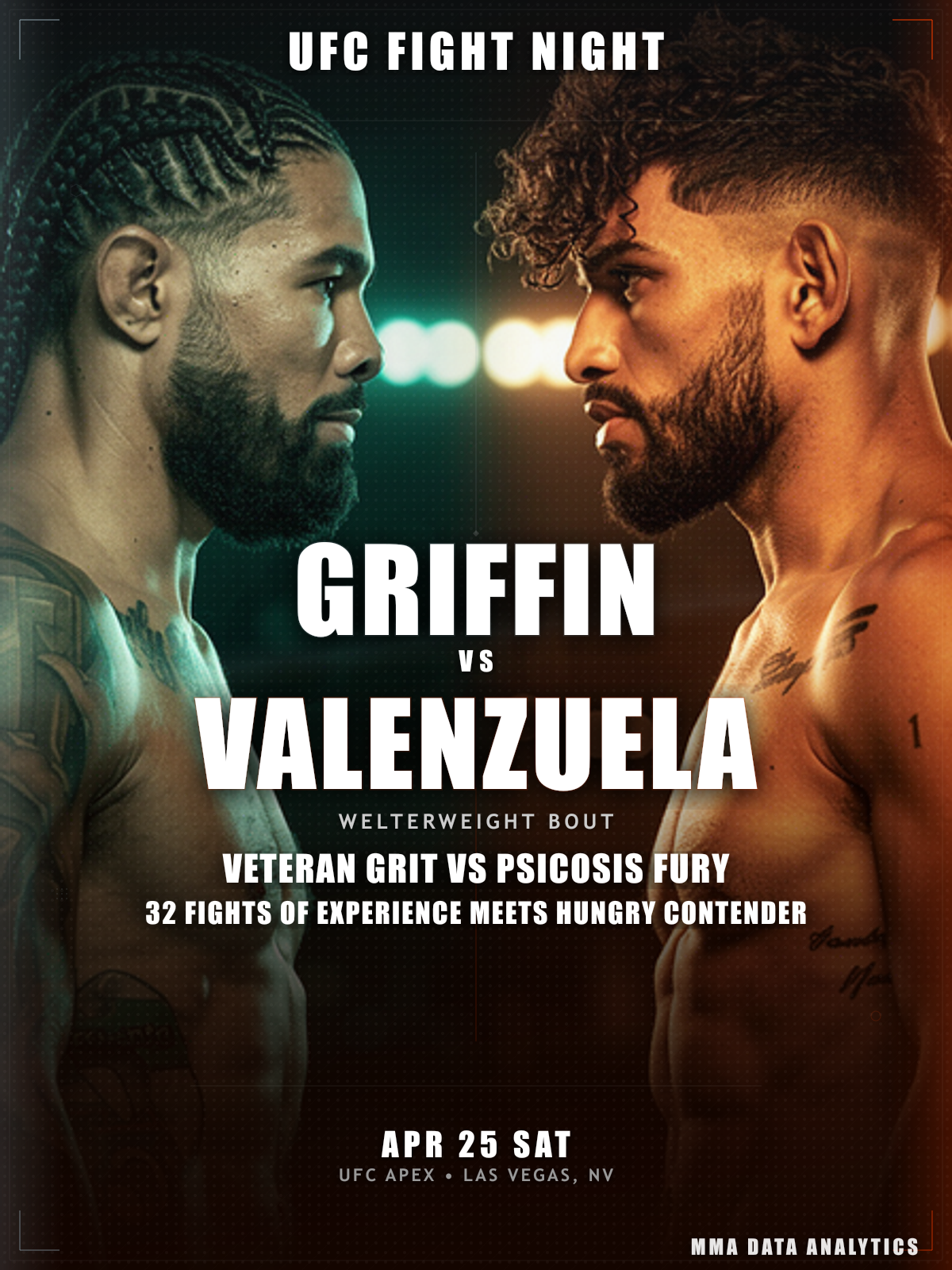
Max Griffin vs Victor Valenzuela
Welterweight Bout • UFC Fight Night: Sterling vs. Zalal
Sunday, April 26, 2026
Explore Detailed Fighter Profiles
Click on either the fighter's name or profile image for each fighter to access comprehensive UFC statistics including striking metrics, grappling data, clinch performance, complete fight history, offensive & defensive analytics, and round-by-round breakdowns.
Max Griffin
Fighter Metrics
Victory Methods
Win Round Distribution

Victor Valenzuela
Fighter Metrics
Victory Methods
Win Round Distribution
📋 Last 5 Fights - Max Griffin
| Date | Opponent | Result | Method |
|---|---|---|---|
| Jul 2025 | Chris Curtis | L | Decision (Split) (R3, 5:00) |
| Dec 2024 | Michael Chiesa | L | Submission (RNC) (R3, 1:56) |
| Feb 2024 | Jeremiah Wells | W | Decision (Split) (R3, 5:00) |
| Jul 2023 | Michael Morales | L | Decision (Unanimous) (R3, 5:00) |
| Oct 2022 | Tim Means | W | Decision (Split) (R3, 5:00) |
📋 Last 5 Fights - Victor Valenzuela
| Date | Opponent | Result | Method |
|---|---|---|---|
| Mar 2026 | Yusaku Kinoshita | W | TKO (R2, 4:13) |
| Oct 2025 | Michael Oliveira | L | TKO (Punches) (R2, 3:56) |
| Jun 2025 | Bruce Whitehead | W | TKO (Knee) (R1, 1:28) |
| Mar 2024 | Dustin Parrish | W | TKO (Leg Kick to GNP) (R1, 2:43) |
| May 2023 | Shinsho Anzai | W | TKO (R2, 1:54) |
Technical Analysis
Technical Score
Cardio Score
Overall Rating
📊 Technical Score
Calculated as the average of Striking Composite (49.0 vs 45.0) and Grappling Composite (37.0 vs 38.0). Griffin's edge comes from UFC-caliber striking experience, while Valenzuela brings comparable raw athleticism from regional circuits.
💪 Cardio Score
Based on average fight duration, striking rate per minute, takedown rate, and finish rate. Griffin's 13:45 avg fight duration vs Valenzuela's 6:20 shows Griffin is battle-tested over longer bouts while Valenzuela seeks early finishes.
🎯 Overall Rating
Simple average of Technical Score and Cardio Score. Provides a holistic view of fighter capabilities combining skill level with physical conditioning and fight performance.
Striking Composite
Grappling Composite
Technical Radar Comparison
Visual comparison of key performance metrics between both fighters
📊 Detailed Statistical Comparison
🥊 Fight Analysis Breakdown
🧩 Max Griffin Key Advantages
Griffin stands 6'0" with a 74-inch reach compared to Valenzuela's 5'9" and 71-inch reach. This 3-inch reach differential is significant in the welterweight division and allows Griffin to operate at a range where he can land without being hit. His 42-inch leg reach (vs 40") also permits effective distance management through teeps and kicks. Griffin's physical frame creates a consistent jab threat that forces Valenzuela to close distance against incoming fire—a recipe for counter opportunities that Griffin has exploited throughout his 18-fight UFC career.
With 18 UFC fights under his belt, Griffin brings an invaluable experience edge against Valenzuela's UFC debut. He has faced ranked welterweights including Mike Perry, Neil Magny, Carlos Condit, and Michael Morales. This experience manifests in cage awareness, comfort with the big-show atmosphere, and familiarity with UFC-caliber competition. Valenzuela's regional (Combate Global, LFA, Shooto) opponents represent a significant step down in quality compared to the competition Griffin has faced consistently since 2016.
Griffin's 54% striking defense significantly outperforms Valenzuela's 42%, creating a damage economy where Griffin absorbs fewer clean shots while maintaining offensive output. Despite absorbing 3.78 SApM, Griffin has only been stopped by strikes once in 32 professional fights—demonstrating elite durability. His 72% takedown defense also provides insurance against any Valenzuela grappling forays, keeping the fight in Griffin's preferred range where his size and experience advantages are maximized.
⚠️ Unfavorable Scenarios
Valenzuela's 54% KO/TKO finish rate and explosive early-round tendencies (5 of 9 finishes in R1) present a real danger in the opening minutes. His leg kick setups into ground strikes (as seen vs Dustin Parrish) and flying knee entries (vs Bruce Whitehead) can catch fighters who aren't prepared for his unorthodox attack angles. If Griffin is passive early and allows Valenzuela to build momentum, the Mexican's aggression could overwhelm before experience factors kick in.
Griffin's 83% of losses coming by decision (10 of 12 losses) reveals a pattern of close fights where judges don't favor him. His recent split decision losses to Chris Curtis, Alex Oliveira, and Neil Magny show he struggles to clearly win rounds in competitive bouts. At 37, his output may be declining—if Valenzuela can match his pace and land at higher accuracy (48% vs 44%), the younger fighter could steal rounds on the scorecards.
📋 Likely Gameplan
Griffin should leverage his 3-inch reach advantage by establishing a stiff jab early and using his teep kick to maintain distance. His 44% striking accuracy needs to improve in this fight—by operating behind his jab and using straight punches rather than looping hooks, he can exploit Valenzuela's 42% striking defense and keep the fight at a range where the smaller fighter can't generate knockout power. Consistent distance management drains Valenzuela's confidence and forces him into longer entries.
Griffin's 13:45 average fight duration demonstrates his ability to operate at a sustainable pace over three rounds. He should stay disciplined early, weather Valenzuela's initial aggression, and capitalize on the Mexican's tendency to fade—Valenzuela's 6:20 average fight duration suggests he's not accustomed to sustained combat beyond two rounds. By maintaining composure in R1 and increasing output in R2-R3, Griffin can exploit the cardio differential that becomes decisive in later rounds.
🚀 Victor Valenzuela Key Advantages
Valenzuela finishes 69% of his wins—including 7 by KO/TKO out of 13 victories (54%). His finishing ability is diverse: flying knees (vs Whitehead), ground-and-pound setups from leg kicks (vs Parrish), and traditional punch combinations (vs Kinoshita, Diaz). This versatility in finishing methods makes him unpredictable and dangerous. Against Griffin's 54% striking defense, Valenzuela has opportunities to land fight-changing shots, particularly in the pocket where his shorter frame allows for uppercuts and body work under Griffin's guard.
At 29, Valenzuela is entering his athletic prime while Griffin at 37 shows signs of physical decline—his recent record of 2-3 in his last 5 UFC fights with all losses by decision suggests diminishing output. Valenzuela's 3.80 SLpM slightly outpaces Griffin's 3.46, and his 48% striking accuracy edges Griffin's 44%. The 8-year age gap matters most in explosive exchanges where Valenzuela's reaction time and recovery speed provide tangible advantages. His win over Kinoshita in March 2026 demonstrates current form and confidence heading into his UFC debut.
⚠️ Unfavorable Scenarios
If Griffin successfully manages distance with his 3-inch reach advantage, Valenzuela will struggle to close the gap and land his power shots. The Mexican's TKO loss to Michael Oliveira on DWCS showed vulnerability when he can't control range—he was caught with hooks and hammerfists when overcommitting to entries. Against a disciplined jab-heavy approach, Valenzuela's shorter arms force him into disadvantageous exchanges where he absorbs strikes before landing his own, gradually eroding his confidence and physical reserves.
Valenzuela's 6:20 average fight duration reveals that most of his fights end before the third round. Only 4 of his 13 wins came by decision, and his regional competition hasn't consistently tested his cardio over 15 minutes of UFC-paced action. If Griffin survives the early storm and pushes the fight into R3, Valenzuela may find himself in uncharted territory—fighting against a veteran who knows how to grind out rounds against fading opponents. The jump from Combate Global/LFA pace to UFC pace is substantial.
📋 Likely Gameplan
Valenzuela must close distance aggressively and fight in the pocket where his speed advantage and diverse finishing tools can be effective. His approach should involve cutting off the cage, using feints to draw Griffin's jab, and countering with hooks and uppercuts inside. The leg kick setups that worked against Parrish could be effective here—targeting Griffin's lead leg to limit his movement and create opportunities for follow-up ground strikes or combination entries.
Valenzuela's best path to victory requires capitalizing on R1 and R2 when his explosive output is highest. His 5 R1 finishes demonstrate early-round effectiveness—he should attack aggressively from the first bell, overwhelming Griffin before the veteran can settle into his rhythm. By front-loading damage and pursuing the finish, Valenzuela avoids the cardio concerns of a third round where Griffin's experience, durability, and pace management become decisive advantages.
🎯 Fight Prediction Analysis
Data-driven prediction model based on statistical analysis
📊Detailed Analysis Summary
🏟️Experience vs Explosiveness
This matchup pits Griffin's 18-fight UFC career against Valenzuela's debut—a classic veteran vs prospect dynamic. Griffin has shared the octagon with ranked welterweights including Mike Perry (whom he dominated by unanimous decision), Carlos Condit, and Neil Magny. Valenzuela's best win came against Dustin Parrish in LFA, a fighter with a 10-4-1 record competing primarily in regional circuits. The quality-of-competition gap is significant and typically manifests in the octagon through better defensive instincts, cage awareness, and composure under pressure.
🎯Technical Breakdown
The statistical comparison reveals closely matched fighters with subtle differences. Valenzuela has slight edges in SLpM (3.80 vs 3.46) and striking accuracy (48% vs 44%), but Griffin's 54% striking defense significantly outperforms Valenzuela's 42%. The 12-point defensive gap means Griffin is consistently avoiding more shots—a metric that compounds over three rounds. Griffin's 72% TD defense vs Valenzuela's 60% also provides insurance against scrambles. The physical advantages (height, reach, leg reach) all favor Griffin, creating a framework where the veteran can control distance and outwork his younger opponent.
🧩Key Battle Areas
Three critical factors will determine this fight: (1) Range control— if Griffin maintains distance with his 3-inch reach advantage, he neutralizes Valenzuela's power; (2) Early-round survival—Valenzuela's 69% finish rate and 5 R1 stoppages represent his primary threat, and Griffin must weather the initial storm; (3) R3 conditioning—Valenzuela's 6:20 average fight duration creates serious questions about his ability to sustain UFC-level output for 15 minutes against a veteran who has repeatedly demonstrated third-round resilience. Griffin's path runs through patience and attrition; Valenzuela's through early aggression and explosive finishes.
🏁Final Prediction
The most likely outcome is Max Griffin by Decision (32% probability), achieved through range management, superior defensive efficiency, and third-round conditioning. Griffin's KO/TKO path (14%) becomes viable if he catches Valenzuela overcommitting to entries against the jab. Valenzuela's primary lane is KO/TKO (28%) via early-round explosiveness— his diverse finishing tools and power advantage in the pocket create legitimate upset potential. Valenzuela's decision path (10%) requires consistently outworking a larger, more experienced fighter over three rounds—a scenario his 4 career decision wins suggest he's capable of but faces a significant test at this level.
💰 Betting Analysis: Model vs Market
Detailed value assessment in the betting market
📊Market Odds
🤖Analytical Model
💎Value Opportunities
MAXIMUM VALUE
Model: 32% | Experience grinds out rounds
GOOD VALUE
Model: 28% | Early blitz finish path
SLIGHT VALUE
Model: 42% | Griffin's pace control
⚠️Key Market Discrepancies
- • Debut discount – Market may undervalue Valenzuela's skills due to lack of UFC tape, creating potential underdog value.
- • Age concerns – Griffin at 37 with a 2-3 recent record may be overvalued due to name recognition.
- • Style clash – Valenzuela's unorthodox finishing entries (leg kicks to GNP, flying knees) may surprise a rhythm-dependent fighter.
🎯 Comprehensive Probabilistic Analysis
100 hypothetical fight simulation based on statistical data
🏆Outcome Distribution - Max Griffin
Primary path via range control and attrition
Counter shots against overcommitting entries
Low historical submission profile for Griffin
💥Outcome Distribution - Victor Valenzuela
Primary upset lane via early explosive finish
Requires volume advantage over 3 rounds
Secondary path via armbar from scrambles
⏰Fight Timeline Analysis
⚡Window of Opportunity - Victor Valenzuela
- • First 5 minutes: Highest KO equity via explosive entries.
- • Leg kicks: Target Griffin's lead leg to limit movement.
- • Pocket exchanges: Close distance and use hooks + uppercuts under guard.
🎯Progressive Control - Max Griffin
- • Jab control: Establish range with reach advantage and teeps.
- • Damage economy: Use defensive shell and counter opportunities.
- • R3 volume: Increase output when Valenzuela's cardio fades.
🎯 Final Confidence Assessment
Confidence level and uncertainty factors
Confidence Level
Moderate edge via experience, but debut unknowns add volatility
✅Supporting Factors
- • 18 UFC fights vs debut—massive experience gap
- • 3-inch reach and 3-inch height advantage
- • 54% vs 42% striking defense differential
- • 72% takedown defense provides insurance
⚠️Risk Factors
- • Griffin's age (37) and recent 2-3 record
- • Valenzuela's 69% finish rate and R1 KO threat
- • Unknown quality ceiling for debuting fighter
🏁Executive Summary
Max "Pain" Griffin's 18-fight UFC veteran status, significant size advantages (6'0"/74" reach vs 5'9"/71" reach), and superior defensive metrics (54% StrDef vs 42%) create a framework where he should be able to manage distance and outwork Victor "Psicosis" Valenzuela over three rounds. However, Griffin's age-related decline (37 years old, 2-3 in last 5) and Valenzuela's explosive finishing ability (69% finish rate, 54% KO/TKO rate) make this far from certain. Valenzuela's primary threat centers on the first two rounds where his explosive output is highest—his 5 R1 finishes and diverse KO entries (knees, leg kicks to GNP, combinations) present legitimate upset potential against a fighter whose chin and reflexes may be declining.
Prediction: Griffin by Decision is the most likely outcome (32%) through range management and late-round conditioning, but Valenzuela by KO/TKO (28%) represents the primary upset path via early-round explosiveness. The fight's outcome hinges on whether Valenzuela can close the distance and land fight-changing shots before Griffin's experience, size, and cardio advantages become decisive factors in the third round.