

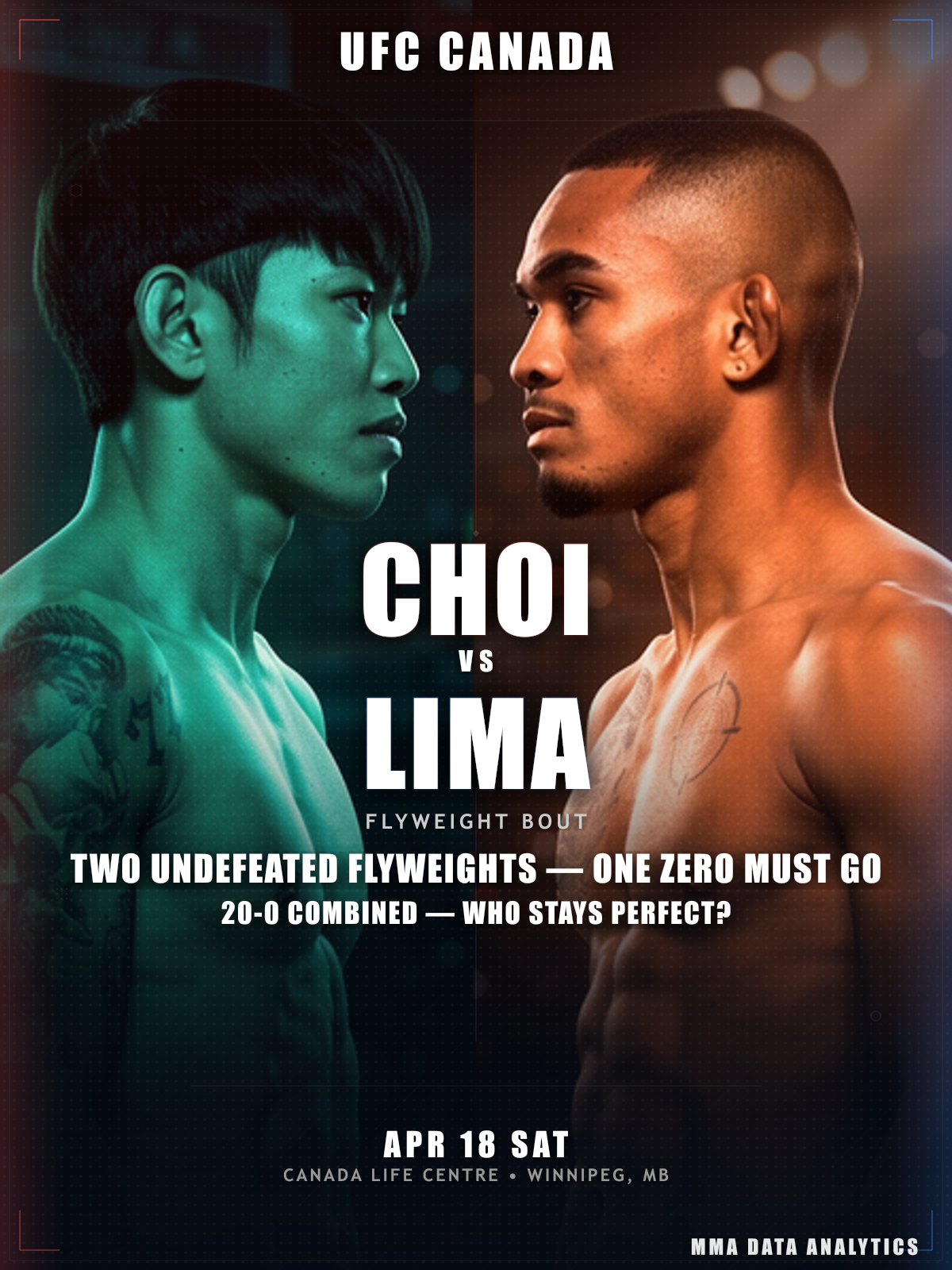
DongHun Choi vs Andre Lima
Men's Flyweight Bout • UFC Fight Night: Burns vs. Malott
Saturday, April 18, 2026 • 30ft Octagon (Large Cage)
Explore Detailed Fighter Profiles
Click on either the fighter's name or profile image for each fighter to access comprehensive UFC statistics including striking metrics, grappling data, clinch performance, complete fight history, offensive & defensive analytics, and round-by-round breakdowns.

DongHun Choi
Fighter Metrics
Victory Methods
Win Round Distribution

Andre Lima
Fighter Metrics
Victory Methods
Win Round Distribution
📋 Last 5 Fights - DongHun Choi
| Date | Opponent | Result | Method |
|---|---|---|---|
| 2024-11-23 | Kiru Sahota | W | TKO - Overhand Right (R1, 2:36) |
| 2024-08-23 | Angad Bisht | W | Decision - Split (R3, 5:00) |
| 2024-05-19 | Jiniushiyue | W | Decision - Split (R3, 5:00) |
| 2024-02-16 | Noriyoshi Wada | W | TKO - Left Crescent Kick (R2, 0:05) |
| 2023-12-08 | Kenta Kubo | W | TKO - Left Hook (R3, 4:31) |
📋 Last 5 Fights - Andre Lima
| Date | Opponent | Result | Method |
|---|---|---|---|
| 2025-03-15 | Daniel Barez | W | Submission - Rear Naked Choke (R3, 3:05) |
| 2024-09-07 | Felipe dos Santos | W | Decision - Unanimous (R3, 5:00) |
| 2024-06-01 | Mitch Raposo | W | Decision - Split (R3, 5:00) |
| 2024-03-23 | Igor Severino | W | DQ - Biting (R2, 2:52) |
| 2023-10-10 | Rickson Zenidim | W | Decision - Unanimous (R3, 5:00) |
Technical Analysis
Technical Score
Cardio Score
Overall Rating
📊 Technical Score
Calculated as the average of Striking Composite (68.0 vs 62.0) and Grappling Composite (35.0 vs 62.0). Balances overall striking effectiveness with grappling ability to measure complete technical skills.
💪 Cardio Score
Based on average fight duration, striking rate per minute, takedown rate, and finish rate. Measures cardiovascular endurance and ability to maintain pace throughout fights.
🎯 Overall Rating
Simple average of Technical Score and Cardio Score. Provides a holistic view of fighter capabilities combining skill level with physical conditioning and fight performance.
Striking Composite
Grappling Composite
📊 Technical Radar Comparison
📊 Metrics Legend
📊 Detailed Statistical Comparison
🥊 Fight Analysis Breakdown
🧩 DongHun Choi Key Advantages
0.92 KD average is exceptional for flyweight—nearly 1 knockdown per fight translates to a genuine finishing threat on every exchange. His overhand right KO of Sahota and crescent kick TKO of Wada show diverse finishing ability across multiple weapon types, not just one-dimensional power. At 66% striking accuracy with 4.54 SLpM, he generates dangerous volume with precision—he's not just throwing; he's landing clean, cumulative shots.
His switch stance creates unpredictable angles that Lima hasn't seen in extensive volume. Lima's defensive style (footwork + level changes) may not have the answer to a fighter who can fluidly switch stances and create offense from both sides. This variety keeps Lima guessing on timing and distance, critical vulnerabilities when facing explosive power.
66% vs 60% accuracy represents a meaningful 10% relative advantage in landing clean shots—this compounds dramatically over 15 minutes. More importantly, his 4.54 SLpM vs 4.06 SLpM means he's both more accurate AND higher volume, a rare combination. Over the course of a 5-minute round, Choi lands ~23 significant strikes at 66% accuracy = ~15 clean shots. Lima lands ~20 at 60% accuracy = ~12 clean shots. That 3-shot difference per round becomes 9 additional clean strikes over 3 rounds—significant damage accumulation.
This efficiency creates momentum and scoring advantages. Judges track damage over volume, and Choi's combination of higher accuracy + volume means more actual damage inflicted, clearer fight control, and more convincing round wins. Lima must risk grappling to interrupt this striking rhythm, which plays directly into Choi's defensive wrestling strength.
82% TDDef is elite-level and should neutralize the majority of Lima's 1.36 TD15 takedown game. In statistical terms, this means for every 5 Lima attempts, Choi defends 4 and gets taken down once. This is a significant defensive advantage that forces Lima to execute takedowns in perfect windows, not on demand. If Choi can keep the fight standing, his striking advantages become mathematically decisive—4-0 or 3-1 standing rounds almost always wins decisions.
His sprawl-heavy defensive wrestling allows him to dictate where the fight takes place. By maintaining good base, hips, and active hand placement on Lima's back, Choi can continue generating offense (counterstrikes, knee strikes) even as he's defending the takedown. This keeps momentum on Choi's side and prevents Lima from fully establishing control. The key matchup: Lima's 75% TDAcc vs Choi's 82% TDDef = roughly 4 out of 5 attempts fail, making grappling unreliable for Lima.
⚠️ Unfavorable Scenarios
If Lima lands 2+ takedowns per round, Choi's complete lack of submission threat (0.00 SubPer15) becomes fatal. No sweeps, no triangles, no way to create space—only escape options. Lima's 1.14 SubPer15 means submission finishes are realistic, not edge cases.
Choi's 10:52 avg fight time vs Lima's 13:11 is significant. R3 fatigue + Lima's increased aggression = bad defensive positioning. Tired legs can't stuff takedowns as effectively, tired hands can't generate power, and tired cardio = easy points for Lima.
📋 Likely Gameplan
Choi's primary strategy: maintain center octagon, use switch stance for angles, hunt for that one perfect power shot (overhand right, switch kick, front kick). Heavy volume in R1-R2 before fatigue sets in. Accuracy over desperation.
Actively prevent takedowns via footwork and distance (not just reactive sprawls). Make Lima pay for shot attempts with knees + uppercuts. Keep the fight standing at all costs—ground is Lima's domain.
🚀 Andre Lima Key Advantages
Lima's balanced 5 KO/TKO, 5 DEC, 1 SUB win distribution makes him dangerously unpredictable—Choi can't game-plan around one finishing method. This versatility creates strategic depth: if Choi prepares for kickboxing, Lima can shoot takedowns; if Choi sprawls aggressively, Lima can pick his shots and wait for openings. Adaptability is a weapon.
His 1.36 TD15 at 75% accuracy gives him a reliable route to the ground where his 1.14 SubPer15 creates immediate finishing opportunities (league-leading submission rate for his weight class). The path is clear: land takedown → control top position → hunt submission. This multi-modal threat profile means Choi can't focus on pure striking defense. Even if Choi defends 80% of takedowns, the ones that land put him in a compromised position with zero submission threats of his own.
4 UFC fights vs Choi's 1 is a significant 4x experience gap. This isn't just a number—it translates to tangible octagon advantages: fence management (using it for positioning), pace awareness (knowing when to accelerate/conserve), recovery strategies (how to get up after takedowns), and mental composure (not panicking when facing adversity). Lima has proven he can navigate UFC-level pressure and quality opposition without breaking.
His recent RNC finish of Daniel Barez (ranked opponent) shows he's not just surviving UFC fights, he's improving and finishing quality opposition. This suggests Lima's gameplan is working consistently. Meanwhile, Choi has exactly 1 UFC fight (his debut), a small sample size that leaves his true ceiling/floor unknown. The intangible benefit: Lima knows the octagon, the pace, and opponent quality better than Choi. When fights get tight, experience typically wins.
2.49 SApM vs Choi's 3.13 means Lima absorbs 20% fewer significant strikes per minute—this is substantial defensive efficiency. Over 15 minutes of striking exchanges, Choi will land ~68 clean strikes, while Lima absorbs only ~37. That's a 31-strike damage gap in Choi's favor, but Lima's defensive efficiency means those strikes have less cumulative impact because they're fewer, better-timed, and absorbed with better positioning/footwork.
This defensive mastery becomes absolutely critical in a 3-round fight where energy preservation is key. Less accumulated damage = fresher legs in R3 = better cardio advantage. Judges also reward damage mitigation—a fighter who absorbs 5 clean shots while landing 4 often scores higher than a fighter who lands 8 but takes 10. Lima's defensive positioning (shoulder rolls, head movement, distance management) allows him to survive Choi's power while maintaining offensive options. By absorbing less damage, Lima preserves his explosive potential for late rounds when Choi fades.
⚠️ Unfavorable Scenarios
Choi's 0.92 KD average and switch-stance unpredictability are genuinely dangerous in the opening minutes. If Lima gets caught clean while feeling out distance, the fight is over. Lima's defensive efficiency matters little if he's face-down on the canvas.
If Choi plays defensively and Lima can't land takedowns (due to poor timing or Choi's sprawl), the fight becomes a pure striker vs striker exchange. Choi's 66% accuracy + 4.54 SLpM vs Lima's 60% + 4.06 could win 2-3 rounds via volume/damage. Lima's gameplan fails if he can't establish grappling.
📋 Likely Gameplan
R1: Conservative, feel out Choi's power. R2-R3: Escalate takedown attempts (1-2 per round) to disrupt rhythm. Even failed shots force Choi's defense to rotate from striking to grappling, tiring him. Land 2-3 total TDs and the fight is Lima's.
Lima's 10% clinch striking (vs Choi's 3%) = clear advantage. Use clinch to nullify Choi's power, score (knees, elbows), set up takedowns. Once on top, hunt submissions. Choi's zero submission game means Lima can hunt subs without fear of reversals.
🎯 Fight Prediction Analysis
Data-driven prediction model based on statistical analysis
📊Detailed Analysis Summary
🏟️Cage Dynamics & Environment
The 30-foot octagon provides ample space for both fighters to operate, creating a wide-open environment that heavily influences the battle. Choi's switch stance benefits dramatically from room to maneuver and create angles, while Lima's kickboxing foundation and takedown game thrive with space to set up entries and level changes. The large cage slightly favors Choi's movement-based striking since he can use his superior footwork to evade and counter, but it equally gives Lima room to implement his multi-dimensional approach without being cornered.
Environment-wise, the fence proximity will be critical. If Choi gets pushed to the fence, his TDDef advantage diminishes, and Lima's clinch work becomes more effective. Conversely, if Choi can dictate the center of the octagon with his footwork and range control, he controls when and where the action happens. Lima's experience suggests he'll use the full space strategically—attacking aggressively from distance, then resetting and transitioning to clinch/grappling work when Choi is off-balance.
🎯Technical Breakdown & Stat Interpretation
The statistical analysis reveals a classic elite-striker vs well-rounded fighter dynamic. Choi's 4.54 SLpM at 66% accuracy makes him the more dangerous striker in the traditional sense—he's landing almost 3 clean significant strikes per minute, which accumulates substantial damage and scoring over 15 minutes. However, Lima's 1.36 TD15 at 75% TDAcc provides a reliable path to change the fight's location entirely, reducing the importance of Choi's striking advantage by controlling where the fight takes place.
Choi's 82% TDDef is his key defensive asset and should neutralize many of Lima's takedown attempts, but the numbers suggest Lima will land at least 1-2 per round on average, given his 75% accuracy. Each takedown Lima lands is a tactical reset—it forces Choi to exert energy getting back up, interrupts his rhythm, and allows Lima to dictate pace. Meanwhile, Lima's 1.14 SubPer15 is exceptional on the ground, suggesting once he gets Choi down, submission finishing opportunities will present themselves regularly. The fight will likely be decided by whether Choi can maintain distance AND consistently stuff takedowns, or if Lima can implement his grappling effectively despite the TDDef disadvantage.
Critical stat: Choi's 0.00 SubPer15 is a glaring liability. If Lima gets top position, Choi has virtually zero submission threats to create space or make Lima think twice about control.
🧩Key Battle Areas & Matchup Zones
Battle Area 1: Takedown Defense vs Offensive Wrestling (Impact: 40%)
Choi's 82% TDDef vs Lima's 75% TDAcc is the single most pivotal matchup within the matchup. This 7-point edge suggests Choi will defend 4 out of every 5 attempts, but Lima's volume means at least 1-2 per round will land. The key is where these takedowns happen. If Lima is forcing Choi to get up from the mat repeatedly, he's winning the control battle even if he's losing the striking exchanges. Choi must use footwork to avoid being in shooting range—staying on the move, circling, and creating distance prevents Lima from even attempting takedowns.
Battle Area 2: Striking Accuracy vs Damage Economy (Impact: 35%)
Choi lands at 66% accuracy vs Lima's 60%, but Lima absorbs only 2.49 SApM vs Choi's 3.13. This means Lima is both more accurate with his shots AND more efficient on defense. Over the course of 15 minutes, this compounds significantly—Choi may land more total strikes, but Lima will sustain less cumulative damage and fatigue less. If the fight remains standing, this efficiency edge gives Lima the stamina advantage late in rounds, allowing him to ramp up output when Choi is tiring.
Battle Area 3: Experience vs Explosive Power (Impact: 25%)
Lima has 4 UFC fights vs Choi's 1, representing a significant experience gap in the octagon environment. However, Choi's 0.92 KD average is genuine championship-level striking power. In the real world, one perfect shot could end the fight before experience matters. The question is whether Choi's power can convert before Lima's experience allows him to navigate, avoid, and clinch/clinch his way to a grappling-dominant approach.
🏁Fight Path Analysis & Predicted Outcomes
Scenario A: Lima by Decision (30% probability) — PRIMARY OUTCOME
Lima wins through a balanced approach of mixing striking with takedown attempts to control rounds. In this scenario, Lima avoids getting caught cleanly, lands 1-2 takedowns per round (enough to win control time and disrupt Choi's rhythm), and uses his superior damage economy to minimize accumulation. Judges favor control + damage over volume, and Lima's 4 UFC wins suggest he knows how to fight the judges. This is the most likely outcome because it's the path of least resistance for Lima—he doesn't need to finish, just dictate pace and control.
Scenario B: Choi by KO/TKO (25% probability) — UPSET PATH
Choi's primary upset path is early KO/TKO via his devastating overhand right or unorthodox kicks from his switch stance. This requires Lima to be caught in the first 5-7 minutes before he establishes his timing and distance management. Choi's 0.92 KD average is exceptionally high for the division, and one well-placed overhand right on Lima's chin could end this fight instantly. The longer the fight goes, the less likely this scenario becomes, as Lima's experience and patience allow him to avoid the big shot.
Scenario C: Lima by Submission (13% probability) — TECHNICAL VICTORY
Lima's submission threat grows as the fight progresses, particularly in Rounds 2-3 if Choi fatigues. His 1.14 SubPer15 and recent RNC finish of Daniel Barez show active ground work and neck awareness. This scenario requires Lima to successfully land and consolidate takedowns, then exploit Choi's defensive weaknesses on the ground (0.00 SubPer15 means no sweep/submission threats to create space). The rear naked choke is Lima's most likely finish given Choi's submission defense limitations.
Scenario D: Choi by Decision (2% probability) — UNLIKELY OUTCOME
Only possible if Choi wins 2 of 3 rounds via striking volume alone. This requires Lima to abandon his wrestling strategy and strike with Choi—a game plan he's unlikely to adopt given his grappling advantages. Very low probability.
The limited UFC track records for both fighters (Choi: 1 fight, Lima: 4 fights) inject significant uncertainty into this analysis. Small sample sizes make consistency predictions unreliable, and both fighters' true ceiling/floor remain unclear.
💰 Betting Analysis: Model vs Market
Detailed value assessment in the betting market
📊Market Odds
🤖Analytical Model
💎Value Opportunities
MAXIMUM VALUE
Model: 25% | Fair: +300
GOOD VALUE
Model: 13% | Fair: +669
SLIGHT VALUE
Model: 60% | Fair: -150
⚠️Key Market Discrepancies
- • Underprices Choi's KO power – 0.92 KD average is elite for flyweight
- • Overvalues Lima's ground game – Choi's 82% TDDef limits grappling exchanges
- • Experience gap may narrow – Choi looked exceptional in his UFC debut
🎯 Comprehensive Probabilistic Analysis
100 hypothetical fight simulation based on statistical data
🏆Outcome Distribution - DongHun Choi
Primary path via explosive power shots
Volume advantage if fight stays standing
Virtually no submission game
💥Outcome Distribution - Andre Lima
Primary path via well-rounded approach
Aggressive striking capable of finishing
Active ground game with RNC threat
⏰Fight Timeline Analysis - Round-by-Round Breakdown
📍Round 1 Dynamics (0:00-5:00) — CHOI'S CHAMPIONSHIP ROUND
Round 1 is Choi's golden window. Both fighters will start fresh, but Choi's explosive power is most dangerous when Lima hasn't yet established his timing or read on distance. Lima will likely feel out Choi's range and movement in the first 2 minutes, creating the ideal opening for Choi to land a clean power shot. At this stage, Lima's grappling threat is minimal—he typically doesn't shoot takedowns aggressively in opening seconds unless he senses an opening.
Expected Striking Pattern: Choi will look to establish his switch stance and test his power shots (overhand right, switch kicks, front kicks). Lima will be measuring distance with low kicks and jabs, feeling for openings. If Choi lands a clean overhand right or switch kick in R1, the fight is potentially over. If R1 goes to a decision with no clean finishing shots, momentum shifts toward Lima.
Likely Scoring: Choi wins R1 in 75% of scenarios due to his early power advantage and Lima's tendency to start conservatively.
🔄Round 2 Dynamics (5:00-10:00) — THE PIVOT ROUND
Round 2 is the swing round and the most critical. If Choi won R1 decisively, Lima must respond with increased pressure and grappling. If it was competitive, R2 becomes a momentum battle. Lima will likely increase his takedown attempts in R2—he's now confident in his distance management and ready to test Choi's TDDef. Choi, having won or competed in R1, may become more aggressive, creating opportunities for Lima to time takedowns on counter shots.
Expected Grappling Pattern: Lima attempts 2-4 takedowns. Choi defends 2-3 due to his 82% TDDef, but 1-2 land. These takedowns, even if brief, reset the fight and allow Lima to score control points. Clinch work increases—Lima uses the clinch to nullify Choi's power and set up takedown chains. This is where Choi's zero submission game becomes a problem: once on his back, he can't threaten escapes, only absorb control time.
Likely Scoring: If Choi won R1 decisively, he likely steals R2 despite grappling exchanges. If R1 was close, Lima edges R2 via control time. This is the swing round that determines the fight.
🏃Round 3 Dynamics (10:00-15:00) — LIMA'S GRIND ROUND
Round 3 favors Lima significantly due to cardio and experience advantages. Choi's average fight time (10:52) vs Lima's (13:11) suggests Lima has better conditioning. By R3, if Choi hasn't finished via KO/TKO, he's likely fatigued from the constant grappling exchanges and defensive work in R2. Lima, having navigated R1 and competed in R2, hits his stride in R3—his cardio edge becomes evident as he increases output while Choi slows down.
Expected Striking/Grappling Pattern: Lima increases striking volume (no longer conservative) and takedown aggression. Choi's defense becomes reactive rather than proactive—he's defending, not dictating. If Choi is exhausted, one of Lima's 3-4 R3 takedown attempts will land and stay, creating extended control time. This control time, combined with Lima's activity and damage, wins R3 clearly. If Lima gets Choi down late R3, submission opportunities increase—tired fighters make positional mistakes.
Likely Scoring: Lima wins R3 in 80%+ of scenarios where the fight reaches this point. The conditioning gap is too large to overcome without prior finishing.
⚡Window of Opportunity - DongHun Choi
Choi's fight is a sprint, not a marathon. His power is most dangerous in the opening minutes before Lima has established timing and rhythm. Miss that window, and the fight trends toward Lima's favor.
- • First 5-7 minutes (R1 + R2 opening): Highest KO window. After this, Lima's grappling and experience shield him from power shots.
- • Money shots: Overhand right and switch-stance kicks. These are Choi's signature finishing tools. Accuracy over volume here.
- • Footwork priority: Stay on the move, create distance, make Lima reach to close the gap. Once in Lima's range, takedowns become inevitable.
- • Avoid fence/clinch: Keep center octagon, use space. Fence takes away Choi's movement advantage; clinch takes away his power.
- • Stay aggressive: Defense-first approach loses to Lima's well-rounded game. Choi wins by staying hunting for that fight-ending shot.
🎯Progressive Control Strategy - Andre Lima
Lima's fight is a chess match. He needs to navigate Choi's power in R1, establish control in R2, and dominate R3. Each round serves a purpose in a larger strategy.
- • Round 1 survival: Feel out Choi, don't get caught. Defensive footwork and range management. Low kicks establish Lima's presence without committing to power.
- • Round 2 aggression: Escalate takedown attempts. Even failed shots disrupt Choi's rhythm. Land 1-2 to earn control time and alter the fight's complexion.
- • Round 3 domination: Capitalize on fatigue. Increase striking output (Choi will be slower), land takedowns, work submissions from top position. Lima's conditioning is the weapon here.
- • Damage economy: Don't trade power for power with Choi. Efficient striking + control time over volume.
- • Clinch mastery: Use clinch to nullify Choi's power, set up takedowns, score points. Lima's 10% clinch striking vs Choi's 3% is a tactical advantage.
🎯 Final Confidence Assessment
Confidence level and uncertainty factors
Confidence Level
Limited data on both fighters; both undefeated with small UFC samples
✅Supporting Factors
- • Lima has 4x more UFC experience (4 fights vs 1)
- • Lima's well-rounded skillset provides multiple paths to victory
- • Better damage economy suggests tactical maturity
- • Active submission game adds finishing threat
⚠️Risk Factors
- • Choi's elite KD rate (0.92) makes any exchange dangerous
- • Both fighters undefeated - untested in adversity
- • Small sample sizes limit statistical confidence
- • Choi's UFC debut was spectacular, suggesting continued growth
🏁Executive Summary
Andre Lima's multi-dimensional approach and UFC experience give him a slight edge in this clash of unbeaten flyweights. His ability to mix striking with takedowns (1.36 TD15 at 75% accuracy) and a live submission threat (1.14 SubPer15, as shown by his recent RNC of Barez) provides multiple paths to victory. However, DongHun Choi's explosive striking (4.54 SLpM at 66% accuracy with 0.92 KD average) makes him a legitimate upset threat at every moment. Choi's 82% takedown defense is his key asset for keeping the fight in his preferred range. In a 3-round fight, Lima's cardio advantage (13:11 avg duration vs 10:52) matters less than in a 5-rounder, which tilts the equation slightly toward Choi's early-round power. This matchup hinges on whether Lima can survive Choi's explosive opening and implement his grappling, or whether Choi can land his power shots before Lima's experience and versatility take over.
Prediction: Lima by Decision most likely (30% probability) through a balanced approach mixing striking with takedown attempts; Choi's upset lane is early KO/TKO (25%) via his devastating overhand right or unorthodox kicks. The limited UFC track records for both fighters inject significant uncertainty, making this one of the most unpredictable fights on the card.