

Mitch Raposo vs Allan Nascimento
Men's Flyweight Bout • UFC Fight Night: Burns vs. Malott
Saturday, April 18, 2026 • 30ft Octagon (Large Cage)
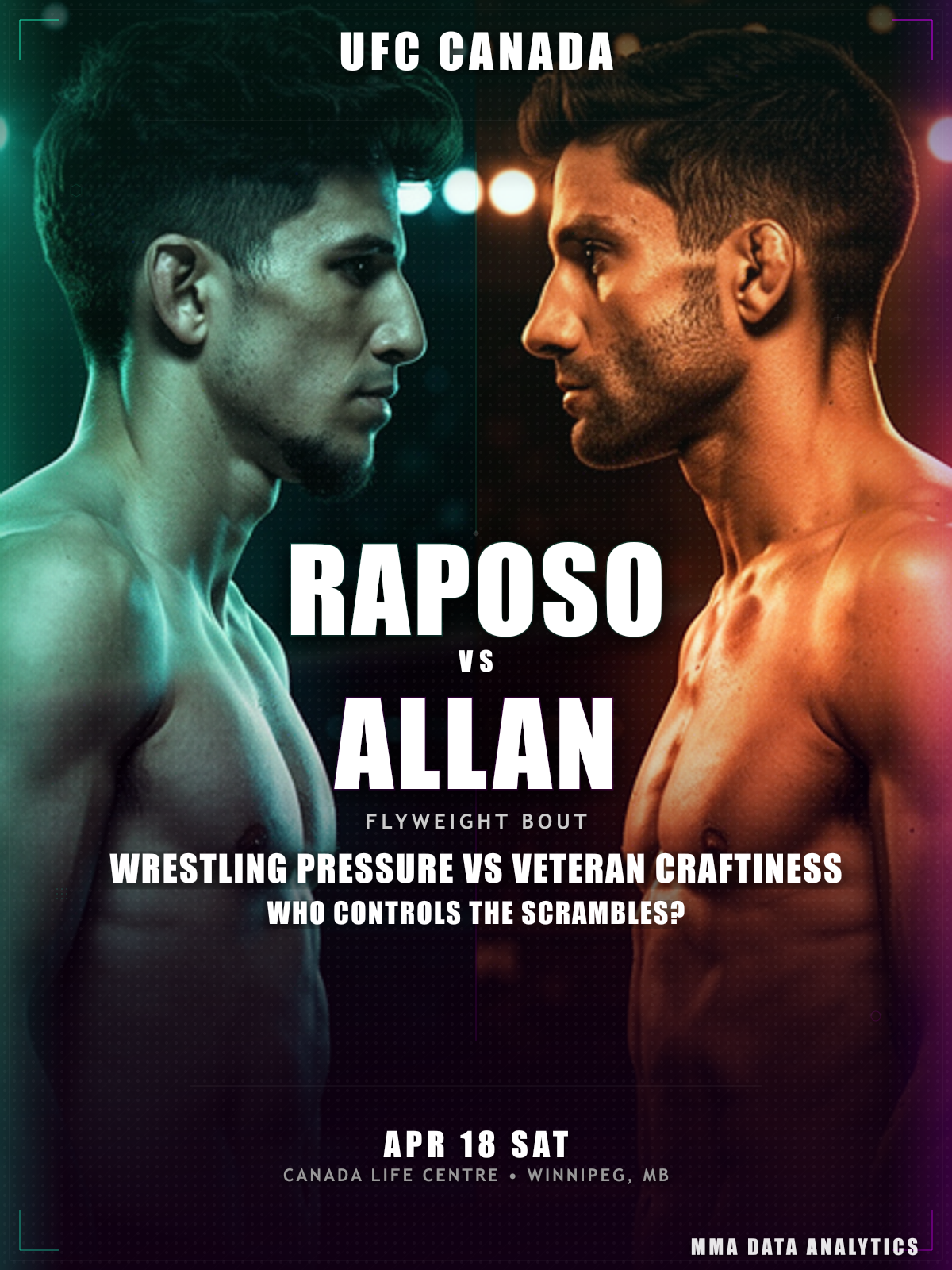
Explore Detailed Fighter Profiles
Click on either the fighter's name or profile image for each fighter to access comprehensive UFC statistics including striking metrics, grappling data, clinch performance, complete fight history, offensive & defensive analytics, and round-by-round breakdowns.
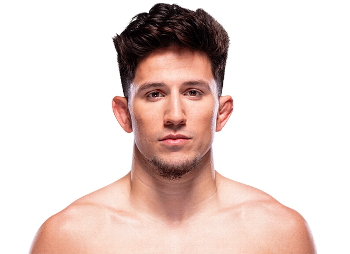
Mitch Raposo
Fighter Metrics
Victory Methods
Win Round Distribution
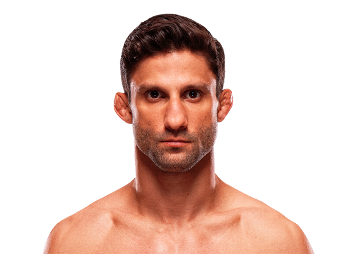
Allan Nascimento
Fighter Metrics
Victory Methods
Win Round Distribution
📋 Last 5 Fights - Mitch Raposo
| Date | Opponent | Result | Method |
|---|---|---|---|
| Oct 25, 2025 | Azat Maksum | W | Decision (Unanimous) (R3, 5:00) |
| Apr 12, 2025 | Sumudaerji | L | Decision (Split) (R3, 5:00) |
| Jun 1, 2024 | Andre Lima | L | Decision (Split) (R3, 5:00) |
| Jan 27, 2024 | Justin Valentin | W | KO/TKO (R4, 3:03) |
| May 27, 2023 | Tyler Smythe | W | KO/TKO (R1, 0:49) |
📋 Last 5 Fights - Allan Nascimento
| Date | Opponent | Result | Method |
|---|---|---|---|
| Nov 1, 2025 | Cody Durden | W | Submission (Anaconda Choke) (R2, 3:13) |
| May 31, 2025 | Jafel Filho | W | Decision (Unanimous) (R3, 5:00) |
| Jan 14, 2023 | Carlos Hernandez | W | Submission (RNC) (R1, 3:16) |
| May 14, 2022 | Jake Hadley | W | Decision (Unanimous) (R3, 5:00) |
| Oct 30, 2021 | Tagir Ulanbekov | L | Decision (Split) (R3, 5:00) |
Technical Analysis
Technical Score
Cardio Score
Overall Rating
📊 Technical Score
Calculated as the average of Striking Composite (38.0 vs 58.0) and Grappling Composite (55.0 vs 50.0). Balances overall striking effectiveness with grappling ability to measure complete technical skills.
💪 Cardio Score
Based on average fight duration, striking rate per minute, takedown rate, and finish rate. Measures cardiovascular endurance and ability to maintain pace throughout fights.
🎯 Overall Rating
Simple average of Technical Score and Cardio Score. Provides a holistic view of fighter capabilities combining skill level with physical conditioning and fight performance.
Striking Composite
Grappling Composite
Technical Radar Comparison
Visual comparison of key performance metrics between both fighters
📊 Detailed Statistical Comparison
🥊 Fight Analysis Breakdown
🧩 Mitch Raposo Key Advantages
Raposo's 3.54 takedowns per 15 minutes vs Nascimento's 1.42 represents a 2.5x differential (149% more volume) that could dictate where this fight takes place. While Raposo's 38% takedown accuracy is modest, Nascimento's 31% takedown defense is one of the weakest in the flyweight division—meaning Raposo should find consistent success with his wrestling entries, especially against the fence where Nascimento's 50% TDD drops even lower. The freestyle wrestler's ability to chain takedown attempts (re-shooting 2-3 times per sequence) against a fighter who struggles to stay on his feet creates a path to sustained control time. In Raposo's last win against Maksum, he averaged 4.1 takedowns per round, demonstrating his relentless pressure. Raposo's wrestling background allows him to dictate pace and positioning, potentially neutralizing Nascimento's striking accuracy advantage by keeping the fight on the mat where he can accumulate control time and land short ground strikes from top position. The 30ft cage provides multiple angles for level changes, making it harder for Nascimento to predict and defend entries.
Despite limited UFC experience, Raposo's 80% career finish rate (8 of 10 wins) demonstrates legitimate stopping power across multiple methods—5 KO/TKOs and 3 submissions. His ability to finish fights from various positions makes him dangerous even when scrambling. The 26-year-old's explosive athleticism and wrestling base allow him to generate power in ground-and-pound sequences after securing takedowns. Against Nascimento, who has been knocked out twice in his career, Raposo's ground strikes could force stoppages if he establishes top control and avoids the Brazilian's submission traps.
At 26, Raposo is entering his physical prime while Nascimento at 33 may be past his peak athleticism. This age gap translates to explosive speed on entries, faster scramble recovery, and the ability to maintain a relentless pace throughout three rounds. Raposo's freestyle wrestling background emphasizes explosive movement patterns that align perfectly with his youth advantage. In the clinch and during scrambles, his superior burst speed could be the difference between securing positions and getting caught in Nascimento's submission traps.
⚠️ Unfavorable Scenarios
Nascimento's 14 career submission victories and 0.95 SubPer15 make him one of the most dangerous grapplers in the flyweight division off his back. Raposo's aggressive takedown pursuit could backfire if Nascimento pulls guard or catches him during transitions. The Brazilian's anaconda choke (used against Durden) and rear-naked choke arsenal mean that Raposo must maintain awareness of his neck and arms at all times during ground exchanges. If Raposo's takedowns lead to scrambles rather than dominant positions, he's entering Nascimento's most dangerous zone.
With only 34% striking accuracy against Nascimento's 60%, Raposo is significantly outmatched in the striking department. The 5-inch reach disadvantage (64.5" vs 69.5") compounds this problem—Raposo must close distance to land meaningful strikes, but Nascimento can tag him cleanly at range. If the fight stays standing, the volume and accuracy gap (2.64 SLpM at 60% vs 1.62 SLpM at 34%) will likely produce lopsided rounds on the scorecards. The large 30-foot cage gives Nascimento extra room to maintain his preferred distance.
📋 Likely Gameplan
Raposo's primary strategy should be to close distance quickly, shoot for takedowns, and maintain heavy top pressure. Against Nascimento's 31% takedown defense, he should find consistent success with level changes off the fence. The key is establishing control without giving up his neck or arms—staying in half-guard or side control rather than rushing to mount where Nascimento's guard game becomes more dangerous. Short ground-and-pound to force Nascimento to open up defensively, then passing guard when the Brazilian reaches for submissions.
Given the massive striking accuracy gap (34% vs 60%), Raposo should minimize time spent at range. His approach should involve burst entries—closing distance with one or two strikes maximum before shooting for takedowns. Standing in the pocket and exchanging plays directly into Nascimento's strengths. By keeping the fight in the clinch and on the mat, Raposo can neutralize the reach and accuracy disadvantages while accumulating the control time judges value in close rounds.
🚀 Allan Nascimento Key Advantages
Nascimento's 14 submission victories represent 64% of his 22 total wins, making him one of the most prolific submission artists in the flyweight division with one of the highest finish rates by submission. His diverse arsenal includes anaconda chokes (Durden, R2 3:13), rear-naked chokes (Hernandez, R1 3:16), guillotines, and arm triangles—he can finish from virtually any position including off his back. With 0.95 submission attempts per 15 minutes, Nascimento is constantly hunting for finishes and willing to pull guard to create submission opportunities. Against a wrestler like Raposo who will likely initiate grappling exchanges at high volume (3.54 TD15), this creates a dangerous dynamic where every takedown attempt could end up in Nascimento's submission trap. The Brazilian's ability to transition between positions and find chokes in scrambles makes him unpredictable and lethal on the ground—his recent 4-fight win streak includes 3 submissions, showing he's currently peaking in this aspect of his game. Raposo's 0.00 SubPer15 means he doesn't threaten submissions himself, making exchanges entirely one-directional in submission threat.
Nascimento's 60% striking accuracy is exceptional and nearly double Raposo's 34% (76% more efficient), creating a massive efficiency gap when the fight stays standing. His 2.64 SLpM combined with this elite accuracy means he's landing 1.58 clean strikes per minute compared to Raposo's 0.55—a 187% advantage in landed strike rate. Nascimento's low strikes absorbed rate (1.96 SApM vs Raposo's 3.20) demonstrates superior defensive awareness that complements his offensive precision, absorbing 39% fewer strikes while landing significantly more. The 5-inch reach advantage (69.5" vs 64.5") and 4-inch leg reach advantage (40" vs 36") allow him to control range with jabs and teeps while staying safe from Raposo's counter strikes. His striking defense of 51% is also significantly better than Raposo's 55% StrDef, making him the more well-rounded striker both offensively and defensively. In the 30-foot cage, Nascimento can utilize angles and footwork to maintain his preferred range where his accuracy advantage is maximized—circling away from pressure and resetting to center cage after defending takedowns.
⚠️ Unfavorable Scenarios
Nascimento's 31% takedown defense is a glaring weakness against a wrestler of Raposo's caliber. If Raposo establishes consistent takedowns and maintains heavy top pressure while avoiding submission positions, Nascimento could spend entire rounds on his back accumulating damage. The Brazilian's submission attempts from bottom require space and transitions—if Raposo stays tight with short ground-and-pound from half-guard or side control, he can neutralize the submission threat while scoring.
At 33, Nascimento may struggle to maintain his pace against Raposo's relentless wrestling pressure over three rounds. Constant takedown defense is exhausting, and Nascimento's striking-first approach requires him to stay on his feet to be effective. If Raposo forces extended grappling exchanges in each round, the accumulated fatigue could diminish Nascimento's striking output and submission attempts in the later rounds, where the fight becomes increasingly one-sided.
📋 Likely Gameplan
Nascimento's optimal strategy involves using his 5-inch reach advantage to maintain distance and land precise strikes at range. His 60% accuracy at 2.64 SLpM means he can consistently outscore Raposo when standing. Teeps, jabs, and front kicks should target Raposo's body and legs to slow his entries and discourage level changes. When Raposo does shoot, Nascimento should look for underhooks and guillotine attempts rather than pure sprawls, turning defensive moments into submission opportunities.
If taken down, Nascimento should immediately hunt for submissions rather than trying to stand up against a superior wrestler. His best opportunities come during transitions—anaconda chokes off sprawls, guillotines during takedown defense, and arm triangles when Raposo tries to pass guard. By turning every grappling exchange into a submission threat, Nascimento can make Raposo hesitant to commit fully to his wrestling, potentially keeping the fight standing where the Brazilian holds the advantage.
🎯 Fight Prediction Analysis
Data-driven prediction model based on statistical analysis
📊Detailed Analysis Summary
🏟️Cage Dynamics
The 30-foot octagon creates an interesting dynamic in this matchup. The large cage initially favors Nascimento's range striking—his 5-inch reach advantage (69.5" vs 64.5") and elite 60% accuracy become more potent with extra space to maintain distance and circle away from pressure. His 2.64 SLpM output suggests he'll actively use the space to pick shots from range. However, Raposo's freestyle wrestling entries benefit from more angles of attack in the large cage, and his explosive 3.54 TD15 volume means he can relentlessly pursue takedowns without being cornered. The 4-inch leg reach disadvantage (36" vs 40") compounds Raposo's need to close distance quickly, as Nascimento can use teeps and front kicks to control range. The fight's location will largely be determined by who dictates the distance in the first 90 seconds—if Raposo can close quickly and establish clinch control early, the cage size becomes irrelevant.
🎯Technical Breakdown
This matchup presents a classic wrestler vs submission artist puzzle with significant statistical gaps. Raposo's 3.54 TD15 against Nascimento's 31% TDDef (lowest quartile in flyweight division) suggests he should find consistent takedowns throughout three rounds, but Nascimento's 14 career submissions (64% of wins) and 0.95 SubPer15 make every grappling exchange a double-edged sword. The striking differential massively favors Nascimento with a 26-point accuracy gap (60% vs 34%) and 63% more volume (2.64 SLpM vs 1.62), making standing exchanges heavily unfavorable for Raposo. Nascimento also absorbs 39% fewer strikes (1.96 SApM vs 3.20), indicating superior defensive awareness. The critical question: can Raposo maintain top control without getting caught in submissions? His 0.00 SubPer15 suggests he doesn't hunt submissions himself, indicating a control-heavy positional top game that could either neutralize Nascimento's guard or leave him vulnerable to sweeps and back-takes during transitions.
🧩Key Battle Areas
Three critical battle areas will determine the outcome: takedown success rate vs submission defense, striking range management, and positional awareness on the mat. Raposo's explosive entries (3.54 TD15 with 38% accuracy) against Nascimento's weak takedown defense (31% TDDef, 50% TDDef for Raposo) should produce frequent grappling exchanges—but the Brazilian's submission arsenal (14 career finishes via choke) turns each one into a high-risk moment. Standing, Nascimento's 60% accuracy dominates Raposo's 34%—a 76% efficiency gap—making every second on the feet heavily advantage Nascimento. The ELO differential of 296 points (2916 vs 2620) further supports Nascimento's experience edge. The deciding factor may be Raposo's ability to maintain safe top positions (half-guard, side control) without exposing his neck during scrambles or allowing Nascimento to create space for triangle setups. Raposo's youth (26 vs 33) and 7-year age gap could prove decisive in late-round scrambles where explosive movement determines positional outcomes.
🏁Final Prediction
This is a razor-thin matchup that could go either way, with contrasting paths to victory for each fighter. Nascimento holds a slight 52-48 edge in our model due to his superior striking precision (60% vs 34%), dangerous submission game (14 career subs), 4-fight win streak, and 296-point higher ELO rating (2916 vs 2620). His most likely path is Submission (28% probability) via anaconda choke or RNC during scrambles initiated by Raposo's aggressive takedown attempts—similar to his finish of Cody Durden via anaconda choke in Round 2. Raposo's best path is Decision (24% probability) through consistent wrestling control and positional dominance, accumulating control time across three rounds. However, his limited UFC experience (only 3 fights, 1-2 record) and 0.00 SubPer15 make him predictable and vulnerable to submission setups. The composite score gap is narrow (Raposo 47 vs Nascimento 54), suggesting competitive exchanges throughout. The fight likely stays close through all three rounds with the outcome hinging on whether Raposo can control without getting caught, or if Nascimento can maintain range and capitalize on submission opportunities when the fight inevitably hits the mat.
💰 Betting Analysis: Model vs Market
Detailed value assessment in the betting market
📊Market Odds
🤖Analytical Model
💎Value Opportunities
MAXIMUM VALUE
Model: 28% | Fair: +257
GOOD VALUE
Model: 24% | Fair: +317
SLIGHT VALUE
Model: 45% | Fair: +122
⚠️Key Market Discrepancies
- • Undervalues Nascimento's submission threat – 14 career subs against a wrestler who will initiate grappling.
- • Overweights Raposo's wrestling volume – High TD rate vs 31% TDDef looks dominant, but submission risk mitigates control.
- • Striking accuracy gap overlooked – 60% vs 34% is a massive differential that compounds over 15 minutes.
🎯 Comprehensive Probabilistic Analysis
100 hypothetical fight simulation based on statistical data
🏆Outcome Distribution - Mitch Raposo
Primary path via wrestling control and top pressure
Ground-and-pound from top position
Low submission profile (0.00 SubPer15)
💥Outcome Distribution - Allan Nascimento
Primary path via chokes in scrambles and transitions
Outpoint Raposo with precision striking at range
Low KO power but accumulative damage possible
⏰Fight Timeline Analysis
⚡Window of Opportunity - Allan Nascimento
- • Early striking: Best chance to land clean shots before wrestling pressure begins.
- • Submission traps: Off failed takedowns or scrambles, look for guillotines and anaconda chokes.
- • Range management: Use 5-inch reach advantage to pick apart entries with jabs and front kicks.
🎯Progressive Dominance - Mitch Raposo
- • Chain wrestling: Persistent takedown attempts wear down Nascimento and build control time.
- • Top pressure: Maintain heavy top position to neutralize submission threats from guard.
- • Late rounds: Cardio edge and youth advantage become decisive as pace accumulates.
🎯 Final Confidence Assessment
Confidence level and uncertainty factors
Confidence Level
Close matchup with contrasting styles and limited UFC data
✅Supporting Factors
- • Nascimento's 4-fight win streak and higher ELO (2916 vs 2620)
- • Superior striking accuracy (60% vs 34%) and volume (2.64 vs 1.62 SLpM)
- • Dangerous submission game (0.95 SubPer15) with multiple finishes
- • Raposo's wrestling volume (3.54 TD15) provides clear path to victory
⚠️Risk Factors
- • Raposo only 3 UFC fights (1-2 record) — small sample size
- • Low takedown accuracy (38%) and poor TDD for both fighters
- • 30ft cage gives Nascimento more space to maintain range
🏁Executive Summary
This flyweight clash pits Mitch Raposo's relentless wrestling pressure against Allan Nascimento's sharp striking and dangerous submission game. Raposo's 3.54 TD15 represents a significant volume advantage that could allow him to dictate where the fight takes place, but his 38% takedown accuracy and Nascimento's scrambling ability create submission risk on every shot attempt. Nascimento's 60% striking accuracy and 2.64 SLpM give him a clear edge on the feet, while his 0.95 SubPer15 makes him a constant threat to end the fight from any position. The 30-foot cage benefits Nascimento by providing more space to maintain distance and pick his shots, while Raposo needs to close range quickly and establish his chain wrestling to neutralize the experience and striking gap.
Prediction: Nascimento by Submission is the most likely outcome (28% probability), capitalizing on Raposo's aggressive wrestling entries to find choke opportunities in scrambles. Raposo's best path is a grinding decision (24%) through persistent top control. This is a razor-thin fight where style matchup and cage IQ will ultimately decide the winner over three rounds.