
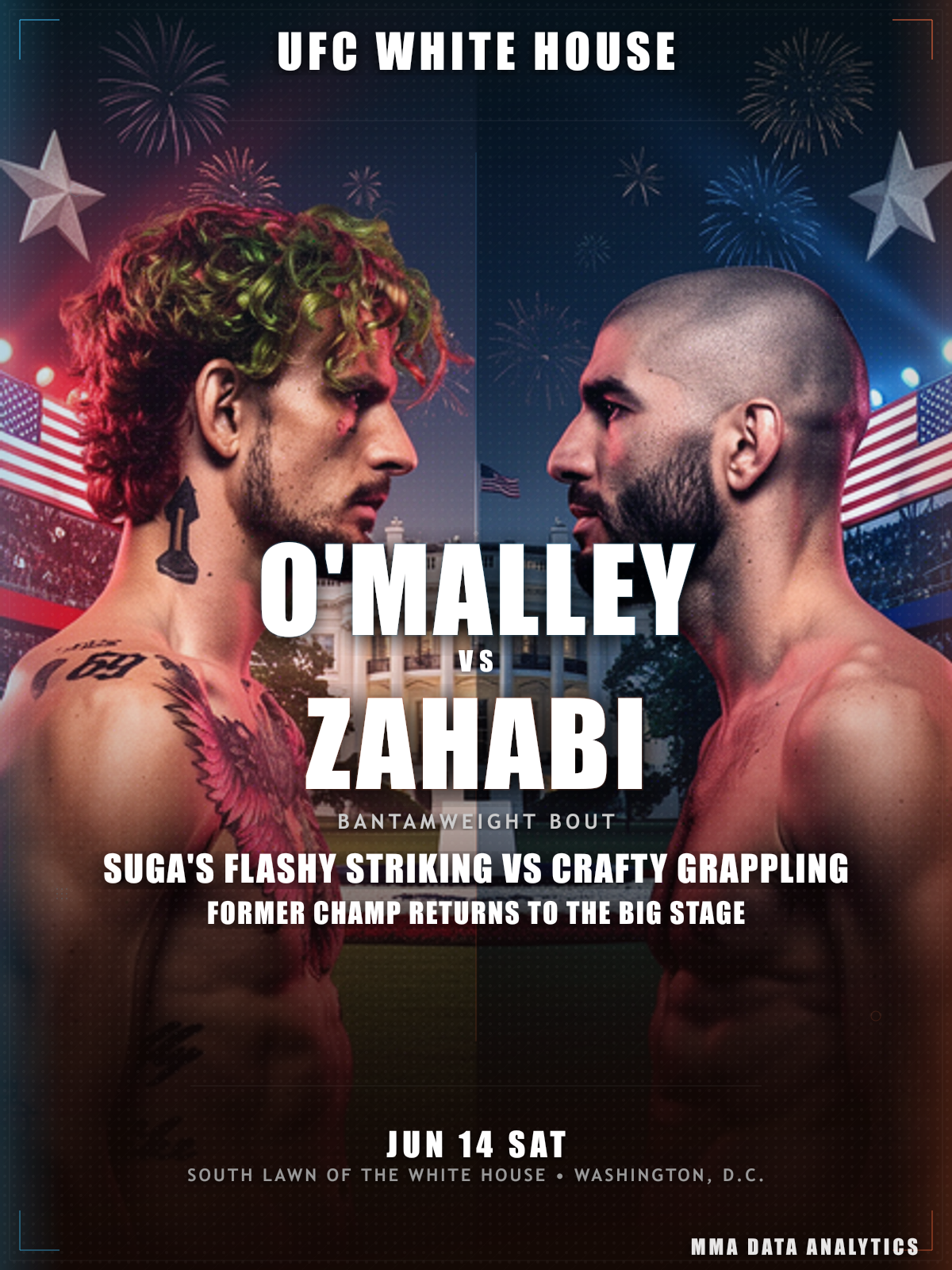
Sean O'Malley vs Aiemann Zahabi
Bantamweight Bout • UFC Freedom 250
Sunday, June 14, 2026 • 30ft Octagon (Large Cage)
Explore Detailed Fighter Profiles
Click on either the fighter's name or profile image for each fighter to access comprehensive UFC statistics including striking metrics, grappling data, clinch performance, complete fight history, offensive & defensive analytics, and round-by-round breakdowns.
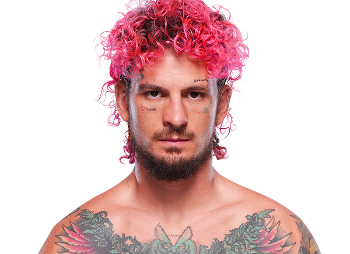
Sean O'Malley
Fighter Metrics
Victory Methods
Win Round Distribution
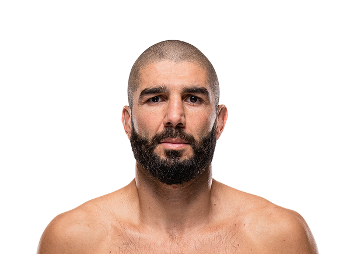
Aiemann Zahabi
Fighter Metrics
Victory Methods
Win Round Distribution
📋 Last 5 Fights - Sean O'Malley
| Date | Opponent | Result | Method |
|---|---|---|---|
| 2026-01-24 | Song Yadong | W | Decision (Unanimous) (R3, 5:00) |
| 2025-06-07 | Merab Dvalishvili | L | SUB — Guillotine Choke (R3, 4:42) |
| 2024-09-14 | Merab Dvalishvili | L | Decision (Unanimous) (R5, 5:00) |
| 2024-03-09 | Marlon Vera | W | Decision (Unanimous) (R5, 5:00) |
| 2023-08-19 | Aljamain Sterling | W | KO/TKO — Punches (R2, 0:51) |
📋 Last 5 Fights - Aiemann Zahabi
| Date | Opponent | Result | Method |
|---|---|---|---|
| 2025-10-18 | Marlon Vera | W | Decision (Split) (R3, 5:00) |
| 2025-05-10 | Jose Aldo | W | Decision (Unanimous) (R3, 5:00) |
| 2024-11-02 | Pedro Munhoz | W | Decision (Unanimous) (R3, 5:00) |
| 2024-03-02 | Javid Basharat | W | Decision (Unanimous) (R3, 5:00) |
| 2023-06-10 | Aoriqileng | W | KO/TKO — Punch (R1, 1:04) |
Technical Analysis
Technical Score
Cardio Score
Overall Rating
📊 Technical Score
Calculated as the average of Striking Composite (66.0 vs 66.0) and Grappling Composite (78.0 vs 55.0). Balances overall striking effectiveness with grappling ability to measure complete technical skills.
💪 Cardio Score
Based on average fight duration, striking rate per minute, takedown rate, and finish rate. Measures cardiovascular endurance and ability to maintain pace throughout fights.
🎯 Overall Rating
Simple average of Technical Score and Cardio Score. Provides a holistic view of fighter capabilities combining skill level with physical conditioning and fight performance.
Striking Composite
Grappling Composite
Technical Radar Comparison
Visual comparison of key performance metrics between both fighters
📊 Detailed Statistical Comparison
🥊 Fight Analysis Breakdown
🧩 Sean O'Malley Key Advantages
At 135 lbs, O'Malley's 72-inch reach and 5'11" frame create a completely different tactical geometry. He can land jabs, left straights (southpaw), head kicks, and right-hand counters from a range where Zahabi's 68-inch reach simply doesn't reach back. In the 30-foot cage, O'Malley's ability to maintain the outside perimeter while generating offensive output is maximized. Every step Zahabi takes to close the gap exposes him to counters from above at an angle his defensive training has never been specifically calibrated for. This size advantage functions as an independent high-probability factor before technique is even considered.
O'Malley's 60% striking accuracy places him in the top 2-3 in the bantamweight division. Zahabi's 47% is at the division average. In a pure striking contest at range, the fighter who can pick his shots with better precision wins the high-value exchange. O'Malley's accuracy with his jab, switch kick, and right-hand combinations consistently creates the clean-hit sequences that lead to knockdowns and stoppages. His 11 KO/TKO wins built primarily on distance punching demonstrate a power-per-connection profile at the elite end of the division.
6.05 SLpM vs 4.42 SLpM — O'Malley throws 36.7% more significant strikes per minute than Zahabi. In a 3-round contest, that volume differential compounds into a meaningful strikes-landed gap even if Zahabi's superior defense filters some of it out. More volume at higher accuracy means more scoring moments, more chances for the fight-ending shot, and a cleaner scoreboard margin if the fight goes to the cards. Very few fighters in bantamweight history have combined 6.05 SLpM with 60% accuracy simultaneously.
Zahabi is an orthodox counter-striker calibrated to read incoming angles from conventional stances. O'Malley's switch stance generates both orthodox and southpaw strike patterns — sometimes within the same combination. His ability to shift stance mid-exchange means Zahabi's parrying and head movement mechanics need to simultaneously account for multiple strike angles while also managing the distance gap. Elite counter-strikers have generally been most successful against fighters with predictable lead-hand patterns. O'Malley is the opposite of predictable.
⚠️ Unfavorable Scenarios
O'Malley opens tentatively and catches a sharp Zahabi R1 counter right hand during a moment of reach-testing — Zahabi's 0.20 KD average in R1 shows his early-round striking is his clearest danger window. If O'Malley reaches for a power shot while Zahabi's defensive system is fresh, the counter-right has genuine one-shot knockout potential. This scenario requires Zahabi to time O'Malley's overextension perfectly, but his tech_counter_rate of 0.59 indicates he punishes overcommitment with high frequency.
O'Malley loads up trying to produce the highlight KO and fades output in R3, allowing Zahabi's volume surge (173% R3/R1 ratio) to accumulate toward the scorecards. His one dangerous tendency is occasionally pursuing a dramatic KO rather than allowing his statistical advantages to accumulate. Against a counter-striker, patience wins more than aggression. If O'Malley overextends for big shots repeatedly, Zahabi's 70% defense may hold better than expected, leading to close rounds that Zahabi can edge.
📋 Likely Gameplan
Establish the jab from 72" reach immediately — it sets the distance, prevents Zahabi from closing, and creates timing uncertainty for Zahabi's counter system. At his reach advantage, a stiff jab is a range-control weapon that Zahabi's 68" reach cannot directly counter from the outside. Use body kicks early to lower Zahabi's guard — O'Malley's body work sets up the head attack. Against a fighter who defends 70% of head shots, body kicks and punches compromise the guard and open the head for power shots.
The switch to southpaw creates the left body kick → left head kick sequence that is extremely difficult to defend because the lead-leg switch changes the angle of attack entirely. Zahabi has not faced this specific combination in his recent fight history. Look for the second-shot KO — O'Malley's career KOs (Paiva, Wineland, Quinonez) show he can finish with a follow-up punch after an initial connect. When Zahabi's defensive head movement betrays him once, the follow-up punch on a stunned opponent is the finishing sequence.
O'Malley should resist the temptation to close distance for a power shot when his power works perfectly from outside range. Zahabi's counter-striking is most dangerous in the pocket. O'Malley's best striking happens at 72" distance, not at 68". Don't get reckless chasing highlights — against a counter-striker with 70% defense, patience and volume accumulation win more than desperate aggression. Let the reach and accuracy advantages compound over three rounds.
🚀 Aiemann Zahabi Key Advantages
Zahabi's 70% striking defense (top 3-4 in the BW division, DB-confirmed) is genuine and consistent across 10 UFC fights. Even accounting for the reach-disadvantage adjustment (reducing his effective defense to ~60-62% against O'Malley), that is still at or above O'Malley's own defensive ability. If Zahabi's defensive technique can partially transfer to reading O'Malley's longer-range threats, he can limit the damage per exchange. This defensive brilliance is the one variable that keeps this from being an 80%/20% conversation.
Zahabi's tech_counter_rate of 0.59 (DB confirmed) indicates he punishes overcommitment with a high frequency — higher than most bantamweights. O'Malley, for all his brilliance, does occasionally overextend on big shots. Against a faster, longer opponent, those overextensions typically don't get punished. Against Zahabi's counter-timing, if O'Malley becomes predictable or reaches for the KO at range, Zahabi's counter-right-hand has genuine one-shot knockout potential (KD dealt: 6 career, ratio 1.50:1).
If Zahabi weathers Rounds 1 and 2, the database is clear: his R3 is statistically his best round (28.1 sig landed at 47.5% acc, nearly double his R1 output). If the fight is close entering R3 and Zahabi is not hurt, he may surge to his highest output exactly when a tired or damaged O'Malley might be expecting a slow final round. He has won multiple fights by grinding down opponents late. His R3 surge is volume-based accumulation that can steal close rounds on the cards.
⚠️ Unfavorable Scenarios
Zahabi's 50% slow start rate means he begins R1 tentatively, and O'Malley's R1 KO threat (3 R1 finishes, including Paiva via punches at distance) could end the fight before Zahabi calibrates. The opening minute of Round 1 is statistically O'Malley's most dangerous window and Zahabi's most vulnerable. This is not a coincidence — it's the fight's highest-variance moment. If Zahabi starts slow and O'Malley is aggressive early, the fight could end before it truly begins.
Zahabi's 70% StrDef is partially negated by O'Malley's 4-inch reach advantage, reducing his effective defense to 60-62% and allowing O'Malley's elite volume (6.05 SLpM) and accuracy (60%) to land at rates that cause cumulative damage or a clean stopping shot. His average absorption rate (4.13 SApM) reflects that he does get touched — against O'Malley's power-per-connection profile, those touches carry dramatically different consequences. At 37 years old, absorbing O'Malley's first clean power shot may have significantly higher impact than his career SApM metrics suggest.
📋 Likely Gameplan
Move laterally immediately in R1 and avoid the center — in the large cage, Zahabi's advantage is not size but footwork and angles. He cannot match O'Malley's reach by standing in front of him; he needs to circle to his own left (O'Malley's weaker power line) and make O'Malley constantly reset. Target the body in R1 to establish the inside — his R1 body targeting (25%, DB confirmed) is a documented tactic to lower the guard for later head shots.
Use his counter rate (0.59) on O'Malley's overextensions — every time O'Malley loads for the switch kick or the reaching right hand, Zahabi's counter window opens. His best chance at a KO is catching O'Malley mid-extension, which is the one moment the reach advantage is neutralized. Accept that he cannot match volume and prioritize quality exchanges — trying to out-volume O'Malley (6.05 SLpM vs 4.42) is a losing strategy. Zahabi's path is quality counters, not quantity.
The data says Zahabi's output nearly doubles from R1 to R3 (14.4 → 28.1 sig, 173% ratio). If he can reach the championship round of a 3-round fight, he will be at his statistical peak. An O'Malley who is not visibly dominating by R3 is a fight Zahabi can win on the scorecard. The 4-fight win streak momentum and mental confidence are real factors — Zahabi has been solving problems and winning fights.
🎯 Fight Prediction Analysis
Data-driven prediction model based on statistical analysis
📊Detailed Analysis Summary
📏Physical Dimension — The Decisive Factor
The 30-foot cage at the White House South Lawn creates the perfect environment for O'Malley's 4-inch reach advantage to manifest. At 135 lbs, O'Malley's 72-inch reach and 5'11" frame create a completely different tactical geometry than Zahabi's 68-inch reach and 5'8" height. In a 30-foot cage, Zahabi needs 5-6 steps to close the gap and force a range reset — and O'Malley can reset to the center each time, returning to his optimal range. The geometry of the large cage materially favors the longer fighter in pure distance management. This size advantage functions as an independent high-probability factor before technique is even considered.
🎯Technical Breakdown — Offense vs Defense
The statistical analysis reveals two divergent profiles: O'Malley dominates the offensive striking metrics (60% accuracy, 6.05 SLpM — both top 3 in the division) while Zahabi dominates defensive metrics (70% StrDef — top 3-4 in BW). The key nuance: in a striking fight, the offensive metrics matter more. O'Malley's 60% accuracy running into Zahabi's 70% defense is the central exchange — but O'Malley's reach advantage effectively reduces Zahabi's practical defense toward 60-62% for this specific matchup. Meanwhile, Zahabi's average accuracy (47%) runs into O'Malley's above-average defense (60%). The net effective landing rates favor O'Malley, and his power-per-connection from those landed shots is dramatically superior (57.9% finish rate vs 35.7%).
🧩Key Battle Areas
Three critical battle areas will determine the outcome: the slow-start mutual risk in R1, the switch stance vs counter-striking read system, and the R3 volume escalation. Zahabi's 50% slow start rate vs O'Malley's R1 KO threat (3 career R1 finishes) creates the highest-variance moment of the fight. O'Malley's switch stance generates both orthodox and southpaw patterns mid-combination, which dramatically increases the latency of Zahabi's counter-response timing. If Zahabi weathers the first two rounds, his R3 volume nearly doubles (173% R3/R1 ratio), giving him a path to steal a close decision if O'Malley isn't dominant on the cards.
🏁Final Prediction
The most likely outcome is Sean O'Malley by KO/TKO (43% probability), achieved through reach-advantage striking, elite accuracy hitting compromised defense, and power-per- connection that Zahabi's career hasn't faced. O'Malley's decision path (25%) reflects fights where Zahabi's defense keeps him competitive enough to avoid stoppage, but O'Malley's volume and accuracy build an insurmountable scoreboard gap. Zahabi's decision path (18%) is his primary upset scenario — counter-striking accumulation over three rounds where his R3 surge edges out a close fight. Zahabi's KO/TKO path (8%) is the counter-right scenario where O'Malley overextends during the early calibration period. Conviction Rating: 7.5/10 — a clear O'Malley lean grounded in multiple decisive advantages that compound each other.
💰 Betting Analysis: Model vs Market
Detailed value assessment in the betting market
📊Market Odds
🤖Analytical Model
💎Value Opportunities
MAXIMUM VALUE
GOOD VALUE
SLIGHT VALUE
⚠️Key Market Discrepancies
- • Overweights early KO volatility – Underprices five-round wrestling cycles.
- • Undervalues damage economy – Low SApM differential drives optics on cards.
- • Big-cage bias – Space helps early, but fence/rides erode it late.
🎯 Comprehensive Probabilistic Analysis
100 hypothetical fight simulation based on statistical data
🏆Outcome Distribution - Sean O'Malley
Primary path via fence control and rides
Attritional GNP and accumulative pressure
Back-takes off rides create RNC chances
💥Outcome Distribution - Aiemann Zahabi
Best lane via intercepts and counters
Requires extended range control in big cage
Low historical submission profile
⏰Fight Timeline Analysis
⚡Window of Opportunity - Aiemann Zahabi
- • R1 Counter Right: 0.20 KD avg in R1 — catch O'Malley overextending early.
- • Lateral Movement: Circle left, force resets, don't stand in front.
- • Body Targeting Early: 25% body work in R1 lowers guard for later head shots.
- • Survive to R3: 173% output surge — steal close rounds late.
🎯Progressive Dominance - Sean O'Malley
- • Jab Establishment: 72" reach controls distance from outside Zahabi's range.
- • Body-Head Combinations: Lower 70% guard with body work, finish upstairs.
- • Switch Stance Angles: Southpaw left kicks create uncalibrated attack vectors.
- • Second-Shot KO: Follow-up power after initial connects finishes fights.
🎯 Final Confidence Assessment
Confidence level and uncertainty factors
Conviction Rating
Clear O'Malley lean via multiple compounding advantages
✅Supporting Factors
- • 4-inch reach advantage at bantamweight (72" vs 68")
- • Elite accuracy (60% vs 47%) and volume (+36% SLpM)
- • Prime age (31 vs 37) in athletic peak years
- • Switch stance creates targeting chaos
- • R1 KO threat vs Zahabi's slow start (50% rate)
- • No wrestling threat from Zahabi (0.14 TD15, 14% TDAcc)
⚠️Risk Factors
- • Zahabi's elite 70% striking defense (top 3-4 BW)
- • High counter-striking rate (0.59 tech_counter)
- • R3 volume surge (173% R3/R1 output ratio)
- • 4-fight win streak momentum and confidence
- • Age 37 with accumulated experience advantage
🏁Executive Summary
Sean O'Malley's 4-inch reach advantage and 3-inch height differential at 135 lbs creates a structural striking advantage in every round before a single punch is thrown. His 60% accuracy (top 2-3 BW) combined with 6.05 SLpM (top 3-5 BW) represents elite offensive metrics that few bantamweights have ever combined. Zahabi's 70% defense, while genuinely elite, faces structural compromise against O'Malley's longer-range angles — his effective defense drops to approximately 60-62% in this specific matchup. At 31 vs 37, the athletic prime gap is meaningful when reflexes determine defensive success. Critically, Zahabi cannot threaten any dimension that has historically hurt O'Malley — his 0.14 TD15 and 0.00 submission attempts mean this is a pure striking contest, which maximizes O'Malley's advantages.
Prediction: O'Malley by KO/TKO most likely (43% probability) through reach- advantage striking and power-per-connection; decision path (25%) if Zahabi's defense holds; Zahabi's upset lane is counter-right KO (8%) or grinding decision (18%) via R3 surge. The data gives us a clear edge to Suga — and for once, "clear" is not an overstatement.