
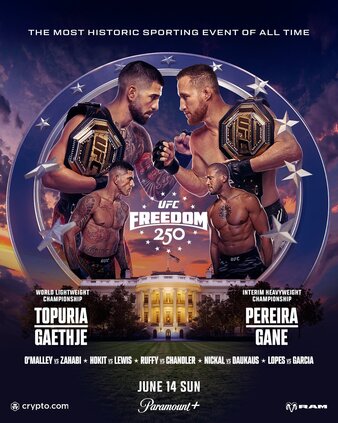
Derrick Lewis vs Josh Hokit
Heavyweight Bout • UFC Freedom 250: Topuria vs Gaethje
Sunday, June 14, 2026 • 30ft Octagon (Large Cage)
Explore Detailed Fighter Profiles
Click on either the fighter's name or profile image for each fighter to access comprehensive UFC statistics including striking metrics, grappling data, clinch performance, complete fight history, offensive & defensive analytics, and round-by-round breakdowns.
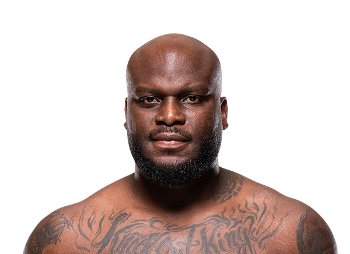
Derrick Lewis
Fighter Metrics
Victory Methods
Win Round Distribution
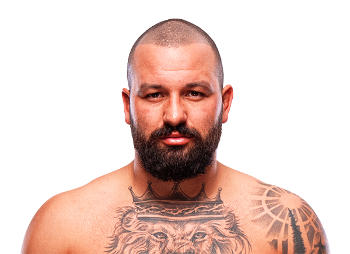
Josh Hokit
Fighter Metrics
Victory Methods
Win Round Distribution
📋 Last 5 Fights - Derrick Lewis
| Date | Opponent | Result | Method |
|---|---|---|---|
| Jan 2026 | Waldo Cortes-Acosta | L | KO/TKO (R2, 3:14) |
| Jul 2025 | Tallison Teixeira | W | KO/TKO (R1, 0:35) |
| May 2024 | Rodrigo Nascimento | W | KO/TKO (R3, 0:49) |
| Nov 2023 | Jailton Almeida | L | Decision (R3, 5:00) |
| Jul 2023 | Marcos R. de Lima | W | KO/TKO (R1, 0:33) |
📋 Last 5 Fights - Josh Hokit
| Date | Opponent | Result | Method |
|---|---|---|---|
| Apr 2026 | Curtis Blaydes | W | Decision (R3, 5:00) |
| Jan 2026 | Denzel Freeman | W | KO/TKO (R1, 4:59) |
| Nov 2025 | Max Gimenis | W | KO/TKO (R1, 0:56) |
| Aug 2025 | Guilherme Uriel | W | KO/TKO (R2, 1:06) |
| May 2025 | Eric Lunsford | W | KO/TKO (R1, 2:00) |
Technical Analysis
Technical Score
Cardio Score
Overall Rating
📊 Technical Score
Calculated as the average of Striking Composite (34.0 vs 59.0) and Grappling Composite (34.0 vs 74.0). Balances overall striking effectiveness with grappling ability to measure complete technical skills.
💪 Cardio Score
Based on average fight duration, striking rate per minute, takedown rate, and finish rate. Measures cardiovascular endurance and ability to maintain pace throughout fights.
🎯 Overall Rating
Simple average of Technical Score and Cardio Score. Provides a holistic view of fighter capabilities combining skill level with physical conditioning and fight performance.
Striking Composite
Grappling Composite
Technical Radar Comparison
Visual comparison of key performance metrics between both fighters
📊 Detailed Statistical Comparison
🥊 Fight Analysis Breakdown
🧩 Derrick Lewis Key Advantages
This is the entire Lewis case, and it is not a small one. Sixteen UFC knockouts — the most in company history — 24 career KO/TKOs (83% of his wins), and a 3.67:1 knockdown exchange ratio. He has ended fights against elite competition in a single second from positions where he was losing. The collision that matters: Hokit absorbs 6.81 strikes per minute — roughly 75% above the heavyweight average — and just won a 351-strike war by trading in the pocket. Against Lewis, whose per-connection danger is categorically higher than anyone Hokit has shared a cage with, that habit is an open invitation. Lewis only needs to land once, cleanly, and a nine-fight unbeaten chin faces a question it has never been asked.
Lewis's chin is rated Elite in our database — he is hard to finish on the feet and absorbs few clean strikes relative to volume (2.57 SApM, rank 5 of 22 heavyweights). Pair that durability with a +6" reach (79" vs 73") and a ~25 lb weight edge, and you have a fighter built to survive adversity and stay in any fight long enough for his power to decide it. He doesn't need to win minutes or out-work the younger man — he needs to weather the storm and arrive at a single moment. The bigger, longer, heavier man with the harder hands and the better chin: that is the version of "puncher's chance" most opponents never have to face.
A two-time title challenger with a Championship-tier strength of schedule, Lewis has been in the deepest waters the sport offers. Our database logs him at 122% of his normal output in championship-setting fights — the bigger the moment, the more he produces. The lights of the White House South Lawn won't shrink a man who has headlined against Ngannou and Miocic; for a 28-year-old in his first true main-stage spotlight against a legend, the occasion is a genuine variable. And the knockout threat never sleeps: his knockdown average actually peaks in Round 3 (0.25), meaning that even late, even behind, the fight is one swing from over.
⚠️ Unfavorable Scenarios
Lewis's losing blueprint is precise and recent: a strong wrestler changes levels, plants him on his back, and finishes or decisions him on the mat. Almeida wrestled him to a clear decision; Spivac arm-triangled him in Round 1; Cortes-Acosta ground-and-pounded him to a stoppage in January 2026. Hokit is a better wrestler than all three. Once Lewis is down, his bottom game is among the weakest of any elite heavyweight — he survives on explosion to stand, which fades with age and fatigue. The database adds a chilling footnote: across three career fights in which he was knocked down, Lewis has zero wins.
At 41, with the division's lowest-tier output (2.46 SLpM, rank 21 of 22) and a "Low Output" pace label, Lewis cannot win a tempo war. Worse, he owns the single worst striking defense in the heavyweight division (39%, rank 22 of 22) — 61% of what's thrown at him lands. Run Hokit's 9.25 SLpM and 62% accuracy into that wall and the math is brutal: clean shots accumulate every minute the fight stays competitive. If Lewis doesn't find the one-shot finish in the opening rounds while he's fresh, the youth, the cardio, and the volume compound against him — and a flash knockdown from accumulated damage triggers the 0-for-3 recovery pattern that haunts his record.
📋 Likely Gameplan
Lewis must keep this standing, and his takedown defense (52%) has to hold while he's fresh in Round 1. His most reliable answer to a wrestler is the knee on the entry — his highest tech-tool rate (0.64), and the exact weapon that finished Marcos de Lima with a flying knee into ground strikes. If Hokit shoots from distance, he should run into a knee or uppercut. From there, Lewis wants the clinch and the fence, where his size and dirty boxing turn the fight into a heavy, short-range phone booth rather than a wrestling match he will lose.
Every model says Lewis's win equity is front-loaded. Rounds 1 and 2 — fresh, full power, before the cardio and age gap bite — are his fight. He should walk Hokit down, cut the cage, and time a single right hand or uppercut into Hokit's 44% defensive pocket. He does not need volume; he needs one detonation. What he cannot allow is a sustained-pace contest that drags into deep water against a 28-year-old with a record-setting gas tank. Hunt the finish, respect the takedown, and make every exchange count before the fight gets late.
🚀 Josh Hokit Key Advantages
This is the spine of the entire prediction. Hokit owns the exact key that fits Lewis's exact lock: a Fresno State All-American with 3.89 takedowns per 15 minutes (nearly double the division average), 43% takedown accuracy, 75% takedown defense, and three career submission finishes. The three men who beat Lewis most convincingly — Almeida, Spivac, Cortes-Acosta — all did it by wrestling, and Hokit out-classes every one of them on the mat. Against a 52%-takedown-defense, 41-year-old brawler with no meaningful bottom game, this isn't a stylistic edge; it is one of the most lopsided grappling matchups we can build at heavyweight.
At 28 against a 41-year-old, Hokit brings an athletic and cardiovascular profile from a different planet — and he has the receipts. His war with Curtis Blaydes set a UFC heavyweight record for combined significant strikes (351), with Hokit landing 177 across a full 15 minutes: empirical proof of a freakish gas tank at this weight. That 9.25 SLpM pace is precisely the style that has historically drowned Lewis, whose tank empties early and whose output ranks near last in the division. Layer on the momentum — 9-0, ascending vertically off a Fight-of-the-Year performance against a former title challenger — and the trajectories point hard in opposite directions.
⚠️ Unfavorable Scenarios
Hokit's greatest vulnerability is his own willingness to trade. He absorbs 6.81 strikes per minute and won his signature fight in a shootout — a viable formula against most heavyweights, and a catastrophic one against the all-time UFC knockout king. His 44% striking defense is below average, and his chin has never been tested by anything resembling heavyweight one-shot power; Blaydes can hurt people, but he is a volume-and-wrestling finisher, not a one-punch artist in Lewis's tier. If Hokit gets greedy in the pocket — as he did against Blaydes — he can walk onto the single right hand that has ended a dozen elite careers.
The most dangerous micro-moment for Hokit is his own bread-and-butter: the level change. Lewis's highest tech-tool rate is the knee (0.64), and he has finished opponents with a flying knee into ground strikes as they committed forward. A sloppy or distant takedown attempt runs straight into Lewis's best non-punch finishing weapon. Add only three UFC fights of experience at this level, and an early fight-management error — overcommitting on a shot, eating a counter on the reset — is a live path to the one outcome that erases all his statistical edges in a single instant.
📋 Likely Gameplan
Hokit's clearest path is the simplest one: don't get cute on the feet — change levels early and often. Wrestling against Lewis doesn't mean lying on top for 15 minutes; it means using takedown threats to disrupt his power-shot setups, then putting him on his back, where he is the weakest version of himself. From top position, the ground-and-pound and submission game that finished his regional opponents (rear-naked choke, armbar, crucifix strikes) becomes the safest, highest-percentage route to a finish — one that avoids Lewis's comeback power entirely.
The one round Hokit must respect is the first — Lewis's fresh, full-power window. The smart version of his game is to weather that early danger without reckless pocket trading, use the 30-foot cage to circle and move rather than plant in front of the power, and then let the fight bend toward his conditioning and wrestling. His pace and youth are decisive from Round 2 onward against a "Low Output" 41-year-old. Pour on volume, smother the power-shot rhythm, and force Lewis to carry his own weight and chase — and the age gap does the rest.
🎯 Fight Prediction Analysis
Data-driven prediction model based on statistical analysis
📊Detailed Analysis Summary
🏟️Cage Dynamics
The 30-foot octagon is quietly one of Hokit's biggest allies. The extra space lets him change levels, circle off angles, and avoid the fence — exactly where Lewis's clinch and dirty boxing do their worst damage. It also gives a younger, fresher man room to keep the fight moving, the opposite of what a 41-year-old power-puncher wants. The one caveat cuts the other way: more space also means more room for Lewis to plant, load, and detonate a single shot if Hokit drifts into the pocket. But on balance, the big cage rewards the fighter who wants to wrestle and out-pace, not the one hunting a single clean exchange.
🎯Technical Breakdown
The statistical split is stark and points in two directions at once. On the mat, Hokit's 3.89 TD/15 against Lewis's 0.55 is a roughly 7x wrestling-volume chasm, layered on top of a 13-year age gap and the worst striking defense in the division (Lewis, 39%, rank 22 of 22). Our composites read Hokit 66.5 technical to Lewis's 34, and the archetype history backs the direction: Wrestler vs Well-Rounded resolves to the wrestler 61.3% of the time across 80 documented bouts. But the model cannot fully price the one variable Lewis owns — 16 UFC knockouts of single-shot, fight-ending power, running into a Hokit who absorbs 6.81 strikes per minute and has never had his chin tested at this level. Everything favors Hokit except the most decisive attribute in the sport.
🧩Key Battle Areas
Three battlegrounds decide it. First, Hokit's level changes against Lewis's 52% takedown defense and his knee-on-entry counter — the single weapon (tech rate 0.64) that has finished a forward-committing opponent before. Second, the chin question: whether Hokit's untested jaw and 44% striking defense can survive the early rounds where Lewis's power is most live. Third, the cardio curve — a 28-year-old with a record-setting gas tank against a 41-year-old "Low Output" fighter whose average night lasts 8:52 because it ends, one way or the other. Win the first exchange of the takedown battle cleanly and Hokit likely runs away with it; lose focus in the pocket for one second and the whole calculus flips.
🏁Final Prediction
The most likely outcome is Josh Hokit by Decision (30%), earned through takedown pressure, top control, and a pace Lewis cannot answer over three rounds. Hokit's KO/TKO path (18%) opens via ground-and-pound or accumulated volume as Lewis fades — remember, he was stopped by strikes as recently as January 2026 — and his submission lane (14%) is real against a man with one career submission win and a documented history of being tapped. Lewis's entire route home is the knockout (35%): not a decision (3%), not a submission (0%) — just the one clean shot. It is the narrowest path in the fight, and also the most dangerous, because it belongs to the hardest hitter in UFC history.
💰 Betting Analysis: Model vs Market
Detailed value assessment in the betting market
📊Market Odds
🤖Analytical Model
💎Value Opportunities
MAXIMUM VALUE
Model: 32% combined KO/TKO + Submission — his top-game finishing is underpriced behind the "decision wrestler" tag
GOOD VALUE
Model: 35% | A live-dog hedge on the most proven one-shot power in UFC history against an untested chin
SLIGHT VALUE
Model: 67% finish — two finishers and a fading 41-year-old make the "under" on rounds attractive
⚠️Key Market Discrepancies
- • Overrates the "decision wrestler" tag – Hokit's top-game finishing (KO + Sub) is underpriced.
- • Underprices the puncher's chance – All-time KO power vs an untested chin is live every second.
- • Distance is overbid – Two finishers and a fading 41-year-old make the under on rounds attractive.
🎯 Comprehensive Probabilistic Analysis
100 hypothetical fight simulation based on statistical data
🏆Outcome Distribution - Derrick Lewis
Near-impossible — cannot out-point Hokit's pace
His entire route home — one clean shot ends it
Effectively nil — just one career submission win
💥Outcome Distribution - Josh Hokit
Ground-and-pound or late volume as Lewis fades
Most likely outcome — wrestle and out-pace over 3 rounds
Top control and back-takes; 3 career submission wins
⏰Fight Timeline Analysis
⚡Window of Opportunity - Derrick Lewis
- • First 5 minutes: Highest one-shot KO equity while fresh.
- • Brawl, don't wrestle: Clinch, fence, and heavy hands.
- • Counter the entry: Knee or uppercut on every committed shot.
🎯Progressive Dominance - Josh Hokit
- • Wrestle early: Takedowns disrupt Lewis's power setups.
- • Bank rounds: 9.25 SLpM into the division's worst defense.
- • Late rounds: Youth and cardio pull away as Lewis fades.
🎯 Final Confidence Assessment
Confidence level and uncertainty factors
Confidence Level
Clear wrestling, youth, and pace edge — capped by Lewis's all-time one-shot power
✅Supporting Factors
- • Elite wrestling edge (3.89 vs 0.55 TD/15)
- • 13-year youth gap; record-setting gas tank
- • Lewis owns the division's worst striking defense (39%)
- • Wrestler beats Well-Rounded 61.3% in our database
⚠️Risk Factors
- • Lewis's 16 UFC KOs — power never ages
- • Hokit's chin untested; 6.81 SApM, 44% defense
- • Small 3-fight UFC sample; knee-on-entry counter
🏁Executive Summary
Josh Hokit's youth, wrestling, and pace should compress this fight into the shape that has beaten Derrick Lewis before: change levels, take him into deep water, and either finish on the mat or out-pace him over three rounds. The differentials are emphatic — a 3.89-to-0.55 takedown gap, a 13-year age advantage, a record-setting gas tank already on tape against Curtis Blaydes, and an opponent who carries the worst striking defense (39%) in the entire heavyweight division at 41 years old, coming off a knockout loss. The archetype history agrees: the wrestler beats the well-rounded brawler 61.3% of the time, and nearly every fight-specific factor pushes Hokit above that baseline.
Prediction: Hokit by Decision most likely (30%) through takedown pressure and top control, with real finishing equity via ground-and-pound (18%) and submission (14%). But this is a 6/10 conviction, not an 8 — Lewis holds the single most dangerous equalizer in the sport. His 35% knockout path is the largest single outcome in the simulation, and Hokit's untested chin and pocket-trading habits keep that door ajar for all fifteen minutes. Bet the wrestler, respect the bomb.