
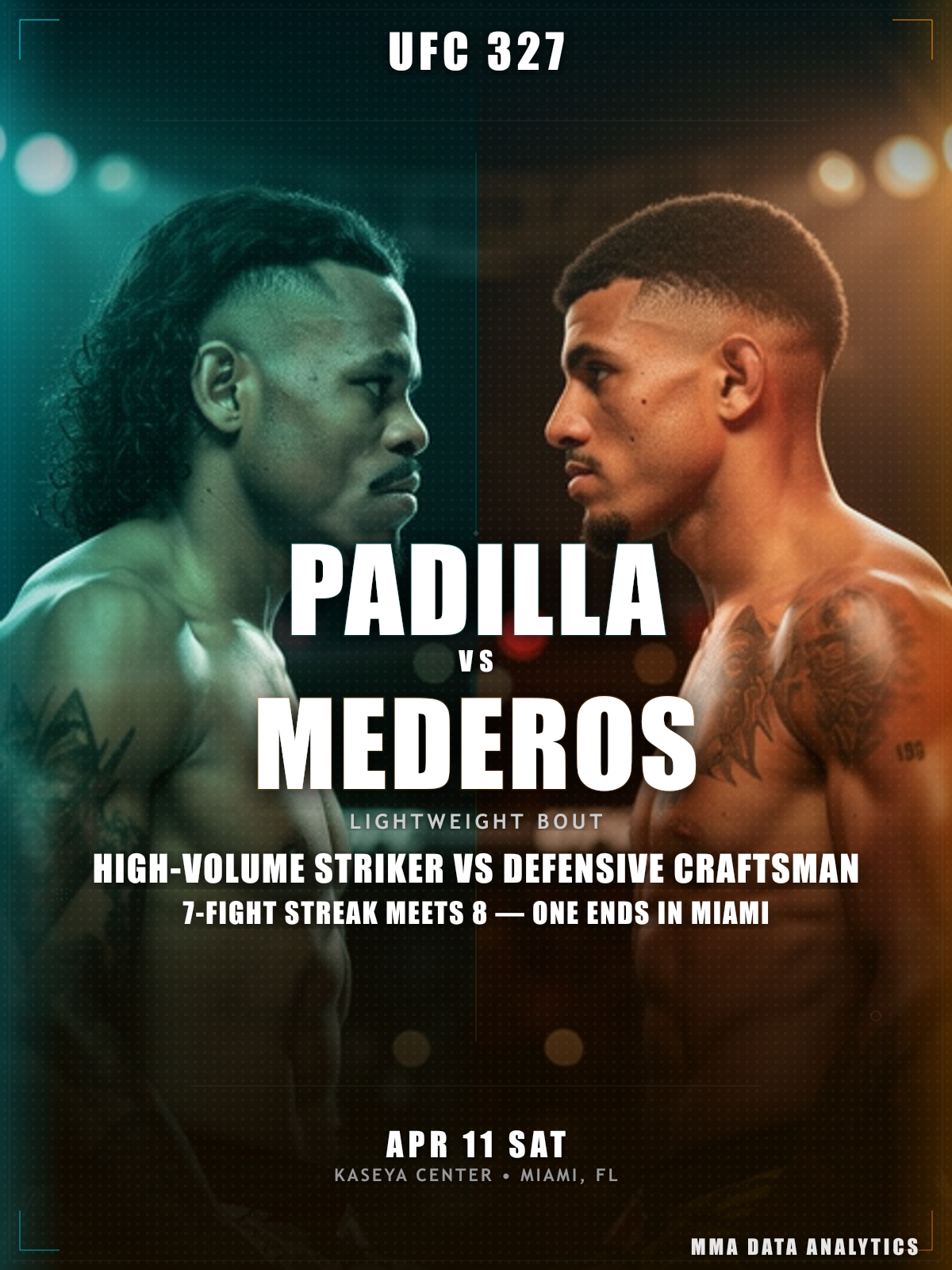
Chris Padilla vs MarQuel Mederos
Men's Lightweight Bout • UFC 327
Saturday, April 11, 2026 • 30ft Octagon (Large Cage) • Kaseya Center, Miami, FL
Explore Detailed Fighter Profiles
Click on either the fighter's name or profile image for each fighter to access comprehensive UFC statistics including striking metrics, grappling data, clinch performance, complete fight history, offensive & defensive analytics, and round-by-round breakdowns.

Chris Padilla
Fighter Metrics
Victory Methods
Win Round Distribution

MarQuel Mederos
Fighter Metrics
Victory Methods
Win Round Distribution
📋 Last 5 Fights - Chris Padilla
| Date | Opponent | Result | Method |
|---|---|---|---|
| 2025-11-08 | Ismael Bonfim | W | KO/TKO - Punches (R2, 3:41) |
| 2025-03-22 | Jai Herbert | W | Decision - Split (R3, 5:00) |
| 2024-09-07 | Rongzhu | W | TKO - Doctor Stoppage (R2, 4:14) |
| 2024-04-27 | James Llontop | W | Submission - Rear Naked Choke (R1, 4:33) |
| 2023-10-21 | Justin Jaynes | W | KO/TKO (R2, 3:10) |
📋 Last 5 Fights - MarQuel Mederos
| Date | Opponent | Result | Method |
|---|---|---|---|
| 2025-06-07 | Mark Choinski | W | Decision - Unanimous (R3, 5:00) |
| 2025-03-29 | Austin Hubbard | W | Decision - Split (R3, 5:00) |
| 2024-02-03 | Landon Quiñones | W | Decision - Unanimous (R3, 5:00) |
| 2023-10-10 | Issa Isakov | W | TKO - Knee (R1, 4:09) |
| 2023-06-25 | Justice Lamparez | W | TKO - Strikes (R1, 0:53) |
Technical Analysis
Technical Score
Cardio Score
Overall Rating
📊 Technical Score
Calculated as the average of Striking Composite (60.0 vs 60.0) and Grappling Composite (58.0 vs 45.0). Balances overall striking effectiveness with grappling ability to measure complete technical skills.
💪 Cardio Score
Based on average fight duration, striking rate per minute, takedown rate, and finish rate. Measures cardiovascular endurance and ability to maintain pace throughout fights.
🎯 Overall Rating
Simple average of Technical Score and Cardio Score. Provides a holistic view of fighter capabilities combining skill level with physical conditioning and fight performance.
Striking Composite
Grappling Composite
Technical Radar Comparison
Visual comparison of key performance metrics between both fighters
📊 Detailed Statistical Comparison
🥊 Fight Analysis Breakdown
🧩 Chris Padilla Key Advantages
Padilla's 4.78 significant strikes landed per minute provides a meaningful volume advantage over Mederos's 3.75 SLpM. Combined with his 54% striking accuracy (vs Mederos's 50%), Padilla lands more often and with better precision. His orthodox stance and sharp boxing fundamentals allow him to set up combinations behind a stiff jab, mixing power hooks with body shots that keep opponents guessing. In a three-round fight, this volume-plus-accuracy advantage becomes particularly important for round-by-round scoring—Padilla can outpoint Mederos in individual exchanges through sheer activity and clean striking.
With 6 KO/TKO and 6 submission victories in his 17-win career, Padilla is a versatile finisher who can end fights in multiple ways. His recent KO/TKO of Ismael Bonfim demonstrated his ability to end fights with sharp punches, while his submission of James Llontop via rear-naked choke shows ground-game depth. Against Mederos, who has never been finished in his career (11-1 with the lone loss by decision), this dual finishing ability forces defensive respect and limits Mederos's ability to engage freely. Padilla's versatility means every exchange and every scramble carries finish potential, creating multi-layered threats that keep Mederos guessing throughout the fight.
Padilla's 1.18 takedowns per 15 minutes provides a crucial secondary weapon that Mederos completely lacks. While Mederos boasts elite 85% takedown defense, Padilla's grappling ability and submission threat (6 career subs including a rear-naked choke of James Llontop in the UFC) give him real finishing tools on the mat. This grappling dimension forces Mederos to defend multiple threats simultaneously—if he focuses solely on striking defense, Padilla can change levels; if he prepares for takedowns, the striking volume becomes harder to handle. This dual-threat approach is particularly effective in the 30-foot cage where Padilla can use fence pressure to create takedown opportunities.
Padilla enters with an unbeaten 4-0 UFC record and significant momentum. His 17-6 pro record includes wins across multiple organizations, building his mental resilience and tactical adaptability. Against Mederos's relatively limited 3-0 UFC sample size (all against unranked opposition), Padilla's broader 23-fight experience base gives him an edge in adjusting mid-fight when Plan A isn't working. His ability to win rounds through activity, varied attack vectors, and positional dominance demonstrates cage IQ that typically comes from facing diverse styles under high-stakes pressure.
⚠️ Unfavorable Scenarios
Mederos's 62% striking defense combined with his low 2.61 SApM creates a defensive puzzle that could frustrate Padilla's volume approach. If Mederos can consistently parry, block, and evade Padilla's strikes while landing clean counters, the volume differential may not translate to significant scoring advantages. Padilla's 55% striking defense means he's absorbing 3.87 strikes per minute, which could make individual exchanges appear closer to judges than raw output numbers suggest.
Padilla's 55% striking defense and 6 career losses show he can be hit and stopped by skilled opponents. Despite his 4-0 UFC run, his prior losses by submission suggest vulnerability on the ground—exactly what a disciplined counter-striker like Mederos could exploit by forcing Padilla into chaotic exchanges. If Padilla overcommits to volume, he may leave himself open to the type of clean counter shots that Mederos excels at landing.
📋 Likely Gameplan
Padilla should look to overwhelm Mederos with his high-volume striking while mixing in takedown threats to keep the defensive specialist guessing. His 4.78 SLpM output should be aimed at maintaining constant pressure, using combinations to rack up scoring strikes while threatening level changes. The key is not to wait for the perfect shot but to maintain relentless output that forces Mederos out of his defensive comfort zone and into reactive fighting.
Given Mederos's tendency to go the distance (all 3 UFC wins by decision), Padilla should prioritize early aggression to test Mederos's chin and establish dominance. His best chance of a finish comes in Rounds 1-2 when his energy is highest and before Mederos can settle into his defensive rhythm. Power shots mixed with the takedown threat create the chaos that Padilla thrives in—extended technical exchanges at range favor Mederos's defensive style.
🚀 MarQuel Mederos Key Advantages
Mederos's 62% striking defense is superior to Padilla's 55%, creating a defensive efficiency gap that neutralizes much of the volume advantage. His 2.61 SApM vs Padilla's 3.87 means Mederos absorbs less damage, maintaining composure and clarity throughout the fight. This defensive discipline allows him to pick his shots carefully, landing clean counters while avoiding the exchanges where Padilla thrives. Against high-volume strikers, Mederos's ability to make opponents miss while staying in position to counter is his most reliable path to outscoring on the judges' cards.
Mederos's 85% takedown defense is elite-tier and represents a critical neutralizer against Padilla's wrestling threat. While Padilla's 1.18 TD/15 provides a grappling dimension, Mederos has shown the ability to stay on his feet against pressure fighters throughout his UFC career. His three consecutive decision victories demonstrate that opponents struggle to take the fight to the ground against him. This elite TDDef forces Padilla to rely primarily on his striking, where Mederos's superior defensive metrics create a more competitive matchup. If Padilla wastes energy on failed takedown attempts, his striking output and power diminish in later rounds.
Mederos's 65 cardio composite vs Padilla's 62 represents an endurance advantage that becomes meaningful in the third round. His 11:23 average fight time vs Padilla's 10:25 demonstrates superior stamina management over longer durations. While Padilla may dominate early with volume and pressure, Mederos's conditioning advantage means his output holds steadier in later rounds. Mederos's ability to maintain consistent defensive positioning and counter-striking output deep into fights gives him a clear advantage on the scorecards when fights go the distance—which all 3 of his UFC bouts have. Against a volume-dependent fighter like Padilla, the ability to weather early storms and steal the final round with fresher output is a proven championship trait.
⚠️ Unfavorable Scenarios
Padilla's 4.78 SLpM output can overwhelm even disciplined defenders when sustained over multiple rounds. If Padilla manages to push the pace into chaotic exchanges, Mederos's measured counter-striking approach becomes less effective. The sheer volume of strikes can make it difficult for judges to distinguish clean shots from glancing blows, potentially tipping close rounds in Padilla's favor. Mederos's 3.75 SLpM may not generate enough visible offense to overcome this volume disadvantage on the scorecards.
Mederos's 0% UFC finish rate (all 3 wins by decision) and complete absence of grappling offense (0.00 TD/15, 0.00 Sub/15) severely limit his paths to victory. If Padilla is hurt or wobbled, Mederos may lack the finishing instinct to capitalize. His inability to threaten takedowns or submissions means Padilla can focus entirely on his striking game without worrying about grappling threats. This one-dimensional offensive profile makes Mederos predictable and easier to game-plan against.
📋 Likely Gameplan
Mederos should focus on maintaining his preferred range and making Padilla pay for every entry. Using his slight 0.5-inch reach advantage and disciplined footwork, he can circle away from Padilla's power side while landing clean jabs and straight rights. The 30-foot cage provides ample room to reset after exchanges rather than getting backed against the fence. His priority should be making Padilla miss and countering with accurate strikes that score cleanly with the judges, exploiting Padilla's 55% striking defense.
Mederos's path to victory runs through his superior cardio and defensive fundamentals. By maintaining a measured pace and avoiding wild exchanges, he can capitalize on Padilla's lower output as fights progress. Mederos should target body shots to slow Padilla's output and use footwork to make Padilla cover ground, draining his energy reserves. In a three-round fight, Mederos needs to steal at least two rounds through clean effective striking and defensive excellence, potentially making a late push in Round 3 when Padilla's pace historically drops.
🎯 Fight Prediction Analysis
Data-driven prediction model based on statistical analysis
📊Detailed Analysis Summary
🏟️Cage Dynamics
The 30-foot octagon provides ample space for both fighters to operate, creating a dynamic that subtly favors Mederos's defensive approach. With comparable reach measurements, neither fighter holds a significant range advantage. Padilla's solid striking volume (4.78 SLpM) will pressure Mederos to use footwork and cage positioning to maintain his preferred distance. Mederos's superior striking defense (62% vs 55%) suggests he can navigate the bigger cage effectively, using angles and movement to avoid Padilla's forward pressure. The larger space also gives Mederos more room to reset after exchanges, potentially negating Padilla's pace advantage in the early rounds.
🎯Technical Breakdown
The statistical profile reveals a compelling contrast: Padilla brings strong volume (4.78 SLpM) with slightly better accuracy (54% vs 50%), while Mederos operates with surgical efficiency—lower output (3.75 SLpM) but dramatically better damage economy (2.61 SApM). Padilla's 55% striking defense vs Mederos's 62% creates a 7-point gap that impacts damage accumulation over three rounds. The grappling dimension adds uncertainty: Padilla's 1.18 TD15 gives him a wrestling option that Mederos (0.00 TD15) completely lacks, but Mederos's elite 85% takedown defense suggests those attempts may be largely neutralized. The question becomes whether Padilla's volume and versatility outweigh Mederos's efficiency and defensive craft on the scorecards.
🧩Key Battle Areas
Three critical battle areas will determine the outcome: volume management vs counter efficiency, takedown defense integrity, and cardio sustainability. Padilla's 4.78 SLpM represents a meaningful strike-per-minute advantage that can trouble fighters who cannot match his pace—but Mederos's 62% striking defense and 85% takedown defense suggest he has the tools to weather the storm. The second key area is whether Padilla can convert his wrestling (1.18 TD15) against Mederos's elite takedown defense—if those attempts are stuffed, Padilla expends energy without scoring. The third battleground is late-round durability: Mederos's longer average fight time (11:23 vs 10:25) and superior cardio composite (65 vs 62) suggest he may be fresher in Round 3, potentially stealing a close fight on the scorecards when Padilla's volume begins to wane.
🏁Final Prediction
The most likely single outcome is Mederos by Decision (33% probability), achieved through defensive discipline, counter-striking efficiency, and superior cardio over three rounds. Padilla's primary path is by Decision (28%) via sheer volume and activity, with a secondary KO/TKO lane (22%) if his pressure overwhelms Mederos's defense in exchanges. Padilla's submission path (7%) exists through his grappling but is unlikely against Mederos's 85% TDD. Mederos's KO/TKO upset path (8%) centers on clean counter shots when Padilla overcommits to volume. This is a genuinely competitive fight where the margin is thin— Padilla's slight edge comes from versatility and finishing ability, but Mederos's defensive efficiency and cardio make him a live underdog throughout.
🧠Mental & Career Context
The psychological dimension adds critical nuance to this matchup. Padilla enters on a 4-fight UFC win streak, carrying significant momentum with KO wins over Ismael Bonfim and Nelson Rongzhu that demonstrate his finishing ability under pressure. Fighters riding winning streaks often exhibit supreme confidence in the pocket— particularly in the exchanges where Padilla historically thrives. Conversely, Mederos rides a 3-fight UFC win streak (9-fight overall streak) and has never been finished, giving him unshakable confidence in his durability. This psychological edge manifests in willingness to stand and trade: Mederos knows he can absorb Padilla's power, while Padilla is eager to prove he belongs among the division's elite. The momentum battle between two surging fighters could be the deciding factor— Mederos's consistency vs Padilla's rising trajectory.
💰 Betting Analysis: Model vs Market
Detailed value assessment in the betting market
📊Market Odds
🤖Analytical Model
💎Value Opportunities
MAXIMUM VALUE
Model: 61% | Fair: -156
GOOD VALUE
Model: 22% | Fair: +354
SLIGHT VALUE
Model: 33% | Fair: +203
⚠️Key Market Discrepancies
- • Overweights Padilla's volume – High SLpM doesn't account for Mederos's 62% defensive efficiency.
- • Undervalues Mederos's defensive craft – 62% StrDef + 85% TDDef creates a wall that neutralizes diverse attacks.
- • Momentum factor – Both fighters on win streaks; Padilla's 4-0 UFC run may be undervalued vs Mederos's 3-fight streak.
🎯 Comprehensive Probabilistic Analysis
100 hypothetical fight simulation based on statistical data
🏆Outcome Distribution - Chris Padilla
Volume and activity edge on scorecards
Accumulative volume overwhelms defense
Wrestling creates occasional sub opportunities
💥Outcome Distribution - MarQuel Mederos
Primary path via defensive efficiency and cardio
Counter shots when Padilla overextends
Minimal historical submission threat
⏰Fight Timeline Analysis
1️⃣Round 1: Feeling Out Process & Establishing Rhythm
The opening round should be relatively even as both fighters establish their range and timing. Padilla will look to immediately impose his volume with combinations, testing Mederos's defensive shell early. Mederos will use the big cage to maintain distance, circling away from Padilla's power hand while looking for opportunities to counter off the jab. Expect 1-2 takedown attempts from Padilla to gauge Mederos's takedown defense—if stuffed cleanly, Padilla may abandon wrestling until later rounds. The scoring should be close with neither fighter establishing clear dominance: Padilla's activity vs Mederos's clean counter shots make this a potential swing round. Mederos's 62% striking defense will be tested early, and if he can make Padilla miss consistently, it sets a defensive tone for the fight.
2️⃣Round 2: Padilla's Peak Volume & Pressure
Round 2 represents Padilla's best opportunity to bank a decisive round. His cardio should still be at maximum capacity, allowing him to push a relentless pace with his 4.78 SLpM output. Expect increased wrestling attempts as Padilla looks to mix attacks and create uncertainty in Mederos's defensive reads. Mederos will need to continue stuffing takedowns and maintaining defensive discipline—if Padilla can land even one takedown and secure top position, it could swing the round decisively on the scorecards. The key question is whether Mederos's counters land clean enough to offset Padilla's volume in judges' eyes. If Mederos appears to be merely surviving rather than winning exchanges, Padilla should take a clear 10-9. This is the round where Padilla's finishing power creates the most danger—if he can hurt Mederos with a power shot, the fight could end here.
3️⃣Round 3: The Cardio Differential Emerges
The final round becomes Mederos's best opportunity to steal the fight. Padilla's output may start to dip as the fight extends past 10 minutes. Mederos's superior 65 cardio composite vs 62 manifests as fresher footwork, crisper counters, and better defensive positioning. If the fight is 1-1 heading into Round 3, Mederos's ability to maintain consistent output while Padilla's pace slows could be decisive. The judges will reward the fighter who appears "fresher" and more effective—if Padilla is breathing heavy and throwing with diminished pop, Mederos's patient counter-striking becomes more effective. This round likely determines the outcome: if Mederos can make it a technical boxing match while Padilla chases a finish out of desperation, the judges may favor Mederos's efficiency. Padilla needs to find a second wind or secure a late takedown to hold onto a decision.
⚡Window of Opportunity - MarQuel Mederos
- • Round 3 cardio edge: Fresher output when Padilla's volume fades.
- • Counter opportunities: Clean shots as Padilla overcommits to volume.
- • Defensive wall: Stuff takedowns and force standing fight on his terms.
🎯Progressive Dominance - Chris Padilla
- • Volume pressure: Maintain 4.78 SLpM pace to overwhelm defensive shell.
- • Wrestling threat: Mix takedown attempts to keep Mederos guessing.
- • Early rounds: Bank rounds before cardio differential becomes a factor.
🎯 Final Confidence Assessment
Confidence level and uncertainty factors
Confidence Level
Genuinely competitive fight with thin margins
✅Supporting Factors
- • Higher striking volume (4.78 vs 3.75 SLpM)
- • Wrestling dimension (1.18 TD15) adds versatility
- • Versatile finisher (6 KO/TKO + 6 Sub wins)
- • Unbeaten 4-0 UFC record
⚠️Risk Factors
- • Mederos's 85% TDDef neutralizes wrestling threat
- • Padilla's 55% StrDef leaves openings for counters
- • Mederos's cardio edge (65 vs 62) may be decisive in R3
- • Padilla's 6 career losses show he can be beaten
🏁Executive Summary
This is a genuinely competitive lightweight matchup between two contrasting styles. Chris Padilla brings solid striking volume (4.78 SLpM) with 54% accuracy and grappling versatility (1.18 TD15, 0.59 Sub15) that creates multi-dimensional pressure, while MarQuel Mederos counters with exceptional defensive metrics (62% StrDef, 85% TDDef) and superior cardio efficiency (11:23 avg fight time). The key tension is whether Padilla's activity and versatility can outpace Mederos's defensive craft on the scorecards. Padilla's 55% striking defense leaves him open to clean counters that Mederos excels at landing, and the cardio differential (65 vs 62 composite) suggests Mederos may be the fresher fighter in the decisive third round. Padilla's 4-0 UFC record gives him confidence and momentum, while Mederos's 3-0 UFC record—despite all being decisions— demonstrates consistent competitiveness.
Prediction: Padilla holds a slight 57-43 edge driven by volume and finishing versatility. Mederos by Decision is the single most likely outcome (33%), followed by Padilla by Decision (28%) and Padilla by KO/TKO (22%). This fight could go either way— the margin is razor thin and the 5/10 confidence reflects the genuine uncertainty in this evenly-matched contest.
Strategic Considerations: The 30-foot octagon at the Kaseya Center in Miami provides tactical options for both fighters—Padilla can use space to circle into power shots, while Mederos can leverage it for defensive movement and resetting. This is a classic volume-vs-efficiency matchup where round-by-round scoring becomes paramount. Padilla needs to bank Rounds 1-2 before his cardio wanes; Mederos needs to survive early pressure and steal Round 3 when fresher. The mental dimension cannot be understated: both fighters carry momentum on winning streaks, making this a clash of rising contenders rather than a bounce-back scenario. From a betting perspective, the Fight Goes to Decision (61% model probability) represents maximum value, as both fighters' styles and cardio profiles suggest a full 15-minute war. Mederos as a live underdog (+133) offers intriguing value given his defensive discipline and late-round cardio advantages. This fight has "Fight of the Night" potential if both fighters commit to extended exchanges, but it's more likely to be a tactical chess match decided by narrow margins on the judges' scorecards.