
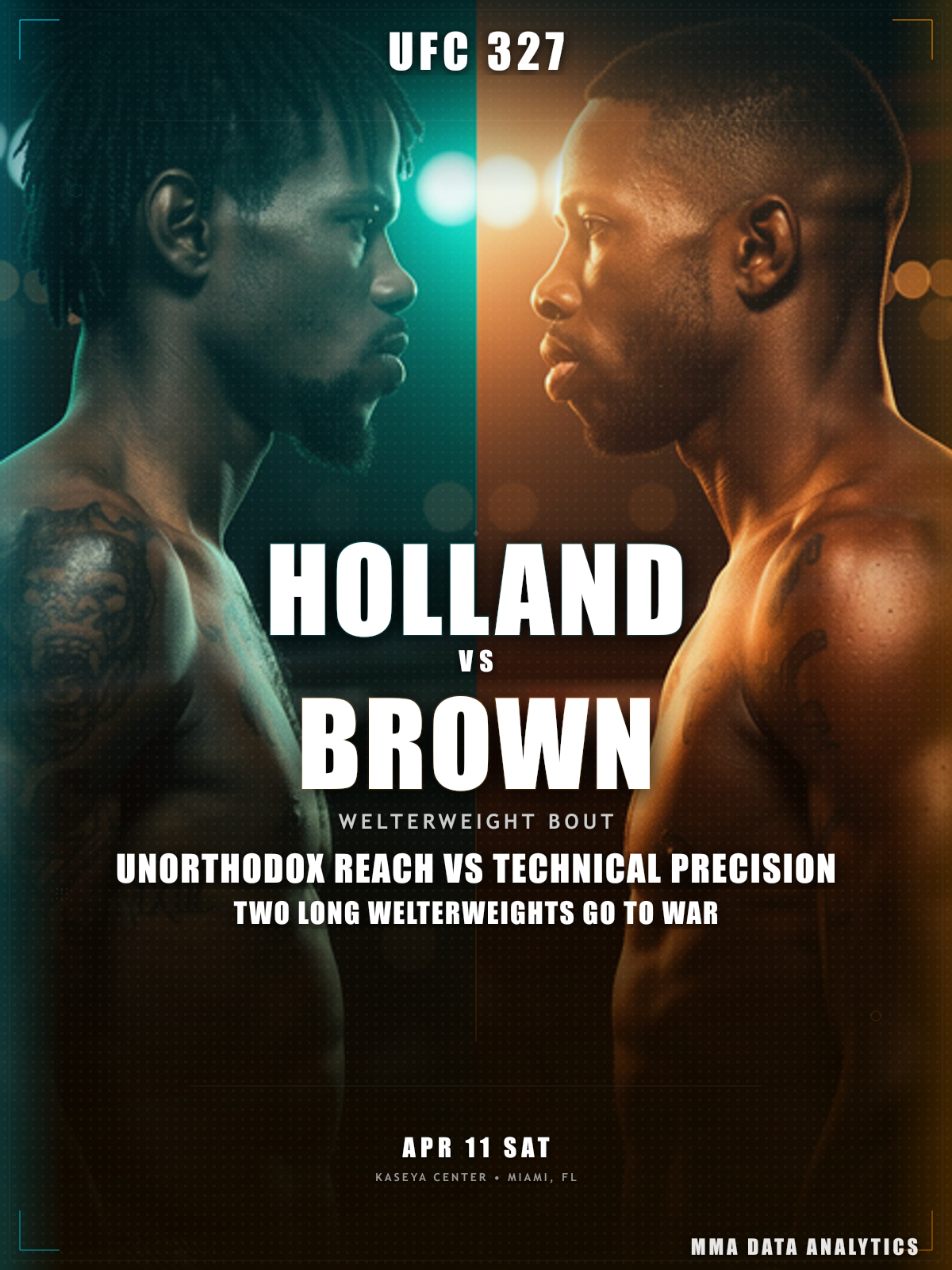
Kevin Holland vs Randy Brown
Men's Welterweight Bout • UFC 327
Saturday, April 11, 2026 • Kaseya Center, Miami, FL • 30ft Octagon (Large Cage)
Explore Detailed Fighter Profiles
Click on either the fighter's name or profile image for each fighter to access comprehensive UFC statistics including striking metrics, grappling data, clinch performance, complete fight history, offensive & defensive analytics, and round-by-round breakdowns.

Kevin Holland
Fighter Metrics
Victory Methods
Win Round Distribution

Randy Brown
Fighter Metrics
Victory Methods
Win Round Distribution
📋 Last 5 Fights - Kevin Holland
| Date | Opponent | Result | Method |
|---|---|---|---|
| 2025-10-18 | Mike Malott | L | Decision - Unanimous (R3, 5:00) |
| 2025-07-19 | Daniel Rodriguez | L | Decision - Unanimous (R3, 5:00) |
| 2025-06-07 | Vicente Luque | W | Submission - Anaconda Choke (R2, 1:03) |
| 2025-03-22 | Gunnar Nelson | W | Decision - Unanimous (R3, 5:00) |
| 2025-01-18 | Reinier de Ridder | L | Submission - Rear Naked Choke (R1, 3:31) |
📋 Last 5 Fights - Randy Brown
| Date | Opponent | Result | Method |
|---|---|---|---|
| 2025-11-08 | Gabriel Bonfim | L | TKO - Clinch Knee (R2, 1:40) |
| 2025-04-26 | Nicolas Dalby | W | TKO - Right Hook (R2, 1:39) |
| 2024-12-07 | Bryan Battle | L | Decision - Split (R3, 5:00) |
| 2024-06-01 | Elizeu Zaleski dos Santos | W | Decision - Unanimous (R3, 5:00) |
| 2024-02-03 | Muslim Salikhov | W | TKO - Straight Right (R1, 3:17) |
Technical Analysis
Technical Score
Cardio Score
Overall Rating
📊 Technical Score
Calculated as the average of Striking Composite (62.0 vs 63.0) and Grappling Composite (52.0 vs 58.0). Balances overall striking effectiveness with grappling ability to measure complete technical skills.
💪 Cardio Score
Based on average fight duration, striking rate per minute, takedown rate, and finish rate. Measures cardiovascular endurance and ability to maintain pace throughout fights.
🎯 Overall Rating
Simple average of Technical Score and Cardio Score. Provides a holistic view of fighter capabilities combining skill level with physical conditioning and fight performance.
Striking Composite
Grappling Composite
📊 Technical Radar Comparison
📊 Metrics Legend
📊 Detailed Statistical Comparison
🥊 Fight Analysis Breakdown
🧩 Kevin Holland Key Advantages
Holland's 81-inch reach vs Brown's 78 inches creates a significant 3-inch advantage at the same height. This allows Holland to land jabs, straights, and teeps from outside Brown's effective striking range. His southpaw stance further compounds this advantage by creating awkward angles that orthodox fighters struggle to navigate, particularly when the longer lead hand controls distance.
Holland's 9 submission victories (32% of wins) represent an elite finishing threat on the ground. His recent anaconda choke of Vicente Luque in just 63 seconds demonstrates his ability to lock in chokes from scramble positions. With 0.56 submission attempts per 15 minutes, Holland is constantly hunting for the tap when fights go to the mat, creating a persistent danger that Brown must respect.
Holland's southpaw stance combined with his creative, unorthodox striking style makes him difficult to prepare for. His 50% striking accuracy from unusual angles—spinning attacks, switch kicks, and unorthodox combinations—creates timing disruptions that conventional fighters find challenging. His 14 KO/TKO wins prove this unpredictability translates into real finishing power. The variety in his arsenal keeps orthodox strikers like Brown constantly guessing between traditional attacks and wild, high-risk techniques that can end fights instantly.
Holland's 14 KO/TKO victories (50% of his wins) demonstrate legitimate one-shot power that can end fights at any moment. His ability to generate power from unconventional angles— particularly spinning elbows and switch head kicks—creates knockout opportunities where opponents feel safest. Against Brown's 55% striking defense, Holland only needs to land one clean power shot to change the complexion of the fight. His recent knockout victories over Tim Means and Santiago Ponzinibbio show this power remains sharp despite recent setbacks.
Holland's BJJ black belt expertise shines in scrambles where his technical grappling and submission hunting create constant threats. His anaconda choke finish of Luque came directly from a scramble position, demonstrating his ability to capitalize on chaotic exchanges. Against Brown's limited submission game (5 career subs), Holland holds a decisive advantage whenever fights hit the mat or enter clinch transitions. His ability to flow between positions and threaten multiple submission chains makes him dangerous even from inferior positions.
⚠️ Unfavorable Scenarios
Holland's 55% takedown defense is significantly below average and represents his biggest vulnerability. While Brown doesn't heavily wrestle (0.79 TD15), any clinch exchanges could expose Holland to trips and throws where his defensive wrestling becomes a factor. His loss to Reinier de Ridder via first-round RNC highlights this vulnerability when opponents successfully take him down.
Holland enters on a 2-fight losing streak, dropping decisions to both Mike Malott and Daniel Rodriguez. This negative momentum could affect his confidence and ring generalship. His 50% striking defense also means he absorbs significant damage (3.22 SApM), which compounds over three rounds against a disciplined striker like Brown.
📋 Likely Gameplan
Holland should utilize his 3-inch reach advantage by staying long, using his southpaw jab and straight left to control distance. His longer frame allows him to land from outside Brown's optimal range while maintaining defensive positioning. Mixing in body kicks and front kicks can keep Brown guessing and prevent him from closing distance.
When exchanges enter the clinch, Holland should look for submission opportunities—guillotines off front headlocks, anaconda chokes from scrambles, and darce attempts. His elite submission game is the primary differentiator in this matchup and represents his best path to a finish.
🚀 Randy Brown Key Advantages
Brown's 55% striking defense compared to Holland's 50% represents a meaningful defensive edge. Combined with his 73% takedown defense (vs Holland's 55%), Brown is significantly harder to hit and take down. This defensive foundation allows him to fight measured, patient rounds while minimizing damage—a style that historically gives Holland problems against disciplined opponents.
Brown's 4.47 SLpM output slightly edges Holland's 4.30, and his more technical, measured approach ensures consistent scoring throughout rounds. His ability to maintain pace while staying defensively sound creates a grinding pressure that accumulates advantages on the scorecards. His 74.1% career win rate reflects this consistency and fight IQ. The Jamaican-American's championship-level cardio allows him to maintain this output across all three rounds without significant dropoff, making him increasingly dangerous as fights progress into later frames.
Brown enters on positive momentum with 3 wins in his last 5 fights, including a dominant performance against Muslim Salikhov and a decision win over Wellington Turman. His recent form suggests improving skills and confidence, while Holland's 2-3 record indicates declining performance against top competition. Brown's mental edge from consecutive wins versus Holland's two-fight skid could prove decisive in close rounds where confidence and ring generalship determine outcomes. Recent success breeds the composure needed to execute gameplans under pressure.
Brown's technical, fundamentally sound striking approach contrasts sharply with Holland's unorthodox style. While his 47% accuracy trails Holland's 50%, Brown's strikes come from predictable, high-percentage positions that set up combinations and minimize counters. His disciplined approach—jab-cross-low kick sequences, consistent body work, and measured footwork—creates cumulative scoring that judges reward. Against Holland's 50% striking defense, Brown's technical consistency should land clean throughout 15 minutes, banking rounds through sheer volume and accuracy rather than relying on explosive moments.
⚠️ Unfavorable Scenarios
Holland's elite submission game creates a persistent threat whenever the fight enters scramble or clinch situations. Brown must avoid guillotine and anaconda choke positions, particularly when shooting for takedowns or engaging in the clinch. One moment of carelessness could result in a fight-ending choke, as Holland demonstrated against Luque.
Holland's 3-inch reach advantage means Brown must close distance to be effective, entering a range where Holland's longer weapons are most dangerous. The 30-foot cage provides ample space for Holland to maintain distance and reset, making Brown's entries more telegraphed and susceptible to counters.
📋 Likely Gameplan
Brown's optimal strategy involves cutting angles and closing the distance to neutralize Holland's reach advantage. Using calf kicks to limit Holland's mobility and timing entries behind his jab, Brown can force exchanges in the pocket where his superior defense allows him to trade more efficiently. His 64% head strike targeting suggests he'll look to land clean shots upstairs.
Brown should avoid wild exchanges and clinch positions where Holland's submissions become dangerous. Instead, maintaining a measured, technical approach—landing clean combinations then resetting—capitalizes on his defensive advantages while minimizing submission risk. His 7 career decision wins show he can execute this strategy effectively over three rounds.
🎯 Fight Prediction Analysis
Data-driven prediction model based on statistical analysis
📊Detailed Analysis Summary
🏟️Cage Dynamics
The 30-foot octagon at Kaseya Center creates a particularly interesting dynamic for this welterweight clash. Holland's unorthodox movement patterns and range weapons—including spinning attacks and oblique kicks—benefit from additional space to create angles. However, Brown's disciplined footwork and 4.47 SLpM volume output thrive when he can maintain his preferred distance and dictate the tempo. The larger cage slightly favors both fighters' striking approaches but limits Holland's ability to close distance for clinch entries where his submission game becomes dangerous. Brown's superior takedown defense (73% vs 55%) means the fight is likely to remain standing where his technical advantages are most pronounced.
🎯Technical Breakdown
The statistical matchup reveals a fascinating contrast between Holland's high-variance finishing ability and Brown's methodical consistency. Holland's 14 KO and 9 submission wins demonstrate legitimate two-dimensional finishing power, but his 50% striking defense leaves him vulnerable to Brown's 4.47 SLpM volume. Brown's 55% striking defense and 73% takedown defense create a fundamentally sound defensive platform that frustrates opponents over three rounds. The key differential lies in damage economy: Brown absorbs 3.26 strikes per minute while Holland absorbs 3.22, but Brown's superior defensive metrics suggest cleaner output with fewer openings for counters. Holland's path relies on creating chaotic exchanges where his unorthodox weapons find openings, while Brown wins by maintaining structure and outpointing over 15 minutes.
🧩Key Battle Areas
Three critical battle areas will determine the outcome: striking range management, clinch transitions, and late-round composure. At range, Brown's volume and defensive discipline give him the edge, but Holland's +3" reach (81" vs 78") and willingness to throw unorthodox strikes create uncertainty. In the clinch, Holland becomes increasingly dangerous with his 9 career submission wins and ability to transition from dirty boxing to takedown attempts. Brown's 73% takedown defense is his best insurance against Holland dragging the fight to the mat. The third round becomes pivotal—Holland's 3 losses in his last 5 suggest potential fatigue or defensive lapses as fights progress, while Brown's 7 career decision wins demonstrate his ability to maintain output when it matters most.
⚔️Stylistic Matchup Analysis
This represents a classic striker-vs-striker battle with contrasting philosophies: Holland's high-variance chaos theory versus Brown's low-variance systematic approach. Holland thrives in unpredictable exchanges where his unorthodox attacks and submission threats create finishing opportunities from seemingly neutral positions. His 23 career finishes in 28 wins (82% finish rate) reflect this explosive, all-or-nothing mentality. Conversely, Brown's 74.1% win rate built on 7 decision victories demonstrates his ability to consistently execute gameplans over 15 minutes. The stylistic clash favors Brown's disciplined approach in a three-round format where consistency trumps explosiveness on scorecards, but Holland's finishing ceiling creates genuine upset equity throughout the fight. Brown's 73% takedown defense is critical—if Holland can drag exchanges to the mat, his submission game becomes the decisive factor in an otherwise competitive striking matchup.
📚Historical Context & Precedents
Holland's career trajectory shows a pattern: devastating finishes against mid-tier opposition but struggles against disciplined, defensively sound fighters who can neutralize his chaos. His recent losses to Mike Malott (submission) and Daniel Rodriguez (decision) came against opponents who either matched his grappling or maintained defensive structure to minimize his finishing opportunities. Brown represents a similar archetype—technically sound, defensively responsible, and unlikely to engage in the wild exchanges where Holland excels. However, Brown's own vulnerabilities against explosive finishers (his losses to Muhammad, Magny, and Belal all came via decision or late finish) suggest Holland's power could be the stylistic wrench that disrupts Brown's methodical gameplan. The key precedent: Holland has never lost to a fighter with Brown's defensive profile when he successfully implements his reach advantage and submission threats.
⚡X-Factor Analysis
The fight's X-factor lies in Holland's mental state after consecutive losses versus Brown's ability to handle adversity when faced with unorthodox threats. Holland's 2-fight skid could manifest as either desperate aggression seeking a statement win or tentative caution to avoid further setbacks. His historically aggressive style suggests he'll opt for the former, potentially creating early finishing opportunities but also leaving defensive openings for Brown's counters. Brown's X-factor centers on his reaction to Holland's unorthodox arsenal—if the spinning attacks and awkward angles disrupt his rhythm, he could abandon his disciplined gameplan for reactive brawling where Holland excels. The Miami crowd at Kaseya Center may also factor: a vocal audience could energize Holland's showman personality or pressure Brown to abandon his technical approach for fan-pleasing exchanges. Judges' scoring preferences matter—if they reward volume over damage, Brown wins; if they value finishing attempts and dangerous moments, Holland's submission threats and power shots could sway close rounds despite lower output.
🏁Final Prediction
The most likely outcome is Randy Brown by Decision (25% probability), achieved through disciplined volume striking, superior defensive positioning, and consistent round-winning output over three rounds. Holland's primary upset path centers on KO/TKO (20%) via his devastating unorthodox strikes or submission (15%) through scramble-to-back sequences in the clinch. Brown's KO/TKO path (18%) becomes viable if Holland's aggressive entries leave him exposed to clean counter combinations. This matchup represents a genuine coin-flip scenario where stylistic factors and in-cage adjustments will determine the winner rather than clear statistical dominance. The 47-53% probability split reflects the fight's volatility—Brown holds the edge in most statistical categories, but Holland's finishing power and submission game create constant danger that could end the fight at any moment. Expect a competitive, tactical affair with potential for explosive finishing sequences.
💰 Betting Analysis: Model vs Market
Detailed value assessment in the betting market
📊Market Odds
🤖Analytical Model
💎Value Opportunities
MAXIMUM VALUE
Model: 15% | Fair: +567
GOOD VALUE
Model: 25% | Fair: +300
SLIGHT VALUE
Model: 37% | Fair: +170
⚠️Key Market Discrepancies
- • Overweights Holland's recent losses – Record doesn't capture his finishing ceiling in favorable stylistic spots.
- • Undervalues submission threat – Holland's 9 career subs vs Brown's 55% TDDef creates real grappling equity.
- • Brown's defensive edge underpriced – 73% TDDef and 55% StrDef compound over 15 minutes in a close fight.
🎯 Comprehensive Probabilistic Analysis
100 hypothetical fight simulation based on statistical data
🏆Outcome Distribution - Kevin Holland
Unorthodox strikes and spinning attacks in open space
Clinch-to-back transitions and scramble submissions
Reach advantage and volume in open-cage striking
💥Outcome Distribution - Randy Brown
Primary path via volume, defense, and round control
Counter combinations and accumulative damage
Opportunistic guillotine or choke from scrambles
⏰Fight Timeline Analysis
⚡Window of Opportunity - Kevin Holland
- • First 8 minutes (R1 + early R2): Maximum finishing equity with fresh unorthodox attacks. Spinning strikes, switch kicks, and unpredictable angles create KO opportunities before Brown establishes defensive rhythm.
- • Clinch-to-submission sequences: Any clinch exchange represents potential fight-ender. Guillotine and anaconda threats off front headlock positions force Brown to disengage or risk tap. 9 career submissions prove elite finishing from grappling exchanges.
- • Scramble creation: Holland thrives in chaos. Initiating scrambles through explosive takedown attempts or defensive wrestling activates submission game. Brown's 73% TDDef excellent but one slip = danger zone.
- • Southpaw advantages: Lead hand controls Brown's orthodox stance. Long jab and straight left establish distance while setting up power kicks. Orthodox fighters historically struggle with Holland's southpaw angles.
- • Desperation finishes (late R3): If down on cards entering final minutes, Holland's aggressive all-or-nothing mentality creates explosive finish attempts. Recent losses may fuel desperate energy seeking statement win.
🎯Progressive Control - Randy Brown
- • Volume accumulation strategy: 4.47 SLpM output banks points through consistent striking. Clean jabs, body work, and low kicks score repeatedly on judges' cards. Technical consistency over explosive moments.
- • Defensive framework execution: 55% StrDef and 73% TDDef keep fight standing in technical range where Brown excels. Superior defensive metrics minimize damage while maximizing scoring output—judges reward clean work.
- • Round 2-3 momentum shift: As Holland's explosive energy fades, Brown's championship cardio and sustained output create cumulative advantages. Recent losses show Holland fading late—Brown capitalizes with increased volume and cleaner combinations.
- • Clinch disengagement discipline: Avoid prolonged clinch exchanges where Holland's submissions activate. Clean breaks after brief dirty boxing neutralize grappling threat while maintaining striking range control.
- • Angle cutting and pressure: Nullify reach disadvantage through disciplined footwork. Cut cage angles, force Holland to reset positioning, and time entries behind feints. Superior fight IQ and experience create openings for clean counter combinations.
- • Late-round composure banking: Final 90 seconds of R3 critical if scorecards tight. Brown's 7 career decision wins demonstrate ability to close rounds with authority—technical volume + defensive responsibility = clear round-winning formula on scorecards.
🔥Critical Moments & Scenario Analysis
🎯 If Holland Lands Early Power Strike
Clean spinning elbow or switch head kick in first 5 minutes could fundamentally alter fight trajectory. Brown forced to abandon disciplined gameplan for survival mode, creating additional finishing opportunities for Holland. One explosive moment = momentum shift.
🔒 If Holland Secures Clinch Position
Guillotine and anaconda attempts off any front headlock force Brown into defensive grappling. One mistake = tap. Holland's elite submission game from clinch creates persistent finishing threat Brown must navigate perfectly to survive.
🛡️ If Brown Establishes Range Control
Clean jab-low kick combinations accumulating over R1-R2 create scoring foundation. Holland forced to abandon reach advantage and close distance, entering Brown's optimal technical range. Volume banking = decision path.
📉 If Holland Fades in R3
Historical pattern shows Holland's recent losses involve late-round defensive lapses. Brown's sustained 4.47 SLpM output in R3 becomes overwhelming if Holland's explosiveness wanes. Clean late-round finish or dominant decision round seals victory.
🎯 Final Confidence Assessment
Confidence level and uncertainty factors
Confidence Level
Near coin-flip — stylistic variance drives high uncertainty
✅Supporting Factors
- • Brown's superior defensive metrics (55% StrDef, 73% TDDef)
- • More consistent recent form (3-2 vs 2-3 last 5)
- • Decision-winning pedigree (7 career decisions)
- • Higher striking volume sustains round-winning output
⚠️Risk Factors
- • Holland's 23 career finishes = constant threat
- • +3" reach advantage creates range problems for Brown
- • Unorthodox style disrupts technical gameplans
- • Holland's submission game from clinch is elite-level
🏁Executive Summary
This welterweight clash pits Kevin Holland's explosive finishing ability against Randy Brown's disciplined defensive framework in a genuine toss-up scenario at UFC 327. Holland's 14 KO and 9 submission wins demonstrate legitimate two-dimensional finishing power, while his +3" reach advantage (81" vs 78") and unorthodox movement create unique challenges for opponents. However, Brown's 73% takedown defense, 55% striking defense, and 4.47 SLpM volume output represent a consistently reliable approach that wears down opponents over three rounds. Holland's 2-3 record in his last 5 fights versus Brown's 3-2 suggests recent momentum favors the Jamaican-American, though Holland's losses came against higher-caliber competition. The 30-foot cage at Kaseya Center provides space for both fighters' preferred striking approaches, creating a pure skills matchup where tactical adjustments will be decisive.
Prediction: Randy Brown by Decision is the most likely single outcome (25% probability) through disciplined volume and superior defense, though Holland's finishing power makes this a genuine pick'em. Holland's best path runs through early KO/TKO (20%) or submission (15%) before Brown's defensive game takes hold. The fight's outcome likely hinges on whether Holland can create the chaotic exchanges he thrives in, or whether Brown can maintain the structured, technical tempo that neutralizes unorthodox styles.