
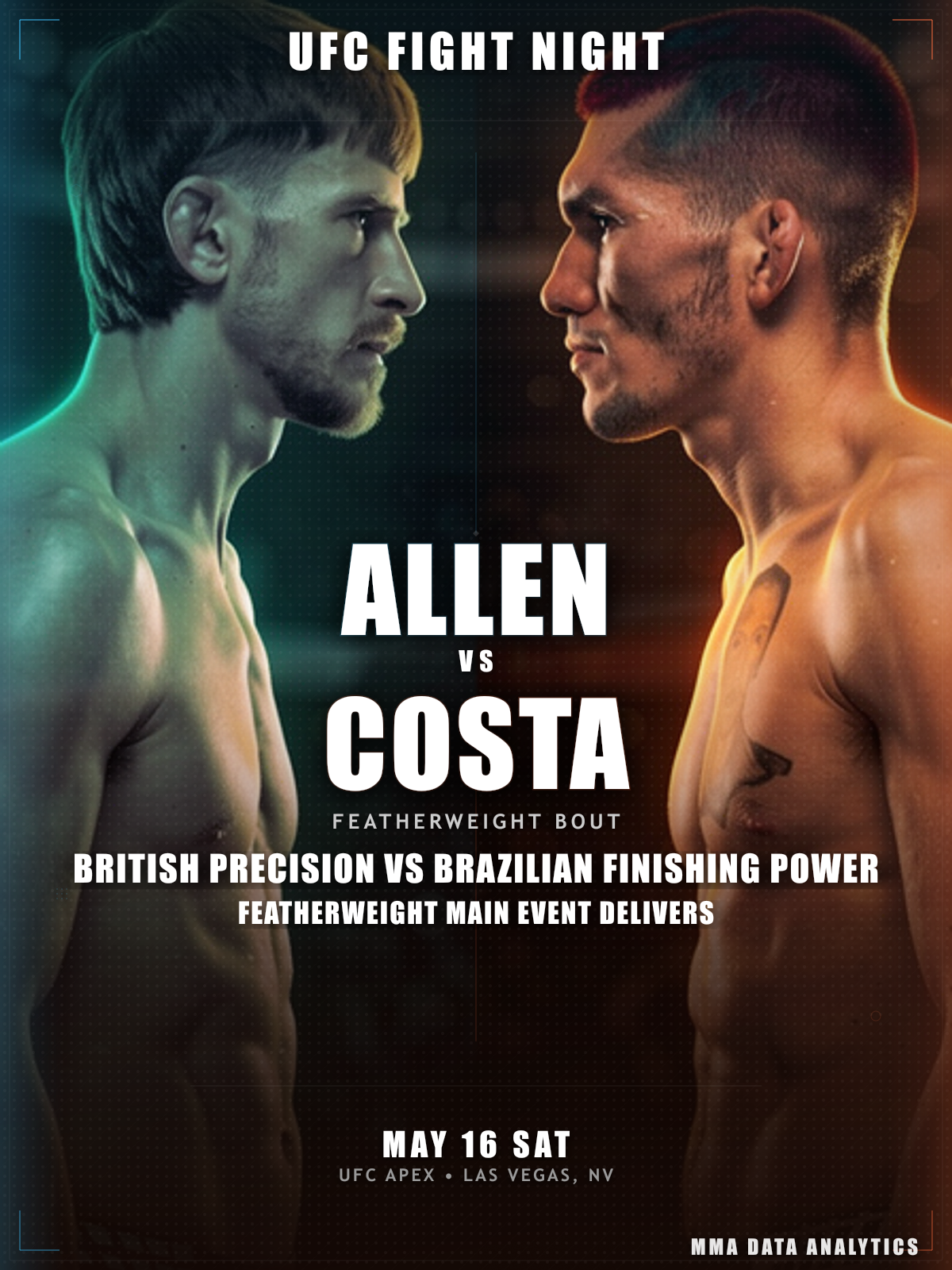
Arnold Allen vs Melquizael Costa
Men's Featherweight • UFC Fight Night: Allen vs. Costa
Saturday, May 16, 2026 • Meta APEX, Las Vegas, NV • 25ft Small Cage
Explore Detailed Fighter Profiles
Click on either fighter's name or profile image to access comprehensive UFC statistics including striking metrics, grappling data, clinch performance, complete fight history, offensive & defensive analytics, and round-by-round breakdowns.

Arnold Allen
Fighter Metrics
Victory Methods
Win Round Distribution
Last 5 Fights

Melquizael Costa
Fighter Metrics
Victory Methods
Win Round Distribution
Last 5 Fights
Technical Analysis
Technical Score
Cardio Score
Overall Rating
Technical Score
Calculated as the average of Striking Composite (72 vs 80) and Grappling Composite (65 vs 72). Balances overall striking effectiveness with grappling ability to measure complete technical skills.
Cardio Score
Based on average fight duration, striking rate per minute, takedown rate, and finish rate. Measures cardiovascular endurance and ability to maintain pace throughout fights. Allen's 12:30 avg vs Costa's 9:00 reflects the championship-round durability gap.
Overall Rating
Simple average of Technical Score and Cardio Score. Provides a holistic view of fighter capabilities combining skill level with physical conditioning and fight performance metrics.
Striking Composite
Grappling Composite
Technical Radar Comparison
Visual comparison of key performance metrics between both fighters
Detailed Statistical Comparison
🥊 Fight Analysis Breakdown
🧩 Arnold Allen Key Advantages
Allen's 60% striking defense is a significant structural edge over Costa's 54%. In a 5-round featherweight fight this compounds dramatically — Allen's technical head movement, southpaw lateral angles, and footwork allow him to avoid clean power shots that accumulate damage over 25 minutes. His defensive IQ has frustrated elite strikers including Calvin Kattar and Giga Chikadze, and against Costa's multi-method finishing arsenal — head kicks, spinning back kicks, guillotine entries — Allen's 60% defense is the primary survival mechanism. The 6-point differential in defensive efficiency translates to meaningful damage reduction each round that compounds in championship-distance fights.
Allen's 71% takedown defense is a critical counter to Costa's 2.00 TD15 — a 133% grappling volume advantage. Costa's 40% takedown accuracy means Allen has meaningful denial windows against each shot. Critically, Allen's own submission threat — four career victories including a front choke and guillotine choke — turns Costa's wrestling entries into double-edged opportunities. Every takedown attempt Costa makes risks Allen's guillotine counter from the failed shot, the exact same submission that Allen used to finish Mads Burnell and Alan Omer. Allen's active defensive grappling converts Costa's primary offensive tool into a finishing risk for both fighters.
Allen has contested multiple five-round UFC fights including going the full 25 minutes with Max Holloway — the pound-for-pound featherweight benchmark. His 12:30 average fight duration and 78 cardio score indicate a fighter built for championship distance. Costa's 9:00 average fight duration and finish-heavy style raise legitimate questions about sustained 25-minute performance. Allen's conditioning advantage is not speculative — it is demonstrated across 14 UFC fights including five-round wars. If Allen survives Costa's early finishing pressure, his conditioning edge grows geometrically in rounds four and five where Costa's untested endurance becomes a decisive variable.
Unfavorable Scenarios
Allen's counter-striking game depends on lateral movement, range control, and footwork — all compressed by the 25ft Meta APEX cage. The smaller octagon systematically removes the space Allen used against Kattar and Chikadze to reset distance after exchanges. Costa's cage-cutting pressure and forward aggression thrive when opponents' exit routes narrow. Allen must find ways to create space in an environment specifically designed to limit it.
Allen has gone 1-2 in his last three fights, with all three losses coming via unanimous decision. The pattern — losing Jean Silva (Jan 2026), Movsar Evloev, and Max Holloway on the cards — suggests Allen struggles to accumulate sufficient scoring volume against aggressive, high-output opponents. Costa's 4.38 SLpM with 49% accuracy is precisely the offensive profile that has cost Allen on the scorecards in recent outings.
📋 Likely Gameplan
Allen must use his southpaw angles to neutralize Costa's head kick threat — the weapon that stopped Morgan Charrière in 74 seconds. By circling away from Costa's power left hand, using his jab to maintain distance, and landing precise counter rights when Costa overcommits, Allen can score while avoiding Costa's explosive combination entries. After each exchange, immediate lateral movement to reset distance prevents Costa from establishing the pocket range where his finishing power peaks.
Allen's most dangerous weapon against Costa's wrestling is his guillotine choke — the same submission used to finish Mads Burnell and Alan Omer. Against Costa's 40% takedown accuracy and 2.00 TD15, Allen should set guillotine traps on Costa's single-leg and double-leg entries. Each failed takedown attempt creates a submission opportunity that forces Costa to choose between grappling activity and submission safety. Active clinch work also creates body lock trips and knee strikes that score while neutralizing Costa's wrestling.
🚀 Melquizael Costa Key Advantages
Costa's 65% finish rate through three distinct methods creates a multi-dimensional threat that forces Allen to track danger from every vector simultaneously. His TKO of Dan Ige via spinning back kick to ground punches (R1, 4:56) showcased elite technical striking. His head kick stoppage of Morgan Charrière in just 1:14 demonstrates one-shot KO danger at any moment. His guillotine choke submission of Andre Fili (R1, 4:30) confirms elite submission finishing on the feet. Five finishes in seven fights means Costa brings sustained stopping intent regardless of how the fight develops — he is never simply fighting to a decision.
Costa's 4.38 SLpM with 49% accuracy versus Allen's 3.47 SLpM at 42% accuracy represents a double-edge statistical advantage — more output and better precision simultaneously. In a 5-round fight this translates directly to scorecard accumulation: approximately one additional significant strike per minute throughout the bout, creating steady damage buildup that compounds over 25 minutes. Against Allen's 60% defensive efficiency, Costa's volume still generates a consistent clean-shot landing rate. Even with Allen defending well, Costa's sustained output creates cumulative striking dominance across rounds.
The 25ft small cage at Meta APEX systematically amplifies Costa's strengths while compressing Allen's. Allen's counter-striking style depends on lateral movement, distance management, and footwork — commodities scarce in the smaller octagon. Costa's forward pressure, cage-cutting angles, and aggressive entry style thrive when opponents cannot disengage and reset. The smaller octagon converts the octagon from Allen's preferred long-range platform into Costa's pressure-fighting environment where grappling entries, combination exchanges, and wall-and-stall clinch work dominate the scoring metrics.
Costa's five-fight UFC win streak includes increasingly impressive stoppages — Charrière (1:14 R1 head kick), Ige (4:56 R1 spinning back kick), Fili (4:30 R1 guillotine), plus decisions over Erosa and Rodriguez. Allen enters having gone 1-2 in his last three, with the most recent loss to Jean Silva in January 2026. Costa's ascending trajectory, improving finish quality, and current form versus Allen's recent inconsistency creates a momentum gap that statistical models treat as a predictive signal.
Unfavorable Scenarios
Costa's 9:00 average fight duration is the single largest risk factor against Allen's 78 cardio score. If Allen survives rounds one and two, Costa enters rounds four and five without a meaningful data set on his sustained performance at 25 minutes. Early finishing failures drain energy from wrestling entries and combination attempts, potentially exposing Costa to Allen's counter-striking as the fight lengthens beyond his typical finishing window.
Costa's 40% takedown accuracy means 60% of his shot attempts are denied — each failed entry creates an Allen guillotine counter opportunity. Allen's four career submission victories and active front choke game on takedown defense represent a specific threat to Costa's grappling-heavy strategy. If Costa loses a fight via submission guillotine counter off a failed takedown, it would be the exact scenario his 40% TDAcc profile predicted.
📋 Likely Gameplan
Costa's optimal strategy is aggressive early pressure in rounds one and two to exploit Allen before he establishes his counter rhythm. Jab-body-head combinations to set up head kick entries, spinning back kick threats from southpaw open stance, and guillotine entries off failed defensive sprawls — Costa must keep Allen reactive rather than proactive. Given Costa's recent R1 finishing streak (Charrière 1:14, Ige 4:56, Fili 4:30), the early rounds carry maximum finishing probability.
Costa's 2.00 TD15 creates constant wrestling pressure that disrupts Allen's striking rhythm even when takedowns fail. Each shot attempt forces Allen to commit defensive energy, disrupts his footwork patterns, and creates defensive positions that limit his counter-striking output. Even with 40% accuracy, Costa's volume means successful takedowns occur and create ground control time, submission threat, and fence pressure that scores with judges and accumulates damage across rounds.
🤖 Model Prediction
📊Detailed Analysis Summary
🏟️Cage Dynamics
The 25ft small cage at Meta APEX is the pivotal contextual variable in this matchup. Allen's technical counter-striking depends on lateral movement, distance management, and footwork — all systematically reduced in the smaller octagon. Costa's forward pressure and cage-cutting ability thrive when opponents' exit routes compress. The small cage transforms Allen's preferred counter-striking platform into a volume-versus-precision exchange at close quarters, where Costa's 4.38 SLpM at 49% accuracy creates sustained damage accumulation pressure that Allen's 60% defense must absorb rather than evade.
🎯Technical Breakdown
Statistical analysis reveals two intersecting battlefields: striking output and grappling volume. Costa's 4.38 SLpM at 49% accuracy versus Allen's 3.47 at 42% represents a compounding double advantage — more output with better precision. Allen counters with superior defense: 60% vs 54% StrDef and 71% vs 58% TDDef. Both southpaw — mirror stance eliminates stance-based range advantages, making technical execution and head movement primary differentiators. The critical question is whether Allen's defensive mastery can withstand Costa's volume and grappling pressure across 25 minutes in the small cage, or whether Costa's multi-method finishing creates the stoppage before Allen's conditioning advantage materializes in the championship rounds.
🧩Key Battle Areas
Three decisive battle areas: First, the southpaw mirror — both fighters sharing stance creates equal-leverage engagement with no stance-based outside-foot advantage, making technical head movement and angle creation primary differentiators. Second, the early-round finishing window — Costa's maximum finishing probability is rounds one and two before Allen's rhythm establishes; if Allen survives, his conditioning advantage compounds geometrically. Third, the grappling interface — Costa's 2.00 TD15 must overcome Allen's 71% TDDef and guillotine counter threat, but even failed attempts drain energy and disrupt Allen's offensive output. The fight is fundamentally decided in the first two rounds.
⚡Win Scenarios by Probability
Costa's primary win path is a stoppage in rounds 1–3 (35% probability) via head kick, spinning back kick, or guillotine choke — consistent with his recent finishing pattern. A decision win for Costa (17%) represents sustained volume dominance across five rounds. Allen's primary win path is a decision via defensive mastery and counter-striking accumulation over the full 25 minutes (28%). Allen's secondary path is a submission or TKO upset (20%) when Costa overcommits on a finish attempt and Allen lands a guillotine counter from the failed shot or mounts ground-and-pound from a reversal. The fight's ultimate outcome depends on whether Costa's finishing versatility produces results before Allen's experience and conditioning architecture tips the scales.
💰 Betting Analysis: Model vs Market
Value assessment in the betting market
📊Market Odds
🤖Model Probabilities
⚠️Key Market Considerations
- • Small cage multiplier — 25ft Meta APEX cage systematically advantages Costa's pressure style over Allen's range management game
- • Both southpaw — Mirror stance eliminates stance-based reach/angle advantages; technical execution and head movement dominate
- • Costa's 5-round cardio untested — 9:00 avg fight duration raises legitimate endurance questions at championship distance
- • Allen's recent form — 1-2 in last 3 fights, all losses via decision, suggesting volume scoring issues vs aggressive opponents
🎯 Fight Outcome Scenarios
Melquizael Costa by Finish (R1–R3)
35%Head kick, spinning back kick, or guillotine stoppage in the opening three rounds — consistent with Costa's recent R1 finish pattern.
Arnold Allen by Decision
28%Allen's defensive mastery and 5-round conditioning produce a decision via accumulated counter-striking and defensive efficiency over 25 minutes.
Arnold Allen by Sub/TKO
20%Allen exploits Costa overcommitting — guillotine counter off failed takedown, rear-naked choke from defensive scramble, or TKO from ground reversal.
Melquizael Costa by Decision
17%Costa dominates volume and grappling control across all five rounds, winning a clear scorecard despite Allen's defensive resistance.
⏰Fight Timeline Analysis
⚡Window of Opportunity — Arnold Allen
- • Rounds 3–5: Conditioning advantage grows as Costa exceeds his 9:00 avg fight duration
- • Guillotine counters: Allen's front choke/guillotine entries from failed takedown defenses
- • Counter-right hand: Costa's overcommitting combinations expose him to Allen's precise counter right
- • Body work: Sustained body strikes slow Costa's pace in championship rounds
🎯Window of Opportunity — Melquizael Costa
- • Rounds 1–2: Maximum finishing probability before Allen establishes counter rhythm
- • Head kick entries: Jab-body-kick combo setups that produced the Charrière stoppage
- • Spinning back kick: Long-range spinning attack that stopped Dan Ige — effective vs southpaw mirror
- • Guillotine from shots: Costa's own guillotine choke threat on Allen's defensive scrambles
Model Pick
✅Supporting Factors
- • 5-fight win streak with 3 methods of finishing
- • 25ft small cage amplifies pressure-finishing style
- • Superior volume (4.38 vs 3.47 SLpM) and accuracy (49% vs 42%)
- • Allen's 1-2 in last 3 fights, coming off January 2026 loss
⚠️Risk Factors
- • Allen's 60% StrDef frustrates high-volume opponents
- • 5-round cardio completely untested at this level
- • Allen's 71% TDDef neutralizes key grappling entries
- • Guillotine counter-threat on every Costa takedown attempt
🏁Executive Summary
Melquizael Costa enters this 5-round featherweight main event as the model's slight favorite at 52% on the strength of his ascending trajectory — five straight wins including multiple highlight-reel finishes — combined with statistical advantages in striking output (4.38 vs 3.47 SLpM), accuracy (49% vs 42%), grappling volume (2.00 vs 0.86 TD15), and finishing versatility (65% vs 55% finish rate). The 25ft small cage at Meta APEX systematically removes Allen's primary defensive tool: space and lateral movement. Costa's three-method finishing capability — head kicks, spinning back kicks, guillotine chokes — creates a multi-vector threat that Allen's 60% StrDef and 71% TDDef must absorb across five rounds.
Prediction: Costa by finish in rounds 1–3 is the primary scenario (35% probability) through head kick, spinning back kick, or guillotine — consistent with his recent R1 finishing streak against Charrière, Ige, and Fili. Allen's best path is a decision through defensive mastery and counter-striking accumulation (28%), with the fight growing more favorable for Allen in rounds 4–5 if he survives the early storm. This fight's outcome hinges on whether Allen's defensive IQ and championship-round experience can neutralize Costa's finishing surge before his conditioning advantage tips the scales in the final two rounds.